Breaking News | Hikrobot's annual revenue exceeded 6.4 billion in 2025, and the company said it will continue to promote the integration of AI and the layout of embodied intelligence.
Author | Qiao Yujie
Editor | Yuan Silai
Currently, the manufacturing industry is standing at a critical juncture of transitioning from "automation" to "intelligence."
In 2026, Hikrobot will celebrate its 10th anniversary. As an innovator and practitioner in the field of industrial intelligence, Hikrobot has been continuously promoting the in - depth integration of machine vision, mobile robots, and flexible manufacturing technologies in recent years. It has built a full - stack technical capability integrating "eyes, feet, and hands," and formed three major business systems centered around machine vision, articulated robots, and mobile robots.
In the whole year of 2025, Hikrobot's revenue exceeded 6.452 billion yuan. Among them, the cumulative shipment volume of machine vision products exceeded 10 million units, and the cumulative offline volume of mobile robots exceeded 180,000 units. Based on a complete hardware product line, the authorized users of its self - developed industrial software exceeded 600,000 person - times, and it served over 20,000 customers globally.
From April 22nd to 24th, 2026, the "Hikrobot Intelligent Manufacturing Conference 2026" was held in Tonglu, Hangzhou. Jia Yonghua, the CEO of Hikrobot, put forward the concept of "embodied intelligent manufacturing." He said that the traditional automation system is facing the problem of insufficient flexibility and is difficult to adapt to the fragmentation of demand and changes in the employment structure. "Embodied intelligent manufacturing" needs to be addressed through two capabilities: one is the highly flexible equipment with multi - tasking capabilities, and the other is the scene - based application capability that can be quickly replicated, so as to promote the transformation of the manufacturing system from "humans adapting to machines" to "machines adapting to the environment."
During the conference, in addition to demonstrating the application and implementation of machine vision, articulated robots, and mobile robots in manufacturing, circulation, and other industry scenarios, Hikrobot also released more than 35 new products, covering standard vision (2D and 2.5D computational optics), high - precision 3D vision, and AI intelligent vision. These products mainly target engineering problems such as imaging in complex scenarios, high - precision measurement, and the difficulty of AI implementation.
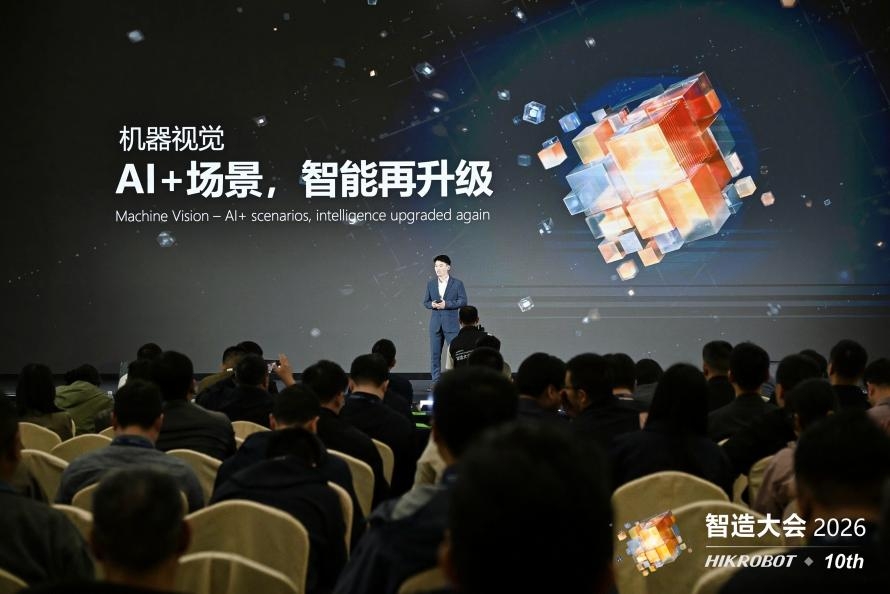
Image source: The enterprise
Facing the future, Hikrobot is also actively promoting the integration of AI and the layout of embodied intelligence.
During an exclusive interview with 36Kr, Zhang Wencong, the vice - president of Hikrobot, introduced that the company has systematically promoted the implementation of AI technology in its products since 2016. Currently, it has achieved large - scale application in multiple product lines and has become an important means to improve product performance and engineering efficiency.
As early as 2019, Hikrobot's RCS (Robot Control System) for dispatching mobile robots began to introduce reinforcement learning and operational optimization methods in path planning and task scheduling, breaking through the upper limit of dispatching scale. By the beginning of 2021, it had achieved the collaborative operation of more than 1,000 robots across maps in a single factory of FAW Toyota. "Next, the company will also explore the path for AI to further penetrate into the deep - water area of the industry, including the quality inspection ability in more complex scenarios," Zhang Wencong said.
When asked about the application of embodied intelligence in the industry, Zhang Wencong said that "embodied intelligence" does not mean that all products have to be in an anthropomorphic form. "At this stage, Hikrobot focuses on doing a good job in the end - to - end coordination of eyes and hands. In a broad sense, this is also a great progress towards embodied intelligence. For example, the vision - control integrated application of machine vision and articulated robots will have a great improvement."
Looking at a longer period, Zhang Wencong said that in industrial scenarios, in highly standardized and high - beat links, dedicated equipment still has an efficiency advantage. However, in scenarios with relatively loose beat requirements, embodied intelligence has the potential of "one machine with multiple functions." Overall, embodied intelligence and the existing automation solutions will form a complementary relationship rather than a direct substitution.
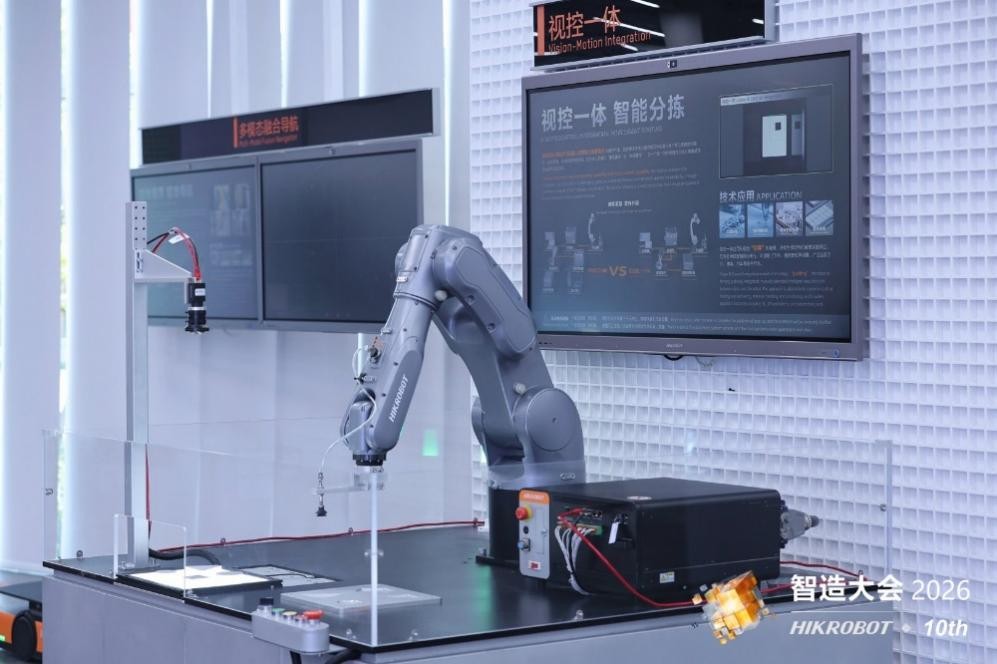
Image source: The enterprise
The following is the content of the interview between 36Kr and Zhang Wencong, the vice - president of Hikrobot, slightly edited:
Question: What are the revenue proportions of the three sectors of machine vision, mobile robots, and robotic arms?
Zhang Wencong: At present, our revenue mainly comes from the two major sectors of machine vision and mobile robots. The proportion of the robotic arm sector is not large. The main reason is that we entered the robotic arm field relatively late. Although we have been working on it for about 5 years, the entire product line is still in the process of continuous enrichment, and the overall revenue scale is still in the climbing stage.
Question: What are the actual applications of AI in our products at present?
Zhang Wencong: AI has been relatively deeply applied in our products, especially in the field of machine vision. In scenarios such as code reading and OCR recognition, we have made many upgrades using deep learning. In the past, many recognition algorithms needed on - site training. Now, they can basically be "out - of - the - box" applications. In most scenarios, there is no need for secondary training, and the effect is relatively stable.
Another key area is industrial quality inspection, which we have been continuously investing in over the years. From the early small models to the gradual introduction of large models. Take our cooperation with a large domestic medical supplies production enterprise as an example. They hope to introduce a fully automatic, high - precision, and traceable quality inspection system for the disposable medical gloves they produce. Gloves are flexible objects, prone to deformation, and come in a wide variety of colors. Detecting defects in such products is actually very difficult.
When we first used the traditional CNN model in 2021, we basically had to resample and retrain for each production line, and the expansion was relatively slow. After switching to the large - model solution in 2023 and 2024, multiple production lines in the same workshop can be quickly replicated. Originally, tens of thousands of samples might be needed, but now one or two hundred are enough. Now, this system can stably detect defects larger than 0.8 millimeters, and the detection rate of important defects such as stains and breakages exceeds 99.995%. One production line can inspect 300,000 gloves a day, and the overall deployment and delivery efficiency has been significantly improved.
Question: Overall, what is the implementation situation of AI - related products in industrial scenarios at present?
Zhang Wencong: The implementation of AI in industrial scenarios is still relatively slow. The core reasons lie in cost and delivery cycle. On the one hand, industrial quality inspection and other application scenarios are complex, and the system development cycle is long, resulting in a relatively high cost of the overall solution. On the other hand, when end - customers evaluate the input - output ratio, if the payback period is too long, they often delay or abandon the deployment.
In response to this problem, the company is continuously improving its algorithm capabilities to reduce development and deployment costs on the one hand, and shortening the delivery cycle by introducing large models and optimizing engineering capabilities on the other hand, reducing the dependence on sample data and manual debugging. The overall goal is to promote the "popularization" of AI capabilities so that more industries can use intelligent solutions at an acceptable cost.
Question: How do you view the implementation value of humanoid robots in industrial scenarios?
Zhang Wencong: I think it has value, but the premise is to truly achieve "versatility." If a humanoid robot can be used for multiple purposes, such as handling, simple quality inspection, and even loading and unloading, then in some scenarios with less strict beat requirements, its value is very obvious, and it can become a "multi - skilled worker."
However, on highly standardized and high - beat production lines, "specialized machines" are more efficient and the cost is more controllable. So, the two are more like a complementary relationship rather than a substitution relationship. At present, the implementation of humanoid robots in the industry is still in its early stage. Especially, the industry has high requirements for stability, and many capabilities still need continuous iteration.
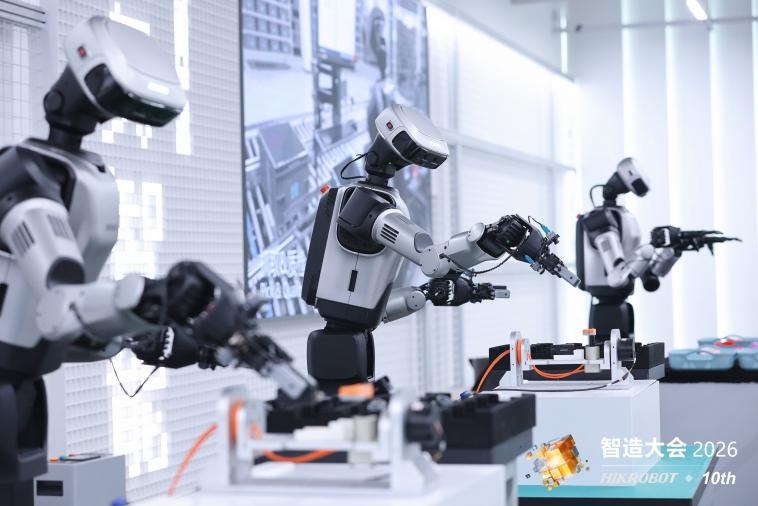
Image source: The enterprise
Question: What is the relationship between the "eyes - hands - feet" coordination emphasized by Hikrobot and the VLA model?
Zhang Wencong: The VLA (Vision - Language - Action) model is an ideal end - to - end paradigm, aiming to achieve a full - process closed - loop from perception to decision - making and then to execution through a single large model. However, from the perspective of the current technological maturity, this path is still in the early stage, and there are still many challenges in actual implementation.
In contrast, the "eyes - hands - feet" coordination we proposed is more of an engineering - oriented path: through the coordination of modules such as vision (eyes), operation (hands), and movement (feet), the automation of specific tasks is achieved. In actual implementation, we often use a combination of multiple small models to solve problems rather than relying entirely on a single large model. Of course, we are also working on the VLA direction, and a dedicated team is involved. Overall, our understanding is that in the short term, we rely on the "combination of small models" for implementation, and in the long term, we will evolve towards an end - to - end large model. The two routes are parallel and complementary.
Question: What core advantages does the layout of hardware - software integration bring to the company?
Zhang Wencong: Hardware - software integration is one of the company's core strategies. On the one hand, simply doing hardware is prone to homogeneous competition and lacks differential barriers. On the other hand, only focusing on software also faces challenges in business models and customer stickiness. The coordination of hardware and software can achieve mutual promotion: hardware drives software sales, and software enhances the added value of hardware.
Taking machine vision as an example, our self - developed software platform can be opened to customers for secondary development in a modular way, thus forming ecological stickiness. At the same time, the software can help customers reduce development costs, improve efficiency, and avoid intellectual property risks. Overall, it also builds higher technical and business barriers.