Young people don't love "Moutai". What they need is their own "Laocunzhang".
As night falls, the newly trendy liquor shops this year light up their warm yellow lights.
Groups of young people gather around the wooden tables in front of the shops. There are no elaborate etiquettes of clinking glasses, no sense of superiority with phrases like "I'll finish my drink, you can take your time". All that can be heard are the crisp sounds of peanuts and free - flowing chats.
This scene forms a strange contrast with the formal Chinese liquor banquets in high - end restaurants where people sit upright.
While well - known liquor brands like Moutai are worried about "why young people don't drink Chinese liquor anymore", the ancient way of selling loose liquor is quietly reviving in the nooks and crannies of the city.
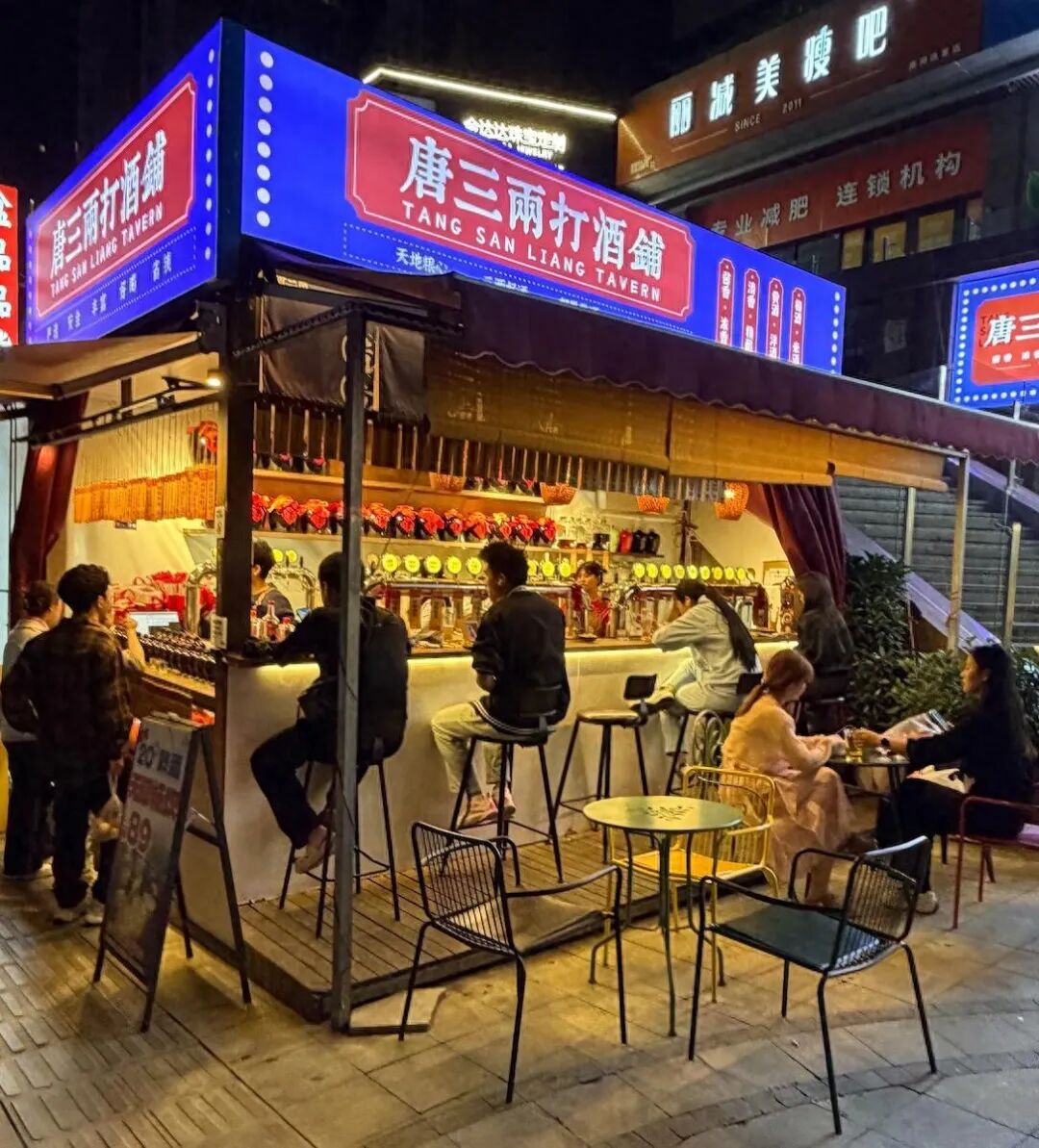
According to Tianyancha APP, there are already more than 20 similar brands, with Tang Sanliang and other liquor shops leading the way. The popularity of loose liquor is spreading rapidly.

Some people say it's a cycle.
Because a hundred years ago, Chinese liquor was mainly sold in bulk. Neighbors would bring their flasks to buy a couple of taels of liquor and have a great meal with some fennel beans.
Later, with industrialization, branding, and high - end development, Chinese liquor became more formal, moving into private rooms and taking the main seat. Now, young people are bypassing private rooms and going back to the streets, as if everything has come full circle.
In other words, the loose liquor shops a hundred years ago were a helpless choice in an era of material scarcity; today's liquor shops are an active selection in an era of material abundance.
Behind this lies the dynamic exploration of the ever - changing consumer market by the modern Chinese liquor industry during the period of rational consumption.
The "old bottle" of products can't hold "new wine"
Before analyzing the phenomenon of liquor shops, it's necessary for us to look back at the past "innovation" map of the Chinese liquor industry.
Only in this way can we understand why previous attempts failed to truly tap into the young market and what the emergence of liquor shops really means.
Over the years, many investors have commented that the Chinese liquor industry is a business that "even my grandma could run well", which implies that there has been little fundamental change in its business model.
Consumers' impression of Chinese liquor has also been stuck with the somewhat joking but accurate label of "old - fashioned".
Of course, some people may say that if you look at the long - term history, the Chinese liquor industry has never really stopped exploring new business models and new consumers.
For example, in terms of liquor flavors, from the popularity of strong - flavored liquor, to the rise of soy - sauce - flavored liquor with its complex production process and the concept of "core production areas", and now the comeback of light - flavored liquor led by Fenjiu with its "pure" taste. There are also various flavor categories such as rich - flavored, pottery - flavored, and sesame - flavored liquor.
It seems that "innovation" does exist in the Chinese liquor industry. But upon closer inspection, it always feels like scratching an itch through one's boots. Whether it's the change in flavors or the upgrade of brand image, in essence, it's just an improvement based on the existing market and products, without any revolutionary changes.
Take Moutai, the most innovative brand, for example. Under the leadership of Ding Xiongjun, Moutai launched ice cream and collaborated with Luckin to create Moutai coffee.
Moutai ice cream does provide emotional value, but its core is still the product logic, that is, trying to reach new customers through a specific, youthful product form.
Even the soy - sauce - flavored latte, which is jokingly called "the first sip of Moutai for young people" and even "humble" enough to be used as a kind of "cooking wine", still follows the product logic.
The essence of the logic of product diversification is the internet - celebrity logic, selling novelty. Young people will pay for the novelty and social currency, but it's difficult to form continuous consumption stickiness.
So, after enough people have tried it, Moutai ice cream has quietly scaled back, and the popularity of the soy - sauce - flavored latte has returned to normal, mostly becoming a highlight in marketing cases.
Now, liquor companies are also launching low - alcohol and fruit - flavored liquors, trying to "please" young people by lowering the alcohol threshold. This is essentially an extension of the product logic.
Unfortunately, these attempts have had limited success.
Why?
Because what young people dislike is never Chinese liquor itself, but the power - oriented thinking and power - related labels associated with traditional Chinese liquor. This label is so strong that it is incompatible with the strong self - esteem and pursuit of self - experience of this generation of young people, making it difficult for them to embrace brands like Moutai.
So, is there a more successful exploration? Yes, Jiangxiaobai.
The rise of Jiangxiaobai is essentially a definition of an entire group.
To put it simply, what it sells is not liquor, but copywriting. Behind the copywriting is the resonance of group emotions, and it has successfully directed the topic of Chinese liquor towards the young group.
However, it ultimately failed to revolutionize the core consumption habits.
The "limitation" of Jiangxiaobai lies in: on the one hand, when the novelty of emotional marketing fades, the product quality itself fails to build a solid enough moat.
On the contrary, we can look at Xiaomi and Pop Mart. They both achieved success by targeting specific groups. Different from Jiangxiaobai, the products they finally presented are of the top - level in the industry.
So, Pop Mart has survived, while Jiangxiaobai has temporarily become a "passer - by".
On the other hand, the "chicken - soup copywriting" it relies on has gradually lost its empathetic ground in today's era of "anti - chicken - soup" and the pursuit of authenticity and relaxation.
So far, we can see that previous explorations and these "innovations" are essentially just adding to the existing framework of "Chinese liquor".
The emergence of liquor shops marks that the industry's exploration has entered a new dimension.
The mission of liquor shops: from "power prop" to "emotional companion"
By reviewing the past, we will find that young people don't care about the premium of grand narratives in brand advertisements, and they are no longer easily influenced by the repeated category stories.
They pursue extreme rational consumption and immediate emotional consumption.
The real source of emotions is not the illusion built by advertising fees, but the real, tangible and specific scene experience.
What liquor shops provide is exactly such a scene.
It is a roadside stall in the community, a "third space" downstairs from home. Those who gather here, whether in groups or for individual meetings, are friends without pretense, close - knit family members, and like - minded classmates.
This scene itself naturally strips away the power attributes and social performances of traditional wine tables. Here, comfort and freedom are the main tones, and the free - flowing talks after a little intoxication are the highlights.
Moreover, in terms of price, there are no high thresholds. Charging by the cup, for young people with limited wealth accumulation, it is not only stress - free but also changes the previous image of Chinese liquor as "unaffordable".
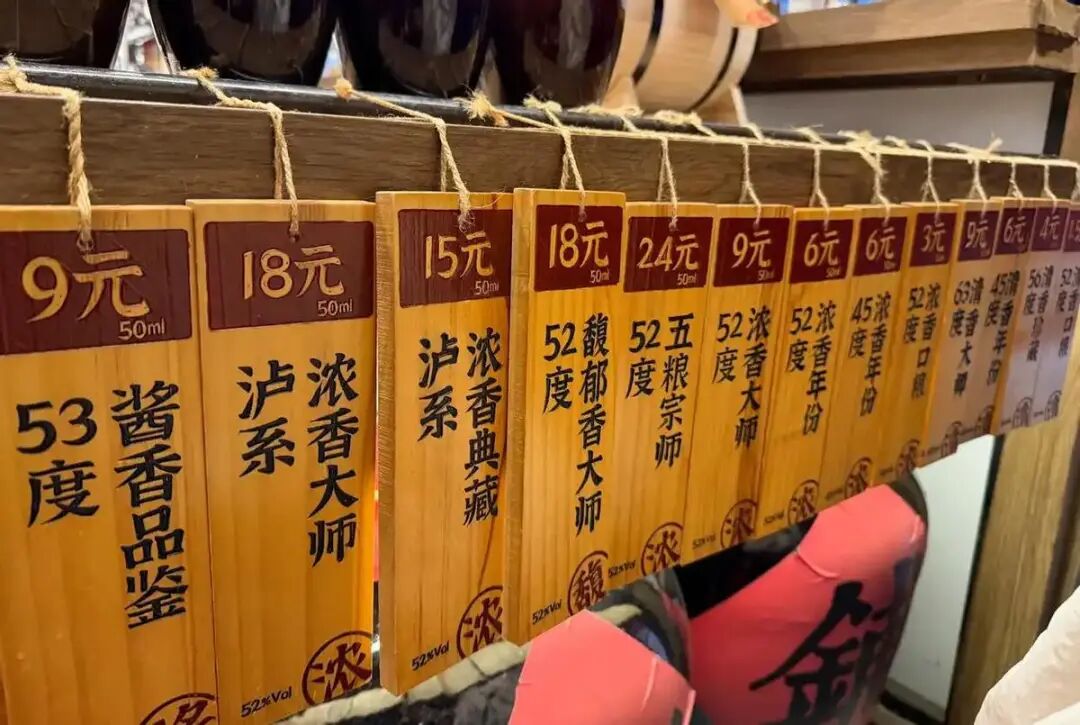
Generally speaking, the scene of liquor shops restores the original value of Chinese liquor as an emotional catalyst and social lubricant. It not only breaks away from the past stereotypes but also creates a "pull" for the future.
Even good wine is afraid of being in a deep alley: new growth in new scenes
If the changes on the consumption side are the "pull" for the rise of liquor shops, then the increasingly severe difficulties on the supply side are the powerful "push" behind it.
Moreover, from the perspective of the supply side, the excess production capacity also needs an increase in consumption scenarios.
Just like tea, although the production capacity is of high quality, it is difficult to sell at the terminal.
The crux lies in: on the one hand, tea is a highly non - standardized product with a chaotic price system, and the threshold for consumers to trust is extremely high.
On the other hand, although tea is ubiquitous in daily life, traditional distribution channels have shaped it into a consumer product with a certain threshold and a sense of mystery, which is far from the casual consumption habits of young people.
However, in the past two years, we have seen the dawn of improvement. For example, supermarket channels represented by Fat Donglai have greatly reduced the decision - making cost through strong self - brand endorsement and supply - chain integration.
More importantly, new tea - drink brands such as Guming and Mixue Bingcheng have combined traditional tea bases with young elements in a "new bottle for old wine" way, creating new consumption demands and drinking scenarios.
The same is true for Chinese liquor. It is difficult to circulate the excess production capacity through traditional methods.
The traditional wine - table scene is shrinking continuously. The frequency and scale of government and business banquets are both decreasing, while the production - capacity expansion of liquor companies has not stopped. A large amount of high - quality base liquor needs a new outlet.
Meanwhile, on the other side of the coin, excess production capacity also means better supply and more affordable prices.
Just like the real - estate market in the past two years, when the market returns to rationality, consumers can enjoy good living quality at a relatively low price.
In the Chinese liquor industry, the excess production capacity has led to a decrease in the procurement cost of high - quality base liquor, which has greatly improved the quality of loose liquor. Moreover, traditional liquor companies with a keen sense, such as Gujinggong and Jinzhongzi, have begun regional attempts and layouts.
To put it simply, the forces from both the supply and demand sides are converging, and liquor shops are just at this intersection.
However, just like every emerging industry has its inherent flaws, the other side of the coin for liquor shops is also the same:
1. Trust issue
This is the Sword of Damocles hanging over the heads of liquor shops.
After all, the Chinese liquor industry has experienced the pain of food - safety incidents such as "plasticizer" and "sweetener". Bottled liquor from well - known brands has the multiple endorsements of corporate reputation, market supervision, and third - party testing, which can still gain consumers' trust.
However, liquor shops ultimately present loose liquor to consumers, and it's difficult to intuitively show consumers the quality guarantee of the products like bottled liquor.
With the franchise - based model, the supply - chain management will be a huge test.
Is the source of the base liquor reliable? Are there any risks in the transportation and storage process? How to ensure the consistent quality of each store? Once a problem occurs at a certain point, the blow to the entire industry will be devastating.
For consumers, the only way to dispel this concern may be the emotional connection with the shop owner, which puts higher requirements on the operation ability of each store.
This is like the difference between traditional repair shops and 4S stores - between the standardized and guaranteed 4S stores (branded bottled liquor) and roadside stalls (unbranded loose liquor), how to establish unique professional trust and community stickiness?
These are all problems.
2. Profitability issue
Liquor shops focus on "eliminating brand premium", which creates a psychological expectation of "high cost - performance" for consumers.
However, the reality may not be the case. Although loose liquor saves on fancy packaging and huge advertising fees as it moves down the supply chain to the terminal, there are still costs for logistics, warehousing, store rent, labor, and franchise management fees.
Especially when ensuring the quality of the base liquor, the final retail price may not have an overwhelming advantage over bottled liquor of the same quality.
Once the price advantage is not obvious, its attractiveness to price - sensitive young consumers may be greatly reduced.
Conversely, if the profit model cannot be established, the model itself will be difficult to sustain.
3. Scene authenticity
The "relaxed" scene created by liquor shops is its soul, but does this scene have uniqueness and exclusivity?
Because liquor manufacturers are also actively changing, and various small - bottled liquors and low - alcohol trendy drinks are flooding the market.
Young people can simply buy a bottle of their favorite liquor and take it home, to a park lawn, or to a restaurant with good food that allows BYOB, and still have a comfortable and free experience.
So, what is the irreplaceability of the physical space of liquor shops?
In addition, small - bar formats such as Helen's and JIWU THINKING, and even catering enterprises like Wei's Cold Noodles are also competing for young people's night - time consumption scenes.
At this time, where is the boundary between liquor shops and small bars? Although it seems that the former is more inclined to "liquor retail + minimal snacks for drinking", and the latter is more inclined to "space service + standardized catering".
But the competitive relationship objectively exists when they are competing for young people who pursue "drunken freedom".
So, the question is, is it worth investing in liquor shops with so many unpredictable problems?
Be able to attack and defend, are liquor shops the "Jieting" for liquor companies?
Objectively speaking, despite the many "bugs", the future that liquor shops point to is still a strategic area not to be missed.
First of all, it's better to have one bird in hand than ten in the bush.
In the past two years, with the boom of technology, the funds of first - tier liquor companies have flowed into emerging industries. However, for traditional enterprises like liquor companies, whether it's AI or robots, it tends to be a financial investment.
The biggest feature of financial investment in emerging industries, besides high returns, is the "reset" risk brought by the ever - changing technology.
Even if it is successful, the value for reuse in the main business is very small.
Investing in new business models like "liquor shops" that explore the forefront of consumption is different. It is not only a financial investment in future consumption trends but also a strategic defense to prevent competitors from seizing the beachhead first.
In other words, even if you don't understand it, you have to "get to the table" first.
Secondly, this is a mandatory requirement to break out of the "cognitive cocoon".
Ma Huateng of Tencent once admitted that if WeChat had not been born out of internal competition but had been developed by the mature QQ team, it might have failed due to path dependence. He also mentioned that when he didn't understand Snapchat, he felt a fear of being disrupted.
To put it simply, many great innovations often germinate in chaos, decline, and misunderstanding.
For example, Didi Chuxing was operating in the gray area of policies at the beginning, but it ultimately reshaped the travel landscape.
If Chinese liquor companies stick to their traditional successful paths, they are likely to look down on "micro - innovations" like liquor shops. However,