In Q1 2026, AI captured 81% of venture capital funds. Is this the biggest bubble in history or the starting point of a new economy?
God Translation Bureau is a compilation team under 36Kr, focusing on fields such as technology, business, workplace, and life, and mainly introducing new technologies, new ideas, and new trends from abroad.
Editor's note: In the first quarter of 2026, the total global venture capital soared to $297 billion, a year-on-year increase of 150%, setting a new historical record. Among them, AI companies attracted 81% of the funds, and four super financings accounted for 63%. Sovereign wealth funds entered the market, non-AI startups faced a cold spell, and valuations soared. Will this AI investment frenzy give birth to a new economy or create a bigger bubble? This article is a translation, taking you to uncover the truth behind the data.

Image source: tech insider.org
In the first quarter of 2026, the total global venture capital soared to $297 billion, not only breaking all previous records but also becoming the quarter with the highest capital concentration in the history of entrepreneurship. According to Crunchbase data released on April 1st, four of the five largest venture capital financings in history were completed in just 90 days, and cutting-edge AI labs took away nearly two-thirds of the funds. This quarter completely rewrote the power structure in Silicon Valley, pushing sovereign wealth funds to the throne of "kingmakers" and leaving more and more non-AI startups in a tough battle for attention and capital.
These numbers are astonishing from any perspective. According to reports from TechCrunch and Crunchbase, investors poured funds into about 6,000 startups globally, a growth of more than 150% compared to the $118 billion in the fourth quarter of 2025. The United States absorbed $250 billion of it, accounting for 81% of the total global venture capital, while this proportion was only 55% a year ago. This concentration raises a fundamental question: Is the venture capital industry financing a real technological revolution or blowing up the biggest asset bubble in financial history?
Four Super Rounds of Financing That Rewrote Venture Capital History
The record in the first quarter of 2026 almost entirely relied on four extraordinary financing rounds, which totaled $188 billion, accounting for about 63% of the total global venture capital in that quarter. OpenAI set a record for the largest private company financing in history with a financing of $122 billion, and the company's valuation reached $852 billion, attracting a consortium of corporate and institutional investors. Amazon invested about $50 billion, NVIDIA $30 billion, and SoftBank $30 billion. In addition, Microsoft, Andreessen Horowitz, Sequoia Capital, Thrive Capital, Temasek, and BlackRock also participated in the investment.
Anthropic followed closely, completing a $30 billion Series G financing, pushing its valuation to $380 billion. The Government of Singapore Investment Corporation (GIC) and Coatue Management led the investment, and D.E. Shaw, Founders Fund, Microsoft, NVIDIA, and the Qatar Investment Authority participated. Elon Musk's xAI completed a $20 billion Series E financing, led by Andreessen Horowitz, with 8VC, Lightspeed Venture Partners, and Shield Capital following. Waymo received $16 billion from investors including Lightspeed Venture Partners, SoftBank, Amazon, Jeff Bezos, and Coatue.
"The first quarter of 2026 not only set a record - it shattered every benchmark the venture capital industry had previously known," an analysis by Intellizence pointed out. "This is the first time in history that the amount of a single financing round has exceeded the entire quarterly record of global venture capital investment before." Just this round of financing by OpenAI exceeded the total venture capital in most quarters of the United States in 2024.
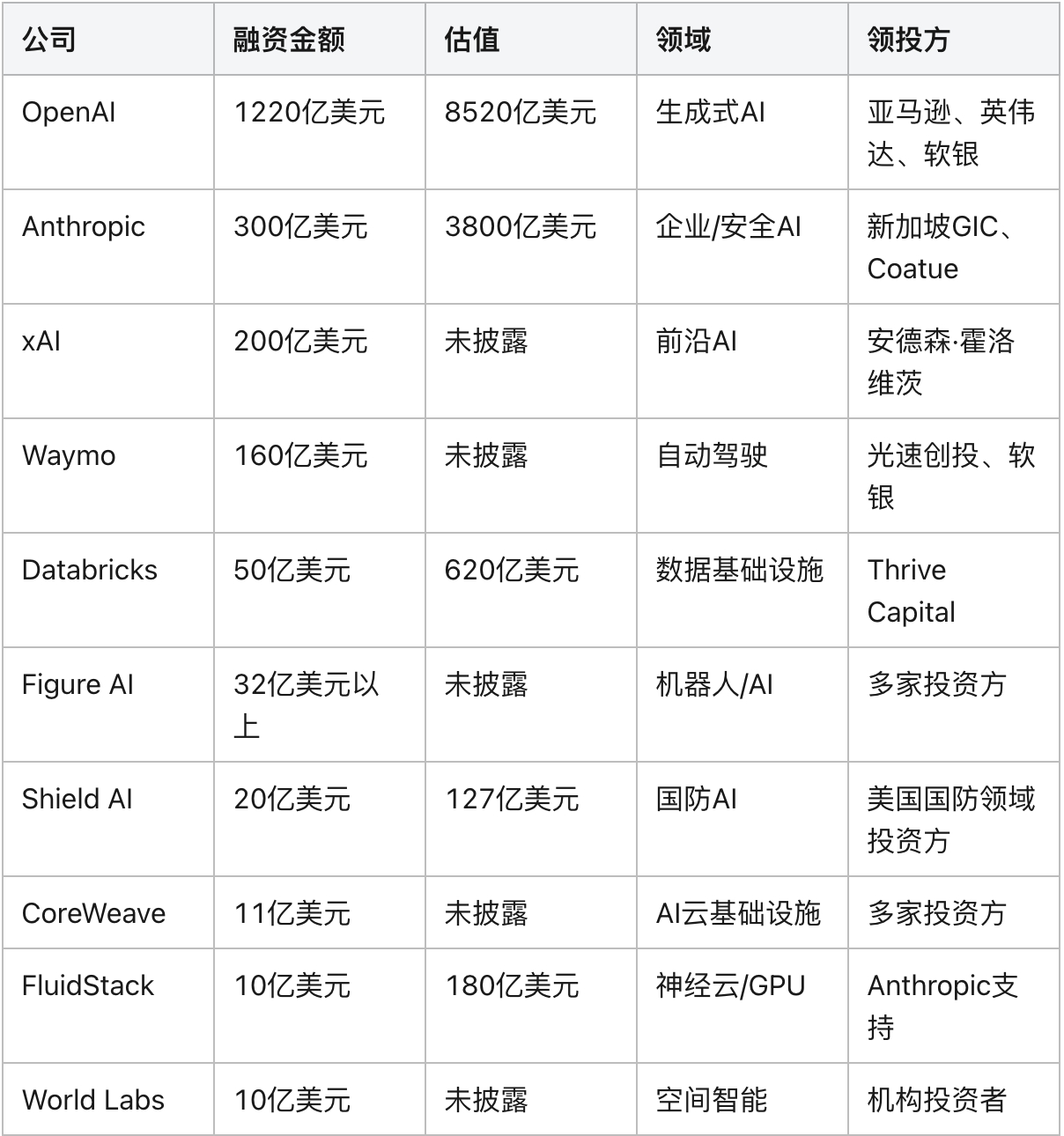
Top 10 Startup Financing Rounds in Q1 2026
The above table reveals a decisive feature of the first quarter of 2026: AI and AI-related companies had an almost absolute dominance in the super rounds of financing. Every company in the top ten either built foundational models, provided AI infrastructure, or deployed AI in physical systems such as self-driving cars and military drones. Traditional software, fintech, and consumer tech startups almost completely disappeared from the billion-dollar financing club.
AI Absorbed 81% of Venture Capital
The most astonishing statistic in the first quarter of 2026 is the extent to which AI devoured the venture capital market. According to an analysis by Trending Topics EU, AI companies absorbed 81% of all venture capital in that quarter, totaling more than $240 billion. This is the highest capital concentration in a single technology field in the history of venture capital, exceeding the concentration of internet companies in the first quarter of 2000 at the peak of the internet bubble.
The AI financing boom can be divided into two distinct categories. Cutting-edge AI labs, which are companies building large language models and foundational models, took the largest share, led by OpenAI, Anthropic, and xAI. AI infrastructure companies, including GPU cloud providers like CoreWeave and FluidStack, data platforms like Databricks, and chip manufacturers like Cerebras Systems, absorbed a considerable second category of funds. And application-layer AI startups, which build products on top of foundational models, received relatively less funding.
"What we're seeing is a capital structure more like that of the oil industry in the early 20th century, rather than the traditional venture capital model," Sarah Chen, managing partner at Sapphire Ventures, said in an interview. "A few infrastructure players are absorbing almost all the capital, and everyone else is building applications on their platforms. The question is, can the returns justify this concentration?"
Geographical Concentration: The United States Absorbed 83% of Global Venture Capital
The geographical distribution of venture capital in the first quarter of 2026 revealed an increasingly unbalanced global pattern. According to Crunchbase data, the United States attracted $250 billion out of the total global $297 billion, accounting for 81% of the global venture capital, a significant increase from 55% in the first quarter of 2025. This concentration was almost entirely driven by the super financing rounds of AI companies headquartered in the United States, all of which were located in San Francisco or the broader Bay Area.
China attracted $16.1 billion in the first quarter of 2026, maintaining its position as the second-largest venture capital market. The United Kingdom attracted $7.4 billion, thanks to the self-driving startup Wayve and the continuous growth of the fintech sector in London. According to the KPMG "Venture Capital Pulse Q1 2026" report, the total financing in Asia was $33.6 billion, and at least two financing rounds of over $1 billion were completed outside the United States.
"We're witnessing the biggest wealth creation event in human history, almost happening in just one country," Dr. Thomas Ramge, a technology analyst at the Bertelsmann Foundation, told the Financial Times. "The regulatory approach in Europe brings stability, but it doesn't generate the risk appetite that can give rise to billion-dollar financing rounds."
Later-Stage Financing Soared by 205%, and Super Big Deals Dominated
The stage distribution of venture capital in the first quarter of 2026 revealed a phenomenon of extreme capital concentration in the later stages. The total financing in the later rounds was $246.6 billion, accounting for about 82% of all venture capital, a year-on-year increase of 205%, according to Capitaly VC and Crunchbase. Among them, $235 billion came from only 158 financings of $100 million or more, which means that less than 3% of venture capital transactions contributed more than 79% of the capital.
Seed-stage financing performed relatively well, with a year-on-year increase of 31% to $12 billion. However, the number of seed-round transactions decreased by 30% to about 3,800, indicating that although investors were writing larger seed-round checks, the number of invested companies was decreasing. The average seed-round size increased accordingly, a trend that favored well-connected founders but made it more difficult for first-time entrepreneurs without a Silicon Valley network to raise initial funds.
"The venture capital market has undergone a fundamental split," Mike Volpi, a general partner at Index Ventures, said in an interview with Bloomberg. "A few companies are raising funds that look more like sovereign bond issuances, while everyone else is competing for a shrinking pool of capital. The middle ground has been hollowed out."
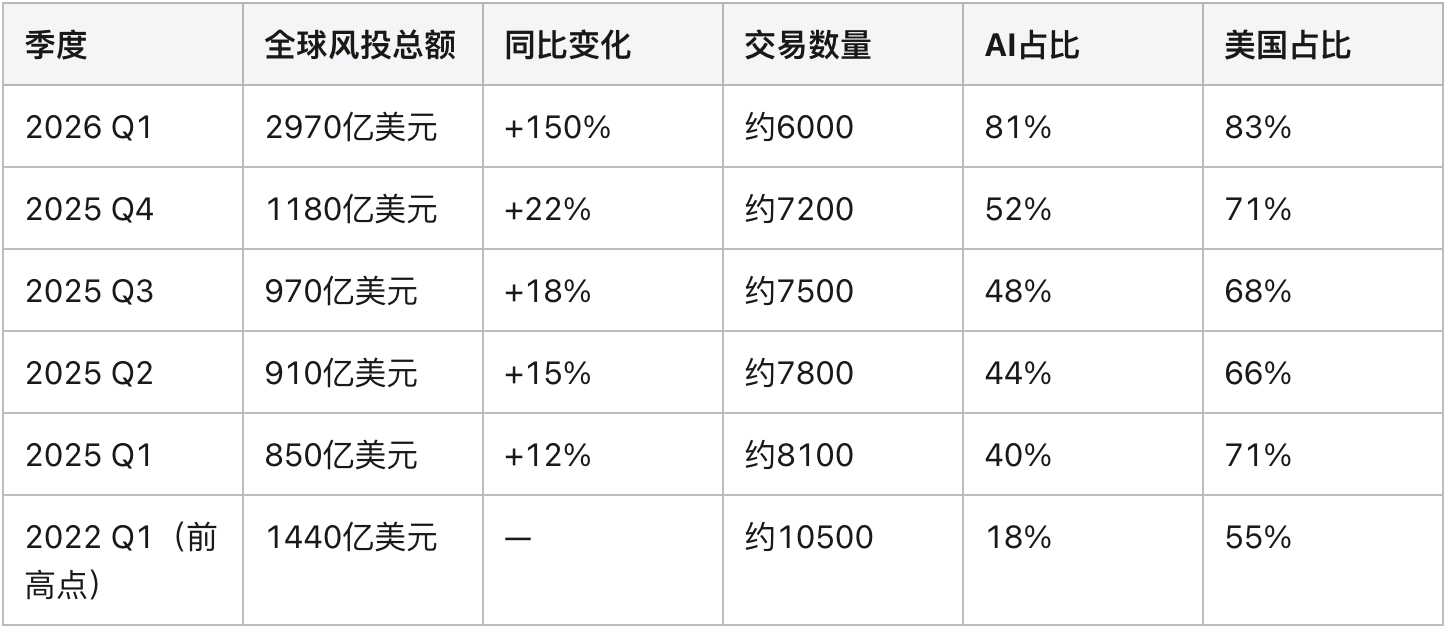
Venture Capital Financing in Q1 2026 vs. Historical Quarters
The above table highlights two key trends. First, the venture capital record in the first quarter of 2026 more than doubled that of the first quarter of 2022 during the zero-interest rate period. Second, the number of transactions actually decreased compared to 2022, meaning that this record was entirely driven by larger financing rounds rather than the growth of a broader startup ecosystem. This concentration pattern has significant implications for the diversity of startups and the breadth of innovation.
The Rise of Sovereign Wealth Funds as "Kingmakers" in the AI Field
One of the most significant structural changes in the first quarter of 2026 was the rise of sovereign wealth funds as a decisive force in cutting-edge AI financing. The Government of Singapore Investment Corporation (GIC) co-led Anthropic's $30 billion financing. Another Singaporean sovereign wealth fund, Temasek, participated in OpenAI's $122 billion financing. The Qatar Investment Authority supported Anthropic. The Public Investment Fund of Saudi Arabia and Mubadala Investment Company of Abu Dhabi significantly increased their allocations to AI throughout 2025 and 2026.
The participation of sovereign funds reflects a fundamental shift in the financing method of cutting-edge AI development. Traditional venture capital firms, even the largest ones, lack the balance sheet capacity to write checks of $10 billion or $30 billion. And sovereign wealth funds with a total global asset of more than $12 trillion can deploy capital at this scale without the liquidity constraints of pension funds and university endowments.
"Sovereign wealth funds are now the most important investors in the AI ecosystem," said Aswath Damodaran, a finance professor at New York University's Stern School of Business. "They bring patient capital, geopolitical motives, and a balance sheet that no traditional venture capital firm can match. The question is, does their participation add governance value or just drive up valuations?"
The Question of Valuation: Why Is a Company with an Annual Revenue of $11 billion Valued at $852 billion?
The most controversial aspect of the venture capital boom in the first quarter of 2026 was the valuation multiples assigned to cutting-edge AI companies. OpenAI's valuation of $852 billion was based on an annualized revenue of about $11.6 billion, meaning a revenue multiple of about 73 times. Anthropic's valuation of $380 billion was based on much lower revenue, resulting in an even higher multiple. In contrast, the most highly valued listed technology companies usually trade at 15 - 25 times revenue.
Defenders of these valuations argue that cutting-edge AI companies are building the infrastructure that supports the entire economy, similar to how the returns generated by cloud computing platforms justified the early investments in AWS and Azure. The bullish logic is based on the assumption that AI will account for a large part of the global GDP (currently estimated at $105 trillion), making even a valuation of $852 billion still modest relative to the overall potential market.
Critics counter that these valuations reflect a "greater fool" mentality rather than fundamental analysis. "We've never seen this level of capital concentration in pre-profit companies in any industry, never," said Scott Galloway, a marketing professor at New York University's Stern School of Business. "The implicit assumption is that these companies will achieve profit margins and scales beyond any company in economic history. It might happen, but the price already reflects the most perfect outcome."
Non-AI Startups Face a Capital Winter
While AI companies are bathing in record capital, the rest of the startup ecosystem is experiencing what founders call a "capital drought." Since 81% of venture capital flowed to AI, the remaining $57 billion was divided among thousands of fintech, biotech, climate tech, enterprise SaaS, and consumer startups. After adjusting for inflation, non-AI venture capital financing in the first quarter of 2026 was actually lower than that in the first quarter of 2020.
This impact has been reflected in recruitment data, extended cash flows, and business transformation announcements. Many SaaS companies that completed Series B financing in 2023 and 2024 are now struggling to secure follow-on financing as investors shift their attention and capital to AI infrastructure. The entire SaaS market has been under great pressure in 2025 and 2026, and the industry has experienced a significant stock decline as AI agents threaten to automate many traditional software workflows.
The situation in climate tech is particularly in sharp contrast. Despite the increasing urgency of decarbonization, according to data from multiple venture capital data providers, climate startups raised less funds in the first quarter of 2026 than in the first quarter of 2024. Energy transition companies that attracted enthusiasm during the post-IRA boom in 2023 - 2024 are now competing for investors' attention in a market where every conversation circles back to AI.
Corporate Venture Capital: Tech Giants Became Their Own Venture Capital Firms
A prominent feature of the first quarter of 2026 was the scale of corporate venture capital participation. Amazon, NVIDIA, Microsoft, and SoftBank jointly invested more than $140 billion in the top financing rounds of that quarter, blurring the line between strategic investment and traditional venture capital. Just Amazon's $50 billion investment in OpenAI exceeded the total managed assets of most professional venture capital firms.
Corporate participation raises complex questions about market structure and competition. When companies that build cloud infrastructure, manufacture GPUs, and operate platforms that AI applications rely on also hold equity in leading AI labs, the potential for vertical integration and market foreclosure is huge. Antitrust regulators in the United States and the European Union have indicated their intention to review these relationships. The broader $650 billion AI infrastructure construction will only further amplify these concerns.
NVIDIA's dual role is particularly notable. The company invested about $30 billion in OpenAI and is also OpenAI's main GPU supplier. This arrangement creates an alignment of incentives - NVIDIA benefits from OpenAI's growth both through equity appreciation and hardware sales - but it also raises the question of whether other AI labs can access NVIDIA's latest chips on an equal footing.
The Road to IPO: Can the Returns Support This Capital?
The ultimate test of the venture capital boom in the first quarter of 2026 lies in whether these investments can generate returns through public market exits. The IPO pipeline for AI-related companies is the most crowded in market history. Databricks has filed for an IPO, and analysts expect it to be the largest enterprise software IPO ever. SpaceX has filed for an IPO, and the company's valuation could reach $1.75 trillion. Anthropic's leadership has publicly discussed the timing of an IPO.
However, compared to the private financing environment, the IPO market for venture-backed companies has been underperforming. Companies are staying private for longer, raising larger and larger rounds of financing instead of subjecting themselves to the scrutiny of the public market. The gap between private and public market valuations has widened significantly, increasing the risk of "discount IPOs" - that is, a company's IPO valuation is lower than its last private valuation.
"The private market has basically become the new public market for these companies," Jenny Lee, managing partner at GGV Capital, commented at the ASU+GSV