The foreign trade landscape is changing. Why is it the "biggest dark horse"?
The foreign trade market has witnessed a series of high - tides in the first quarter of this year.
The total import and export value of foreign trade goods across the country reached 11.84 trillion yuan, with both imports and exports achieving double - digit growth. Affected by factors such as the explosive growth of global AI computing power demand, the export value of integrated circuits, the largest single foreign trade item in China, increased by as much as 77.5%.
Behind this, semiconductor cities such as Xi'an, Chongqing, and Hefei are rising strongly, quietly reshaping the strength pattern of national foreign trade cities. According to data from the General Administration of Customs, in the first quarter of this year, the growth rates of foreign trade imports and exports in Xi'an, Fuzhou, Chongqing, Tangshan, and Hefei were 74.2%, 35.6%, 34.3%, 33.8%, and 33.7% respectively, leading the country in growth.
In particular, Xi'an, which is neither by the sea nor on the border, has seen its foreign trade scale climb to 181.922 billion yuan, surpassing five cities including Zhengzhou, Nanjing, Dalian, Yantai, and Foshan in one go, becoming the "biggest dark horse" in the foreign trade map.
What exactly does Xi'an rely on?
01 Ranking First in Growth Rate
Behind the rapid growth of the national foreign trade, trillion - level cities have become a stable support. In the first quarter of this year, the total foreign trade import and export volume of 29 trillion - level cities across the country reached 8.15 trillion yuan, accounting for 68.9% of the national total, an increase of 1.5 percentage points compared with the same period last year.
These cities have different industrial structures and trading partners, resulting in different foreign trade growth trends. In the first quarter of 2025, 20 out of 29 cities had a higher growth rate of foreign trade imports and exports than the national average (1.3%), while 9 cities such as Fuzhou and Tangshan had negative growth; in the first quarter of this year, 13 cities outperformed the national average (15%), and only Nanjing and Quanzhou have not yet achieved positive growth.
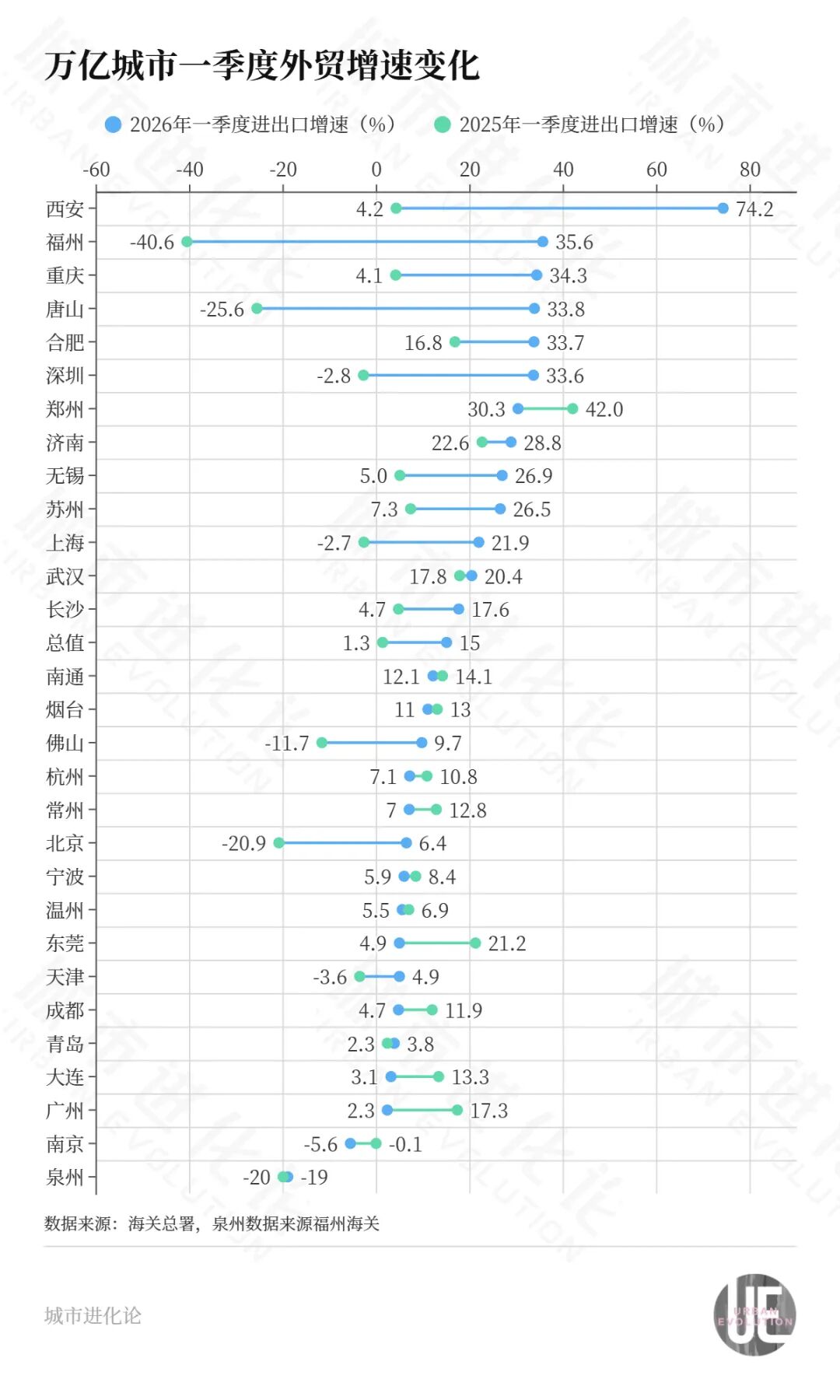
Located in the inland western region, Xi'an has caught the biggest "tailwind". In the first quarter of this year, the total value of Xi'an's foreign trade imports and exports was 181.922 billion yuan, a year - on - year increase of 74.2%. Among them, exports were 141.406 billion yuan, a year - on - year increase of 95.9%; imports were 40.516 billion yuan, a year - on - year increase of 25.7%.
This import and export growth rate leads all trillion - level cities in the country, leaving the second - ranked Chongqing nearly 40 percentage points behind. It also breaks last year's record set by Zhengzhou, raising the "ceiling" of the first - quarter foreign trade growth rate champion of trillion - level cities by more than 30 percentage points. What a strong momentum!
Zeng Zhaoning, the former vice - president of the Shaanxi Economics Society, analyzed for Urban Evolution that the strong growth of Xi'an's foreign trade is mainly driven by exports, and key industries such as semiconductors, new - energy vehicles, and photovoltaics have provided strong support. Leading enterprises such as Samsung, BYD, and LONGi Green Energy have strong competitiveness globally, representing Xi'an's advantages in these emerging industries.
Not long ago, the Guanshan Customs disclosed that in the first two months of this year, the total import and export value of Xi'an was 113.72 billion yuan, a year - on - year increase of 69.3%, accounting for 93.9% of Shaanxi's total import and export value, 51 percentage points higher than the national import and export growth rate. Among them, exports and imports of mechanical and electrical products accounted for 93.4% and 78.6% of the city's total respectively.
This trend continues. According to the statistical bulletin of Xi'an Customs in March 2026, in the first quarter, the exports of Shaanxi's integrated circuits, automatic data processing equipment and its parts, and electrical equipment were 76.147 billion yuan, 23.859 billion yuan, and 3.618 billion yuan respectively, with year - on - year increases of 165.98%, 238.27%, and 81.61% respectively.
Meanwhile, the growth rates of foreign trade imports and exports in Fuzhou, Chongqing, Tangshan, Hefei, Shenzhen, and Zhengzhou have also exceeded 30%, showing very impressive performance. Fuzhou and Tangshan have reversed the negative growth trend of the same period last year, and Chongqing, Hefei, and Shenzhen have also returned to the high - growth track of foreign trade thanks to the explosion of the integrated circuit industry.
02 Sudden Change in the Pattern
Under the super - strong growth momentum of some cities, the foreign trade pattern of the "Trillion - GDP Club" has changed suddenly. Shenzhen's foreign trade import and export scale has exceeded one trillion yuan, surpassing Shanghai with an advantage of more than 80 billion yuan and regaining the position of the city with the largest foreign trade volume.
Data shows that the foreign trade imports and exports of Shenzhen and Shanghai were 1.32 trillion yuan and 1.23 trillion yuan respectively, with year - on - year increases of 33.6% and 21.9% respectively. They are the only two cities in the country whose quarterly foreign trade volume has exceeded one trillion yuan. Behind them, Suzhou, the strongest prefecture - level city, has also surpassed Beijing with a foreign trade growth rate of 26.5%. Its foreign trade scale reached 799.993 billion yuan, taking the third place in foreign trade.
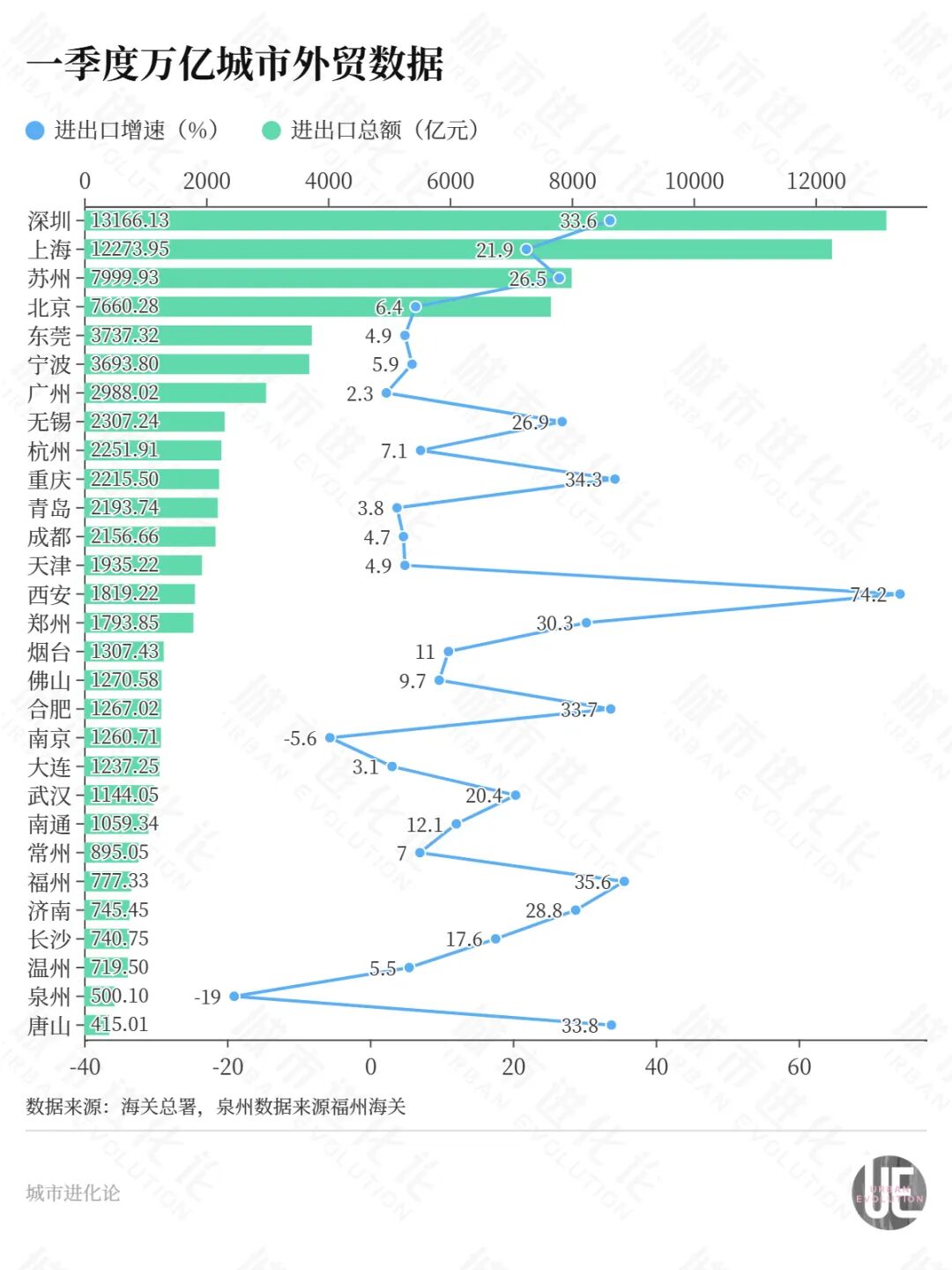
These five cities also form the first echelon of China's foreign trade cities, leading by a large margin. At the same time, the foreign trade scales of Dongguan, Ningbo, Guangzhou, Wuxi, Hangzhou, Chongqing, Qingdao, and Chengdu are also over 200 billion yuan, forming a relatively stable second echelon.
With a relatively high foreign trade growth rate, Wuxi has successively surpassed four cities including Qingdao, Hangzhou, Chengdu, and Tianjin to rank eighth in foreign trade, and Chongqing has also surpassed three cities including Qingdao, Chengdu, and Tianjin to enter the top ten foreign trade cities. Data shows that in the first quarter of this year, the total foreign trade imports and exports of Wuxi and Chongqing were 230.724 billion yuan and 221.550 billion yuan respectively, with year - on - year increases of 26.9% and 34.3% respectively.
This is also a microcosm of the sudden change in the national foreign trade pattern. But whether it is the foreign trade growth rate or the city ranking, Xi'an is undoubtedly the one with the stronger momentum -
After successively defeating five cities including Zhengzhou, Nanjing, Dalian, Yantai, and Foshan, Xi'an's foreign trade scale has risen from the 19th place to the 14th place, becoming the "biggest dark horse" in the national foreign trade map. Looking forward, the gap with Tianjin has narrowed from more than 800 billion yuan to more than 100 billion yuan. Looking backward, Xi'an also has a slight advantage over Zhengzhou.
Behind the foreign trade growth rate is often the trend of industrial development. In recent years, the semiconductor, photonics, and new - energy vehicle industries in Xi'an have rapidly increased their national visibility, forming new advantages in foreign trade competition.
For many years, China's semiconductor industry has shown a pattern of "strong in the east and weak in the west", with the Yangtze River Delta and the Pearl River Delta dominating. However, in recent years, high - end elements have also accelerated their aggregation in the central and western regions. In terms of the import and export scale of integrated circuits, in addition to Guangdong and Jiangsu, provinces such as Shaanxi, Sichuan, and Chongqing have jumped to the second echelon. Focusing on Xi'an, which is home to two giants, Samsung and Micron, the flash memory chips produced here have the highest global market share.
Especially during the global storage chip price increase cycle, overseas giants and domestic new forces are collectively increasing their investment in Xi'an. From the full - year production capacity of the first - phase of the 8 - inch chip production line in the northwest region being fully ordered after its completion and operation, to Samsung Electronics recently announcing the completion of the first phase of the process upgrade of its Xi'an factory and starting mass - production of 236 - layer (V8) products, Xi'an's semiconductor production capacity is being released at an accelerated pace.
This will further inject new impetus into foreign trade growth.
03 Emerging Pillars
In the past two days, the stock price of local company Yuanjie Technology once exceeded that of Kweichow Moutai, becoming the "new king of A - shares", which has also attracted continuous attention from the outside world to Xi'an's semiconductor and photonics industries.
In the global competition of computing power infrastructure, optical chips are an easily overlooked segment - responsible for converting electrical signals into optical signals, they are the core devices for internal and inter - connectivity in data centers. As the "number one domestic optical chip company", Yuanjie Technology has also become the focus of the capital market.
Not long ago, Yuanjie Technology disclosed a major investment plan. The company plans to invest about 1.251 billion yuan to build the second - phase project of the R & D and production base for optoelectronic communication semiconductor chips and devices in Fengxi New City, Xixian New Area, further deepening its layout in the field of high - speed optical chips. This will further strengthen the advantages of Xi'an's semiconductor industry.
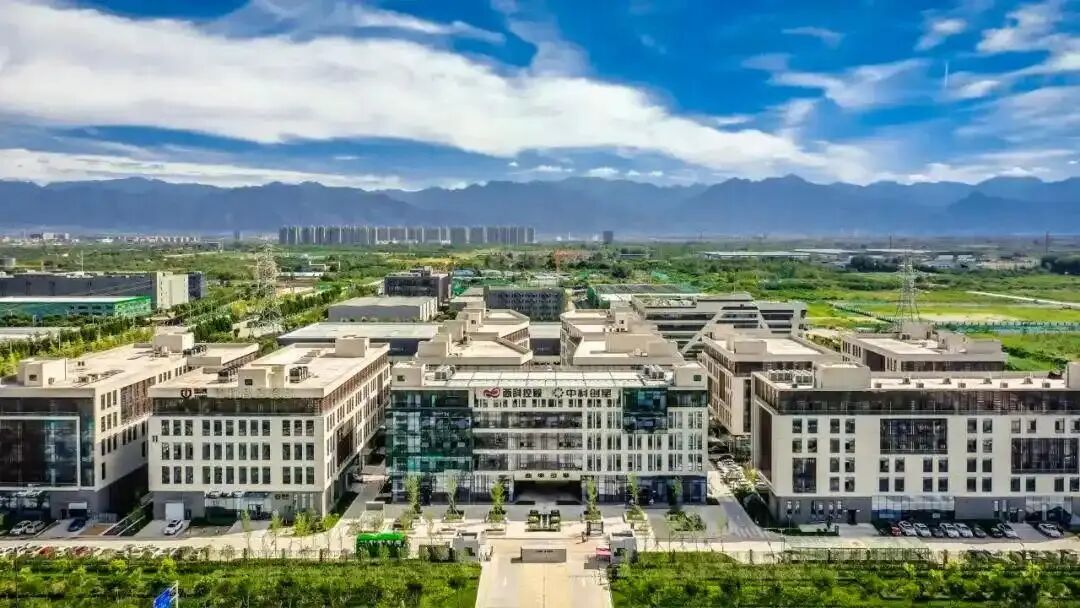
The "Curvature Engine" Photonics Manufacturing Park (Zone 1) in Xi'an High - tech Zone. Picture source: Xi'an Daily
Entering the 15th Five - Year Plan period, emerging pillar industries such as new - energy vehicles, semiconductors, and artificial intelligence have become the focus of competition among various regions and important growth poles to support foreign trade growth. The 15th Five - Year Plan Outline of Xi'an proposes to cultivate and expand emerging industries, promote the scale leap of emerging pillar industries such as intelligent connected new - energy vehicles, semiconductors and photonics, and new energy, and promote the cluster development of industries.
For example, it is necessary to focus on emerging fields such as wide - bandgap semiconductors, advanced packaging, RISC - V, and AI computing, strive to layout a 12 - inch wafer manufacturing project in Xi'an, and promote the construction of projects such as the second - phase of the silicon industrial base in the High - tech Zone and the upgrade and transformation of the new V9 production line of Xi'an's flash memory chips.
This will further promote the cluster development of Xi'an's semiconductor and photonics industries. In the past, the development model of Xi'an's semiconductor industry was led by Samsung, driving packaging and testing, materials, equipment, and supporting services. However, now it has increasingly formed a situation of "dual - wheel drive" with "international giants + domestic leading enterprises", with more than 200 enterprises covering the entire chain from materials, design, manufacturing to packaging and testing, and applications.
According to the plan, Xi'an aims to achieve a scale of over 300 billion yuan in the intelligent connected new - energy vehicle industry chain, over 280 billion yuan in the semiconductor and photonics industry, and over 160 billion yuan in the new - energy industry by 2030. This means that in the next five years, the scale of Xi'an's emerging pillar industries will exceed 700 billion yuan, truly reshaping the city's industrial competitiveness.
In Zeng Zhaoning's view, these three emerging pillar industries that support the strong growth of foreign trade actually form a closely - connected industrial chain that can promote and integrate with each other. Xi'an has become an important national base for the new - energy intelligent connected vehicle industry. The automobile and semiconductor industries are closely related. In particular, the intelligence of new - energy vehicles largely depends on the support of semiconductors, and photovoltaic installations can also supply power to them.
Actually, foreign trade competition ultimately boils down to urban industrial competition. The leading position of Xi'an's foreign trade is a signal of the breakthrough of emerging industries such as intelligent connected new - energy vehicles, semiconductors and photonics, and new energy. Whether these industries can be cultivated into "pillars" within the next five - year window period is the key to the transformation of the city's development momentum.
This article is from the WeChat public account "Urban Evolution", author: Dan Zhongkui. Republished by 36Kr with authorization.