Yizhuang Half Marathon: Robots Speed Up, and the "Falling" Story Continues
In 2025, the Beijing Yizhuang Humanoid Robot Half - Marathon presented many memorable moments. One year has passed, and the outside world is particularly concerned about how much the robots have evolved.
On April 19th, the second Beijing Yizhuang Humanoid Robot Half - Marathon kicked off. More than a hundred teams participated, five times the scale of the first event last year.
The biggest difference from the first event is that this year, for the first time, "human - robot co - running" was realized: robots and human participants shared the 21 - kilometer track. Nearly 40% of the participating teams adopted autonomous navigation technology and no longer relied on engineers following with hand - held remote controls. In the end, the autonomous robots under Honor took the top three places. The champion team, "Monkey King Team", finished with a time of 50 minutes and 26 seconds, surpassing the human half - marathon record.
The real performance on the track is far more interesting than the scoreboard. There was "Lightning" leading the way, and "Xiaobiga" staggering forward; there were dark - horse contestants with smooth acceleration and steering, as well as seeded players and defending champions who fell and got injured.
The uneven performance on the track is also a microcosm of China's embodied intelligence industry in the past year.
Another Year of the Robot Marathon
At 7:30 in the morning, with the starting gun, the human half - marathon officially began.
On the other side of the track, the humanoid robots started one by one in the order determined by the qualifying round. Each robot's performance was calculated separately, and the champion, runner - up, and third - place finisher were determined according to their respective finishing times.
To ensure the order of the competition, the track was divided into left and right sections to separate the robots from human participants. At the same time, the areas near the starting and finishing lines were under closed - management and isolated from the public area.
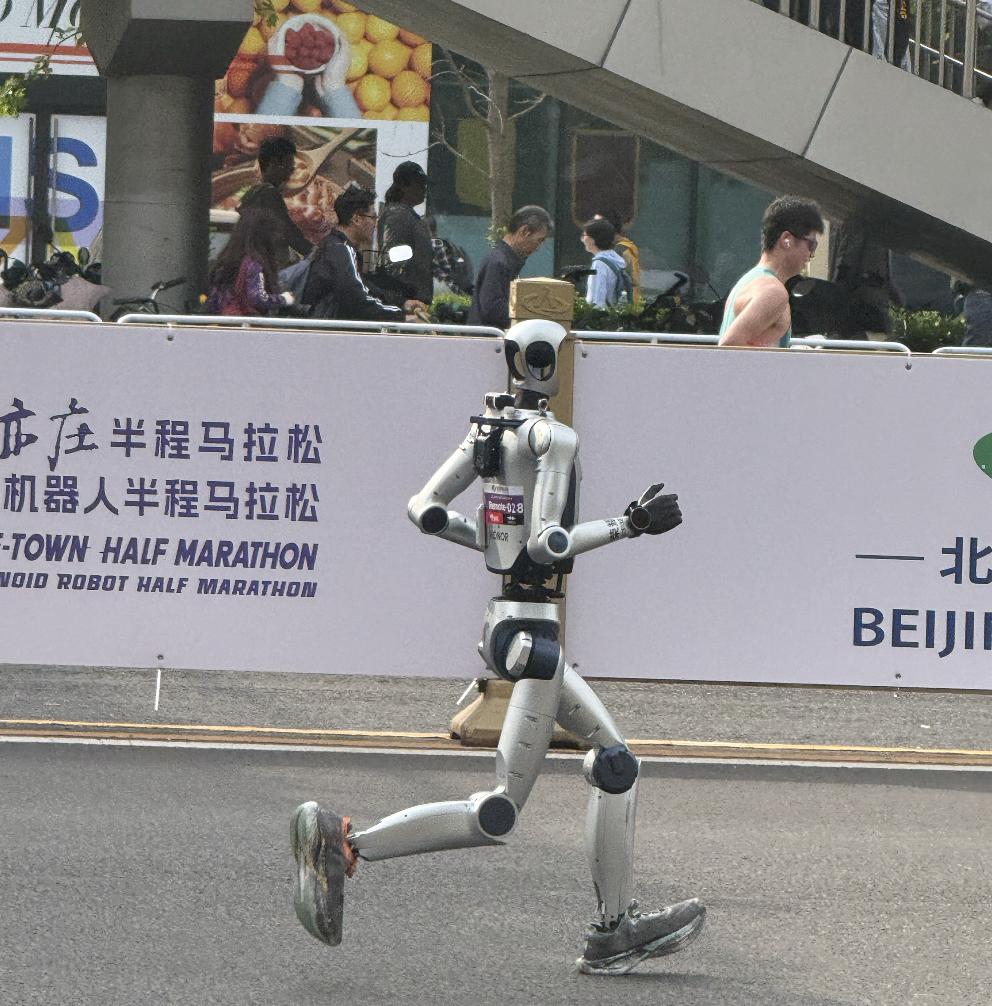
The spectators who wanted to see the contestants filled the middle section of the track, and most of them came to watch the robots. Even the human marathon runners on the track would stop to take pictures of the humanoid robots running beside them.
The first robot to appear in the spectators' view was "Lightning" from Honor, belonging to the Jueying Chitu Team. This robot was operated by remote control. It was the first to start and the first to reach the finish line, setting the best "raw score" of 48 minutes and 19 seconds.
Since the scores of the remote - control group were multiplied by a coefficient of 1.2 for conversion, the champion in the end was the Monkey King Team in the autonomous navigation group. This team was also equipped with Honor's "Lightning" robot, with a net time of 50 minutes and 26 seconds. It surpassed the human world record of 57 minutes and 20 seconds for the half - marathon, and the time taken was only one - third of that of last year's champion.
Whether in autonomous navigation or remote - control mode, Honor's "Lightning" robots were as fast as lightning and took the top six places in this competition. "Before we could even see clearly, the robots had already run past," a spectator described the scene.
On the track, the fastest were the robots, and the slowest were also the robots. Among them were "Xiaopai", only 73 centimeters tall, from Gaoqing Electromechanical, and "Yuanqizai" from Honor, with a graceful running posture. There were also robots wearing wigs and headgear, trying to stand out with their looks. These robots were affectionately called "Xiaobiga" and "Xiaozangbian" by the spectators.
By around 10 o'clock, there were still human participants approaching the finish line, but it was hard to see humanoid robots. Most of them were loaded on vehicles and left under the spectators' gaze. The completion rate of the robots this year was about 45%. There were 18 teams that completed the race using autonomous navigation and 29 teams using remote control, far higher than last year's 30%.
This event almost gathered all the major players in the embodied intelligence field. Ti Gong, Unitree, Ubtech, Songyan Power, Galaxy General, Xinghai Map, etc., all showed up. And Honor, which participated for the first time, became the biggest dark horse.
Honor's robot team was established in February 2025 and currently has more than 200 members. Its business covers the entire chain of perception, motion control, hardware, whole - machine, AI, and testing. In this event, all 10 teams sent by Honor entered the main competition, including 6 teams with "Lightning" robots and 4 teams with "Yuanqizai" robots.
Unitree officially only sent one model, H1, to participate; there were also many independent teams that developed their own robots based on Unitree products and participated. Besides participating, Xinghai Map also provided services at the track's supply station, such as handing out water, towels, and supplies to the participants in a fully autonomous way.
Why Do Humanoid Robots Need to "Run Fast"
The marathon track is an experimental field to test the engineering reliability of robots.
First of all, the 21.0975 - kilometer distance is a severe test for battery life and energy management. In the first event, robots had to be shut down to change batteries, which was time - consuming and risky. The champion, Ti Gong Ultra, basically changed batteries every 5 kilometers in the first 10 kilometers.
This year, the "hot - swapping battery" solution has been popularized among many teams, allowing battery replacement without shutting down the robot. However, the bottleneck in battery technology is still obvious, and the mainstream robots' battery life is only 30 minutes to 1 hour.
Secondly, there is stability and durability. High - speed bipedal running places extremely high requirements on gait control: during the continuous process of taking off and landing, the robot needs to maintain full - body balance in real - time, precisely control the foot - landing points, and complete state judgment and control correction within milliseconds.
The marathon track combines more than a dozen types of terrain, including flat ground, slopes, curves, and narrow sections, with 12 left - hand turns and 10 right - hand turns, including nearly 90° curves. Running on two feet on such a complex terrain is an even greater challenge for robots.
But if robots want to move from the laboratory to factory production lines or home services, they must have the ability to overcome complex terrains.
In the first event, there were frequent accidents such as robots slipping and kneeling at the start, "breaking their legs", and staggering and falling, which exposed the shortcomings in joint stability and material structure. During high - intensity running, the joint motors overheated seriously, and technicians had to spray coolant frequently to cool them down.
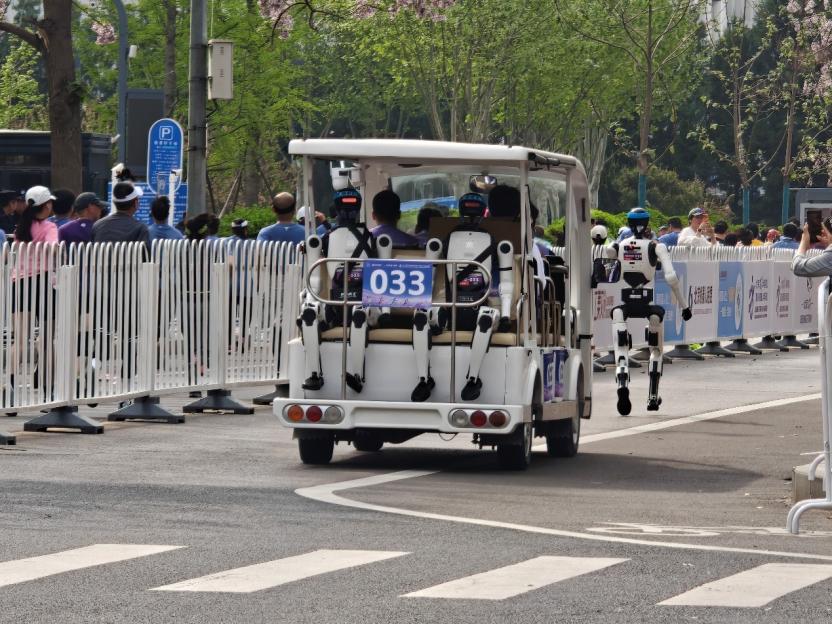
In just one year, the speed of robots has increased significantly. Behind this is a more heat - resistant and durable body and joints, as well as more precise motion control. However, it was still difficult for a single robot to complete the race. Many robots had to be replaced with backup robots one or two times. Even so, many teams had to withdraw sadly because their backup robots were not enough to finish the race.
There were also "fallen kings" among them.
The Unitree H1 robot, which had a remarkable performance in the qualifying round and was regarded as a favorite to win the championship, repeatedly fell during corner turns. The Unitree H1 once completed a more than 1.9 - kilometer curved track in 4 minutes and 13 seconds in the qualifying round, breaking the human 1500 - meter world record. However, it failed to complete the race under the test of the complex terrain and long - distance in the main competition. Even "Lightning" from the Jueying Chitu Team fell about 200 meters from the finish line.
In addition to being a technical test field, the marathon is also a showcase for manufacturers.
In the 2025 Spring Festival Gala of the Year of the Snake, Unitree's humanoid robots amazed the audience with a yangge dance performance. Subsequently, its founder, Wang Xingxing, became a star in the venture - capital circle, and the company's valuation and order volume soared simultaneously. This "Spring Festival Gala effect" is an opportunity that embodied intelligence players are pursuing, and the marathon provides a similar scenario for gathering public attention.
Besides ordinary consumers, it is also a way to showcase strength to B - end customers. When robots can complete a half - marathon on an open road, it means there is a possibility of realizing scenarios such as factory handling, logistics distribution, and inspection.
According to IT Juzi data, in 2025, the financing amount in the primary market of the domestic robot field reached about 58.776 billion yuan, about 2.8 times that of 2024. In such a hot capital environment, enterprises urgently need to prove their technological strength through landmark events to support their valuation and financing needs.
In the past one or two years, the embodied intelligence industry has entered the initial commercialization stage from the R & D verification stage. The year 2025 was called the "Year of Mass Production", and leading enterprises have won a large number of orders.
However, commercialization is still in the "factory training" stage. Currently, humanoid robots entering factories do not replace human labor but jointly verify the efficiency and cost in the production line with enterprises, which is clearly experimental in nature.
Where is the Future of Embodied Intelligence Heading
The prerequisite for large - scale commercialization is cost reduction. The current humanoid robot market shows a polarization: the unit price of industrial - grade products is often hundreds of thousands of yuan, while the price of consumer - grade products is rapidly dropping.
Unitree is the most representative price disruptor. Its prospectus shows that the average selling price of humanoid robots dropped sharply from 593,400 yuan in 2023 to 167,600 yuan in the first three quarters of 2025, a decrease of more than 71%. Songyan Power even pulled humanoid robots into the "thousand - yuan machine" discussion range with its Bumi Xiaobumi, which has a pre - sale price of less than 10,000 yuan.
The underlying logic of cost reduction is the localization of core components. The accumulation of the manufacturing industry enables Chinese enterprises to quickly iterate hardware and lower prices. Core components of robots such as planetary roller screws and servo drives are gradually being replaced by domestic products.
However, embodied intelligence is still far from real consumer popularity. Currently, most robots are still used in scientific research and education, commercial performances, or factory displays. The continuous operation ability in the home scenario is not yet mature. Although the motion control of robots has made great progress, fine operation and independent thinking are still short - comings.
The bottleneck in fine operation is concentrated in the field of dexterous hands. More than 70% of human physical interactions and 90% of fine operations rely on hands, but robots cannot achieve dexterous grasping due to the bottleneck in tactile sensing technology. The cost of existing dexterous hands accounts for more than 20% of the total cost of robots, and there are problems such as "difficult to balance strength and speed" and "unable to achieve high flexibility and high precision simultaneously". Actions that are simple for humans, such as catching fish, tying shoelaces, and playing the piano, are still extremely difficult for robots.
And the bottleneck in independent thinking lies in the generalization ability of large models. In essence, the models are still "exam - takers". Once they enter the real physical world, there is a gap between visual semantics and joint actions, and they "know what to do but can't do it". The success rate of cutting - edge VLA models in real tasks is limited, and the industrial - grade reliability is far from meeting the standard. This is an early - stage bottleneck faced by the global embodied intelligence industry.
Therefore, the industry's R & D resources are shifting from the "cerebellum layer" to the "brain layer". Nearly 50% of the 4.2 billion yuan raised by Unitree in its IPO will be invested in the R & D of embodied large models; Ubtech will increase its R & D budget from 500 million yuan to 700 million yuan in 2026, focusing on embodied large models and world models.
Large companies such as JD.com, Meituan, and ByteDance have all made huge investments in embodied intelligence large models. Among them, JD.com will establish the world's largest data collection field and collect 10 million hours of real - scene data in two years, covering fields such as commercial services and industrial manufacturing.
At the same time, the Ministry of Industry and Information Technology established the Humanoid Robot and Embodied Intelligence Standards Committee at the end of 2025 to accelerate the unification of safety, interface, and other standards, paving the way for large - scale consumer - grade applications, and relevant support policies are also being promoted rapidly.
The finish line of the robot marathon is there, but the direction of the robot industry is far more than just running. When the steel contestants on the track can stably complete the 21 - kilometer race, the next step will be to learn to tie shoelaces, screw screws, and serve tea like humans. That will be the real "finishing moment" of embodied intelligence.
This article is from the WeChat official account “Baobian” (ID: baobiannews), written by Zhang Jingwei and published by 36Kr with authorization.