Surpassing human records, decoding the underlying industry layout
On April 19th, at the Beijing Yizhuang Race Track, the world's first half - marathon for humanoid robots came to an end. The "Lightning" robot of the Monkey King Team won the championship in the autonomous navigation group with a net time of 50 minutes and 26 seconds, directly breaking the human world record of 57 minutes and 20 seconds for the half - marathon.
A year ago, the champion of the first robot half - marathon was still hovering around 2 hours and 40 minutes; a year later, the speed tripled. From stumbling to striding forward, this is not science fiction but a hard - core overtaking of domestic humanoid robots.
Looking back at this race, the drama of the race was high from the very beginning. Several robots that started first ran at a very high speed, and human athletes couldn't catch up at all. There was even a famous scene where an athlete shouted "They're running too fast!" at the scene.
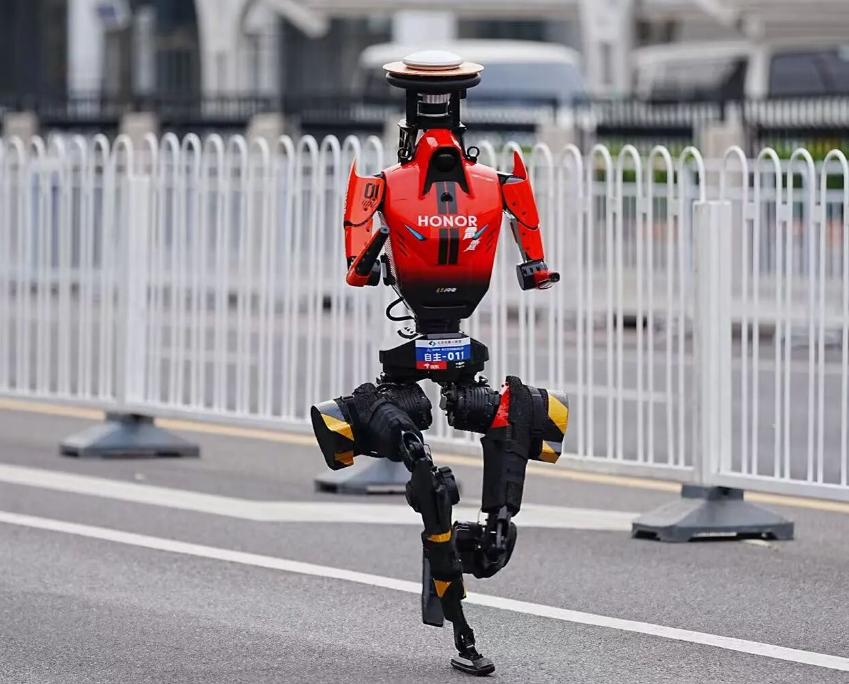
The most exciting moment occurred at the finish line. The "Lightning" robot of the Monkey King Team from Shenzhen Glory Smart Technology Development Co., Ltd. won the championship with a net time of 50 minutes and 26 seconds.
What does this number mean? It is nearly 7 minutes faster than the men's half - marathon world record of 57 minutes and 20 seconds set by Ugandan star Kipruto in the Lisbon Half - Marathon in March this year.
In the first race a year ago, the humanoid robot of the Tiangong Team won the championship with a time of 2 hours, 40 minutes and 42 seconds, and 6 robots completed the race. From 2 hours and 40 minutes to 50 minutes, it only took one winter.
01 Disassembling "Lightning"
Let's first look at its parameters. It is 169 cm tall, weighs about 45 kg, and has a trendy and cool mecha - style design that combines aerodynamics and visual impact. The core secret weapon is Glory's self - developed high - dynamic motion system, which is equipped with autonomous perception and navigation capabilities and can maintain high - speed running stability on complex terrains.
But what really deserves in - depth exploration is the team behind it.
Glory, a company well - known globally for its smartphones and consumer electronics, how did it suddenly take the lead in the robot race? This kind of cross - border dimensionality reduction strike is not rare in the history of technology.
The long - term accumulation of mobile phone manufacturers in heat dissipation technology, lightweight materials, and hardware reliability can almost naturally be transferred to the motion system and battery life management of humanoid robots.
Glory sent two self - developed robots, "Lightning" and "Yuanqizai", to participate in this race, making Glory the world's first terminal giant challenger to send contestants.
Glory's ambition is not limited to winning a single race. The company clearly stated that in the future, its robot business will focus on the consumer market and deeply explore three major scenarios: shopping malls, factories, and families. From mobile phones to robots, Glory is drawing a complete product line from "portable terminals" to "accompanying assistants".
If we regard the victory of "Lightning" as a signal flare, then it illuminates the capital frenzy that the entire humanoid robot industry is experiencing.
In 2025, how hot was this track? Data from the High - tech Robotics Industry Research Institute shows that a total of 144 financing events occurred in the upstream and downstream of the domestic embodied intelligence industry chain, with a total financing amount of 19.5 billion yuan and an average single - financing amount of 135 million yuan.
Even more exaggerated, according to statistics from Kaiyuan Securities, as of October 2025, the total financing amount in the field of embodied intelligence has exceeded 50 billion yuan, a year - on - year increase of more than 400% compared to the whole year of 2024, and there have been more than 200 financing events. In the first three quarters of 2025, the total financing amount obtained by domestic robot start - up companies was about 50 billion yuan, 2.5 times that of the same period last year.
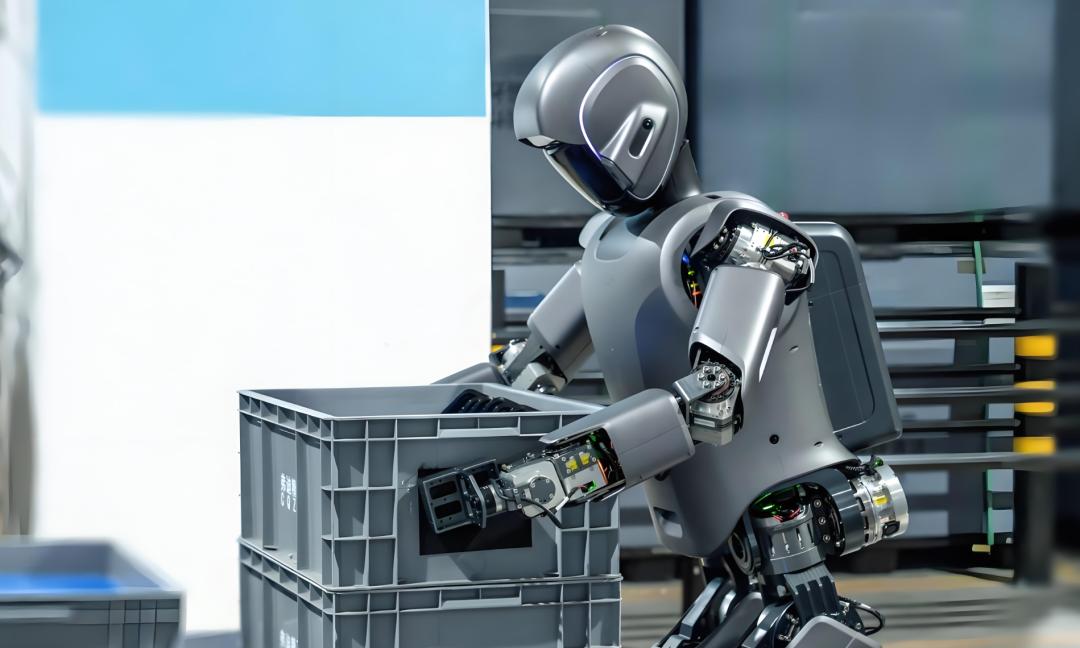
Where does the money come from? Internet giants, industrial capital, and state - owned investment funds are all involved.
From the end of February to the beginning of March this year, Galaxy General announced the completion of a new round of financing of 2.5 billion yuan, breaking the domestic single - round financing record for embodied intelligence. Songyan Power completed a Series B financing of about 1 billion yuan.
Just a few days ago, Tashizhihang completed a Pre - A round of financing of 455 million US dollars, once again breaking the domestic financing record for embodied intelligence, jointly led by Hillhouse, Sequoia, and Meituan.
02 Why are capitals pouring in so crazily?
The answer is actually very simple: they see certainty. This certainty comes from two aspects.
On the one hand, there is a rapid breakthrough in technology. Just as "Lightning" demonstrated on the half - marathon track, humanoid robots have evolved from "being able to walk" to "being able to outrun human champions". On the other hand, the scenarios are becoming clearer. Factories, shopping malls, and families are no longer just imaginings in science fiction novels but are demands verified by real orders.
First, look at domestic players. Unitree Robotics, a Hangzhou - based company founded in 2016, had a revenue of 1.708 billion yuan in 2025, a year - on - year increase of 335.36%; its non - recurring net profit was about 600 million yuan, a year - on - year increase of 674.29%.
In March this year, Unitree Robotics' application for IPO on the STAR Market was accepted, and it plans to raise about 4.2 billion yuan. Its shipment volume of humanoid robots has ranked first in the world. The motion control algorithms and lightweight structure designs accumulated in the era of quadruped robots have enabled Unitree to achieve an almost seamless transition in the humanoid robot track.
Then look at Ubtech. In 2025, its revenue was HK$2.001 billion, a year - on - year increase of 53.29%. The revenue from full - size embodied intelligent humanoid robots was HK$820 million, a year - on - year increase of 2203.7%; the sales volume was 1,079 units, a year - on - year increase of 35866.7%. This sales volume is currently the highest globally.
Changjiang Securities predicts that Ubtech will reach a production scale of 10,000 humanoid robots in 2026. However, it should be noted that Ubtech still had a loss of HK$703 million in 2025. Although the loss has narrowed year - on - year, it is still far from profitability.
Glory Robotics is a player from another dimension. Relying on the supply - chain advantages and R & D accumulation of its mobile phone business, Glory is not in a hurry to independently raise funds or go public. Instead, it regards robots as a natural extension of its existing product ecosystem. This "second - generation rich" approach gives Glory natural advantages in hardware reliability and cost control. But the problem is also obvious: how much resource tilt can the robot business get within Glory? If the mobile phone business is under pressure, will the robot business become a "side business" to be sacrificed?
Then look at overseas. Tesla Optimus has not been mass - produced yet, but Musk has always described this humanoid robot as the source of more than 80% of Tesla's long - term value in the future. Tesla's secret weapon is self - production and self - use in the factory: first run through the entire process in its own super factory, accumulate data, and then launch it into the market. This "using scenarios to nurture technology" model cannot be replicated by any other company in China for the time being.
What really shocked the industry is FigureAI. This start - up company, which was founded only a few years ago, raised more than 1 billion US dollars in its Series C financing, and its post - investment valuation soared directly to 39 billion US dollars, making it the world's most highly valued humanoid robot company.
FigureAI's approach is extremely radical: instead of taking small steps forward, it directly aims at general humanoid robots and has already signed pilot cooperation agreements with giants such as BMW and Amazon. However, the risks are also huge. A valuation of 39 billion US dollars means that investors are expecting exponential growth. Once the mass production is delayed or the implementation fails to meet expectations, the valuation will collapse much faster than it rose.
1X Technologies, invested by OpenAI, has taken a different path: it focuses on the home scenario, emphasizing safety, flexibility, and low energy consumption. 1X is seeking a financing of up to 1 billion US dollars, with a target valuation of at least 10 billion US dollars. Its advantage is a clear scenario, but the disadvantage is also obvious - the willingness to pay and the unit price in the home scenario are much lower than those in the industrial scenario, and it is more difficult to achieve a commercial closed - loop.
The following is a comparison of the core data of each company
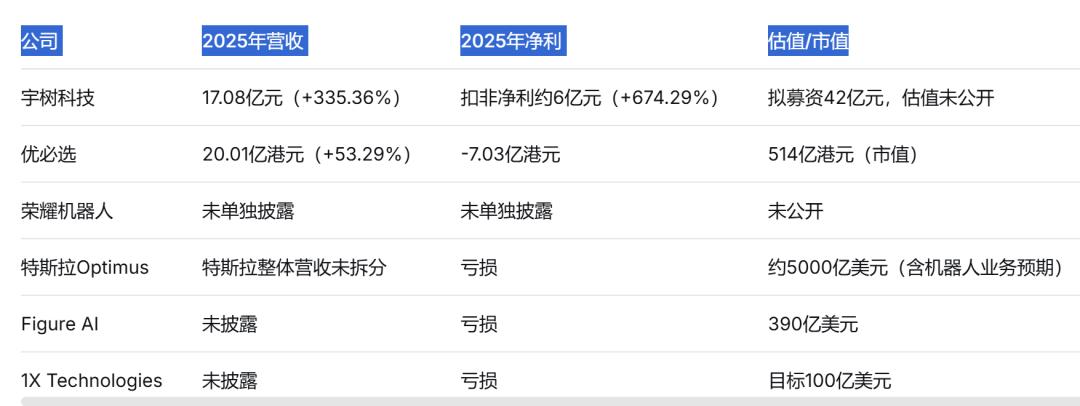
Data source: public query
A harsh commonality: except for Unitree and Ubtech, which have actual sales of humanoid robots, most players are still in the "not mass - produced" or "not disclosed" stage.
A report from Morgan Stanley pointed out sharply that in many "large - scale orders" high - profilely announced by manufacturers, a considerable part are framework agreements or intention orders, not definite and irrevocable purchase contracts. There is still a long way to go from "telling stories" to "real delivery".
Another signal worthy of vigilance is capital efficiency. Taking FigureAI as an example, its valuation of 39 billion US dollars corresponds to zero mass production, zero revenue, and continuous losses. This valuation logic is based on the grand narrative that "humanoid robots will be as popular as smartphones". However, if the mass production is postponed again in 2026, or the failure rate of the first - batch products is extremely high, the patience of the capital market may be much more fragile than expected.
Let's go back to the 21.0975 - kilometer track in Yizhuang.
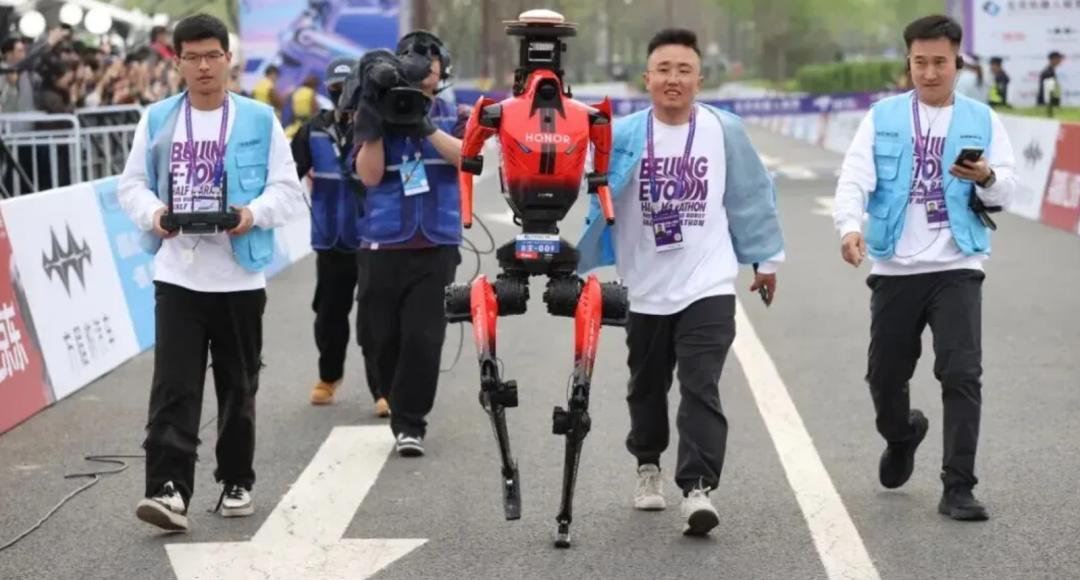
This year's track is much more difficult than last year's: continuous uphill and downhill slopes, nearly 90 - degree right - angle turns, and more than 10 types of road environments. Nearly 40% of the teams chose the autonomous navigation mode, allowing the robots to judge the route and adjust their gaits by themselves. This setting is not to make things difficult for the robots but to push them from the "performance mode" into the "actual combat mode".
The development of the robot industry is like a marathon, requiring long - term investment and continuous iteration. It took one year to go from 2 hours and 40 minutes to 50 minutes and 26 seconds. Then, how long will it take to go from 50 minutes and 26 seconds to truly enter thousands of households?
No one can give a definite answer. But "Lightning" on the track has given a clear signal: robots have achieved a milestone breakthrough in the field of long - distance high - speed movement. The next challenge is no longer about running fast but about running stably, running for a long time, and entering real - life scenarios.
03 Don't be carried away by the "half - marathon champion"
The result of 50 minutes and 26 seconds is indeed amazing, but you have to think about a question: why is it Glory, a mobile phone manufacturer, instead of those start - up companies specializing in humanoid robots?
The answer may be a bit cruel. The biggest bottleneck in this industry at present is not the algorithm, nor the motor, but the engineering ability.
Another signal worthy of vigilance is the capital bubble. More than 50 billion yuan of funds poured in 2025, and a single - round financing is often several billion yuan. However, the number of companies that can actually mass - produce, have revenue, and have customers can be counted on the fingers of two hands. Humanoid robots are not like large - scale models, and there is no such thing as the "violent aesthetics of brute force". It requires screwing each screw and polishing each scenario. Capital can accelerate, but it cannot replace.
Finally, let's be honest: don't be carried away by the "half - marathon champion".
The marathon track is an ideal environment carefully designed, while the real world is full of uncertainties, such as stairs, narrow doors, slippery floors, children's toys, and pet feces. For humanoid robots to truly enter families and factories, they need not to run fast but to make no mistakes.
From this perspective, the championship of "Lightning" is more like a starting point than an end point.
Whoever can run through the first commercial closed - loop before 2027 will be the real winner.
Stay calm and keep moving forward.
This article is from the WeChat official account "Investment Banking Circle", author: Investment Researcher. Republished by 36Kr with permission.