36Kr Exclusive | The first to introduce the "doll + host" model, a multi-agent children's AI toy brand secures tens of millions of yuan in financing
Author | Qiao Yujie
Editor | Yuan Silai
Yingke learned that Beijing Lingji Tianci Technology Co., Ltd. (hereinafter referred to as "Lingji Tianci") completed two rounds of financing worth tens of millions of RMB in the past year. The angel round was led by Delian Capital, with Xiaokonglong Fund and Ruisheng Fund participating. The Pre - A round was led by Implic Capital. Both rounds of financing were advised by Tanqi Capital as the company's exclusive financial advisor.
Yang Bing, the CEO of Lingji Tianci, has long been engaged in the definition and operation of children's content and intelligent hardware products. When interviewed by Yingke, Yang Bing said, "In the AI era, the product concept of letting children directly chat with a virtual character is actually hard to work. Children can't quickly establish a real physical connection with a purely virtual character. Only when the world view, character settings, and scenarios are all constructed can there be a possibility of communication."
To achieve this "credible interaction", the brand "Jollybubu" under Lingji Tianci pioneered an intelligent hardware interaction system of "host + doll".
Each Jolly physical doll corresponds to an independent intelligent agent (Agent), with its own world view, knowledge base, and personality model. When a child places the doll on the host base, the story content of the corresponding character can be activated, and the child can interrupt, ask questions at any time, and have a role - based interactive dialogue with the doll. Meanwhile, the host bubu is more like the center of the whole system, continuously accumulating the child's questions, exploration paths, and interaction preferences, and then realizing personalized guidance.
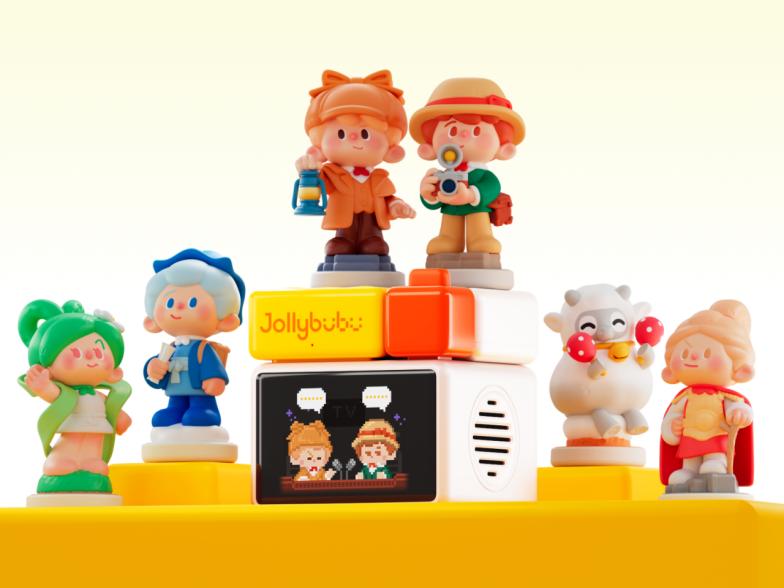
(Image source/Enterprise)
Based on the built - in world view and knowledge base, each physical doll represents a way of thinking and a subject direction. Yang Bing introduced, "We found that when a child asks a question, such as 'Why is the sky blue?', they don't necessarily want a scientific answer. So our dolls will also give various different answers according to their own world views and context, which may be artistic, literary, or scientific." When children use different dolls to ask questions and interact, they are also constantly expanding their cognitive paths and ways of expression.
To achieve this effect, technically, each doll is an independent intelligent agent, supported by speech recognition (ASR), speech synthesis (TTS), character voice system, and large - model capabilities. Since a single interaction may involve continuous responses and collaboration of multiple characters, the background system needs to handle the low - latency linkage between multiple intelligent agents simultaneously and maintain the distinct personality characteristics of different characters in a stable output.
"This is a system that we independently explored and developed," Yang Bing explained. "It's very difficult to control the overall latency to a level close to that of a single - round large - model dialogue when switching and interacting among multiple characters, and at the same time, to keep each character's distinct and stable personality."
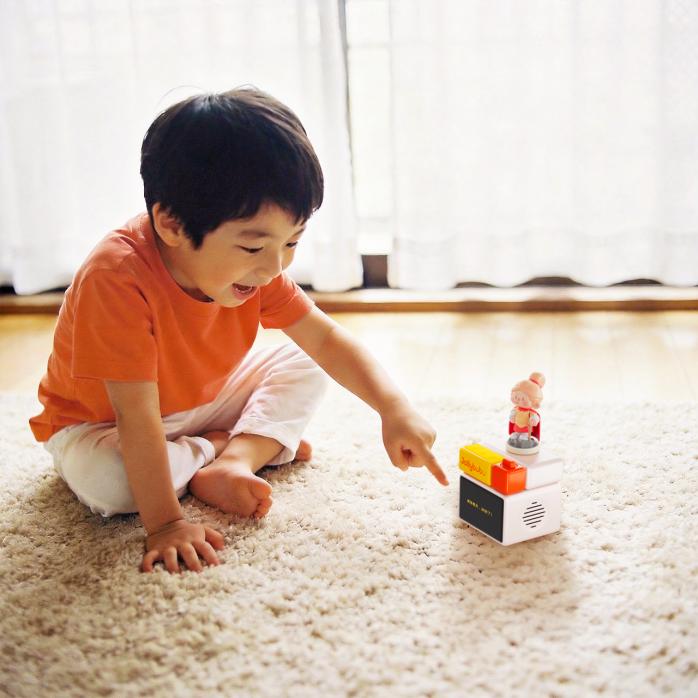
(Image source/Enterprise)
Further differentiation lies in that this system is not just for "chatting companionship".
By placing two dolls, children can actively let them debate based on different world views or endow them with skills to fight against each other. "In the AI era, output is as important as input," Yang Bing said. "What we want to create is a partner system that can discover children's talents and help them grow, rather than just a chatting tool. Obtaining information is not the only important ability. Expression, questioning, debating, and co - creation are also crucial."
In addition to hardware, Lingji Tianci has also developed a supporting mini - program. The child's interaction data (such as memory, emotions, operations, etc.) will be transformed into a virtual pet that is constantly growing and changing. The home page of the mini - program is the display interface of the pet. The dynamic "mind map" will record the topics that the child has shown sensitivity and interest in recently, providing parents with a "thermometer" to understand their children's emotions and a more intuitive window to observe their children's phased interest changes.
In terms of business model, Lingji Tianci chooses to focus on hardware sales and does not use subscription fees as the core threshold. Compared with continuous subscriptions, the team is more optimistic about establishing a repurchase mechanism through the continuous expansion of new dolls, new characters, and new content.
In the long run, Lingji Tianci hopes to build a "symbiotic AI intelligent agent ecosystem". The company will not only provide original IPs and cooperative IPs but also open a co - creation mechanism, allowing parents, children, KOCs, and even B - side copyright holders (such as book content) to distribute and train their own IPs through its platform. "We encourage children to become co - creators,"
Yang Bing said, "They can find their own IPs and content, combine them with our system through 3D printing for training. Let the dolls not only be hardware that carries content but also become an entrance for continuously growing characters."
It is understood that Jollybubu will be officially launched at the end of May this year.
The following is an excerpt from the interview:
Yingke: Why must you make physical dolls?
Yang Bing: Different IPs represent children in different relationships - with themselves, with society, with nature, with the future, and with the world. We have materialized the originally boring and abstract relationships into physical dolls that children can really hold in their hands. Without a complete content setting, character relationships, and a physicalized scenario, it is difficult for children to truly engage with and continuously use such a product. Many products only have a dialogue function, which is the main reason why they are difficult to be continuously used by children.
Yingke: How to solve the problem of children's "long - term retention" in using the product?
Yang Bing: First of all, we are not creating a chatting tool but a "partner tool". Every time a child buys a new doll, they expand into a new knowledge field - mythology, detective stories, nature... Each doll has a stable personality setting, way of expression, and value orientation. The pet on the host is more like the central companion of the whole system, which will gradually grow and evolve with the child's interaction. Children will find that they are growing together with this system, the knowledge base is constantly expanding, and the pet will also change and grow with the interaction data. Secondly, we encourage children to become co - creators. They can create their own IP content and even combine it with our system through 3D printing for training. The addition of a new doll means the start of new gameplay, new tasks, and new social chains. When children can become part of this story world, retention will naturally occur.