35 billion, the fastest IPO of the six rising stars in Hangzhou is born.
The first IPO has emerged among the "Six Young Dragons of Hangzhou."
Today (April 17th), Manycore Tech officially listed on the Hong Kong Stock Exchange, becoming the "world's first stock in spatial intelligence." In this IPO, Manycore Tech issued shares at a price of HK$7.62 per share, and its stock price soared by over 170% at the opening, with its market value reaching HK$35 billion at one point. At the listing ceremony, Paul Chan Mo-po, the Financial Secretary of the Hong Kong Special Administrative Region Government, and Luanne Chan, the Chief Executive Officer of the Hong Kong Stock Exchange, were present.
This is a 15-year-long entrepreneurial journey: In 2011, Huang Xiaohuang, Chen Hang, and Zhu Hao, who met on campus, returned to China to start a business with a GPU physical rendering demo. Soon, they created a national-level spatial design tool, "Kujiale." However, Manycore didn't stop there. The team successfully positioned itself at the forefront of the AI-driven spatial intelligence track and became well-known as one of the "Six Young Dragons of Hangzhou."
Witnessing today's listing ceremony, Mao Chengyu, the founding managing partner of Yunqi Partners, had a lot of feelings. The outside world may not know that he met these three founders as early as 13 years ago and thus became the first institutional investor in Manycore Tech. In the following more than a decade, the Manycore team went through numerous challenges, and the investors behind them accompanied them all the way, creating another wonderful case of mutual success in the venture capital circle.
Just now, the "Three Musketeers" of alumni rang the bell together
Unveiling the investment story
In Mao Chengyu's memory, the bond between the two parties dates back to the Spring Festival in 2013.
At that time, the three founders of Manycore Tech - Huang Xiaohuang, Chen Hang, and Zhu Hao - were still a group of tech geeks who had just returned from Silicon Valley and were a bit lost in the wave of the mobile Internet. Their experiences were remarkable:
Huang Xiaohuang (Chairman) and Chen Hang (CEO) graduated from the Zhu Kezhen College of Zhejiang University. They were not only classmates in the class of 2003 but also roommates. They loved having "bedside talks" to discuss technological development during their college years. Zhu Hao (CTO) graduated from Tsinghua University and later went abroad for further studies. They met on the campus of the University of Illinois at Urbana-Champaign (UIUC). Before starting the business, the three of them had worked at NVIDIA, Microsoft, Amazon, etc.
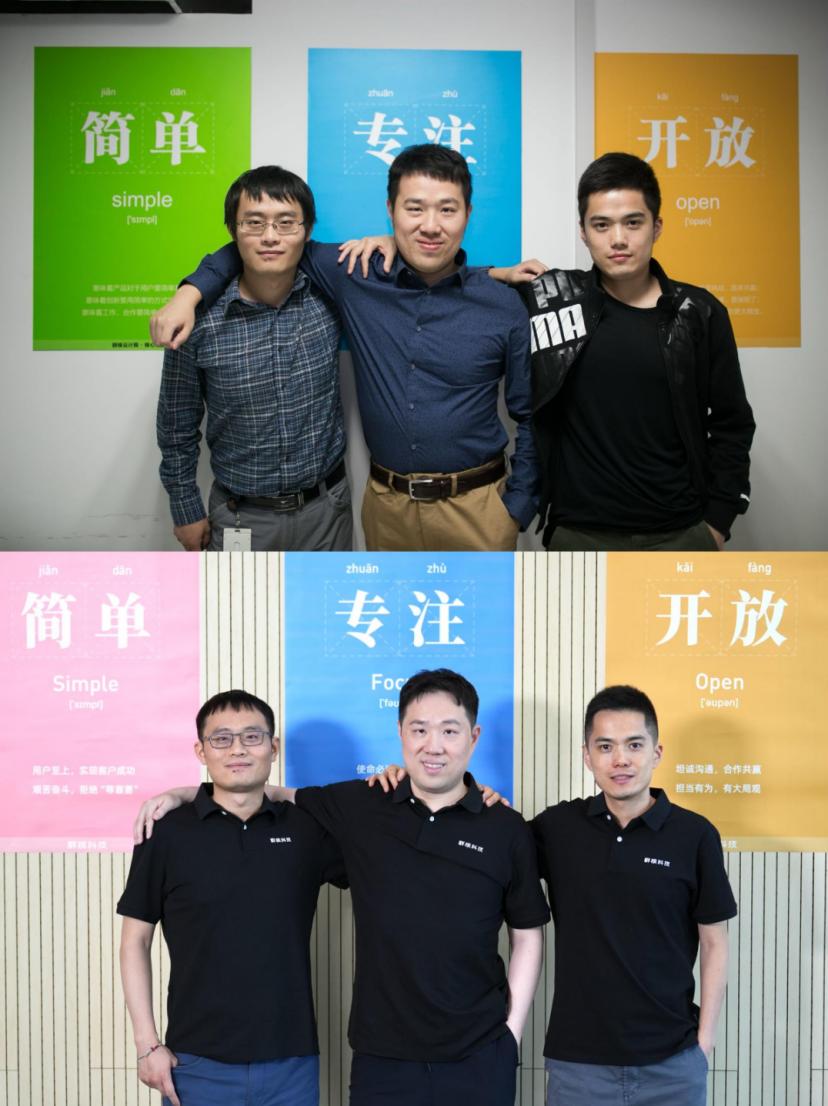
Early and recent group photos of the founding team of Manycore Tech (with a time span of about 10 years). Zhu Hao, Huang Xiaohuang, Chen Hang (from left to right)
During this period, they keenly perceived the huge potential of GPU cloud rendering. In 2011, this field was almost blank in China. With the belief of "moving the GPU to the cloud and doing something that no one else has done," the three of them gave up their high-paying jobs in Silicon Valley. Huang Xiaohuang even sold his NVIDIA stocks to raise 400,000 yuan as startup capital. They borrowed an office from a teacher at Zhejiang University and officially founded Manycore Tech. Huang Xiaohuang once said, "We are not just copying from the West to China. Instead, we are using new products to replace the traditional ones. This is a process from 0 to 1."
In the early days of the startup, the team focused on tackling the underlying technology. They used low-cost graphics cards to form a high-performance GPU cluster with end-cloud collaboration, significantly reducing the computing power cost. However, the financing of Manycore Tech was very difficult throughout 2012. "Huang Xiaohuang met more than 30 investors, but no institution was willing to invest." Later, Wang Huai, an alumnus of Zhejiang University, made the first angel investment in his personal capacity.
It wasn't until they met Mao Chengyu that he, as a partner at that time, represented IDG Capital and expressed the first institutional investment intention. The scene at that time is still vivid in memory: In that borrowed office, Mao Chengyu met the three founders of Manycore for the first time. Huang Xiaohuang showed him an iPad demo, a prototype for graphic computing based on a cloud-based GPU cluster. At that time, there were not many people in China who really understood GPUs. Later, Huang Xiaohuang recalled, "At least when we mentioned GPUs, Michael (Mao Chengyu) knew what we were talking about. That was already a pleasant surprise."
Finally, with the promotion of Mao Chengyu, Manycore Tech completed its first institutional round of financing. In November 2013, Kujiale, the core product of Manycore, a spatial design software, was officially launched. It could generate high-definition renderings in 10 seconds, and the renderings were "physically correct," consistent with real lighting and shadows, achieving the domestic substitution of industrial-grade CAD software. This disruptive experience quickly attracted millions of designers to the platform, making it an instant hit.
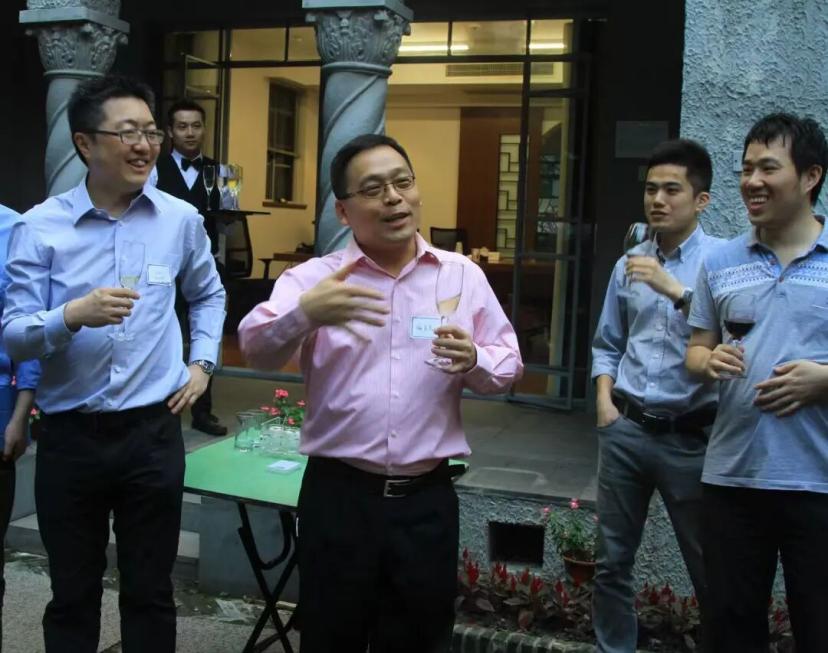
At the opening BBQ of Yunqi Courtyard in 2014. Mao Chengyu, Huang Yubin, Chen Hang, Huang Xiaohuang (from left to right)
In July 2014, Mao Chengyu founded Yunqi Partners. His connection with Manycore became deeper - Yunqi immediately participated in the Series B financing of Manycore Tech. Against the background that the first-phase fund had not been officially closed at that time, Mao Chengyu and Huang Yubin, who founded Yunqi together, advanced funds to participate in the Series B financing. Two of their good friends, Fu Jixun from GGV Capital and Xu Chuansheng from Matrix Partners, also participated in this round of investment. Since then, Yunqi Partners has participated in multiple follow-on investments.
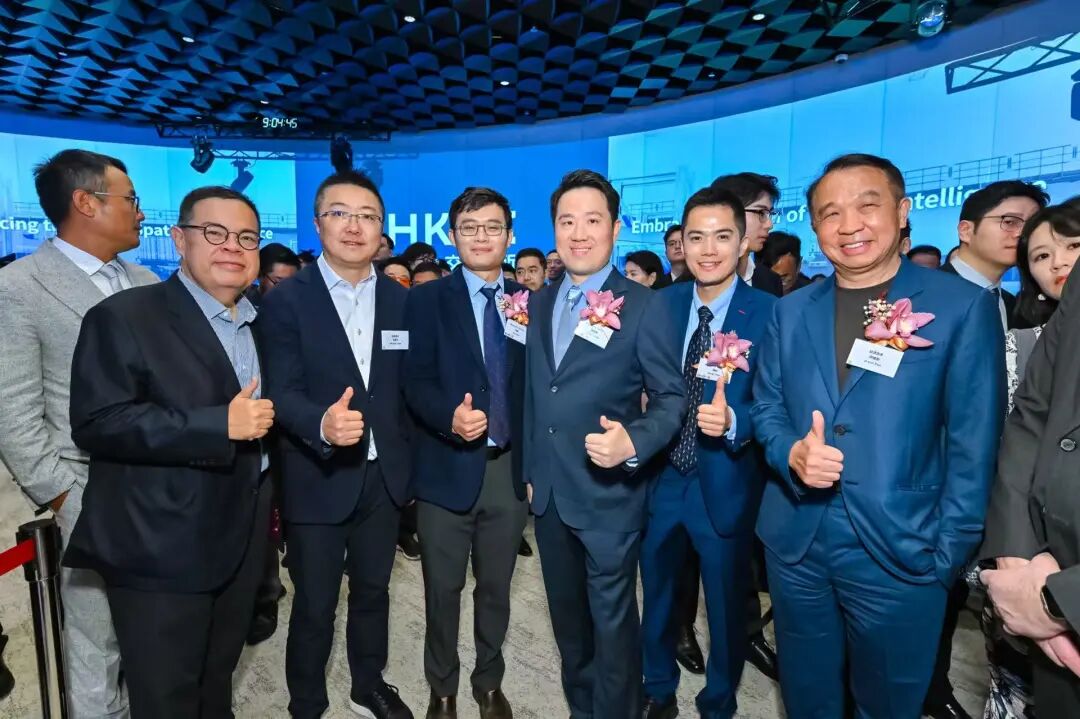
At the listing ceremony on the Hong Kong Stock Exchange. Xu Chuansheng, Mao Chengyu, Zhu Hao, Huang Xiaohuang, Chen Hang, Fu Jixun
In the impression of the Manycore team, Mao Chengyu is not only an investor but also a strategic advisor. Zhu Hao once recalled an incident at the Annual General Meeting (AGM) of Yunqi Partners: At first, the Manycore team planned not to develop products but mainly focus on technology output. However, after a in-depth conversation with Mao Chengyu, the three of them changed their minds. Later, when having breakfast with Mao Chengyu, they discussed changing the name of the original product from "Painter" to "Kujiale."
With the arrival of the Industry 4.0 era, since 2016, Manycore Tech has started to try to connect the entire chain from design and rendering to backend production, helping traditional factories upgrade their flexible production lines. In 2018, the company officially launched its international brand COOHOM, providing 3D cloud design software and rendering services for global home furnishing retailers, manufacturers, and interior designers.
Facing the rapid growth of Kujiale, many Internet giants and industrial players extended olive branches to Manycore Tech. Mao Chengyu and other investors conducted multiple scenario analyses with the founding team. Finally, for the sake of business autonomy, the company decided to reject strategic investments and maintain independent development.
Today, Kujiale and its overseas version COOHOM have grown into the world's largest spatial design platform, serving more than 200 countries and regions around the world. However, as time goes by, Kujiale alone can no longer fully represent Manycore Tech.
The Six Young Dragons of Hangzhou
The first IPO with a market value of HK$35 billion
Manycore Tech is the first of the "Six Young Dragons of Hangzhou" to successfully ring the listing bell. As is well known, the Six Young Dragons of Hangzhou are typical examples of new-quality productivity. Through long-term technological accumulation and collective breakthroughs, they demonstrate the power of China's cutting-edge technology.
Just as Manycore Tech didn't stop at home design, it has been deeply exploring the simulation of physical spaces through GPU acceleration. Since 2018, Manycore Tech has started in-depth exploration of spatial intelligence technology and applications. In 2024, it officially launched the new-generation spatial intelligence solution, SpatialVerse, providing synthetic data training and spatial cognitive capabilities for enterprises and research institutions in cutting-edge fields such as AIGC large models, embodied intelligence, and XR.
From meeting the needs of spatial design, to providing simulation training data for intelligent agents (SpatialVerse), and then to releasing spatial large models and opening up underlying spatial intelligence capabilities, Manycore Tech has successfully entered NVIDIA's territory and become an important player in the field of physical AI. It positions itself as the "water seller" in spatial intelligence, providing underlying infrastructure for the industry and building a digital foundation for AI to enter the physical world.
In Huang Xiaohuang's words, describing Manycore Tech as a home SaaS company is the biggest misunderstanding of the company.
In 2025, Manycore Tech clearly defined its three core layouts of "spatial editing tools - spatial data - spatial large models" and built a "spatial intelligence" flywheel system. It also open-sourced the spatial understanding models SpatialLM, SpatialGen, and InteriorGS to jointly build a spatial intelligence ecosystem. At the end of the year, Manycore further launched the Aholo Spatial Intelligence Open Platform at the "Kujia+ Conference," systematically opening up the underlying spatial capabilities that the company has continuously accumulated since its establishment, including spatial reconstruction, spatial generation, spatial editing, and spatial reasoning capabilities, and making them available to all industries in the form of underlying infrastructure.
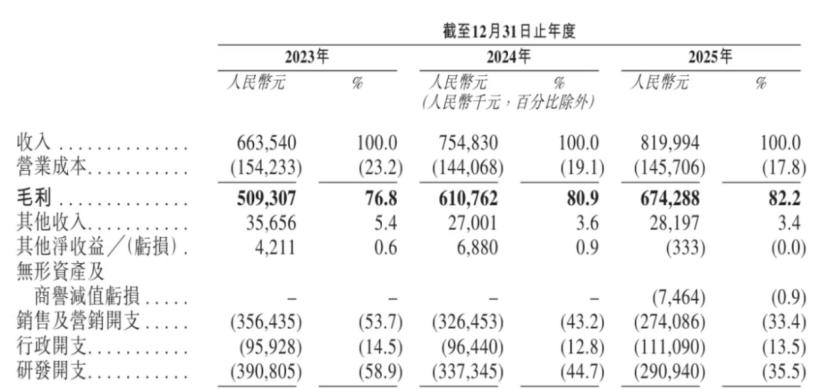
In recent years, the company's revenue has been continuously growing. In 2025, its revenue reached 820 million yuan, turning a profit. Its overseas business revenue increased by 28% year-on-year, with a gross profit of 674 million yuan and a gross profit margin of 82.2%.
According to Frost & Sullivan, in China, in terms of revenue in 2024, Kujiale is already the largest spatial design software provider in the country, occupying a dominant position in the industry. In addition, Manycore Tech has established strategic partnerships with leading enterprises in various industries such as Zhipu Robotics, Galaxy Universal, PICO, Hesai Technology, Hangcha Group, Huace Film & TV, and Ausun E-commerce, supporting the application of spatial intelligence in fields such as interior design, e-commerce, embodied intelligence, film and television, and XR.
Along the way, in addition to Yunqi Partners, the shareholders of Manycore Tech also include IDG Capital, GGV Capital, Matrix Partners, Shunwei Capital, Hillhouse Capital, Coatue, Hearst, Pavilion Capital, Linear Capital, etc. After a long period of companionship, everyone has finally welcomed the harvest season.
Yunqi's harvest season: Two consecutive technology IPOs
The harvest season has quietly arrived.
This is the twelfth year for Yunqi Partners. As one of the first funds in the VC 2.0 era in China to focus on early-stage investments in digitalization and hard technology, the team has invested in more than 200 technology startups so far.
Since this year, Yunqi Partners has successively witnessed IPOs. Remember on January 9th, the large model company MiniMax officially listed on the Hong Kong Stock Exchange, and its market value exceeded HK$100 billion after the opening. Subsequently, MiniMax's continuously rising stock price became a benchmark in the industry, and its market value once exceeded HK$400 billion.
When MiniMax was just starting out, it received angel round investments from Mihoyo, Hillhouse Capital, IDG Capital, and Yunqi Partners. Among them, Yunqi Partners participated in six consecutive rounds of investment, creating a wonderful case of patience and confidence.
With the successful IPO of Manycore Tech on the Hong Kong Stock Exchange today, Yunqi's IPO map is gradually unfolding. In addition to MiniMax, Transworld Logistics and Defeng Technology have submitted listing applications to the Hong Kong Stock Exchange; Anlan Wanjin has started the listing guidance process; and more than a dozen other companies are preparing for listing. For many of these companies, Yunqi Partners made investments in the angel round or at an early stage and participated in multiple follow-on investments.
This is also the impression that Yunqi Partners leaves on its peers: deeply involved in technology, leading early-stage investments, and participating in multiple follow-on investments.
In Yunqi's view, the value creation in the next decade will come more from the structural opportunities brought about by a new round of intelligent revolution and the upgrading of underlying capabilities. Against a broader background, on the one hand, the global technological competition and industrial competition are intensifying, and the self-sufficiency and controllability of "underlying technology + energy" have become a necessity; on the other hand, general artificial intelligence is pushing the Fourth Industrial Revolution to a new turning point, and the country is also continuously emphasizing the development of new-quality productivity and intelligent economy. Therefore, Yunqi has gradually formed a layout logic of "core layer - expansion layer - future layer."
Among them, the core layer focuses on the AI foundation and AI applications. The former includes basic capabilities such as multi-modal large models, edge models, and world models, while the latter extends to rich scenarios such as embodied intelligence, intelligent driving, AIoT, AI for Science, and AI application software. To some extent, Manycore Tech is a typical example of this logic. It started from spatial design and continuously extended to spatial data, spatial large models, spatial simulation, and industrial AI twins. It not only has the attributes of underlying technology but also has penetrated into real industrial scenarios.
In addition, Yunqi also sets its sights on the expansion layer, which is the "intelligent new infrastructure" that supports the continuous evolution of the intelligent era. In Yunqi's view, AI brings not only software and application opportunities but also drives the iteration and expansion of key infrastructures such as computing power and connectivity, advanced semiconductor manufacturing, and energy from the demand side. This is not simply "transforming industries with AI," but the AI revolution itself is giving rise to new underlying demands and further driving broader industrial upgrading opportunities.
Looking further ahead, Yunqi is also actively paying attention to and laying out the future layer, including long-term future technology directions such as commercial space, nuclear energy, quantum computing, and brain-computer interfaces. These fields are still in the early stage today, but in the larger context of the intelligent era, they are expected to become an important part of the next round of technological leap and have a deeper interaction with artificial intelligence in the future.
The more forward-looking the layout, the earlier the perception of scientific research trends is needed. For this reason, Yunqi strengthens cooperation with universities to build a network for discovering cutting-edge technologies. For example, it jointly launched the "Jiao Da - Yunqi AI Angel Fund" with Shanghai Jiao Tong University and is participating in the entire process from scientific research to industrialization of technologies. It not only focuses on technological breakthroughs but also pays attention to the research and talent systems, systematically supporting the industrial transformation of university scientific research achievements.
Behind the implementation of the investment framework and the layout of the cutting-edge technology discovery network is the continuously growing Yunqi team. Since this year, Chen Yu has been promoted to a managing partner, and the young generation of in-house trained investors has gradually matured. At the same time, Yunqi is also continuously introducing professional forces with both industrial backgrounds and capital market experience in some key fields to further strengthen its research and layout in areas such as aerospace, embodied intelligence.