This WeChat Moments post exposes the flaws in the robotics industry.
In the past two days, I saw a post on Moments that really resonated with me.
Zhao Tongyang, the founder of Zhongqing Robotics, said: "Robotics is so popular that half of my time is taken up by clients and business trips, diluting my energy for product refinement."
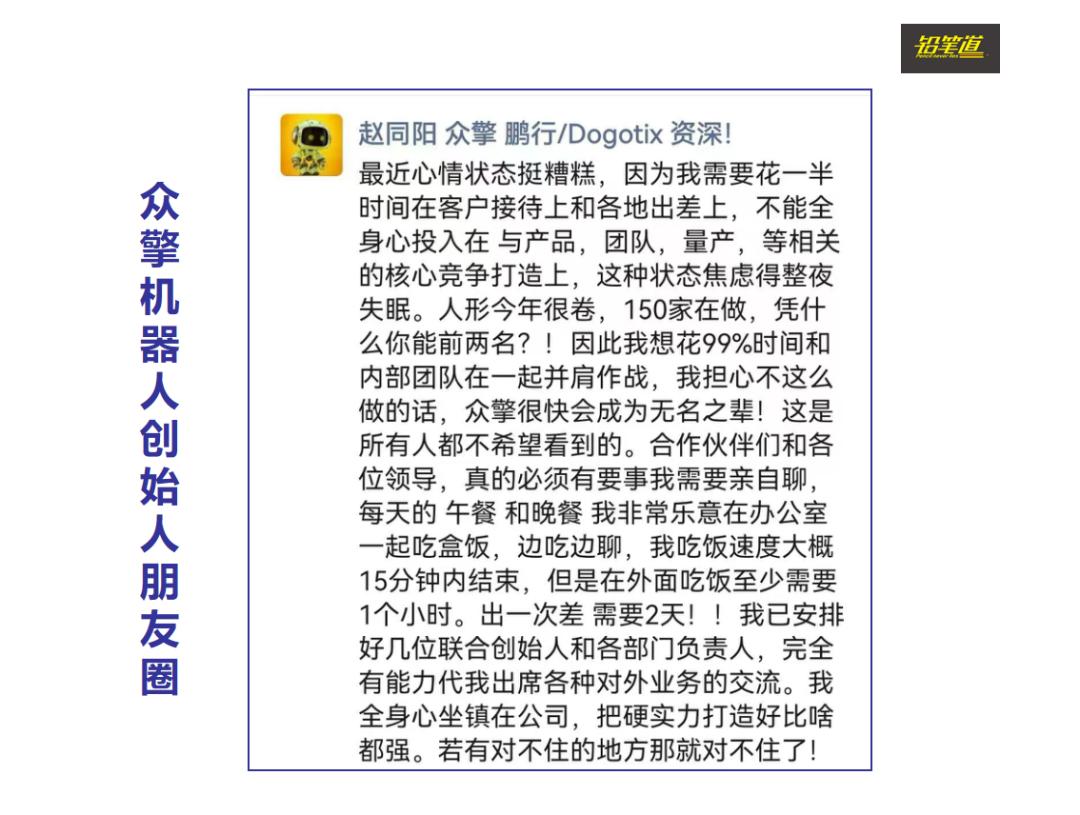
After reading it, I had two feelings.
1. The humanoid robot industry is being overly disturbed.
Especially the leading companies, such as Zhongqing Robotics. Recently, it raised $200 million in financing, and its post - investment valuation exceeded 10 billion RMB, attracting a lot of attention.
2. It serves as a wake - up call for the industry.
All things that contribute to the strength of the product should be the top priority. For all things that distract you, no matter how important they seem, you need to exercise restraint.
The most important thing for a company: Ensure the strongest product power
How popular are humanoid robots this year?
According to IT Juzi data, in the first quarter of this year, there were more than 50 disclosed financings in the domestic embodied intelligence track, with a cumulative amount of about 20 billion RMB, a year - on - year increase of nearly 60%, hitting a record high.
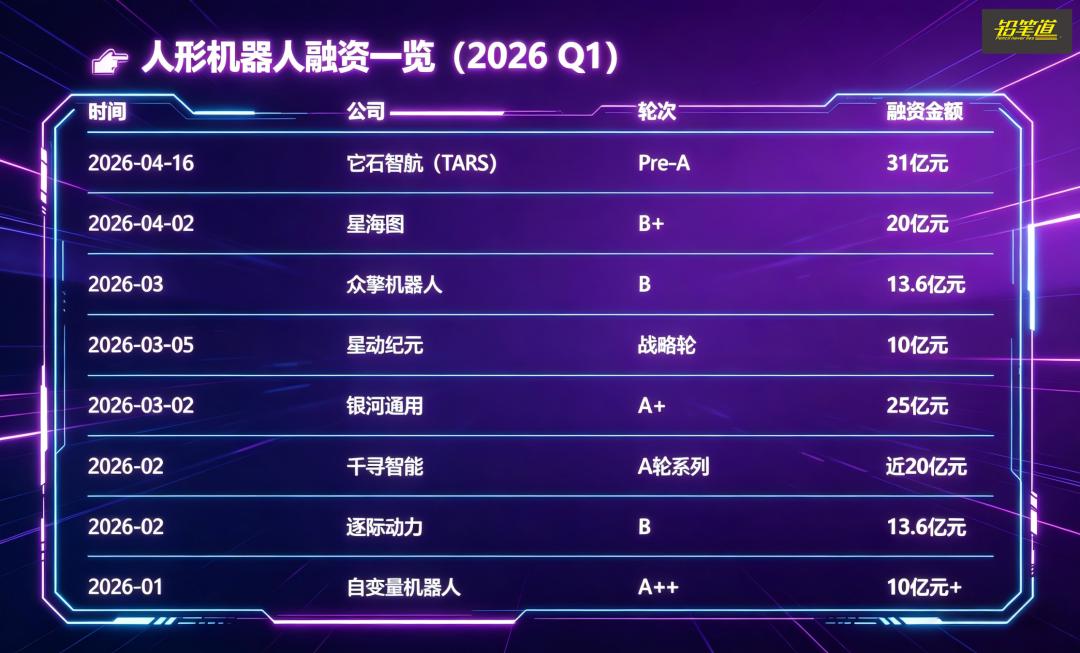
Capital, clients, the government, and even our media are all eyeing this track.
If you are a "leading company", everyone will come to you: clients want to discuss cooperation, investors want to talk about financing, the government wants to discuss implementation, the media wants to conduct interviews, and partners want to "co - build an ecosystem".
Everyone has good intentions and wants to contribute to the industry, and it all sounds like good things.
But the problem is - for entrepreneurs, hardly any of these things can directly enhance product power.
Are they important? Yes. But are they the most important? Not necessarily.
What is the most important thing for a company? Always keep your product power at its strongest.
Why? Only when your product power is the strongest will clients choose you first, and you will have revenue; only then will investors give you money, and the best talents will flock to you.
If you fail to achieve this, talking about other things is meaningless. After 10 years of entrepreneurship, this is the most profound lesson I've learned.
The industry is in a sprint phase: Zero tolerance for errors
What stage is the humanoid robot industry in now? It's a crucial competitive window period.
If we use a more vivid analogy: it's like the last three months before the college entrance examination or the last 2 - 3 seconds of a 100 - meter race.
This stage has a characteristic: the margin for error is very small.
Even if you are half a step ahead now, a small mistake will cause you to be overtaken. And once you fall behind, you'll keep falling behind.
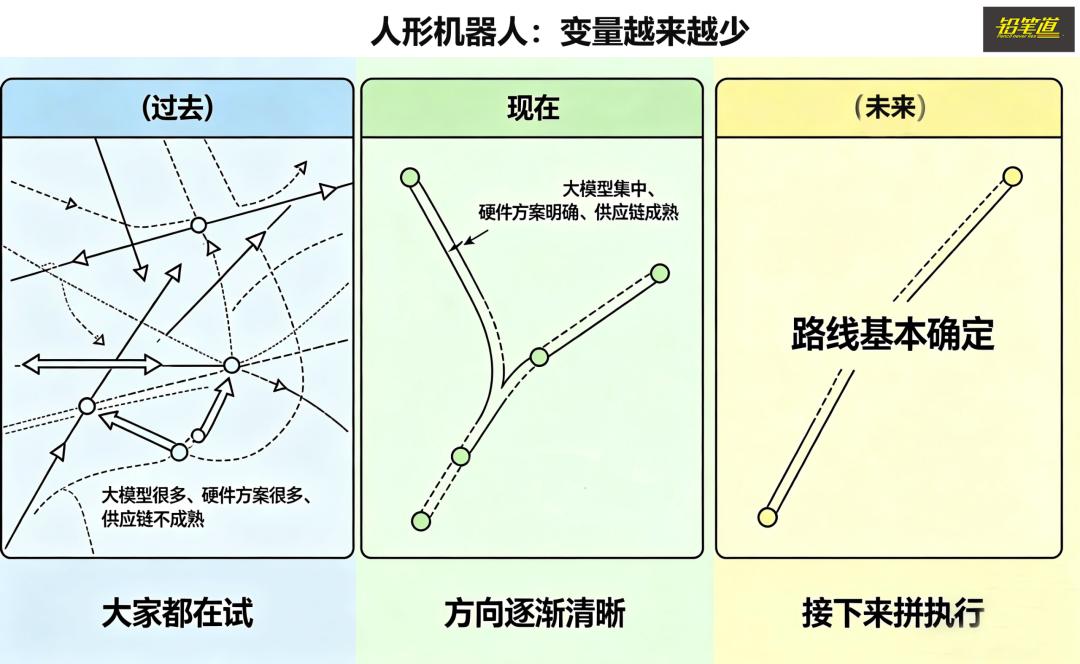
Why? Because several core variables in this industry have been basically determined: the capabilities of large models are converging (OpenAI, Google, Anthropic, etc.), the hardware roadmap is gradually becoming clear (motors, reducers, sensors), and the supply chain is maturing rapidly.
What really determines the outcome are two things: engineering capabilities + product refinement capabilities.
There is no shortcut for these two things. Take Unitree Robotics as an example. Many people think it emerged overnight, but in fact, it was founded in 2016 and has been doing hard, tiring, and dirty work for 10 years.
Don't blindly look for people, money, and directions
Many people say: The most important things for a founder are to find people, find money, and find directions.
This statement is true, but it only tells half of the story. In fact, these three actions should have clear triggering conditions.
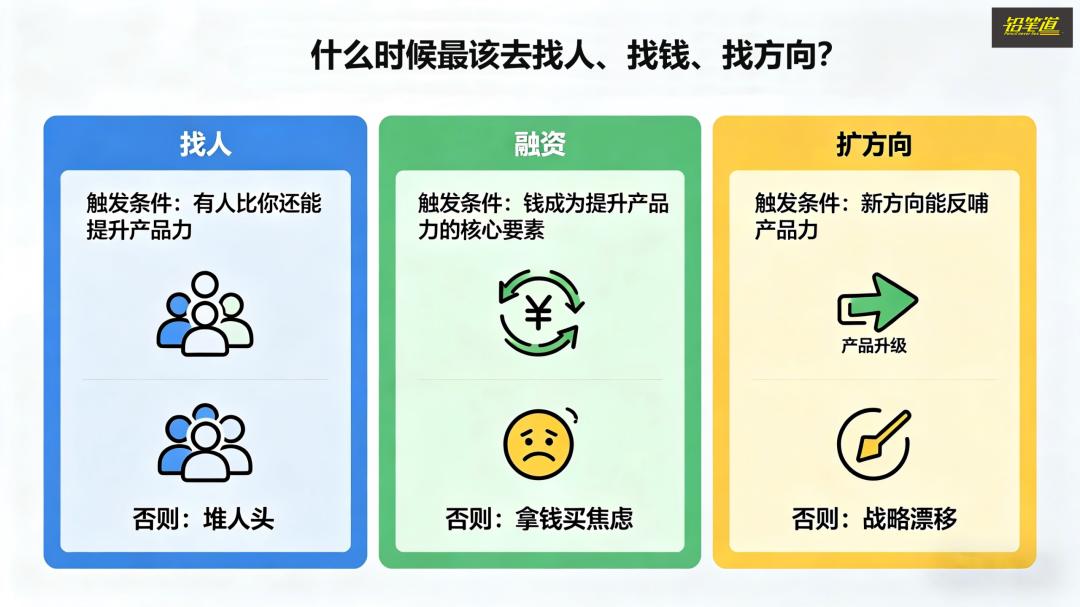
1. When should you look for people?
When you find that someone can enhance product power more than you can, then go and find that person; otherwise, it's just increasing the headcount.
2. When should you raise funds?
When you find that money has become a core factor in enhancing product power, then go and raise funds. Otherwise, you're just buying anxiety with money.
3. When should you expand your directions?
When you find that a new direction can feed back into product power, then go and explore that direction. Otherwise, it's a strategic drift.
I've seen many companies that were very strong when they were small but started to become mediocre once they expanded. Why? The founders got distracted by other things, and the product power was no longer leading, and the company was on the verge of collapse.
In a nutshell: All actions of the founder should be aimed at "making the product stronger". Otherwise, it's just ineffective effort.
Big but not strong is dangerous
The path for a company to grow big and strong should be to become strong first and then grow big. Now, many humanoid robot companies may be doing the opposite.
They have a lot of money, a large team, and a wide - spread business: technology, products, scenarios, ecosystems, and capital, all in one go.
It seems aggressive, but upon closer inspection, it's a bit dangerous.
It's like skiing. If you can't even ski well on the beginner's slope, then you're trying to go on the professional slope; if you haven't even learned the piano well, then you're eager to learn the erhu.
The question is: Where is your product power "strong"? Is it the strongest algorithm, the most stable control system, the optimal cost structure, or the most mature scenario implementation ability?
If these aspects haven't been well - built in the long run, the more you do, the greater the risk. Because: scale will magnify all problems.
Now, I see some humanoid robot companies with a lot of ambitions:
They are working on underlying technologies (models, control, perception) on one hand, on whole - machine products (humanoid robot bodies) on the other hand, and expanding scenarios (industry, exhibition halls, services) at the same time. They are also opening experience spaces, building ecosystems, and even setting up funds and making investments.
For example, Zhipu Robotics set up several equity funds (including direct investment) to layout upstream and downstream sectors such as sensors, actuators, and embodied models while still in the process of continuous financing.
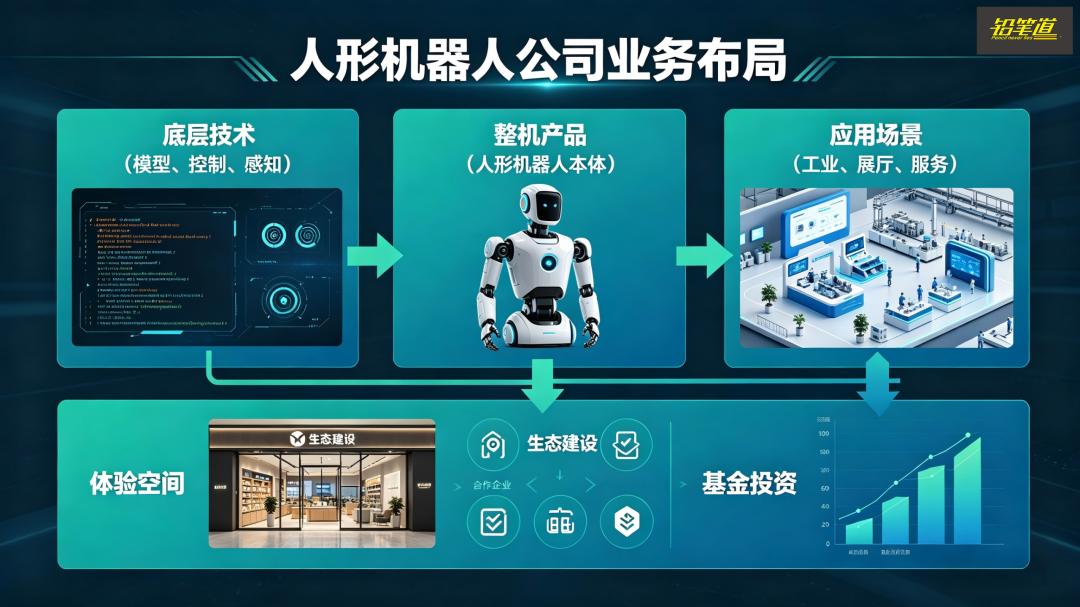
These actions themselves are not wrong. In fact, they can even be considered "standard", but it depends on when to do them: should you become strong first and then grow big, or grow big first and then become strong?
Capital can easily make people overconfident
Why does this situation occur? A very real reason is: there's too much money.
In the past year, the humanoid robot track has seen very intensive financing: Figure AI overseas raised hundreds of millions of dollars in a single round; many domestic companies completed multiple rounds of financing within 3 - 6 months, with the amount often reaching hundreds of millions or even billions of RMB.
While the enthusiasm of capital is a good thing, it also has a side effect: it makes companies have the illusion that they "can do many things at the same time".
We must clearly recognize that many resources do not entirely come from capabilities but from the dividends of the era. When the trend is in your favor, it's easy to get money; but after the trend passes, all that matters is product power.
If you don't focus on building product power at this time, as the trend fades, your chances of survival will become fewer and fewer.
I now have a vague judgment: Companies that "try to do everything" are more likely to fall behind.
The reason is simple: There is no shortage of smart people in this industry. There are a lot of Ph.D.s from Tsinghua and Peking Universities, people with backgrounds from big companies, and people from top overseas laboratories. Why do you think all the opportunities are yours?
If you are a little ahead today, others can catch up quickly; once you get distracted, you'll be overtaken.
In this kind of environment: The only way out is to achieve excellence in one area and then gradually expand, becoming strong first and then growing big.
Conclusion
Going back to that Moments post: What impressed me the most was not its "directness" but its "restraint".
In an environment where everyone is pushing you to grow bigger, he is still thinking about one thing: Have I made the product perfect?
This is very difficult. But only this thing truly determines life and death.
So, I want to tell all readers: All things that contribute to the strength of the product are of top priority. For all things that distract you, no matter how important they are, you need to exercise restraint.
This article does not constitute any investment advice.
This article is from the WeChat official account “Pencil News” (ID: pencilnews), written by Wang Fang, and published by 36Kr with authorization.