NPO, CPO, or XPO: Who Will Hold the Reins of Future Data Centers?
The explosive growth of AI computing power demand is driving the rapid evolution of the internal interconnection bandwidth in data centers from 800G to 1.6T and 3.2T. Traditional pluggable optical modules have approached the physical limits in terms of power consumption control and signal integrity. New technologies such as NPO (Near-Package Optics) and CPO (Co-Packaged Optics) have emerged as a result. As the two major technological routes for the next generation of optical interconnection, they have attracted extensive attention from the global industry.
The report "Photonics Packaging Heads Toward a $14.4 Billion Market by 2031" released by Yole Group on March 17 predicts that driven by strong demand from scenarios such as AI data centers and high-performance computing (HPC), the global photonics packaging market will experience structural growth. It is expected to expand from approximately $4.5 billion in 2025 at a compound annual growth rate (CAGR) of over 21%, reaching $14.4 billion by 2031, with the market size tripling in six years.
NPO and CPO Share the Same Technological Origin but Different Paths
Both NPO and CPO are products of the development of optical interconnection technology towards higher integration. They are not simply in a substitution relationship but represent different stages of technological evolution.
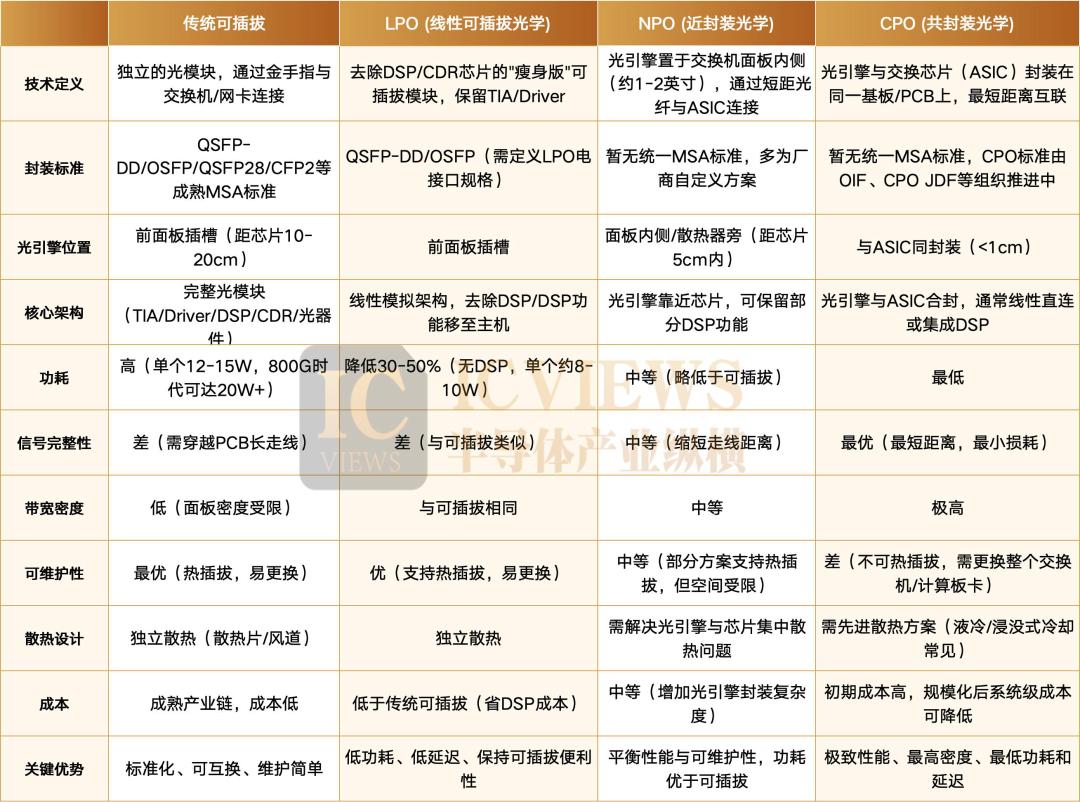
CPO (Co-Packaged Optics) is the industry-recognized "ultimate solution". Its core is to integrate the optical engine responsible for photoelectric conversion and the switch ASIC chip on the same substrate or interposer through 2.5D/3D advanced packaging technology, shortening the electrical signal transmission path from over 100 millimeters in the traditional pluggable solution to the millimeter level. This architecture completely eliminates the signal loss caused by PCB traces, eliminates the need for high-power DSP chips, reduces power consumption by 30%-50% compared to traditional solutions, and achieves ultra-low latency in the nanosecond range and a bandwidth density of 3.2T+ per channel.
However, the implementation of CPO technology still faces multiple challenges: it requires the integration of silicon photonic devices such as micro-ring modulators (MRM) or Mach-Zehnder modulators (MZM) on a 3nm process and highly depends on advanced packaging platforms such as TSMC's COUPE. The technology is complex, the production yield is low, and the industry lacks unified standards, resulting in poor cross-vendor compatibility. Previously, the industry was generally concerned about the maintainability of CPO, but the reliability data of horizontally scalable switches released by Meta at the Optical Fiber Communication Conference (OFC 2026) in 2026 gave a different conclusion: the tested CPO optical transceivers are more reliable than traditional pluggable products, and they are more compact, smaller in size, and lower in power consumption. This discovery strongly refutes the early doubts.
NPO (Near-Package Optics) is a "pragmatic transitional solution" that balances performance and industry status quo. It retains the design of the optical engine as an independent unit and only shortens the electrical signal path to the centimeter level by mounting it close to the ASIC chip on the switch motherboard. While significantly reducing insertion loss, it maintains the replaceability and ease of maintenance of the optical engine. Since the manufacturing process is close to the existing optical module technology, it does not require advanced chip co-packaging capabilities and allows the decoupled design of the switch chip and the optical engine. NPO is more conducive to the formation of a mature ecosystem with multi-vendor collaboration and has become the preferred intermediate form for mainstream manufacturers before large-scale promotion of CPO.
NPO Leads in Volume, CPO is Ready to Take Off
The differences in technological routes directly determine the speed of their commercialization processes and the differentiation of the market landscape. Currently, NPO has entered a period of rapid growth, while CPO is in its infancy but growing at an astonishing rate.
The NPO market has entered a period of rapid growth, and large-scale commercial use officially began in 2026. According to DataIntelo, the global near-package optics market was valued at $3.8 billion in 2025, and it is expected to have a compound annual growth rate of 19.3% from 2026 to 2034, reaching $18.6 billion by 2034.
North America has become the leading region in the global near-package optics market, with revenues reaching $1.38 billion in 2025, accounting for approximately 36.2% of the total revenue. The region's leading position is due to the concentration of hyperscale cloud platform operators, including the world's three largest public cloud service providers, which operate hundreds of data centers in the United States, Canada, and Mexico. Silicon Valley and Northern Virginia have become the main hubs for the deployment of artificial intelligence accelerator clusters, and NPO technology is being adopted earliest and most actively. North America is expected to maintain its leading position until 2034, with a compound annual growth rate of 18.7% during the forecast period, thanks to the continuous reinvestment of cloud-native and enterprise operators in next-generation data center infrastructure. The Asia-Pacific region was the second-largest regional market in 2025, accounting for approximately 31.5% of global revenues, and is expected to achieve the fastest regional compound annual growth rate of 21.4% by 2034. In 2025, Europe accounted for 22.4% of the global near-package optics market and is expected to have a compound annual growth rate of 17.8% by 2034. Germany, the United Kingdom, France, and the Netherlands together account for the majority of European demand, thanks to the significant co-location and hyperscale data center clusters in Frankfurt, London, Amsterdam, Paris, and Dublin.
The CPO market is still in its infancy but growing at an astonishing rate. Yole predicts that by 2031, transceivers alone will drive $8 billion in photonics packaging demand, and CPO-driven demand will soar from almost zero currently to approximately $5 billion. LightCounting predicts that the CPO market size, including scale-up and scale-out scenarios, is expected to reach $10 billion in 2030; Coherent (COHR.US) further revised its forecast upward to $15 billion at the OFC conference.
Global Manufacturer Layout: Chinese Manufacturers Lead in NPO, Global Tech Giants Bet on CPO
Global technology manufacturers have carried out differentiated layouts on the two routes based on their own technological accumulation and market positioning. Chinese manufacturers have formed a significant leading advantage in the NPO field, while international chip giants dominate the technological evolution of CPO.
NPO: Chinese Manufacturers Win Large Orders, and Technological Breakthroughs Continue to be Implemented
On April 7, 2026, Google officially placed an order for 12 million NPO optical modules with a total value of approximately $12 billion to $15 billion, specifically for the interconnection between chips in the scale-up layer of its next-generation TPUv7/v8/v9 supercomputing clusters. Zhongji Innolight and Xinyisheng, two leading Chinese manufacturers, won 60% and 40% of the shares respectively, monopolizing the entire order.
Even earlier, Chinese manufacturers had achieved multiple technological breakthroughs.
On March 2, 2026, Huagong Zhengyuan, a core subsidiary of Huagong Technology, a leading domestic optoelectronic industry company, independently developed the industry's first 3.2T NPO (Near-Package Optics) product, which has been the first to be applied by leading industry customers. This 3.2T NPO optical engine uses silicon photonics technology and packaging technology, achieving a transmission rate of 3.2Tbit/s (integrating 32 channels of 100G) per optical engine. This solution does not use traditional DSP chips but instead uses linear direct-drive technology. It has now been applied to some customers and is planned to be promoted on a larger scale in 2026.
Accelink Technologies showcased the world's first 3.2T silicon photonics single-mode NPO module at OFC 2026. The product completed sample testing several months ago. More notably, Accelink Technologies completed the full-system verification of the 3.2T NPO at a leading domestic CSP during the same period, becoming the first optical module manufacturer in the industry to achieve this breakthrough, which also marks the official transition of this technology from the laboratory to large-scale engineering implementation.
Haiguangxin demonstrated the 6.4T NPO silicon photonics engine technology at OFC 2026. Through advanced silicon photonics packaging technology, the EIC and PIC are stacked, reducing the engine size and shortening the electrical signal path. The single-chip specification of this engine is 16X200G transceiver chips, with a horizontal size of less than 8mm, and it can be applied to high-density optical interconnection product fields such as 3.2T/6.4T NPO, OSFP-XD PCIe, and XPO.
CPO: Chip Giants Dominate, Chinese Manufacturers Accelerate Follow-up
Nvidia is the most radical promoter of CPO technology. At the GTC conference in 2025, Nvidia launched the Quantum-X (IB network) and Spectrum-X (Ethernet) silicon photonics co-packaged chips and three switch products. It chose the micro-ring modulator (MRM) technology route and cooperated deeply with TSMC to develop a 3D stacked silicon photonics engine. It plans to deliver the InfiniBand CPO system in the first half of 2026 and deploy Ethernet CPO products in the second half of the year. At the same time, it is laying out CPO on both the switch side and the GPU side, ultimately achieving optical connection between the GPU and the NVSwitch chip.
Broadcom delivered the industry's first 51.2Tbps CPO Ethernet switch, Bailly, in March 2024. It integrates 8 6.4Tbps optical engines with the Tomahawk5 chip and claims to reduce power consumption by 70%. Technologically, it chose the Mach-Zehnder modulator (MZM) route and is also laying out MRM. Its CPO production line will enter the critical mass production stage in the second half of 2026, with a monthly production capacity expected to reach the thousands level in the fourth quarter. If customer progress is smooth, the monthly output will jump to the tens of thousands level in the first quarter of 2027.
Chinese manufacturers are also actively laying out the CPO track: Ruijie Networks launched a 25.6T CPO switch in 2022 and demonstrated a 51.2T CPO switch commercial interconnection solution based on Broadcom's Bailly chip in September 2025; H3C was the first in the industry to launch a 51.2T single-chip CPO silicon photonics switch supporting 64 800G ports in 2023, with a focus on optimizing the liquid cooling and air cooling heat dissipation design.
It should be noted that the large-scale application of CPO still needs to overcome many practical problems: the cost of a single optical engine is as high as $35,000 - $40,000, and the high-density integration brings severe heat dissipation challenges, requiring a supporting liquid cooling system; moreover, the optical engine is fixedly integrated with the main chip, and once a failure occurs, the entire board needs to be replaced, resulting in poor maintainability and flexibility. In addition, there is a lack of interoperability consensus between Nvidia's COUPE solution and Broadcom's FOWLP solution, and the lack of industry standards has also slowed down the popularization of CPO.
Differentiated Application Scenarios: Different Choices for Scale-up and Scale-out
The competition between NPO and CPO is not a zero-sum game. They will complement each other in different application scenarios and time stages, jointly supporting the upgrade needs of AI computing power clusters.
From the perspective of application scenarios, the different requirements of Scale-up (GPU interconnection within the rack) and Scale-out (interconnection between racks/data centers) determine the choice of technological routes: in the Scale-up scenario, as the single-channel rate evolves to 400G, the copper cable transmission distance will be shortened to less than 1 meter. CPO, with its extreme bandwidth density and low power consumption advantages, will be the first to enter the intra-rack interconnection field; while in the Scale-out scenario, NPO, with its better compatibility and maintainability, has become the preferred transitional solution for high-end data centers from 2025 to 2027.
From the time perspective, in the short term, NPO leads in large-scale volume. It balances performance and compatibility, avoids the core chip and advanced packaging barriers of CPO, allows the existing industrial chain to make a smooth transition, and is also a pragmatic choice for domestic data centers and cloud providers to "upgrade performance while controlling costs". In the medium term, CPO enters a period of high-speed growth. As chip giants such as Nvidia and Broadcom promote mass production and packaging platforms such as TSMC's COUPE mature, CPO will establish its core position in ultra-large-scale AI clusters. Especially when the single-port rate exceeds 3.2T, the power consumption advantage of CPO will become irreplaceable. In the long term, CPO will become the mainstream, but NPO will still have a survival space. The AI computing power market is stratified in a pyramid shape, with different needs from edge computing power to supercomputing centers. Although CPO represents the ultimate technological direction, NPO will still exist for a long time in specific scenarios such as mid-level data centers that require frequent maintenance.
The Emergence of XPO
Just as the competition between the NPO and CPO routes is intensifying, on March 11, Arista, together with more than 45 industry partners, officially released the XPO (Ultra-High Density Pluggable Optics) white paper, proposing a new pluggable optical module standard for the next-generation AI data centers, bringing a third choice to the industry.
XPO is designed for the ultra-high bandwidth, high density, and high power consumption requirements of 100,000 GPU clusters. A single module can provide 12.8Tbps of bandwidth (64 channels × 200Gbps), integrates a liquid cooling cold plate to support a power consumption of over 400W, and achieves a switching capacity of 204.8Tbps in one OpenRack Unit, achieving a four-fold increase in front panel density compared to the existing OSFP standard. It retains the operational convenience of traditional pluggable modules and also takes into account the high-performance advantages of CPO/NPO, covering the full range of Scale up/Scale out/Scale across scenarios.
Currently, domestic manufacturers such as Zhongji Innolight, Xinyisheng, and Linkstar Technology have released relevant XPO products, and some Chinese manufacturers have even become founding members of the XPO MSA, becoming the formulators of the new generation of standards. The XPO solution has been recognized by mainstream customers such as Microsoft and Dell and is expected to form a tripartite market pattern with NPO and CPO in the future.
The competition in AI computing power clusters is shifting from "simply increasing computing power" to "competing in network efficiency", which puts more comprehensive and demanding requirements on optical interconnection technology. The rapid implementation of NPO, the technological breakthroughs of CPO, and the emergence of XPO are jointly driving the innovation and transformation of the optical interconnection industry. In the future, the three technological routes will find their own positions in different scenarios and jointly support the continuous upgrade of the global AI computing power infrastructure.
This article is from the WeChat official account “Semiconductor Industry Insights” (ID: ICViews), author: Peng Cheng. Republished by 36Kr with permission.