Singapore's AI Journey: Nurturing the Next "Silicon Valley"
"Punggol" is a new district located in the northeastern part of Singapore. It has a cute Chinese name: "Bang'e", which indeed sounds like the call of some kind of animal when pronounced.
Actually, "Punggol" is a Malay word. When translated, it means using a stick to beat fruit trees to knock the fruits down.
In reality, for a long time, Bang'e Town was covered by large tracts of forests. While office buildings were springing up one after another in Orchard Road, Singapore, Bang'e was still a wild and uncultivated area. Even now, local Singaporeans tell me that "someone has seen lions in the jungle".
However, today's Bang'e has more than just the legends of dense forests and wild animals. The Punggol Digital District (PDD) located here is a newly emerging gathering place for technological innovation in Singapore.
At the beginning of April, the Chinese autonomous driving technology company WeRide and Grab announced the official launch of autonomous driving mobility services in the Punggol area of Singapore. This is also the first autonomous public mobility service deployed in a residential area in Singapore.
At the end of last year, I saw WeRide's Robotaxi GXR Ai.r in Punggol. It's a seven - seater vehicle with a purple - red gradient appearance, which is very eye - catching among the gray - white public housing in Punggol. During the pilot period, local residents could apply for a test ride in the Ai.r. The interior space of the vehicle is quite large, and it's no problem even if you carry a suitcase.
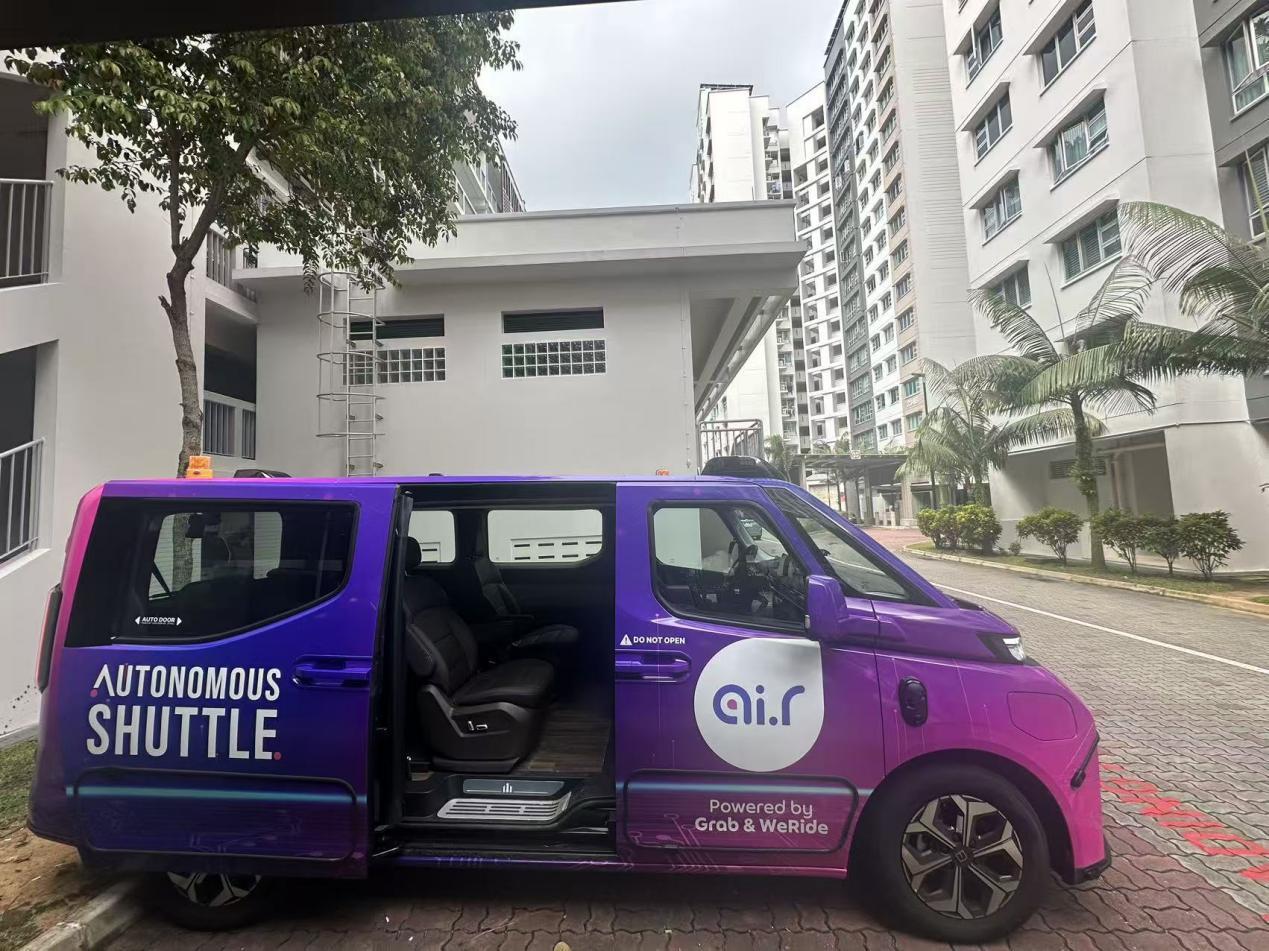
WeRide's Robotaxi GXR Ai.r; Photo taken by the author
The development stage of the Punggol area just meets the requirements for the implementation of emerging technologies. Since it's a new district, the residents here are younger and more receptive to technology.
Take WeRide's autonomous driving as an example. During the initial pilot phase, the pedestrian flow and road conditions in Punggol are not as complex as those in the city center. However, Punggol also has a complete set of living facilities, including public housing communities, subway stations, and office buildings. The Robotaxi GXR can verify the feasibility of the technology in such a real - world environment.
"The Singapore government wants to develop Punggol into an AI - driven and AI - focused area. Autonomous driving fits well with the AI narrative here," said the WeRide staff member accompanying me.
You can imagine this place as Singapore's Silicon Valley. Just like opening up an innovation area in the wilderness, Punggol has been acting quickly. Since 2018, the Singapore government has joined hands with the industrial giant Jurong Group to start building the Punggol Digital District. The first - phase project was launched in 2024, and the entire project is expected to be completed in 2026.
In terms of investment promotion, in addition to attracting Singaporean enterprises to settle in, the park also hopes to introduce more multinational companies. Among the first batch of four multinational companies, there is a Chinese company.
Relevant information shows that these four companies are Delta Electronics Int’l (Singapore), a subsidiary of Delta Group in Singapore that provides smart living solutions, the robotics company Boston Dynamics, the cybersecurity company Group - IB, and the Chinese blockchain company Wanxiang.
In the industrial structure of Silicon Valley, the presence of universities such as Stanford is essential. Adjacent to the Punggol Park is the campus of the Singapore Institute of Technology, the fifth public university in Singapore. To make the cooperation between industry and academia closer, in the park design, the Punggol Park and the Singapore Institute of Technology are "seamlessly" connected through corridors.
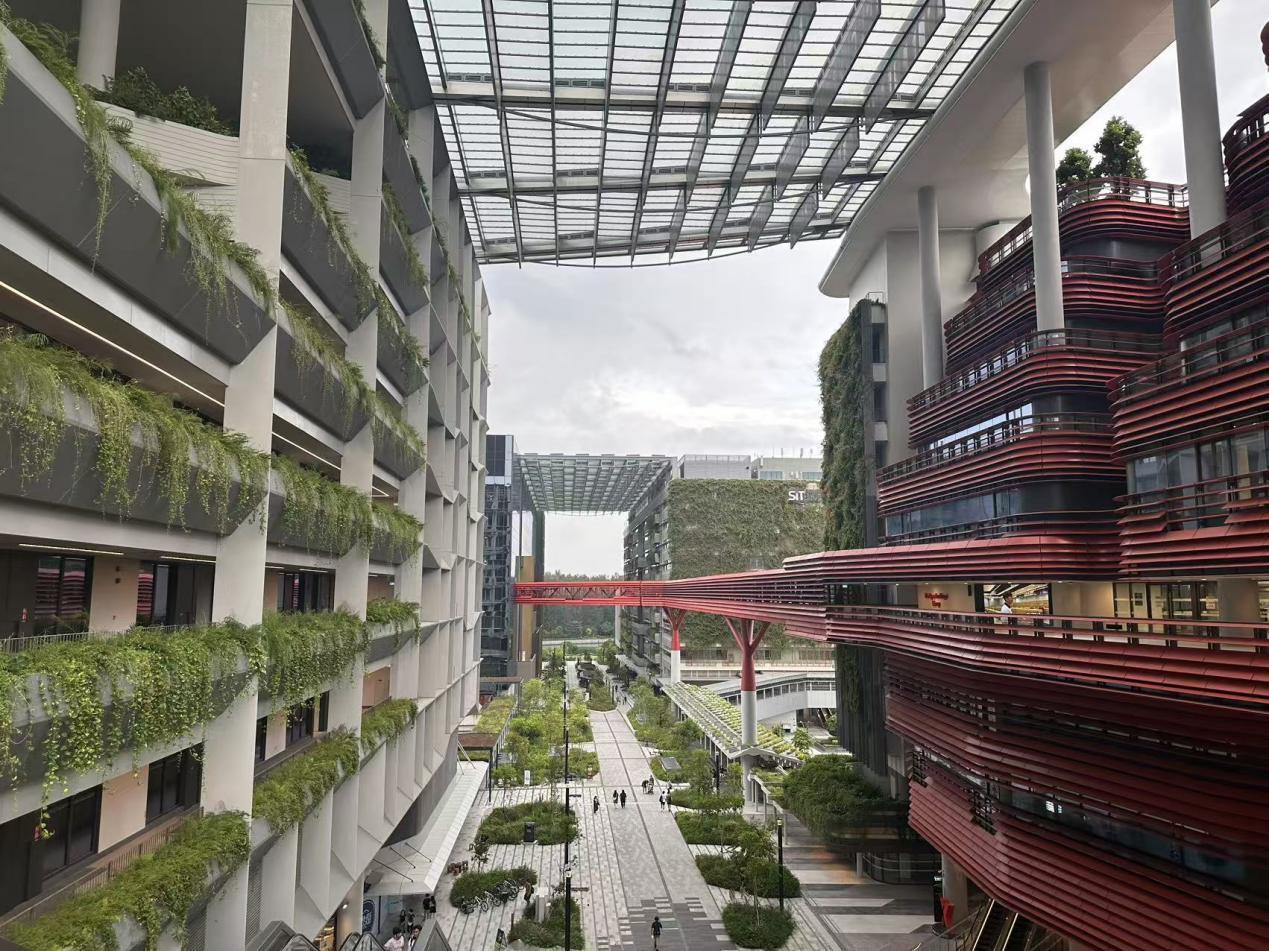
The campus of the Singapore Institute of Technology; Photo taken by the author
Sim Feng - Ji, the Deputy Permanent Secretary of the Digital Government of the Ministry of Digital Development and Information (MDDI) in Singapore, introduced the Singapore government's plan for Punggol to us. In his presentation document, Punggol is positioned as "Singapore’s First Smart Town".
The so - called "smart town" means that the core system behind the park adopts the Open Digital Platform technology. Through sensors and digital platforms, the park can achieve data visualization, real - time equipment monitoring, AI energy - saving, etc. At the same time, the park advocates the concept of sustainability and is equipped with various green facilities such as rooftop solar panels for power generation, rainwater purification for irrigation, and converting food waste into fertilizer, which all reflect Singapore's concept of developing a green city.
Singapore's determination to develop artificial intelligence is obvious. On February 12, 2026, Singapore's Prime Minister and Minister of Finance, Lawrence Wong, mentioned in his budget statement that Singapore will launch a new artificial intelligence development vision (AI Missions) to take the lead in promoting the artificial intelligence transformation in four key economic sectors, namely connectivity, advanced manufacturing, finance, and healthcare.
To implement relevant plans, the Singapore government will also establish a National AI Council led by Lawrence Wong. Lawrence Wong emphasized that in a changing world, Singapore's success depends on how to use new technologies, and artificial intelligence is the most crucial part.
However, for Singapore, which has a population of only 6 million and an area less than twice that of Chaoyang District in Beijing, the most important advantage in developing artificial intelligence is its attractiveness to talents.
Global top - tier technology companies including Meta, OpenAI, and Google all have relatively large branches in Singapore. Many well - known Chinese AI companies have chosen to move to Singapore to develop their businesses. For example, the Chinese AI startup Manus, which was just acquired by Google this year.
Manus' office in Singapore is located in a WeWork near the Funan Mall in the city center. You can often meet Chinese - speaking people with Chinese faces here. The working environment is not much different from that in China. You can have Yoshinoya and hot pot for less than S$5 (less than 30 yuan) on the basement floor, and there is a karaoke bar on the 4th floor.
For Chinese employees who move here, except for the hot and humid climate all year round, they can almost seamlessly switch in terms of living habits.
From the perspective of the Singapore government, it's quite important for innovative enterprises to find a place where talents can live comfortably and can easily reach.
"If you want to find a place in the world where Chinese, Americans, and Europeans are all willing to come, there are really not many such choices. Singapore is one of them," Sim Feng - Ji told us.
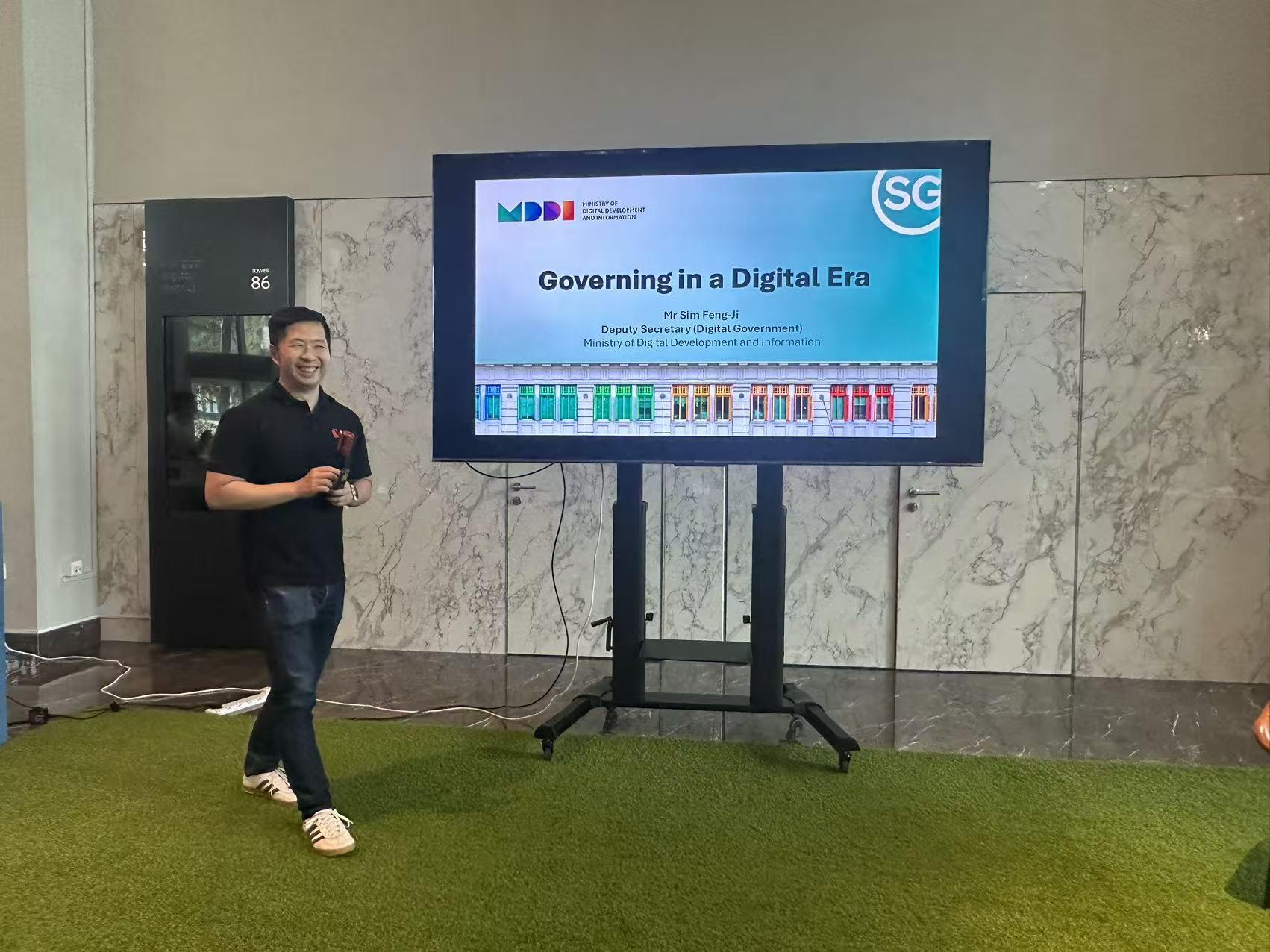
Sim Feng - Ji, the Deputy Permanent Secretary of the Digital Government of the Ministry of Digital Development and Information (MDDI) in Singapore; Photo taken by the author
The Singapore government will also assist such high - tech enterprises in their development and implementation.
"We are like teachers in a class, taking care of the needs of every student in the class," Sim Feng - Ji said with a smile.