IFR Report: China Expected to Lead Global Robot Development
According to the "World Robotics 2025" report released by the International Federation of Robotics (IFR), factories worldwide are further implementing automation.
The organization pointed out that the "robot density", measured by the number of robots per 10,000 employees, has increased on three continents.
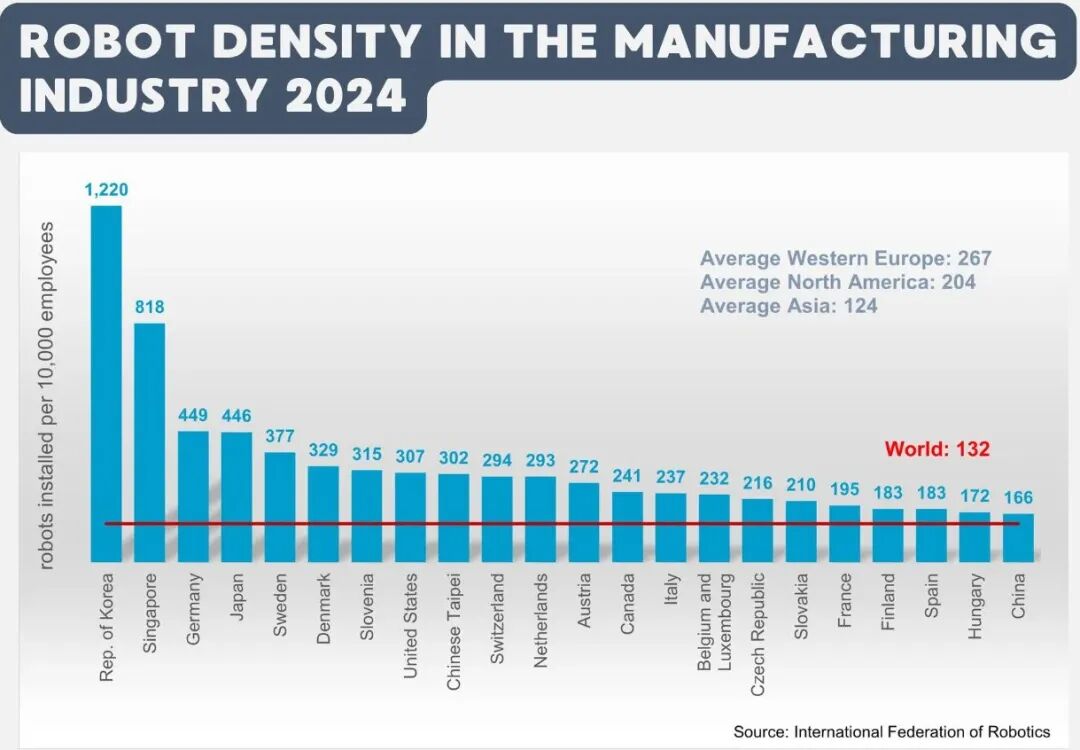
The IFR noted that the growth of robot density in Western Europe is particularly significant, reaching 267 robots per 10,000 employees in 2024, leading North America (204 robots) and Asia (131 robots).
Takayuki Ito, the President of the IFR, said, "The robot density indicator provides a unified basis for comparison, linking the total number of robots in a country to its economic scale (measured by the labor force)."
The organization, headquartered in Frankfurt, Germany, previously reported that the global average robot density doubled between 2014 and 2024.
The IFR explained that its measurement scope can cover the entire manufacturing industry or target specific industrial branches.
The organization said, "Since the number of employees is an indicator of the economic scale, the quotient of the operating stock and the number of employees places the operating stock on a unified basis for comparison."
Europe Maintains the Lead in Robot Density
The robot density in Western European countries increased by 3% year-on-year. Nine countries in the region are among the top 20 in the world, including Germany, Switzerland, the Netherlands, Austria, Italy, Belgium, Luxembourg, France, and Spain.
The average robot density of the 27 member states of the European Union reached 231 robots, higher than the global average (132 robots).
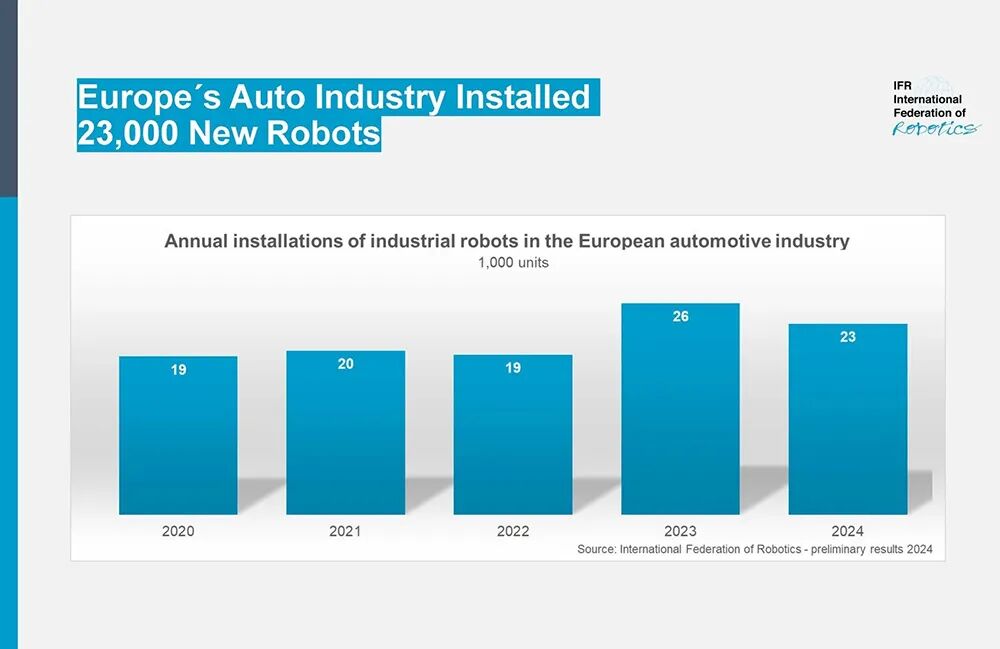
The IFR said last year that the automotive industry in Europe continues to drive the sales of industrial robots.
Robot Usage in North America Increases Synchronously
The IFR said that the robot density in North America increased by 4% in 2024. The United States ranks eighth in the world with a density of 307 robots per 10,000 employees, mainly thanks to its automobile manufacturers.
Meanwhile, US lawmakers are also increasingly concerned about robots, artificial intelligence, and industrial policies to enhance competitiveness and national security.
Alex Shikany, the Executive Vice President of the Association for Advancing Automation (A3), said, "These data confirm what we've seen in North America: more and more manufacturers are turning to robots and automation to improve productivity, address ongoing labor challenges, and enhance competitiveness in the rapidly evolving global market."
He added, "Meanwhile, the gap between the United States and the world's most automated economies clearly shows that there is still room for improvement in the future. In the United States, as we continue to communicate with the government and members of Congress about the need to establish a national robotics strategy, it's encouraging to see that the attention to this issue in Washington, D.C. is increasing."
Shikany also said, "If the United States wants to maintain its lead in advanced manufacturing, supply chain resilience, and industrial innovation, we need a coordinated national plan to support the application of automation, workforce development, and long - term investment in robots and related technologies."
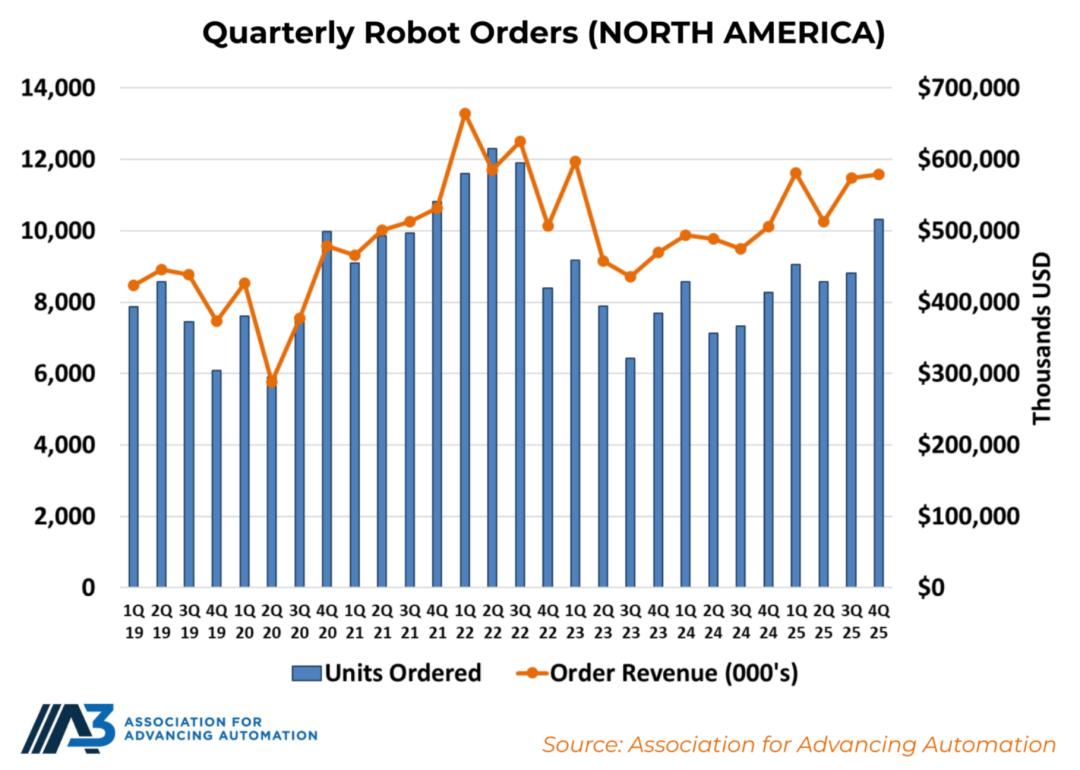
Robert Little, the Head of Robotics Strategy at Novanta, said, "As can be seen from A3's recent robot order report, orders in North America are surging. This is in line with the more than $7 trillion in manufacturing investments announced or underway since 2025. Coupled with the continuous shortage of skilled manufacturing workers, manufacturers have to automate to complete production tasks. This trend is expected to continue for many years."
In addition, the robot density in Canada is 241 robots, and in Mexico it is 62 robots.
Increase in Asian Applications and Revision of Chinese Statistical Data
The average robot density of manufacturing workers in Asia is 131 robots, an increase of 11%.
The IFR also said that the economies of South Korea, Singapore, Japan, and Taiwan (China) are among the top 10 most automated in the world.
According to the latest labor market data released by the National Bureau of Statistics of China, China ranks sixth in Asia and 22nd in the world. China has 166 robots per 10,000 employees, a year - on - year increase of 17%.
The IFR explained, "As a large country with a huge manufacturing labor force, China needs a huge operating stock, not only to be deployed in its manufacturing hubs but also to penetrate rural areas to achieve a high robot density. China's outstanding position in the field of industrial robots is evident from its impressive operating stock, which ranks first in the world."
Statistics show that China has about 2 million robots, about 4.5 times that of Japan, which ranks second. In addition, the IFR said that of all the robots installed globally in 2024, 295,000 (about 54%) were deployed in China.
Jeff Burnstein, the President of A3, said, "Although the revised data shows that China lags behind other major countries in robot density, considering China's current penetration speed compared to these countries, its ranking is likely to rise rapidly."
Samantha Mou, a market analyst at Interact Analysis, believes, "The data highlights a clear divergence in the global robotics landscape: Europe continues to lead in automation intensity, but the growth momentum and total scale are increasingly being driven by Asia (especially China)."
Aaron Prather, the Director of the Robotics and Autonomous Systems Program at ASTM International, posted on LinkedIn, "The situation has changed. This is a revision and re - evaluation. The new data from the National Bureau of Statistics of China has significantly changed China's robot density data. When it comes to certain data points, we need to rethink how to view China, the 'robot powerhouse'."
IFR Ranking of Leading Countries and Regions
South Korea: It has the highest robot density in the world, reaching 1,220 robots per 10,000 employees, with an average annual growth of 7% since 2019.
Singapore: It ranks second with 818 robots. As a small country with a relatively small total number of manufacturing employees, Singapore can achieve a high density with a relatively small operating stock.
Germany: It ranks third with a density of 449 robots. It has had an average annual growth of 5% since 2019.
Japan: It ranks fourth with a density of 446 robots. As the world's leading robot - manufacturing country, its density has increased by 5% annually since 2019.
Other countries and regions in the top ten of the IFR ranking include: Sweden (377), Denmark (329), Slovenia (315), the United States (307), Taiwan (China) (302), and Switzerland (294).
Although the number of robots has increased, a report by Interact Analysis last year showed that the sales revenue of robots decreased from 2023 to 2024.
The report attributes this to the post - pandemic demand decline, high interest rates, and the slowdown in growth due to the electrification transformation of the automotive industry, but it also predicts that the industry will rebound.
Samantha Mou added, "A key insight is the inverse relationship between robot density and market growth: mature high - density markets tend to grow more slowly, while low - density emerging markets grow faster. We see that mature markets are shifting from 'initial application' to 'optimization', while emerging markets are still in the 'rapid expansion' stage. This dynamic is creating a 'two - speed' robotics market, one driven by efficiency improvement and the other by capacity expansion."
She finally said, "Our forecast shows that by 2030, the compound annual growth rate (CAGR) of global industrial robot shipments will reach 6.7%. We see India and Southeast Asia as the next key growth frontiers."
This article is from The Robot Report. The copyright belongs to the original author. If there is any infringement, please contact us to delete it.
This article is from the WeChat official account "Machine Preface". The author is Machine Preface. It is published by 36Kr with authorization.