Raised Nearly 200 Million in Half a Year, He Aims to Solve the Training Problems of 100 Million People Worldwide with AI Ball-Serving Robots | Exclusive Interview by Yingke
Author | Huang Nan
Editor | Yuan Silai
If you want to find Zhang Haibo, the founder of Pongbot, chances are you'll have to go to various stadiums near the company.
Zhang Haibo has trained himself to be an expert in various ball games.
In October 2025, not long after the company's tennis court was built, he picked up his own serving robot and started learning to play tennis from scratch. When interviewed by Yingke, Zhang Haibo said that after six months of training, he has now reached the NTRP 3.0 level - which is equivalent to the advanced level that an average user usually takes one to two years to achieve. He didn't hire a private coach or a training partner. The only teacher was the serving robot that he hit repeatedly.
Zhang Haibo was proficient in table tennis very early on. He was one of the first engineers in China to apply reinforcement learning to table tennis matches. During his tenure at a listed company in the early years, he developed a scheme for an embodied robotic arm that can play "human - machine battles" with people. The cost of this system was as high as more than 200,000 yuan. It provided data analysis for the national team and could even compete with professional players. However, Zhang Haibo soon realized that a robot that can defeat humans is a spectacle and cannot become a product that the general public really needs.
Rather than using flashy demos to show the upper limit of technology, Zhang Haibo prefers to visit small and large stadiums at home and abroad to observe those most discerning and in - depth enthusiasts.
He found that what sports enthusiasts really lack is not a robotic opponent, but coaches, training partners, and efficient self - training methods. Most serving equipment on the market is still at the stage of mechanical ball - spitting: no rhythm, no spin, no guidance, and hardly any training value.
The long - ignored user pain points in technology and the huge industry gap made Zhang Haibo determined to step out of the laboratory. In 2019, Zhang Haibo founded Pongbot, hoping to use the intelligent serving robot as a carrier to provide users with an AI Coach (sports assistant coach) that is always available, professional, and stable.
This path was quickly verified by the market. In October 2024, Pongbot's PACE series of intelligent tennis serving robots were launched on Kickstarter, and the crowdfunding amount exceeded $2.7 million. During the Black Friday period in 2025, the overseas monthly sales exceeded tens of millions of yuan; currently, the company has more than 300,000 global users.
Yingke exclusively learned that Pongbot recently completed a Series A financing. The cumulative amount of the three - round financing is nearly 200 million yuan. Institutions such as Shenqi Capital, Mingzhi Venture Capital, BlueRun Ventures, Jinqiu Fund, and Huachuang Capital participated in the investment collectively. Gaohu Capital served as the exclusive financial advisor.
The confidence of the capital comes from a clear growth logic. According to the data of the International Tennis Federation (ITF) in November 2024, the number of tennis participants globally reached 106 million. Among them, the ratio of active tennis users to coaches in the United States is as high as 800:1, and the supply of professional coaches is seriously insufficient; in China, tennis is rapidly becoming the mainstream sport for urban white - collars and middle - class families, but private lessons that cost hundreds of yuan per hour keep most beginners out. Pongbot hopes to provide a solution with AI technology.
The following is the transcript of the interview between Yingke and Zhang Haibo, the founder and CEO of Pongbot. The content has been edited:
AI Coach in the training scenario
Yingke: You started working on robots ten years ago.
Zhang Haibo: The first - generation robot I developed was a table tennis - playing robot. Different from the common serving robots or humanoid robots used for playing table tennis at present, it uses a robotic arm structure for human - machine battles and is an embodied intelligent system with autonomous judgment and decision - making abilities.
We obtain information from images and input it into the model, which controls the robotic arm to hit the ball to the desired position. During this process, the table tennis ball spins, so we have obtained many patents on how the ball flies, how to predict its trajectory, and how to intercept it. We have also done a lot of data analysis for the national team.
However, what we pursued at that time was not productization, but to be higher, faster, and stronger, and to beat others. So the cost of the equipment was also very high, reaching more than 200,000 yuan per unit.
Yingke: The sports field is a track that highly depends on industry know - how.
Zhang Haibo: In those four years, we gained a lot of understanding of sports, from beginners to in - depth enthusiasts and then to professional athletes. Few people can see this complete path.
I could feel the eagerness of those enthusiasts for technological products. They were very excited every time we communicated. This made me have the idea of starting a business. I no longer wanted to make high - priced equipment worth more than 200,000 yuan - such products are very advanced but have a limited user base and can only solve the pain points of a very small number of people. I wanted to make a sports technology product that the majority of enthusiasts can afford and use.
Yingke: There are obvious positioning differences among various sports intelligent hardware products on the market. How should we understand the definition of different sports scenarios and product positioning? What considerations did Pongbot have when finally locking in the product direction?
Zhang Haibo: Generally speaking, we can divide general sports into four directions. One is Sports, which refers to sports with complete competition rules and professional events, such as football, basketball, and tennis. This is also the track that Pongbot is targeting; the second is Recreation, which are activities with a more leisure and entertainment nature, such as darts, frisbee, and billiards. In overseas markets, some table tennis scenarios can also be classified into this category, which are more used for parties and pastimes; the third is Outdoor, which are outdoor sports that pursue self - breakthrough, such as mountain climbing and rowing. Users pay more attention to challenging their physical limits and refreshing personal records; the fourth category is Fitness, which are fitness exercises aimed at shaping the body and improving physical fitness.
These four categories are not completely unrelated, but from the perspective of professional products for enthusiasts, the boundaries are clear. Pongbot focuses on Sports and some entertainment - oriented presentations of Recreation related to Sports, and has nothing to do with Fitness and Outdoor sports for now.
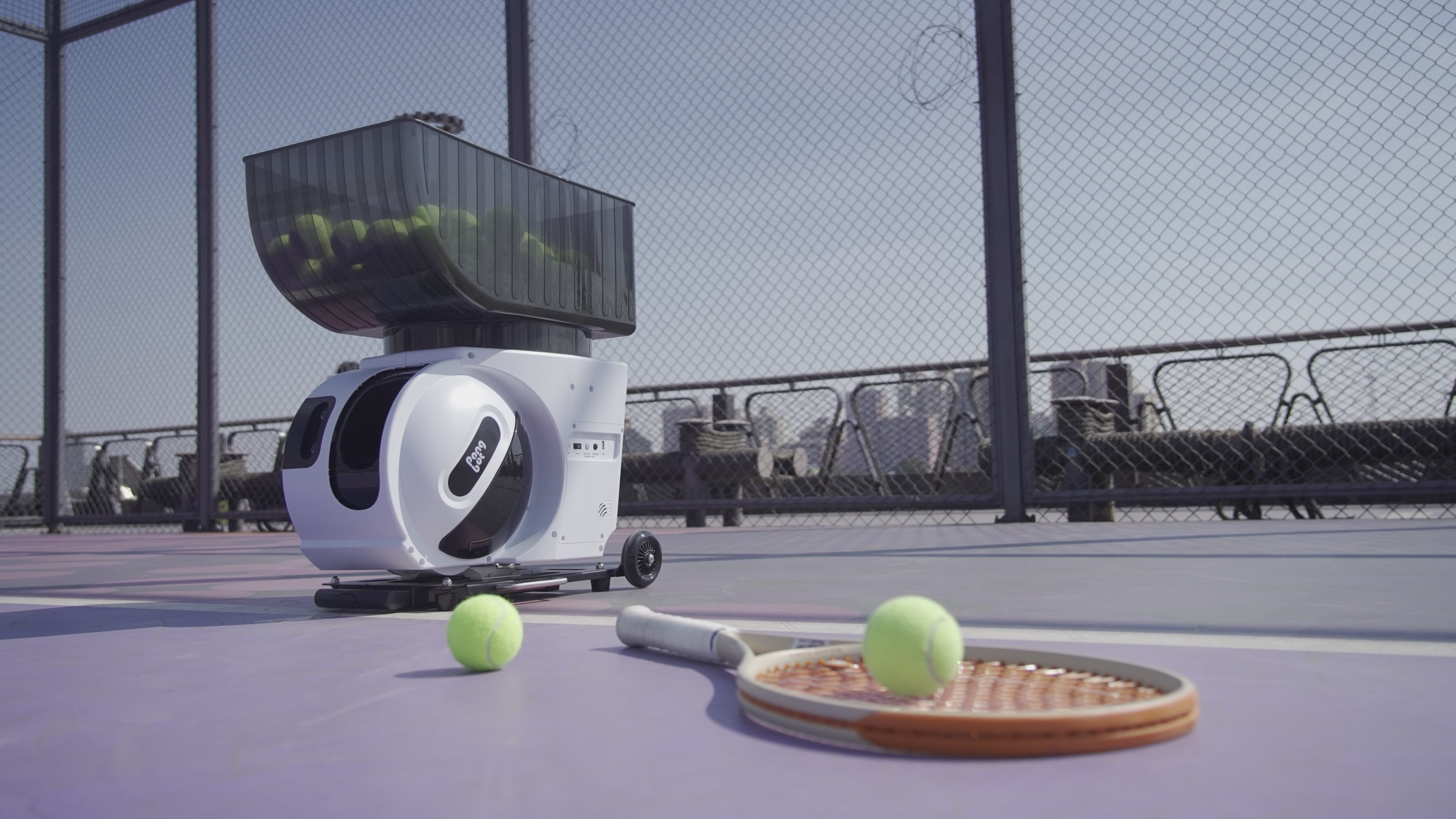
Pongbot's PACE series of intelligent tennis serving robots (Source/Enterprise)
Yingke: In terms of product form, traditional serving machines have been around for decades, but most of them are still at the stage of mechanical ball - spitting, and the user experience has hardly been innovated. What is the core contradiction that Pongbot wants to solve?
Zhang Haibo: In sports scenarios, users are in only three states - pure play, training, and competition/battle. These three scenarios are mutually exclusive, and users can only do one thing on the court. This also determines that we need to choose the focus when making products.
Pongbot focuses on the training scenario. What users really need is not a robotic opponent. Battles have a strong social attribute. Even if the machine can play with the user, the user will eventually return to human - to - human confrontation. Many people find it novel that the robot can catch the ball, but the underlying demand is not "playing with the machine" but "using the machine to assist self - practice". Practice is the core demand.
In mass sports, it is easy to find opponents, and there are even free partners. But good coaches are hard to come by: either they can't be found, or their styles are not suitable, the time is difficult to arrange, and the cost is high. Even if users hire a coach once a week, during most of the remaining self - training time, whether it is dribbling, empty swinging, using a serving machine, or practicing against the wall, everyone hopes to have a "coach" by their side. The coach doesn't need to feed the ball all the time, but can continuously observe and give real - time guidance. Currently, few products can truly meet these needs.
Yingke: What are the characteristics of these user portraits?
Zhang Haibo: There are obvious differences in the training habits of sports enthusiasts at home and abroad. Overseas, there is almost no "pure entertainment" stage in most sports. People either don't participate or start with professional coach guidance from the beginning, and their training awareness is generally stronger. In contrast, domestic users usually start from interest and fun and then gradually turn to systematic training.
This also determines that our first - generation products are mainly for senior sports enthusiasts, that is, users who have mastered specific skills and want to improve their sports abilities. This group of people is familiar with the sport itself. They long to win more games in real competitions but lack clear training goals and need to use equipment to assist their practice.
For this group of users, it's easy to calculate the cost: even if the hourly fee of an offline coach is relatively low, it is $100 per hour, and the advanced courses can cost as much as $200 to $500. Pongbot's serving robots are priced in the range of $1000 - $5000. Whether as a daily auxiliary training tool or an AI Coach (sports AI assistant coach) that replaces some coach functions, it is very cost - effective for long - term training users.
The "hand - eye - brain" integrated architecture
Yingke: From table tennis to tennis, and then to pickleball and badminton, how did Pongbot choose to expand its sports scenarios?
Zhang Haibo: Pongbot positions itself as an AI robot company that focuses on multiple sports. Sports have no boundaries. We chose table tennis first because we are most familiar with this sport. The team has sufficient sports data and technological accumulation and can quickly launch products to help the company get started.
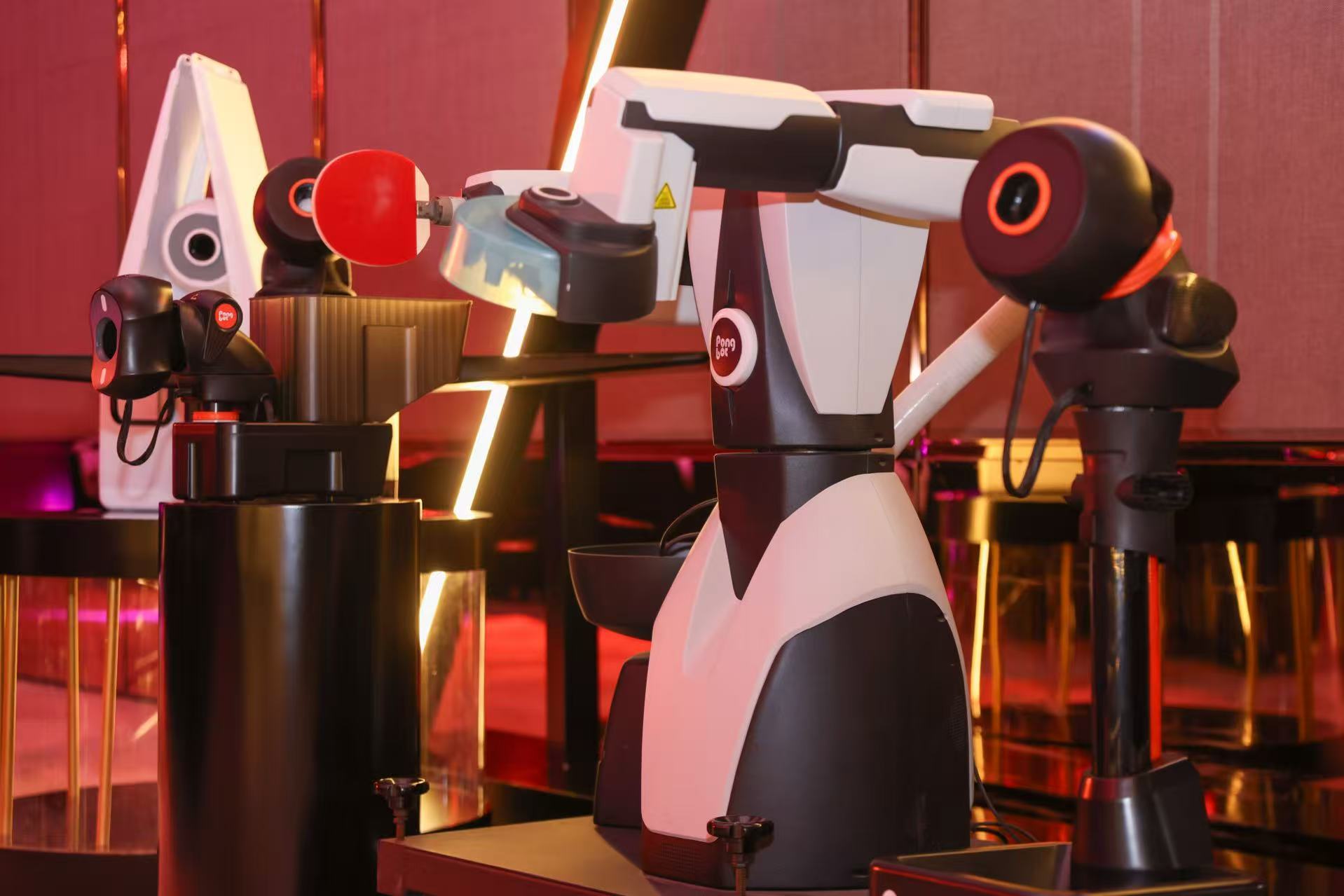
Pongbot's intelligent table tennis serving robot (Source/Enterprise)
When choosing the second sport, our only criterion was that it must be a global sport. Compared with badminton, whose audience is mainly concentrated in China and Southeast Asia, and baseball, which is more popular in single - regional markets such as the United States and Japan, tennis has a high degree of globalization. In the future, we will also make breakthroughs in global sports one by one, including pickleball in the United States, padel in Europe, and baseball in the Japanese market.
Yingke: The action patterns and hitting logics of different sports are significantly different. Is there any transferability of the algorithms behind them?
Zhang Haibo: Table tennis, tennis, pickleball, padel, and badminton can all be classified as net - separated sports. The underlying logics of these sports are highly similar. The venue environment is relatively fixed, and the technical and tactical frameworks of approaching the net, retreating from the table, attacking, and defending are basically the same. The rules for judging in - bounds and out - of - bounds, forehand and backhand actions, and the timing of offensive and defensive transitions are also highly similar.
However, table tennis is the most difficult scenario. Its motion variables are complex, with large differences in rotation dimensions and speeds, and the rhythm of the rounds is extremely fast. Offensive and defensive transitions occur within hundreds of milliseconds.
In contrast, tennis has fewer rotation changes, and the duration of a single round is close to 2 seconds, so the control difficulty is significantly lower. Therefore, after we solved the technical problems of serving control, visual perception, and AI models in table tennis, when we entered other net - separated sports such as tennis, we could quickly gain an advantage.
Yingke: Specifically in the product aspect, how is the AI ability reflected?
Zhang Haibo: We divide the AI Coach into three core ability modules: hand, eye, and brain. The "hand" corresponds to the serving and ball - feeding system, which can accurately reproduce the serving lines and spins of professional coaches; the "eye" is the visual perception system, which is responsible for capturing real - time sports scene and action data; the "brain" relies on large models to achieve natural language interaction, analyze and provide feedback on users' hitting actions and tactical ideas.
Specifically in actual scenarios, the AI Coach mainly provides two major abilities. One is to grade the user's sports ability and formulate a personalized training plan; the other is to provide real - time action guidance and voice feedback.
Its training process follows the work process of a real coach, such as feeding the ball, correcting mistakes, shouting instructions, and writing training reports, reproducing the teaching behavior of professional personnel and adding the advantage of device synchronization. At the same time, we also prevent redundant innovative designs from distracting users. When users feel that using Pongbot's products can provide an experience similar to that of a private coaching session that costs hundreds of yuan, the product is a success.
Yingke: Among the three ability modules of "hand, eye, and brain" in actual training, which one has the highest technological maturity at present?
Zhang Haibo: Our deepest accumulation lies in the "hand", that is, the serving and ball - feeding system.
Multi - ball training is the most core training method in net - separated sports such as tennis, table tennis, and badminton. Usually, we see a coach standing in a fixed position, holding a ball basket or a ball cart, and feeding balls to different landing points: one on the left, one on the right, one forward, and one at the baseline.
In this process, the real key role of the coach is not to dwell on single mistakes, but to assume that the action is effective and continuously and stably send the next ball.
This logic may sound counter - intuitive. Many people think that the AI Coach should correct mistakes in real - time. But in fact, "ignoring mistakes" in the basic training stage is far more important than "correcting mistakes". The essence of training is to form muscle memory through a large number of repetitions of fixed ball paths, rather than being interrupted by random hits.
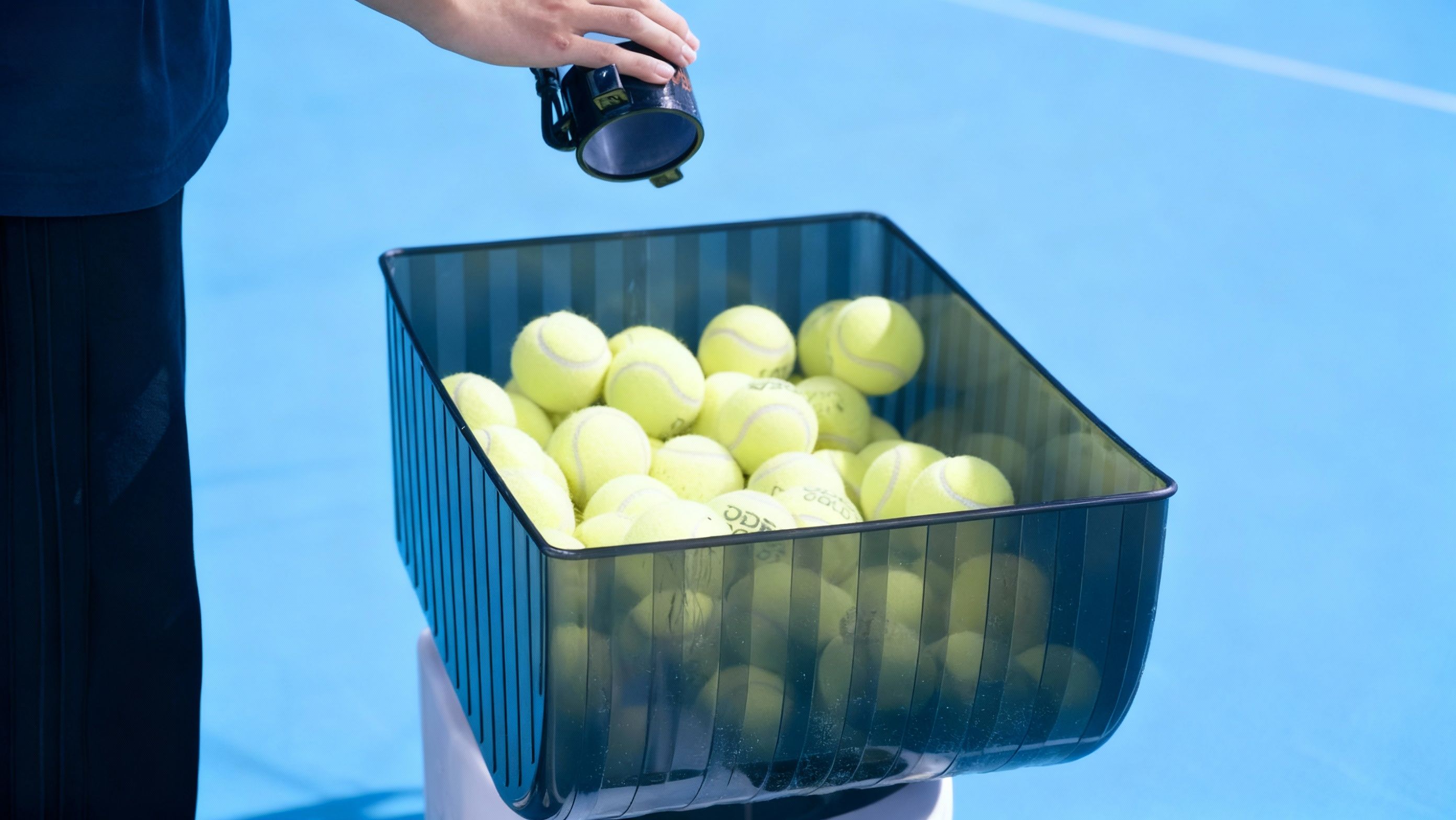
Pongbot's PACE series of intelligent tennis serving robots (Source/Enterprise)
Our serving robot is also designed according to this principle. It stably sends out balls at a fixed position according to a predetermined line and rhythm, without chasing the ball or disrupting the rhythm, helping users efficiently complete thousands of standardized repetitive practices.
The serving ability of the "hand" is the foundation of all intelligent guidance. Without a stable, accurate, and repeatable ball - feeding ability, subsequent visual perception and intelligent analysis are out of the question. Only when the ball is fed correctly and stably can users enter an effective training state, the visual system can capture meaningful action data, and the large model can analyze and provide feedback based on the correct context.
So we insist on developing the "hand" first, promoting the product, accumulating ball - path data and user training behaviors, and then gradually adding the abilities of the "eye" and "brain" and continuously iterating.
Yingke: When expanding from one sport to another, what are the core difficulties at the product definition level?
Zhang Haibo: When entering a new sport, understanding the sport itself is crucial. Different sports challenge different human limits: tennis