Openclaw Lobster has been releasing updates for five consecutive days, with two updates in 24 hours, going all out! So, what exactly has been updated?
I've never been this exhausted chasing the latest versions. It seems that the OpenClaw team doesn't need any rest at all.
Rarely do we see an AI framework that uses the update date as its version number, and the well - known OpenClaw is one of them.
In just five days, there were five version numbers - from v2026.4.7 to v2026.4.11. The open - source personal AI assistant OpenClaw (Lobster) completed an intensive iteration on GitHub that can be described as "going all out".
Reconstruction of the memory system, security reinforcement, repair of multi - platform channels, access to video generation, local voice inference... Almost every version is packed with heavy - weight updates.
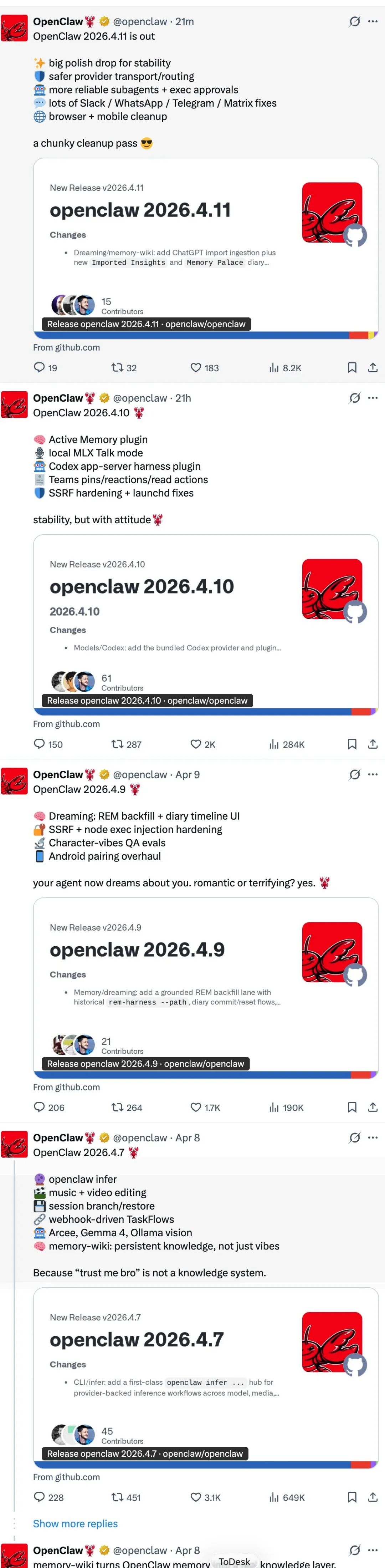
OpenClaw's X homepage is completely filled with update logs. Let's take a brief look:
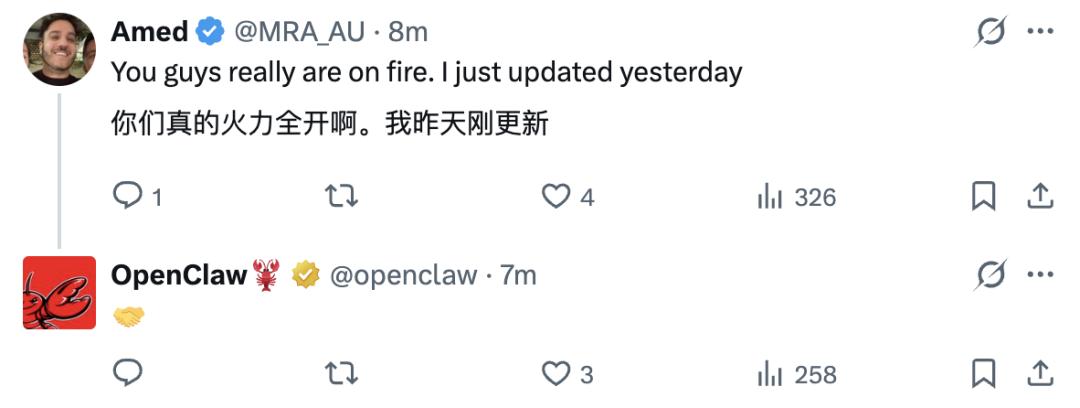
Netizens sighed that the update speed is too fast. It was just updated yesterday, and there's something new today. Even, the latest two updates were released within 24 hours!

V2026.4.7: Major expansion of infrastructure
Reconstruction of inference and memory system: A new openclaw infer CLI inference center is added, supporting unified invocation of multiple models; The full - stack restoration of the Memory Wiki - plugins, CLI, toolchains, and structured claims, digests, and linting are all available; The Dreaming system supports ingesting corpora from desensitized transcribed texts.
Media and generation capabilities: The media generation tool adds an automatic downgrade mechanism across providers, and video generation supports the pre - preparation for Seedance 2.0; A new event cover image is added to Discord.
First wave of security reinforcement: Purification of the host execution environment (intercepting Java/Rust/Cargo/Git/K8s / cloud credentials), enhanced SSRF protection, blocking of browser profile mutations, byte limit for Base64 decoding, discarding of cross - domain redirect request bodies, verification of Teams file authorization URLs, and trusted marking of runtime events.
Channel repair: Handling of iOS structured connection errors, restoration of Apple Watch approval, Slack thread mentions and explicit @bot, automatic joining of Matrix invitations, protected media for QQBot, and an option to exit the private network for BlueBubbles.
In addition, a webhook inbound plugin, persistent compression checkpoints (UI supports branching and rollback), a pluggable compression provider registry, system prompt word overrides, support for Gemma 4, the Arcee AI provider, and Ollama visual detection capabilities are introduced.
OpenClaw says: "Because 'trust me bro' is not a knowledge system."
V2026.4.8: Vulnerability "scavenger"
This is a version centered on fixes. It solves the startup crash problem of multiple channels in the npm build environment: Telegram and all bundled channels (BlueBubbles, Feishu, Google Chat, IRC, Matrix, Mattermost, Teams, Nextcloud Talk, Slack, Zalo) are uniformly changed to load setup/secret contracts through the packaged top - level sidecar.
The compatibility metadata of bundled plugins is also aligned with the release version. In addition, it fixes the problems of HTTP (S) proxy and NO_PROXY support in Slack Socket Mode, the issue of the web crawler guard skipping the DNS fixed strategy under the trusted environment proxy, and aligns the availability of the Agent layer update_plan in the OpenAI family operation and the default reporting behavior of /exec.
V2026.4.9: Memory system upgrade + Tightening of security defense line
Upgrade of memory and dream architecture: A grounded REM backfill mechanism is introduced - historical diary notes can be played back into dreams and persistent memory without maintaining an independent memory stack. With the newly added structured diary view (Diary View), users can directly browse the timeline and track dream summaries in the UI. A new character - vibes evaluation report is added to the QA laboratory, supporting model selection and parallel comparison.
Carpet - style security repair: Re - execute SSRF security checks after interaction - driven page navigation (to prevent batch operations from bypassing isolation); Block runtime control variables and browser override variables in the workspace.env file; Mark the output of remote node exec as untrusted and clean the text; Force the upgrade of basic - ftp to 5.2.1 to fix the CRLF injection vulnerability.
Multi - channel repair: The Android pairing process is comprehensively optimized (cleaning up expired authentication codes, preferentially using stored device tokens, and pausing automatic retries in the background); Issues such as waiting for the Matrix gateway to start, retaining cross - domain authentication for Slack media attachments, and maintaining session routing are all fixed.
OpenClaw says: "Your agent is now dreaming about you. Is it romantic or scary? Yes."
V2026.4.10: Major update - Active Memory plugin debuts
This is the version with the most significant changes among the five.
Active Memory plugin: The most eye - catching new feature - an optional active memory plugin inserts a dedicated memory sub - agent before the main reply, which can automatically pull relevant preferences, context, and historical details during an ongoing conversation. It supports three context modes (message /recent/full), real - time /verbose checks, and custom prompt and thinking parameters. Users no longer need to manually say "remember this" - the AI will do it on its own.
Codex built - in provider + MLX local voice: A new codex/gpt - * built - in provider is added, following the native authentication and model discovery path; The macOS Talk Mode experimentally accesses the MLX framework for local voice synthesis, and voice playback is completely completed locally.
Video generation and message operations: Officially support the Seedance 2.0 model (through the fal provider); New operations such as pinning/unpinning, marking as read, and emoji reactions are added to Microsoft Teams.
Security upgrade again: Seven aspects of browser sandbox navigation defense are tightened (SSRF default policy, hostname whitelist, sub - frame restrictions, etc.); Strengthen the pre - check reading of exec, set a rejection list for host environment variables, enforce the boundary of the QQBot media storage path, secure the ACPX tool hook, and desensitize the Gmail listener token.
Full - platform update:
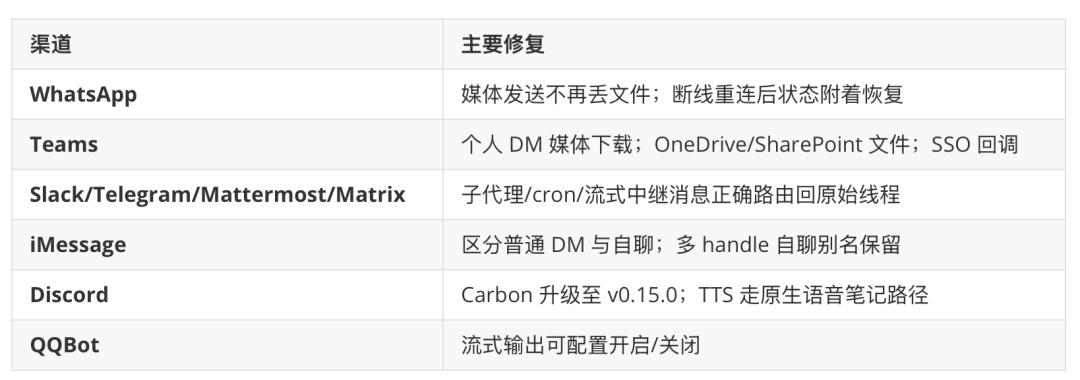
Three new test channels are added to the QA infrastructure: a one - time Matrix server, Telegram private group bot - to - bot testing, and multipass Linux VM scenario operation.
OpenClaw says: "Stable, but with an attitude."
V2026.4.11: Experience refinement and ecosystem improvement
Import of ChatGPT conversations: A new import function is added to Dreaming/Memory Wiki. Users can migrate ChatGPT conversation records to the OpenClaw memory system. New "Imported Insights" and "Memory Palace" tabs are added to the UI - AI interaction experience accumulated on other platforms can be seamlessly migrated.
Rich text output in Webchat: The assistant's replies are rendered as structured chat bubbles, and a new [embed ...] rich external embedded URL tag (configurable switch) is added.
Enhanced video generation: Support for URL - only asset delivery (no need to load large files into memory), typed providerOptions and reference audio input, adaptive aspect ratio, and a higher image input limit.
Plugin ecosystem: The manifest can now declare activation and setup descriptors. Third - party plugin developers can describe the authentication, pairing, and configuration steps required for the installation process without writing hard - coded logic for the core code.
Other fixes: Fix the Codex OAuth invalid_scope error, fix the failure of the audio transcription DNS fixed strategy, avoid secondary switching after the first authorization in macOS Talk Mode, fix the WhatsApp edited picture path hallucination, fix the Agent cross - provider fallback error inheritance bug, and optimize the Ollama metadata cache.
OpenClaw says: "A radical overhaul."
In five days, five versions, and hundreds of changes. This lobster is really running fast.
This article is from the WeChat official account "MachineHeart" (ID: almosthuman2014). The author is someone who pays attention to OpenClaw. It is published by 36Kr with authorization.