Sunwoda has become the Cambrian of the power battery industry.
Sunwoda has won another battle.
On April 9th, according to 36Kr Auto, it learned from multiple industry insiders that Sunwoda Electric Vehicle Battery Co., Ltd., a subsidiary of Sunwoda focusing on power battery business, has entered Tesla's global supply chain and become Tesla's fifth global power battery supplier.
Industry insiders who are involved in the project revealed that this type of battery has been shipped from Sunwoda's factory in Yiwu, Zhejiang, and is installed in the models sold overseas by Tesla's Shanghai factory. "It has been shipped for a while." With this, Sunwoda has become the second Chinese power battery supplier for Tesla after CATL.
It is reported that Tesla's cooperation with Sunwoda on power batteries also adopts a new model. Tesla directly purchases battery cells from Sunwoda and self - manufactures modules and PACK (battery packs). Compared with the previous practice of purchasing modules from CATL, this is also Tesla's new attempt in square batteries.
Tesla is on the decline, while Sunwoda is on the rise
The cooperation between Tesla and Sunwoda is more like an exchange to meet each other's needs rather than a combination of two strong forces.
Everyone actually understands Tesla's recent situation.
Its first - quarter delivery data shows that Tesla only sold 358,000 vehicles in that quarter, 4% lower than analysts' expectations and 7% lower than J.P. Morgan's forecast of 385,000 vehicles.
The sluggish sales directly led to a high inventory. J.P. Morgan said in a research report, "The inventory of unsold new cars has soared, further exacerbating Tesla's free - cash - flow dilemma. In the first quarter of 2026, Tesla's production exceeded the delivery volume by 50,363 vehicles, and the single - quarter inventory backlog reached a record high."
Looking further back, Tesla's performance in 2025 was also not good.
In 2025, Tesla's total annual revenue was $94.827 billion, a year - on - year decline of 3%. It was the first annual revenue decline since its establishment. The GAAP net profit was $3.794 billion, a year - on - year plunge of 46%. The delivery volume was 1.636 million vehicles, a year - on - year decrease of 8.6%, showing a decline for the second consecutive year, and it lost the title of the world's best - selling electric vehicle to BYD.
From the perspective of quarterly revenue, in fact, since exceeding $24 billion in revenue in Q4 of 2022, Tesla has been in a "stagnant" state.
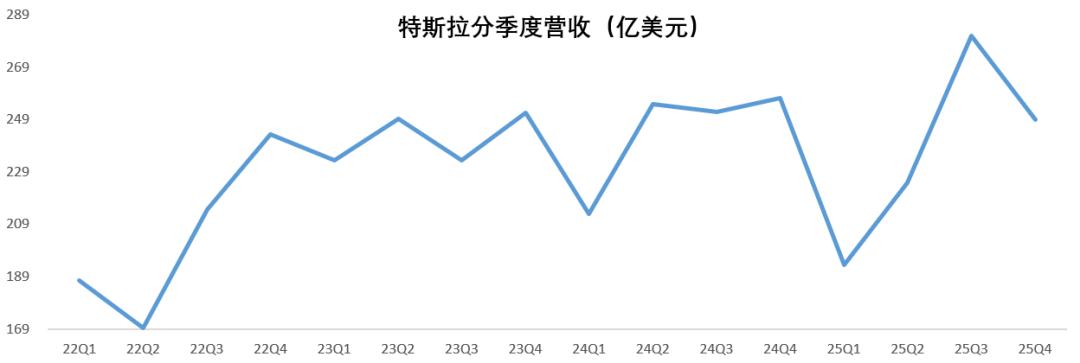
Well, since it's not easy to increase revenue, Tesla can only squeeze profits from the cost side. Whether it's the plan for Model 2 or the "affordable" Model Y, they are all choices to boost the gross profit margin.
The purpose of introducing Sunwoda is also the same.
According to 36Kr Auto, for a long time, Tesla's battery supply has been basically controlled by three giants: CATL, Panasonic, and LG. Among them, CATL mainly supplies lithium - iron - phosphate battery modules, stabilizing the basic market of entry - level and mid - range models; Panasonic and LG Energy Solution focus on high - end ternary lithium batteries to support the needs of high - performance models.
This seemingly stable "iron triangle" lineup in the past has now become a tough nut for Tesla on its cost - reduction path.
CATL has always had a strong say in the supply chain. Adhering to a high - gross - profit strategy, the price - cut it can offer in the face of Tesla's "price - cutting" demand is naturally quite limited.
The other two overseas giants also have little room for negotiation. The ternary lithium batteries supplied by Panasonic and LG Energy Solution naturally have higher material costs than lithium - iron - phosphate batteries. Moreover, in recent years, Panasonic's battery gross profit margin has been hovering around the 5% survival line. It's almost an impossible task for Tesla to squeeze more gross profit from these two "already thin - profit" suppliers.
Since there is no room for cost reduction in the old supply chain, Tesla, which urgently needs to "squeeze" profits from the cost side to save its financial report, can only turn its attention to the players in the second - tier.
Domestic second - and third - tier power battery manufacturers like Sunwoda do not have the strength of top - tier manufacturers. Their core strategy to win orders is very simple and straightforward, that is, offering high - quality products at low prices. They can not only provide highly competitive prices but also actively cooperate in using new materials.
More importantly, in order to secure Tesla's orders, Sunwoda has surrendered a great deal of control. In this cooperation, Sunwoda is willing to stay in the background and only serve as a pure battery - cell supplier, handing back the customization rights, pricing rights, and even the subsequent profit margins of modules and PACK (battery packs) to Tesla for self - manufacturing.
For Sunwoda, breaking into Tesla's supply chain has long been expected.
In the company's meeting minutes in February, Sunwoda said: "It is expected to start supplying batteries in bulk to new customers such as Xiaomi, Tesla, SAIC Volkswagen, and FAW - Volkswagen in 2026. Tesla is expected to contribute an incremental 3GWh in 2026."
This also means that, on the contrary, Tesla may not be that important to Sunwoda. In Sunwoda's strategy, a "low - profile" does not mean "low - value." Instead, it is a proven business approach.
Simply put, it is to "cast a wide net and become the 'super contract manufacturer' of the entire industry."
In addition to Tesla, whose orders are expected to increase significantly this year, Sunwoda's customer list is already full of the names of various star car manufacturers. From establishing a joint venture with Li Auto to forming a team of dozens of people stationed near Xiaomi's car office, and to the expected supply to Hongmeng, SAIC Volkswagen, FAW - Volkswagen and other giants this year, Sunwoda appears in the supplier list of almost every car manufacturer.
As the saying goes, being someone's backup is being a backup; being the backup of a hundred people, they become your basic market.
It is precisely through this extreme degree of cooperation, giving up the profit margins of modules and PACK, and with the core advantage of "high - quality and low - cost" that Sunwoda has penetrated into the supply chains of almost all mainstream car manufacturers. When all car manufacturers are looking for alternatives to CATL to reduce costs, Sunwoda can always be the most cost - effective fallback option.
The synchronous counter - attack of second - tier manufacturers in the battery and computing - power industries
Although in terms of business logic, Sunwoda treats various car manufacturers as "backup options" to expand production capacity, in actual implementation, the services provided by Sunwoda are by no means perfunctory. In fact, they can be described as extremely "subsidized" services.
Different from powerful leading enterprises like CATL, Sunwoda has shown amazing cooperation to win orders. This cooperation is not only reflected in price concessions but also extends to a comprehensive catering in R & D, design, and even organizational structure.
For example, in the cooperation with Li Auto, Li Xiang once said internally: "We need to have the right to define." And Sunwoda has indeed done so.
In the cooperation, Sunwoda does not act like a traditional large - scale power battery manufacturer but plays the role of a pure "contract manufacturer." Core links such as the development of battery cells and the overall design of battery packs are entirely controlled by Li Auto. What Sunwoda does is to produce these "Li Auto - branded" batteries in accordance with Li Auto's requirements, ensuring both quality and quantity.
In the Xiaomi car project, Sunwoda has taken the "intimate service" to the extreme.
According to industry insiders, in order to respond to Xiaomi's new - car development needs at any time, Sunwoda has specially formed a team of 30 to 50 people and stationed them directly at Xiaomi's car division. This on - site service that is available at any time has greatly alleviated Xiaomi's anxiety in supply - chain management in the cross - border car - manufacturing process.
This approach of "giving up the soul" and using an extremely low - profile to gain living space is almost the same as Cambricon's service for ByteDance.
ByteDance has always had a strong ambition for self - developed chips. However, during the "vacuum period" when the overseas computing - power supply is full of uncertainties and its own ASIC chips have not yet taken on the main role, the huge gap in inference computing power has forced ByteDance to look for alternatives.
At this time, Cambricon entered ByteDance's supply chain. In essence, this is not a strategic alliance based on long - term trust but more like a "fear - based procurement" due to the fear of computing power.
According to industry insiders, in order to stay on ByteDance's supplier list, Cambricon has paid a high service price. It has not only provided relatively in - depth customized adaptation, closely cooperated with ByteDance's complex operator requirements in the software stack, but also sacrificed the iteration rhythm to some extent to play the role of a highly obedient "computing - power contract manufacturer."
The same is true in terms of service attitude. According to an internal memo that was leaked in the second half of 2025, Cambricon, like Sunwoda stationed at Xiaomi, sent an engineer team to serve ByteDance specifically. In contrast, the progress of another domestic chip leader entering ByteDance even stagnated for a while due to its poor service awareness. As a result, ByteDance finally chose Cambricon as its primary supplier.
It can be said that whether it is Sunwoda, which caters to Tesla with low prices and 3C fast - charging technology, or Cambricon, which fills ByteDance's computing - power gap with the Siyuan 590, the underlying logic of their performance explosion is exactly the same: both are based on the fact that leading suppliers cannot meet customers' needs, and they use "intimate nanny - style" services and customized compromises to obtain the entry ticket and scale growth.
Therefore, in this survival competition called the "giant supply chain," Sunwoda has become the Cambricon in the power - battery industry.
They are both practical and sober, well aware that on the wasteland full of giants, survival is the only truth. By sacrificing pricing rights and customization rights, they have indeed achieved short - term prosperity and scale leap.
However, before Musk, Zhang Yiming and others completely close the door on self - research and self - production, the "backup options" still need to think about how to build their own core competitiveness.
This article is from the WeChat official account "Super Focus foci", author: Sean. It is published by 36Kr with authorization.