Meet Generalist at the peak. How did Qianxun Intelligence manage to attract 3 billion in just 30 days?
The Capital Blitz Begins: Lei Jun and Jack Ma Rarely Co - Lead an Investment
Qianxun Intelligence has once again accelerated its financing pace.
On April 7, 2026, Qianxun Intelligence announced the completion of a new round of financing worth 1 billion yuan. This round of financing was jointly led by Shunwei Capital and Yunfeng Capital, with significant support from Fortune Capital, a leading RMB - denominated fund, Galaxy Yuanhui, Turing Fund, Xinding Capital, Gengxin Capital and other heavy - hitters.
This is already its second large - scale financing within 30 days. Just in February not long ago, the company completed a financing of nearly 2 billion yuan. With the combination of the two rounds, the cumulative financing amount has directly reached 3 billion yuan.
What's even more interesting is that in this round, there appeared a highly topical combination: Lei Jun (Shunwei) + Jack Ma (Yunfeng), leading an investment together in the embodied intelligence track for the first time.
In the past, they have each bet on key cycles such as mobile Internet, e - commerce, smart hardware and cloud computing. This time, their joint investment in the field of robotics, especially in the still - early stage of embodied intelligence, indicates that this direction is moving from technological imagination to capital consensus and is starting to enter a ranking elimination stage endorsed by giants and with highly concentrated capital.
Qianxun Intelligence was founded in January 2024 by Han Fengtao, a serial entrepreneur in the robotics field, Gao Yang, a top - notch AI scientist, and Zheng Lingyin, a pioneer in robot overseas expansion.
Han Fengtao, the founder and CEO, was formerly the co - founder and CTO of Luoshi Robotics. He led the delivery of nearly a hundred robot models and has profound engineering and mass - production capabilities. Co - founder Gao Yang graduated from the University of California, Berkeley, and studied under the computer vision master Trevor Darrell. He is now an assistant professor at the Institute for Interdisciplinary Information Sciences of Tsinghua University. The Spirit v1.5 model open - sourced by his team surpassed the leading US model Pi0.5 in the RoboChallenge list, becoming the first Chinese open - source embodied model to top the list. Co - founder Zheng Lingyin is a pioneer in the overseas expansion of industrial robots. She built an overseas business unit from scratch, led the team to deeply explore multiple overseas markets and quickly achieved the transformation of commercialization results.
The three founders cover the three core capabilities of AI, robotics and commercialization respectively, jointly forming a rare "hexagonal warrior" team in the industry. This is also the underlying confidence for it to obtain 3 billion yuan in financing within 30 days and for Shunwei Capital and Yunfeng Capital to make a heavy investment. Such a combination enables Qianxun Intelligence to have both world - class technological foresight and commercialization genes from its inception.
Han Fengtao once pointed out that in 2026, what matters is the data scale and model performance. The most important thing this year is not to expand scenarios, but to make the embodied model one of the top 3 in the world. To achieve this, there must be enough money in the account.
Therefore, the blitz - style continuous financing is essentially to use capital density to gain a time advantage, quickly accumulate resources, widen the performance gap and lock in a leading position in advance. At the same time, the continuous investment of old shareholders in this round means that investors have switched from waiting and verification to accelerating their bets.
So, what exactly enabled Qianxun Intelligence to obtain this accelerated entry ticket? How deep has its moat been dug?
The Underlying Logic of Capital Investment: A Path Similar to Large - Scale Models is Verified
Why is capital willing to continuously increase its investment? The answer: the model has already given a phased answer.
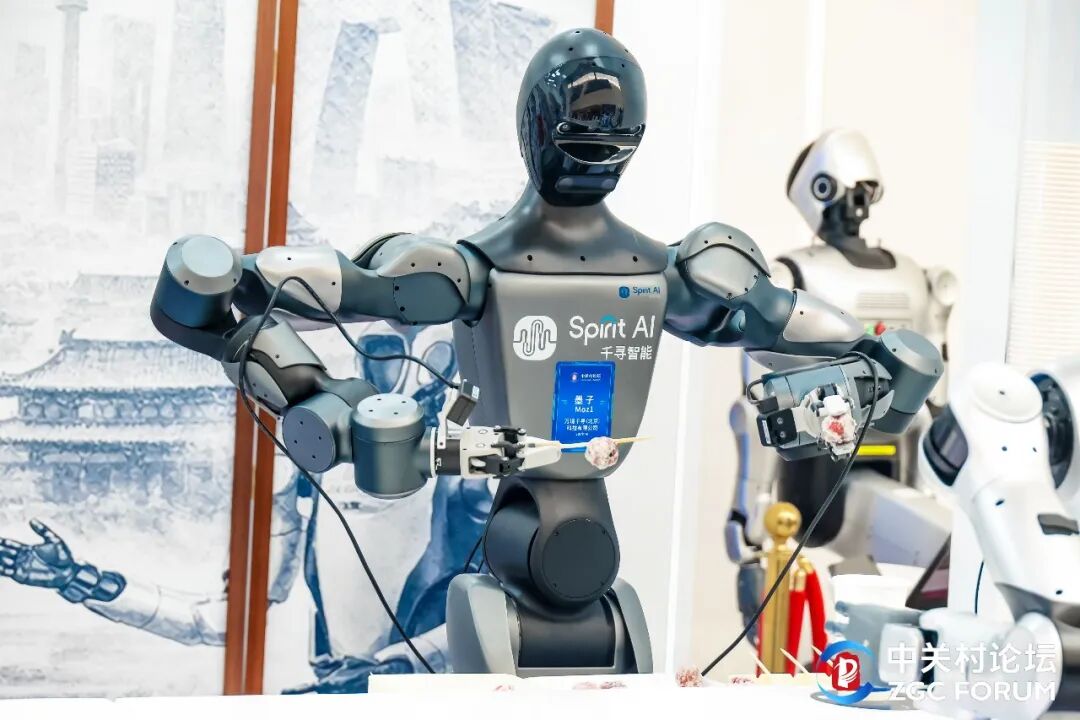
In January this year, Qianxun Intelligence open - sourced the embodied model Spirit v1.5. In public evaluations, this model directly surpassed the then - strongest open - source model Pi0.5.
However, what really impressed the capital was the inflection point of the ability curve.
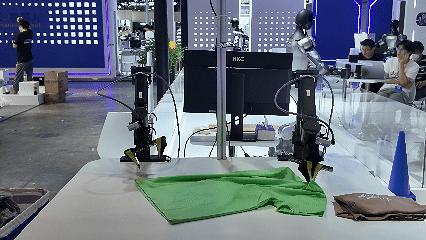
Spirit v1.5 has demonstrated relatively stable zero - sample generalization ability - it can complete a series of complex operations such as wiping, opening and closing hinges and handling flexible objects without additional training.
In other words, robots are no longer just learning a single task, but have the ability to transfer across tasks, which makes people see the possibility of embodied intelligence liberating human productivity.
Behind this corresponds to a technical path highly similar to the large - language model (LLM): make the model larger, feed it enough data, continuously iterate, and then trust the "emergence" of abilities.
Specifically, Spirit v1.5 is an end - to - end VLA (Vision - Language - Action) unified model. It is not obsessed with restoring all the details of the world, nor does it emphasize the explicit world simulation in the middle layer. Instead, it directly learns the mapping relationship from perception to action.
The training method is also very LLM - like. The only difference is that the text data is replaced with robot data. First, pre - train with a large number of Internet videos to establish a basic understanding of the world, and then align with real interaction data - first obtain generalization ability, and then approach specific tasks.
As a result, with lower computing power and parameter scale, it has achieved stronger generalization performance.
Just a few days ago, this path also got the "sympathetic resonance" from Silicon Valley peers.
On April 3, Silicon Valley - based embodied intelligence company Generallist AI released its basic model GEN - 1, which verified the Scaling Law in the field of embodied intelligence with 500,000 hours of real physical interaction data. How powerful is the effect?
These robots have significantly increased the average success rate of multiple physical tasks from 64% to 99%; their execution speed is almost as fast as that of humans, reaching about three times that of the current most advanced systems, and they can also improvise on the spot. Even more exaggerated is that for each new ability, only about one hour of robot data is needed.
Company CEO Pete Florence pointed out that what is happening in the robotics field is very similar to the situation when people open GPT - 3 and ask it to write a brand - new limerick.
Similar observations have also been verified by the Qianxun team. "Our team has also discovered the Scaling Law in the field of embodied intelligence. For every tenfold increase in data, there will be an additional 9 in the result." Gao Yang once described the steepness of this curve. "We are at the Scaling Law moment of embodied intelligence. Since it is more difficult to obtain data for robots, I think it will take longer for the 'GPT - 4' of robots, perhaps 4 - 5 years."
It can be said that what the capital is investing in is a technical route that has been initially verified and has higher cost - effectiveness and expansion potential.
The Data Engine: The Key to the Viability of the Path
In the field of embodied intelligence, almost everyone has a consensus: data collection is a fundamental bottleneck.
Large - scale models can consume a large amount of Internet corpus, but robots cannot - in the world of physical labor, there is no Wikipedia. On the surface, everyone is competing in models, but the underlying competition is actually about the data engine. "We will do whatever it takes to achieve scalability," Pete Florence said bluntly.
Since we believe in the Scaling Law, what kind of data system can be obtained at a low cost, continuously expanded, and have sufficient diversity?
In the past, robot general models with a success rate of over 90% relied on extremely expensive and difficult - to - scale large - scale remote - operation datasets (such as Physical Intelligence). However, Generallist AI developed its own "data hands" - a two - finger wearable device worn on the wrist, which turns human hands into robot - like grippers to collect visual and sensory data.
As a result, the progress of GEN - 0 and GEN - 1 has verified that this data engine can also achieve a high - level proficiency - they did not use robot data, but only the data generated by humans wearing low - cost wearable devices in millions of activities.
Qianxun Intelligence is also promoting a Scaling route centered on diversity.
In terms of the hardware solution, Qianxun also chose a wearable solution, but went further. In order to enable the model to learn human - level fine operations, they adopted a three - finger structure design - the intelligent whole machine is equipped with 26 degrees of freedom, each joint is integrated with a force sensor, and it is equipped with a three - finger dexterous hand. However, the technical challenges have also increased significantly. The three - finger structure faces higher degrees of freedom, more precise force - control requirements and more complex motion mapping in wearable data collection.
Currently, Qianxun's wearable device has been iterated to the fifth generation, with the data availability increasing from 30% to 95%, and the cost being compressed to about one - tenth of remote operation.
It should be noted that, different from Generallist AI, which completely relies on wearable data, Qianxun has built a multi - source integrated data engine.
In the pre - training stage, in addition to a large amount of wearable data, Qianxun Intelligence also actively integrates Internet videos for pre - training to obtain general knowledge and basic abilities. Then, it introduces real - machine remote - operation data for fine - grained SFT (Supervised Fine - Tuning) to improve the model's performance in real tasks. Finally, it further optimizes the model through reinforcement learning: let the model continuously roll out in the real environment, continuously generate new data, and feed it back to the model.
So far, Qianxun has obtained more than 200,000 hours of real interaction data from multiple channels such as Internet videos, remote operation and wearable collection, and this number is still growing rapidly. It is expected to exceed 1 million hours in 2026. As of April 2026, Qianxun Intelligence's data collection team will also reach a scale of one thousand people.
It is worth mentioning that Qianxun's understanding of data has also undergone an essential change.
They are no longer obsessed with the industry - mainstream painstakingly scripted data, but have turned to a more open and diversified collection paradigm: instead of strictly specifying the action path, they let the execution process unfold naturally around the task goal: allowing failure, allowing things to be knocked over, allowing interruptions, and then continuing to complete the task.
This change is fundamental. The model no longer learns how to do a specific thing, but how to handle similar situations. With the same data scale, this data distribution significantly improves the model's migration efficiency and reduces the dependence on computing power.
"Laying Eggs Along the Way": Real - World Scenario Data Feeds Back to the Model
In Qianxun's data engine, what really determines whether the flywheel can turn is not just the data source, but the ability to continuously roll out in the real environment.
Han Fengtao once summarized that moving towards real scenarios is to obtain the fuel (data) for model evolution. Commercialization is to make this acquisition process sustainable and scalable.
Behind this, there actually corresponds to a clear differentiation between Chinese and American paths. In the United States, some companies can invest in the basic model itself for a long time, trading time for the upper limit of ability. However, in China, it is difficult to continuously obtain financing without a demo or a signal of implementation. Most companies that can survive, or even thrive, will choose a more compromise path.
The road to general AI is a long and arduous one. It is impossible to wait for the model to mature before looking for applications. Only by letting robots enter the real production environment and participate in real business operations can we use the massive data generated by real business operations to feed back to the model and make it continuously evolve.
As the first domestic embodied intelligence company to promote the diversified data collection route from theory to engineering and scale, and to complete double verification in real business scenarios, Qianxun Robotics adheres to the principle of "laying eggs along the way". They start from controllable scenarios and first enter the industrial and service sectors, which have relatively stable structures, clear task boundaries, high profits and are willing to pay. While verifying the model's ability, they also support the company's operation.
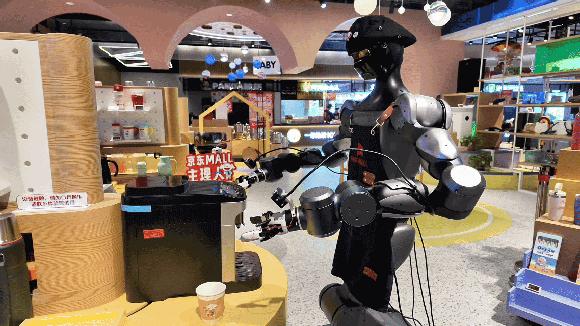
For example, in the retail scenario, Qianxun's cooperation with JD.com (also one of the investors) is deepening. "Xiaomo" has entered JD MALL and taken up the post of barista. While completing service tasks, the robot also synchronously collects multi - modal perception data, joint motion trajectories and fine force feedback information.
This "expert - level data" from the real retail environment will be directly used for the training and fine - tuning of the embodied model, forming a positive closed - loop of "data collection - model iteration - ability improvement".
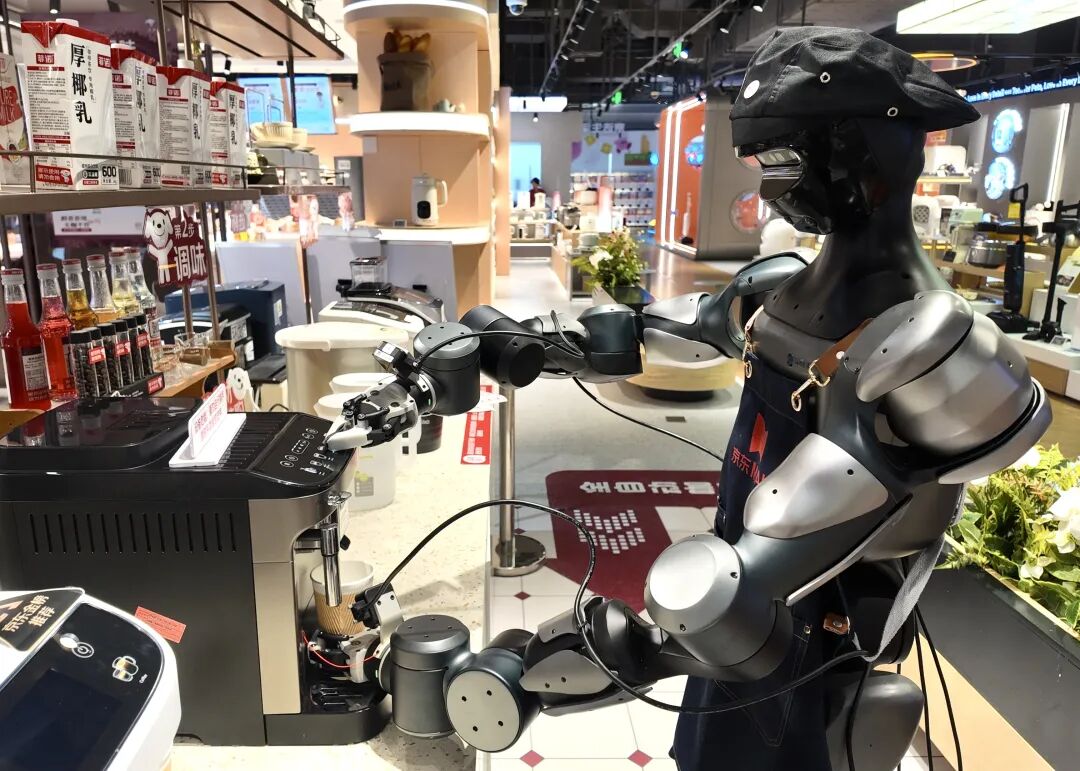
Qianxun Intelligence's robot has officially started working as a barista at JD MALL.
The two parties also plan to further expand embodied intelligence to more retail sub - sectors, including digital home appliance sales guidance, inspection and tour guidance, and automated cleaning. At the same time, JD Pharmacy is also regarded as a core breakthrough point. The robot will participate in high - precision tasks such as automatic sorting and accurate medicine dispensing, and explore unmanned intelligent pharmacy solutions.
Before entering JD Mall, Qianxun had completed a round of verification in the industrial environment. "Xiaomo" has taken up the post on the power battery pack production line of CATL, responsible for the final functional test before offline. So far, it has completed the plug - in operation of more than 1,000 batteries, with a success rate stably above 99%, and the operation rhythm is also approaching that of skilled workers.
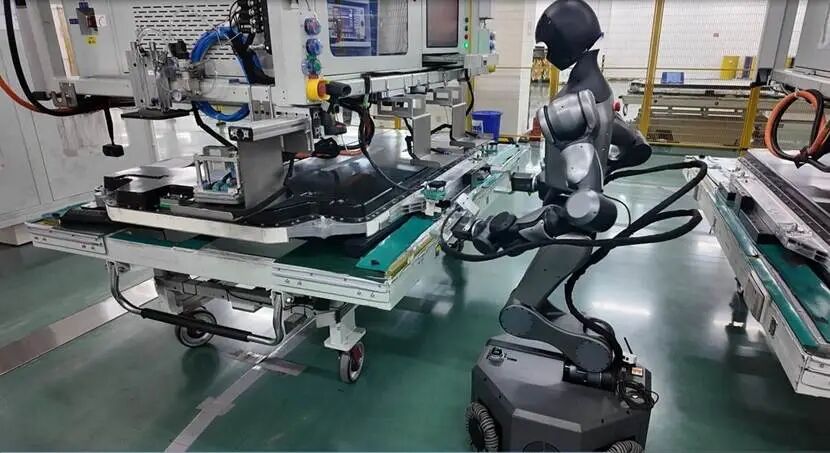
Xiaomo has started working on the power battery pack production line.
In the short term, the moment of victory or defeat in embodied intelligence will not come immediately after implementation. However, a clearer trend has emerged - the competition is no longer just about who has more data, but about who can more efficiently obtain real - world scenario data and who can build a more frequently rotating data - model flywheel closed - loop.
After achieving a phased leap in valuation, Qianxun Intelligence will on the one hand bet on the model's generalization ability, and on the other hand continue to amplify the data scale advantage, using high - frequency feedback from the real world to accelerate model iteration.
Looking back at GPT - 2 in 2019, it may not have seemed significant, but as the scale continued to expand, the returns brought by the generalization ability quickly increased. Now, the same inflection point is being repeated in the robotics field.