70 Years of China Power: How was the "Empire" Built?
On March 4th, Trump met with the leaders of seven major tech giants, including Amazon, Google, Microsoft, and OpenAI, at the White House. There was only one topic on the agenda: companies must solve the power supply problem for their new AI data centers on their own and not consume public electricity.
Currently, the competition for AI computing power has become a key factor in the game among major powers, and the foundation of computing power is electricity.
This meeting at the White House highlights the dilemma of electricity shortage in the United States.
While the White House is struggling with the electricity issue, a global power shortage is spreading across many countries. The electricity price in Germany once soared to the highest level of the year. India's power rationing has hit its domestic industries. Spain and Portugal recently experienced an unprecedented blackout...
In China, the total electricity consumption of the whole society is expected to exceed 10 trillion kilowatt - hours in 2025. For the first time in human history, a country will reach this figure, which is more than twice the electricity consumption of the United States and higher than the total annual electricity consumption of the European Union, Russia, India, and Japan. The Financial Times of the UK exclaimed, "China is about to become the first electricity empire in human history!"
Compared with the 150 - year history of electricity development in European and American countries, China's power industry started very late and from scratch. How did it manage to overtake them significantly in just over 70 years and become the global leader?
One of the important answers is:
From the very beginning, we chose a completely different path.
The Starting Point
In 1949, when New China had just emerged from the war, the total installed power - generation capacity of the whole country was only 1.85 million kilowatts, and the annual power generation was only 4.31 billion kilowatt - hours. On average, each person had less than 8 kilowatt - hours of electricity, ranking last among major countries. It was only half of India's and one - three - hundredth of the United States' at that time, not even enough to run an air - conditioner for 4 hours today.
Comparing with Shanghai's annual electricity consumption of 208.888 billion kilowatt - hours in 2025, the electricity generated by the whole country in 1949 was only enough for Shanghai to use for a week.
At that time, more than 80% of the population in the country had no access to electricity. Many people had never even seen what an electric light looked like. It was truly a "power - poor country."
What was even more embarrassing was the power equipment. Most of the units in the power plants across the country were old machines from the late Qing Dynasty and the Republic of China, and they were generally over - aged. The power transmission lines were also fragmented. Except for the only 220 - kilovolt line and several 154 - kilovolt lines in the Northeast region, there were only scattered direct - connection lines in other areas.
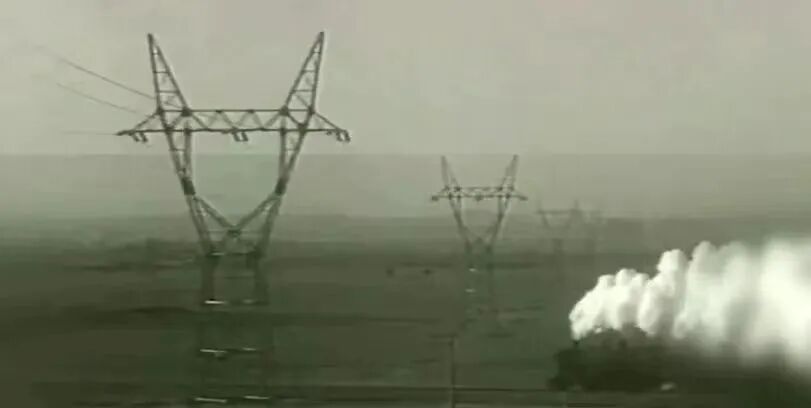
The first 220 - kilovolt high - voltage power transmission line, the Song - Dong - Li Line, in New China in 1954. Image source: The official website of the State - owned Assets Supervision and Administration Commission.
Facing such a difficult start, where should China's power industry begin?
Looking back at the early stages of the power industry in Europe and America, electricity was regarded as a purely profitable commodity, and private enterprises such as General Electric, Westinghouse Electric, and Siemens dominated the market.
Under the pure market - oriented system, electricity in the early days was like a luxury, and most ordinary people couldn't afford it.
In order to seize the market, some enterprises would build redundant power lines in the same area in a competitive way. The power lines over the cities were entangled like spider webs, resulting in redundant construction and a huge waste of resources.
In the United States, this phenomenon was not resolved until the "franchise system" (granting the power supply in each region to a single company for management) was promulgated and the federal government intervened in the unified planning of the power grid.
For New China, which was just established and had lagged behind Europe and America in power development for decades, it was obviously not advisable to copy this development path.
Based on an understanding of the national conditions, Chairman Mao put forward the idea that "electricity is the forerunner of the national economy." In just a few words, he defined the essence of New China's power: It is not a commodity but a basic guarantee and public resource, just like water and roads.
Since it is a public resource, the state should take on the responsibility, make unified plans, and concentrate the country's strength on its priority construction. For example, among the 156 key projects determined in the early days of the founding of the People's Republic of China, as many as 25 were power - related projects, accounting for 16%.
During this period, we built the first high - temperature and high - pressure thermal power plant in New China, the Fularji Thermal Power Plant in Heilongjiang, and the first large - scale water conservancy project on the main stream of the Yellow River, the Sanmenxia Hydropower Station.
However, the most difficult project was the Liujiaxia Hydropower Station in Gansu.
On September 27, 1958, the construction of the Liujiaxia Hydropower Station officially started. More than 20,000 builders gathered at the Yellow River, and a great feat of concentrating strength to conquer the Yellow River was about to begin.
Foreign experts once asserted that "the Chinese cannot build a hydropower station with a capacity of one million kilowatts." This time, the builders were going to challenge the impossible.
The challenge was arduous. The foundation of the main dam of Liujiaxia was uneven like a horse's back, with a drop of more than 10 meters. At that time, China did not have large - scale excavation machinery, so they had to dig manually with shovels and transport the waste rocks little by little in wheelbarrows and wooden baskets. The workers at that time joked that they were "digging the Dragon Palace."
There were only two pneumatic drills at the entire construction site at first. If the water supply was cut off during the excavation of the diversion tunnel, the drill rods would get stuck, seriously slowing down the construction progress. At this time, the hydropower workers even lined up to suck the accumulated water with their mouths and spit it into the water inlets of the pneumatic drills. They would turn the drills a few times after each spit and finally managed to drill through.
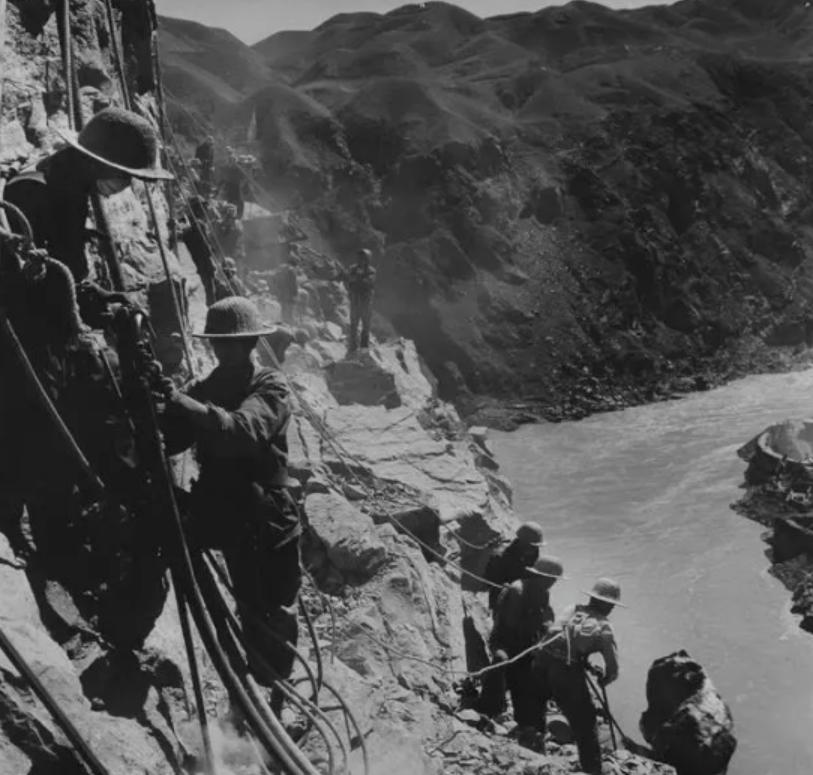
Image source: Linxia Net of China.
It was under such difficult conditions that Chinese power workers built the station brick by brick for nearly 11 years.
On April 1, 1969, the first unit of the Liujiaxia Hydropower Station successfully generated electricity. This was the first hydropower station with a capacity of one million kilowatts in Asia that was completely surveyed, designed, and built by the Chinese.
Relying on the national system of "concentrating strength to do major things," the total installed power - generation capacity of the whole country reached 57.12 million kilowatts in 1978, a 30 - fold increase compared with 1949. The annual power generation reached 256.6 billion kilowatt - hours, nearly 59 times that at the beginning of the founding of the People's Republic of China.
In just 30 years, China almost transformed from an agricultural country into an industrial country from scratch. From the "Two Bombs and One Satellite" to the launch of the first nuclear submarine and the birth of the first million - times integrated - circuit computer, all these milestone achievements were based on electricity.
Of course, China's power situation was still far from being worry - free at this time. Although the fundamental problem of "having or not having electricity" was solved, the per - capita electricity consumption was still only one - sixth of the world average. "Power shortage" was still the main contradiction.
After the reform and opening - up and the rapid economic development, the demand for electricity soared like a flood, and a greater challenge was quietly approaching.
Power Development Should Be "Appropriately Ahead"
In 1978, the horn of reform and opening - up sounded. Farmers in southern Jiangsu left the fields to start township enterprises. Factory owners in the Pearl River Delta scrambled for "processing with supplied materials, samples, and designs" orders with broken English. Hundreds of thousands of salespeople from Wenzhou crowded onto green - skin trains with samples, creating the legend of "feathers flying to the sky."
China's GDP began to grow rapidly at an average annual rate of 9.8%, and the industrial added value increased at an average annual rate of 11.6%.
All these economic activities were supported by electricity. Even though the power generation at this time had increased 30 times compared with 1949, it was still far from enough.
In the factories in the foreign - trade zones in Guangdong, the system of peak - shifting power use, such as "three - day operation and four - day shutdown" or "two - day operation and five - day shutdown," became the norm. A factory owner once mentioned in the meeting minutes, "The factory is built, foreign investment has come, and orders are available, but there is not enough electricity."
In the workshops of equipment enterprises in Chongqing, due to power rationing, the fans could not be used. The workers not only had to endure the high temperature of 38 degrees but also fight with mosquitoes.
Even in Beijing, the capital, during the power - shortage period, there was a record of 110,000 power cuts in a year, with an average of more than 300 power cuts per day. Citizens were afraid to take the elevator for fear of being trapped, and the mayor's hotline was jammed with complaints from the public.
In 1980, a cadre from the Fuel and Power Bureau of the State Economic Commission sighed during a local inspection, "No matter where I go, people are telling me about the power shortage and asking for more electricity!"
A consensus gradually emerged across the country: The old way of "the state pays, one entity generates electricity, and everyone uses it" could no longer solve the new problems.
At this time, a pilot project at the Longkou Power Plant in Yantai, Shandong, caught the attention of the top leadership.
This power plant adopted an innovative model. The Ministry of Electric Power Industry invested 30%, and the local government in Yantai raised the remaining 70%. The principle of "whoever invests, uses the electricity, and benefits" was implemented.
To solve the funding problem, Lin Zhicai, the person - in - charge of the power plant, traveled around the surrounding counties and cities to promote the benefits of raising funds to build a power plant. He also mobilized the employees in the factory, saying, "Don't buy color TVs or refrigerators. Take out your money to build the power plant." In that era, the power workers regarded the factory as their home, so they were willing to contribute to the power plant. Moreover, a shutdown of the factory meant a stop in salary, and investing in the power plant could also earn interest. So, the factory leadership took the lead, with each person investing 500 yuan. All 1,230 employees in the factory actively responded, with some investing 200 yuan and others 300 yuan. Eventually, 500,000 yuan was raised.
Just one year after the Longkou Power Plant was put into operation, Yantai changed from a well - known "power - short area" in the province to one of the areas with the most abundant power supply. The industrial and agricultural output value increased by 1.9 billion yuan, ranking among the top in the cities of Shandong Province.
The success of the Longkou Power Plant provided a feasible path to solve the national power shortage. In August 1984, the central government officially established the policy of "raising funds to build power plants," emphasizing that the central government would contribute a part, local governments would contribute a part, enterprises would raise a part, and banks would provide loans. Foreign investment and joint - venture power generation were also allowed. After the project was completed, the power would be supplied to the investors first. Whoever invested would benefit.
This measure activated social capital, and a wave of power - plant construction swept across the country.
The effect was immediate. In the following decade, China's power - installed capacity increased by 240%, with a net increase of more than 240 million kilowatts in installed capacity. For the first time, the balance between power supply and demand was achieved.
Comrade Li Peng wrote a poem about this: "For thirty years, power cuts and rationing have been the norm. Three - day shutdown and four - day operation have been a bitter experience. Factories stop production and don't emit smoke. Students have no lights and hand in blank papers. Fortunately, the spring breeze of reform has arrived, and raising funds to build power plants helps us overcome the difficulties. China should follow its own path, and those in high positions should speak out frankly."
With the help of raising funds to build power plants, the state was able to focus its efforts on major national projects. A century - long project that had been in the works for more than half a century and was crucial to the country's fate finally moved from the conceptual stage to implementation. This was the Three Gorges Project.
The idea of the Three Gorges Project has a long history. As early as 1919, Mr. Sun Yat - sen first proposed the idea of building a dam in the Three Gorges in his "The Strategy for National Reconstruction: The Industrial Plan." After the founding of the People's Republic of China, due to limitations in national strength and technology, the Three Gorges Project remained on paper for a long time.
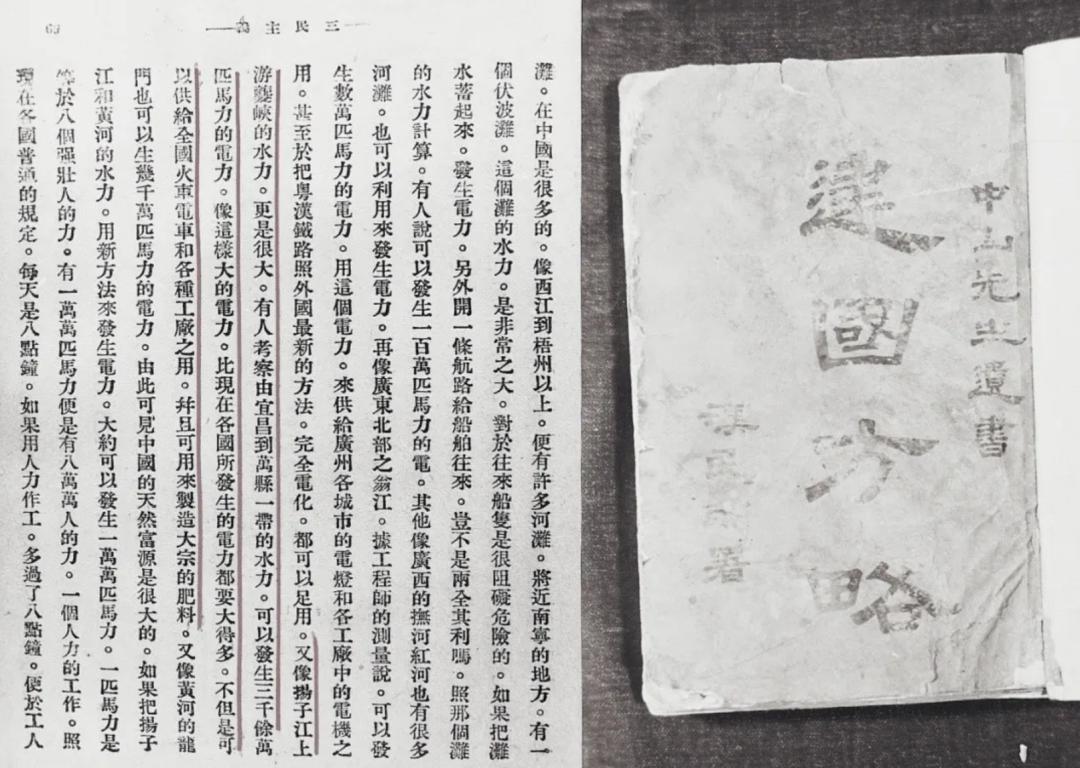
Sun Yat - sen's "The Strategy for National Reconstruction." Image source: Pingliang Water Resources Bureau.
After the reform and opening - up, the Three Gorges Project was put back on the agenda, but the decision - making process was full of intense debates.
Opinions were divided into two camps. Supporters believed that the benefits of the Three Gorges Project far outweighed the drawbacks and that it should be built as soon as possible. Opponents were worried about issues such as an endless need for funds and difficulties in resettling migrants. Some people publicly questioned, "Given the country's limited strength, should we bet the whole nation's strength on one project?"
The state specially established an argument leading group and invited 412 authoritative experts in fields such as geology, water conservancy, and ecology. They were divided into 14 groups for a systematic review.
After full consideration by the central government, the final conclusion was: "It is better to build than not to build, and it is more beneficial to build earlier than later."
Because power projects have a long construction period, they must be planned in advance. Even if there seems to be a surplus in the short term, development reserves must be ensured. If action is taken only after the power shortage becomes apparent, economic development will stagnate during that period.
Yan Kai, a water - conservancy expert and an academician of the Chinese Academy of Sciences and the Chinese Academy of Engineering, also analyzed, "For a project of such great strategic significance, we should look further ahead and not just consider the benefits by the year 2000."
On December 14, 1994, the construction of the Three Gorges Project started as expected.
1.31 million migrants bid farewell