After 8 years of watchOS, Wear OS finally supports 64-bit apps.
Three years after smartphones became standard with 64-bit applications, smartwatches have finally begun to fully embrace 64-bit applications. Recently, there have been reports indicating that Google has extended its 64-bit application popularization plan to the Wear OS smartwatch operating system, requiring all developers to provide 64-bit versions of applications starting from September this year.

According to Google, starting from September, when developers submit Wear OS applications to the Google Play Store, they will no longer be allowed to only offer 32-bit versions. They must additionally provide 64-bit versions. Of course, to accommodate older devices, the support policy for 32-bit applications on Wear OS remains unchanged for the time being. This means that devices with older platforms before the Snapdragon Wear 4100 will not be affected.
So why did Google only mandate that Wear OS applications must have 64-bit versions until 2026? In fact, as early as the fall of 2015, ARM introduced the Cortex-A35, a 64-bit application processor design solution for smartwatches. However, the operating system of Android smartwatches has not had a smooth journey in the past decade, with its name changing three times.
The original Android Wear was born in 2014. At that time, Google positioned it as an "extension of phone notifications" rather than an independent wrist operating system. It wasn't until Android Wear 2.0 in 2017 that it supported independent applications and an application drawer. In the spring of 2018, Android Wear was renamed Wear OS by Google, downplaying the "Android" aspect and emphasizing the "wearable" positioning.
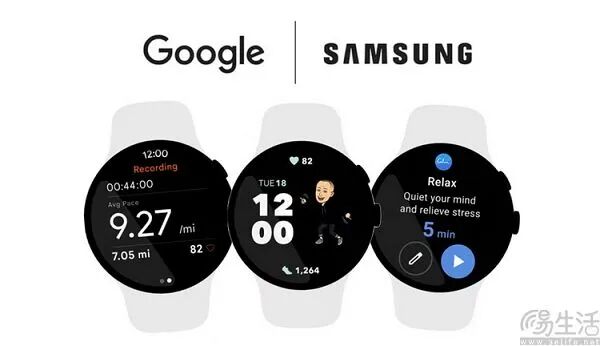
Due to the downplaying of Android, the Android underlying layer used in the era of Wear OS by Google has long been in a severely lagging state. For example, at the end of 2020, when Google released the "Wear OS Fall Update," the underlying system version was still Android 9, which was the version when it was just renamed. Overemphasizing the wearable attribute while neglecting intelligence directly led to Android smartwatches being severely outperformed by Apple Watch.
After learning from past mistakes, Google introduced Samsung's Tizen as an external aid in 2023. The two combined Android and Tizen to create a brand-new Wear OS. However, integrating two different operating systems takes time. If 64-bit applications were launched immediately, the new Wear OS might not be favored by developers.
If third-party developers are "workers" in Apple's ecosystem, then they are "partners" in the Android ecosystem. The openness of Android makes the relationship between Google and developers closer to that of a traditional developer community. The two sides are allies and collaborators. The result of this difference is that once Apple adjusts the review guidelines of the App Store, developers have to follow the lead, while when Google wants to make changes to Android application development, it needs the support of the community.

After three years, Wear OS has accumulated a group of loyal developers. At this time, the resistance to promoting 64-bit applications will naturally be much smaller. Of course, another key factor is that the memory specifications of Android smartwatches in the past two years have finally been able to support the long-term operation of 64-bit applications.
As is well known, computer devices based on the von Neumann architecture are binary, which means they use 0 and 1 (actually high and low potentials) to represent information. With the same operating frequency, it is obvious that a 64-bit processor has a faster data processing speed. This is also the theoretical basis for the superiority of 64-bit systems.
In addition to the difference in data processing performance, the biggest difference between 32-bit and 64-bit systems lies in the supported memory. The maximum addressing space of a 32-bit system is 2^32 (approximately 4GB), while that of a 64-bit system reaches 2^64 (16EB). This means that 64-bit applications can use dynamic memory allocation to process applications larger than 4GB in memory, while 32-bit applications have to use a complex method similar to "block-by-block reading."
The ability of a 64-bit system to support a larger virtual address space means it can address more memory. However, it also means that applications running in 64-bit mode will consume more memory than in 32-bit mode. If the memory required by an application does not exceed 4GB, the 64-bit version may not only fail to improve performance but may also reduce operating efficiency due to increased memory usage and larger instruction overhead.
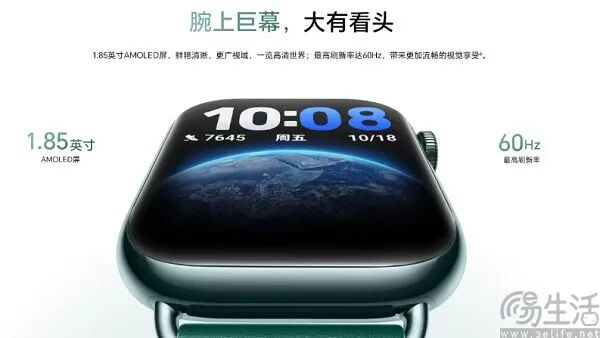
Around 2023, Android smartwatches often used 1GB of LPDDR4 memory. At that time, promoting 64-bit applications would not benefit users but would instead cause trouble for both developers and users. By 2026, the memory configuration of mid-range and above Android smartwatches starts at 2GB. So when memory is no longer a bottleneck, 64-bit applications will bring "free" additional performance.
This article is from the WeChat official account "Three Easy Lives" (ID: IT-3eLife), written by San Yi Jun, and is published by 36Kr with authorization.