A Visual Guide to the Growth of Venture Capital Investments in Provinces and Cities across China: A 1300% Growth Rate in Guangxi vs. an 83% Growth Rate in Zhejiang, Which Is More Realistic?
In the first quarter of 2026, China's venture capital market rebounded strongly, with 2,865 financing events, a year-on-year surge of 52%; the disclosed amount reached 256 billion yuan, a year-on-year increase of 48%.
In this wave of recovery, the regional pattern shows serious differentiation: there are substantial breakthroughs on a medium - high base, statistical illusions created by a low base, and even local "sudden wealth" illusions distorted by extremely large - scale transactions.
Real Growth Poles: The Explosion of Hard - Tech on a High Base
When the national growth rate is anchored at around 50%, the performance of Zhejiang and Shanghai has established the absolute dominance of the Yangtze River Delta.
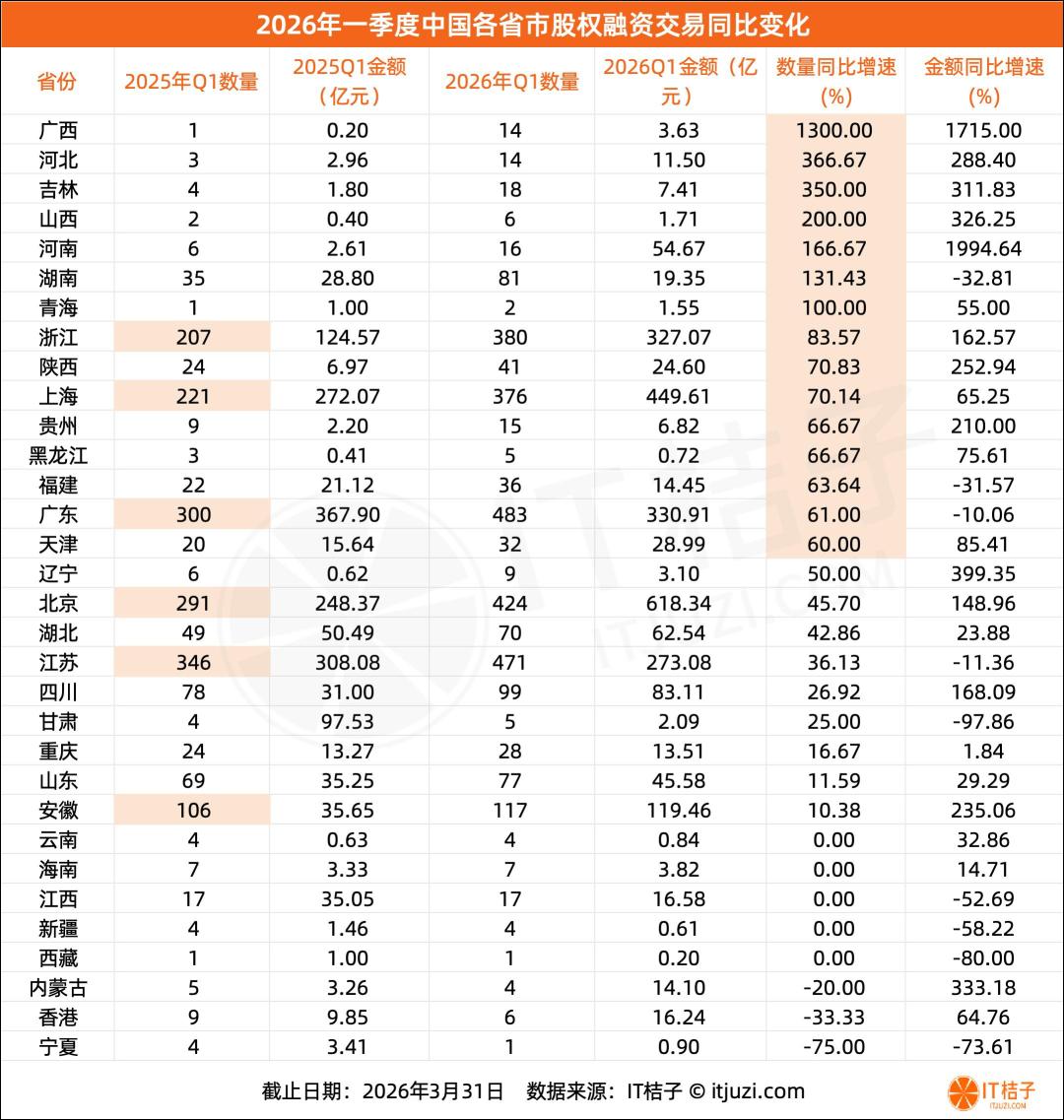
On the high base of 207 events in Q1 of 2025, Zhejiang increased by 83.57% year - on - year to 380 events, and the amount soared from 12.46 billion yuan to 32.7 billion yuan (+162%).
Shanghai also achieved steady growth. The number of events increased from 221 to 376 (+70%), and the amount increased from 27.2 billion yuan to 44.96 billion yuan (+65%).
Together, the two regions account for 26.4% of the national number of events and 30.3% of the amount, and their growth rates far exceed the national average, verifying that their industrial clusters in robotics, semiconductors, and AI applications have entered the capitalization explosion period.
Beijing shows the characteristic of "head siphoning": the number of events increased from 291 to 424 (+45.7%), but the amount skyrocketed from 24.84 billion yuan to 61.83 billion yuan (+148.96%).
This deviation is due to the concentrated implementation of extremely large - scale strategic financings - unicorns in the fields of large AI models and commercial space obtained late - stage funds in batches, with a single - deal scale often reaching billions of yuan. This has strengthened Beijing's position as the "unicorn headquarters", but it also masks the reality of the financing differentiation of small and medium - sized projects.
Shaanxi shows a path of "quality leap": the number of events increased from 24 to 41 (+70.8%), and the amount increased from 697 million yuan to 2.46 billion yuan (+252%). Semiconductor and aerospace projects in Xi'an High - tech Zone have entered the growth stage, and the single - deal financing scale has increased significantly, rather than relying on early - stage projects to boost the quantity.
Structural Differentiation: Early - Stage Sinking and Distortion by Extremely Large - Scale Deals
Behind the growth rates in some regions hides unique market structural changes.
Hunan is a typical example of "sinking - style" growth: the number of events increased from 35 to 81 (+131%), but the amount decreased from 2.88 billion yuan to 1.935 billion yuan (-32.8%).
This is due to the frequent investments of Lushan Venture Capital, a university student entrepreneurship fund in Hunan Province. The fund's activity has ranked among the top 10 in the country in the past two years, specializing in seed - angel - stage university student projects, with a single - deal scale of only a few million yuan. Although this "investing in the early - stage and small - scale" strategy has nurtured the ecosystem, it also exposes Hunan's shortcoming of lacking large - scale late - stage projects to undertake early - stage investments.
Henan goes to the other extreme: the number of events increased from 6 to 16 (+167%), and the amount skyrocketed from 261 million yuan to 5.467 billion yuan (+1995%).
This extreme deviation is caused by three extremely large - scale state - owned strategic investments: Xiantian Suanli received a 2.5 - billion - yuan strategic financing from Henan Investment Group and Yueneng Holding, Baililian received 2 billion yuan, and Zhongke Qingneng received 500 million yuan. After excluding these super cases of state - owned asset layout, the activity of market - oriented venture capital in Henan is still in the second echelon in the central and western regions.
Guangdong and Fujian also show a situation of "increasing quantity but decreasing amount": the number of events in Guangdong increased by 61% but the amount decreased by 10%, and in Fujian, the number of events increased by 64% but the amount decreased by 32%. This reflects that the markets in Shenzhen, Guangzhou, and Xiamen are "sinking" to early - stage hard - tech projects, and the large - scale late - stage transactions in Q1 of 2025 have an interval this quarter.
Data Illusions: The Illusions of Low Base and the Entry of State - Owned Assets
When the growth rate exceeds 300%, beware of the base trap.
Guangxi increased from 1 event to 14 events (+1300%). Behind this is the intensive investment of state - owned enterprises and government funds such as Guangxi Nongken, Guangxi Caijin Venture Capital, and Guangxi Environmental Protection Group in Q1, targeting agricultural modernization and environmental protection technology. Although the 14 events and a total amount of 363 million yuan in a quarter are still less than the level of a week in Yuhang District, Hangzhou, this "from zero to one" breakthrough is of symbolic significance - in the border regions where market - oriented VCs are reluctant to invest, state - owned platforms are playing the role of the "first drop of dew", providing a living soil for local sporadic innovation sparks.
The high growth in Hebei (from 3 events to 14 events, +367%) and Jilin (from 4 events to 18 events, +350%) is also accompanied by the activity of local state - owned asset guidance funds. Although these regions are difficult to change the disadvantage of a low base and cannot form industrial clusters in the short term, the early - stage seeding of government funds is filling the market gap and accumulating potential for the future "spreading of the flames".
The amount in Gansu plummeted by 97.86% (from 9.75 billion yuan to 209 million yuan), which is actually a data cliff after the ebb of a multi - billion - level energy transaction in Q1 of 2025, highlighting the excessive dependence of such regions on a single large - scale transaction. It is even more necessary for government funds to build a diversified investment ecosystem.
Conclusion
Against the backdrop of a 52% growth rate in the entire market, Zhejiang, Shanghai, Beijing, and Shaanxi constitute the real growth poles, and their growth is based on the accumulation of hard - tech industries; Hunan and Henan respectively reveal two structural differentiations of "early - stage sinking" and "extremely large - scale concentration".
For sinking regions such as Guangxi and Hunan, although the high growth rate has a base illusion, the efforts of their government funds to "invest in the early - stage and small - scale" should not be ignored. In the general trend of market - oriented capital concentrating on top - tier cities, these local state - owned platforms are taking on the role of regional innovation infrastructure builders. Through high - frequency and small - scale early - stage investments, they are preserving the sparks for local entrepreneurs. This "sinking - style" layout may not produce unicorns in the short term, but it constitutes an indispensable capillary in China's venture capital ecosystem.
While funds are extremely concentrated on top - tier projects in the Yangtze River Delta, Beijing, Shanghai, and Shenzhen, from the explosion of hard - tech in the Yangtze River Delta to the early - stage seeding in border provinces, a multi - level and differentiated venture capital ecosystem map is taking shape - there are both towering trees and new sprouts breaking through the ground.
This article is from the WeChat official account "IT Juzi" (ID: itjuzi521), author: Judy, published by 36Kr with authorization.