3D printing has also made chips popular.
3D printing has become popular again recently. For example, TuoZhu, known as the iPhone in the 3D printing industry, has shown extremely strong performance.
The reason for its popularity is two - fold. On one hand, domestic core components in 3D printing have made breakthroughs, AI technology has developed rapidly, and the overall cost has been continuously decreasing. On the other hand, policies have been driving the industrial development. Data from the National Bureau of Statistics shows that in 2025, the production of 3D printing equipment in China increased by 52.5% year - on - year.
Among them, consumer - grade 3D printers have developed the fastest. Guojin Securities predicts that the consumer - grade market will experience a "second acceleration" in 2026.
Although the overall penetration rate of consumer - grade 3D printers is currently less than 1%, it has shown a compound annual growth rate of up to 28.8%. It is estimated that the global sales volume of the industry this year is expected to reach the level of tens of millions of units. Benefiting from the commercial aerospace and consumer electronics industries, industrial 3D printing is also booming.
With the popularity of 3D printing, the chip industry has also welcomed new opportunities. Some chip manufacturers have smelled the business opportunity in advance and continuously increased their layout. Today, EEWorld will take stock of those manufacturers that have laid out in 3D printing.
The chip solutions for 3D printing have changed
For 3D printers, the chip solution is the key. Against the background that high - speed printing has become the core, while the motor speed is continuously increasing, higher requirements are put forward for vibration suppression, noise control, and temperature rise management. The requirements of the whole - machine system for the computing power of the main controller, interface resources, and real - time control ability have significantly increased.
In this context, the traditional motor control mode of MCU + multiple dedicated driver ICs has gradually shown limitations in terms of cost and flexibility. The multi - motor structure means the superposition of multiple driver chips, which leads to an increase in BOM cost. At the same time, the hardware architecture is fixed, making it difficult to support the expansion of differentiated functions. Therefore, the industry has begun to accelerate the promotion of the control architecture of high - performance MCU + H - bridge circuit. By integrating the driving function and replacing some dedicated hardware with software algorithms, the concentration of control ability and the simplification of the system structure are achieved.
In addition, an excellent 3D printer not only needs powerful main - control computing power but also requires the support of large - capacity storage, precise analog devices, and sensors. Therefore, the industry has begun to transform from a single - chip solution to a full - stack solution.
These manufacturers have laid out in 3D printing
GigaDevice
GigaDevice recently stated that for products in the Cortex - M33/M4 range, the company has achieved performance upgrades through product iteration. For example, the GD32F503 series inherits the market positioning of the GD32F303 series, improving performance while maintaining rich resources. In the high - performance field, the GD32H77D/779 series is an upgrade of the GD32H737/757 series, providing more abundant computing power space for high - speed and high - precision control. This hierarchical planning enables customers to complete product upgrades under a unified technical system.
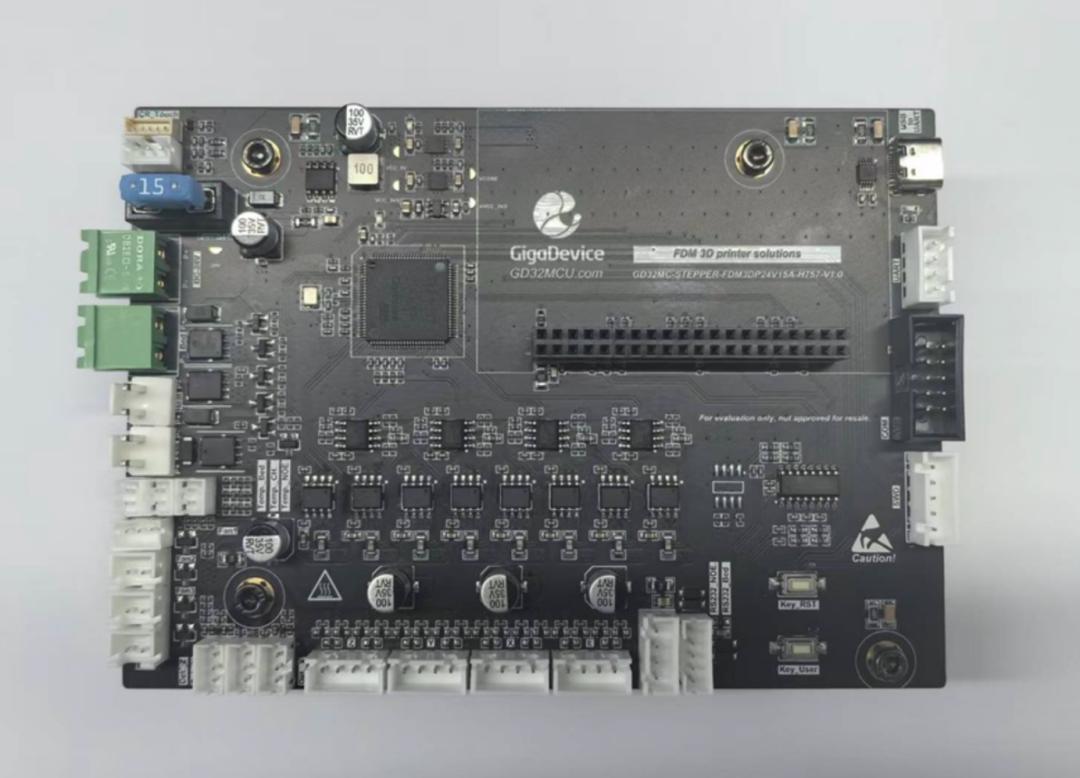
At the specific solution level, the high - performance MCU with the Cortex - M7 core represented by GD32H737 has a main frequency of up to 600MHz, rich timer resources, and multiple ADC channels. The ADC accuracy can reach 14 bits, and it can drive four - axis or even more stepper motors simultaneously. Relying on the computing power advantage of the high - performance MCU, GigaDevice's solution can implement higher - order control algorithms and improve the high - and low - speed control performance:
In high - speed performance, the maximum measured speed can reach 1000mm/s (over 2000rpm), and the acceleration can reach 20000mm/s²;
In low - speed performance, it can implement the low - speed resonance suppression function, actively suppressing the low - speed resonance caused by the harmonic interference torque of the stepper motor, reducing the low - frequency resonance noise and vibration patterns during low - speed operation, and improving the printing quality of the model surface.
In addition, the self - developed stall detection algorithm can achieve positioning without a physical limit switch during the zero - return stage, reducing the structural complexity. The self - developed adaptive current reduction algorithm reduces the driving current when the non - moving axis is stationary, effectively controlling the temperature rise and power consumption. Multiple algorithm modules operate collaboratively within the same MCU platform, making the system control more centralized and efficient.
The actual test results confirm the excellent performance of this solution. In the rapid printing test of a small boat model, including the heating waiting time, the printing was completed in 15 minutes. In the high - speed printing test of a thin - wall model, the maximum speed was 600mm/s, and the maximum acceleration reached 11000mm/s². In the printing test of a 50×50×50mm cube model, the maximum speed was 500mm/s, the maximum acceleration was 12000mm/s², and the printing accuracy was ±0.1mm.
In addition to the MCU, GigaDevice also provides SPI NOR/NAND Flash, the GD30DR30 series H - bridge, and the GD30AP series operational amplifiers, constructing a full - stack solution.
National Technology
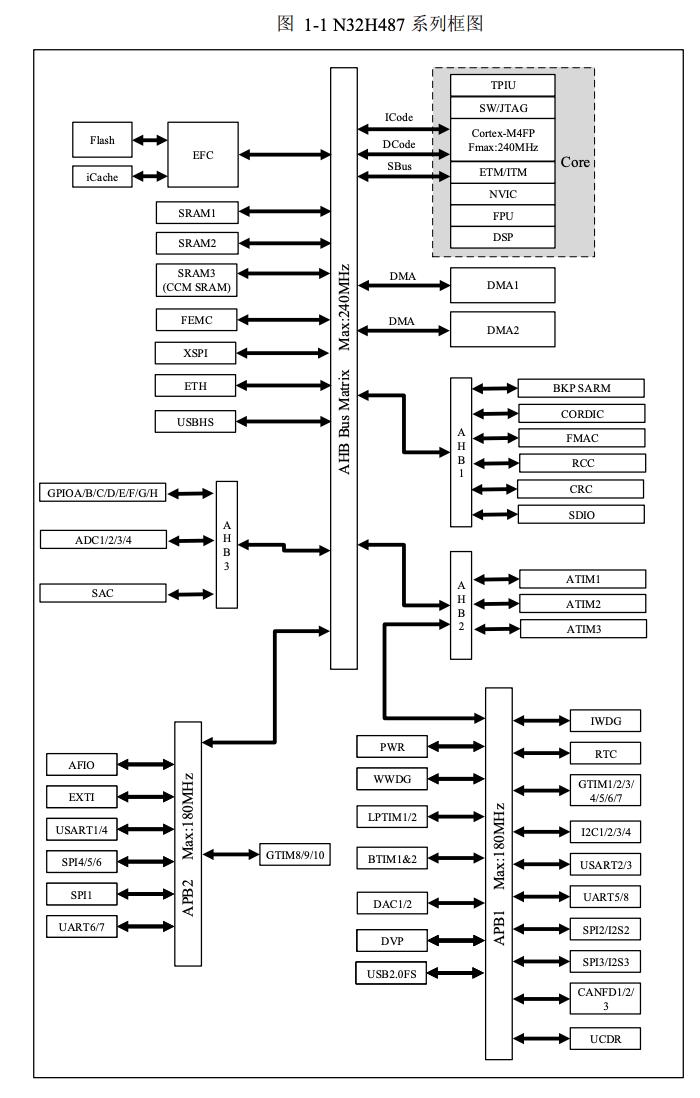
Last year, National Technology also highlighted the application of its products in the 3D printer field. National Technology stated that in recent years, 3D printing technology has developed rapidly. Its application scope has been continuously expanding from industrial manufacturing to the medical field, from architectural design to cultural and creative industries, profoundly changing the traditional production mode. As the "brain" of a 3D printer, the performance and functions of the MCU directly affect the printing accuracy, speed, and stability. The N32H487 series MCU launched by National Technology provides a highly potential solution for 3D printers with its powerful performance, rich peripheral interfaces, and high reliability.
According to National Technology, the N32H487 has three major features that meet the needs of 3D printers:
Firstly, high performance injects strong power into 3D printing. The N32H487 series MCU is based on the ARM Cortex - M4 core, with a main frequency of 240MHz. It integrates a floating - point unit (FPU) and a digital signal processing (DSP) instruction set, and can easily handle complex path planning, motion control, and data processing tasks during 3D printing. Its built - in 512KB Flash memory and 192KB SRAM provide sufficient storage space for complex 3D printing algorithms and model data, ensuring a smooth and stable printing process.
Secondly, rich peripherals build a complete 3D printing ecosystem. The N32H487 series MCU integrates rich peripheral interfaces, including USB, CAN, Ethernet, I2C, SPI, UART, etc., which can be easily connected to various sensors, actuators, and communication modules to build a complete 3D printing ecosystem.
It supports multi - channel PWM output and encoder interfaces, which can precisely control stepper motors or servo motors to achieve high - precision three - dimensional motion control, ensuring clear details and a smooth surface of the printed model. It supports high - speed communication interfaces such as USB and Ethernet, which can realize fast data transmission with the host computer and improve printing efficiency. It supports peripherals such as touch screens and LCD displays, providing users with a friendly human - machine interaction interface for easy operation and monitoring of the printing process.
Thirdly, high reliability ensures the stable operation of 3D printing. The 3D printing process usually requires long - term continuous operation, which puts extremely high requirements on the reliability of the MCU. The N32H487 series MCU uses advanced process design and strict testing procedures, has excellent anti - interference ability and stability, and can ensure the long - term stable operation of the 3D printer.
HPMicro
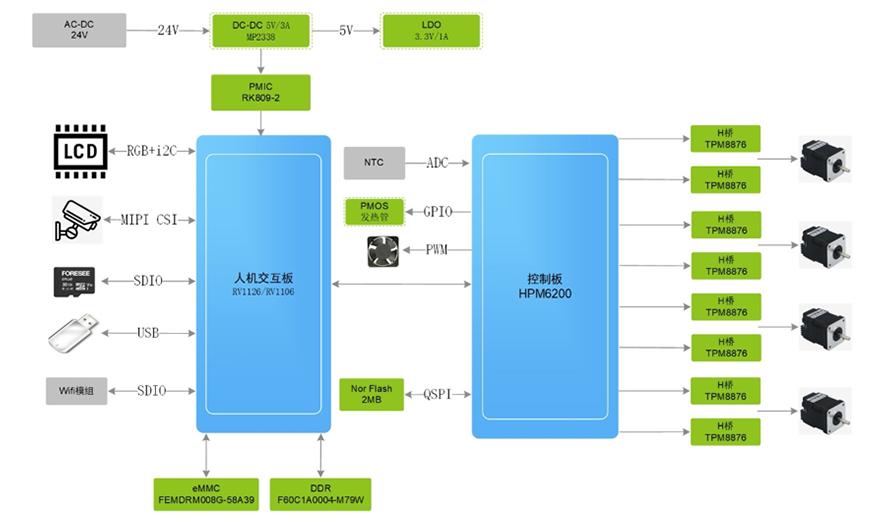
HPMicro also has a specialized customized solution for high - speed 3D printers. Its HPM6280 high - performance CPU has a built - in FOC algorithm + H - bridge driver chip, and can achieve open - loop control of four - axis stepper motors at a current loop frequency of 50K, with the stepper motor speed > 1200RPM. This solution is specially customized for the 3D printing industry and is also suitable for applications in industries such as stage lighting, engraving machines, feeders, and flat knitting machines.
Compared with the traditional TMC control solution in the 3D printing industry, this industry - customized solution has the advantages of high - speed printing, low system cost, and high synchronization.
This solution provides a product - level stepper algorithm. Based on FOC stepper control, the motor speed and acceleration can reach 1500rpm and 2.4G. The motor algorithm is self - developed. Through system design, it can reduce costs and increase efficiency. It also opens up the schematic diagram of the solution and motor library files. In addition, HPMicro has a perfect and timely technical and business support ability.
ADI
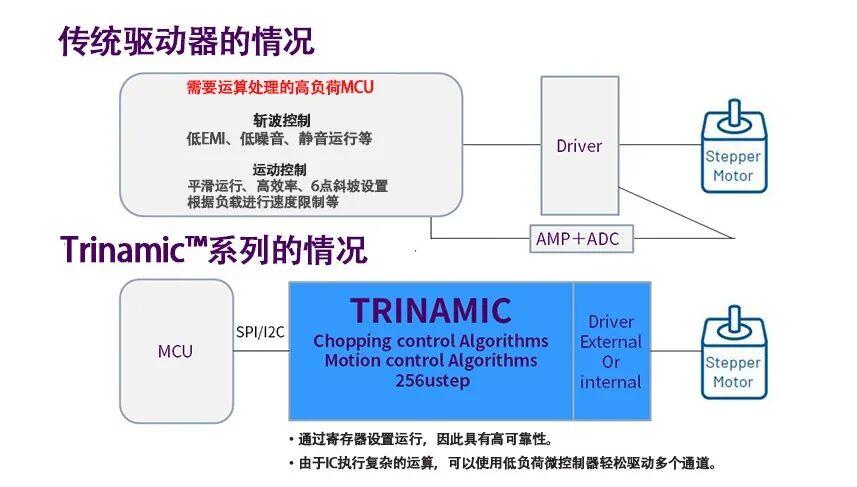
When it comes to 3D printers, ADI's Trinamic must be mentioned. Its product solutions are a benchmark in the 3D printer industry, and it can mainly solve one problem - noise.
Usually, to solve the noise problem, using an open - loop stepper motor for driving will lead to problems such as low accuracy, slow speed, easy step - loss, high noise, high power consumption, and easy vibration. In 3D printers, this is manifested as slow printing speed. Once the speed is increased, the motor is prone to step - loss, resulting in printing burrs, a significant decrease in accuracy and success rate, and large printing vibration and resonance noise. In addition, when the 3D printing stepper motor has no feedback, the high - speed operation of the motor, sudden load, or pressure increase may affect the normal operation of the stepper motor, resulting in step - loss. In addition to step - loss caused by high speed and load, the acceleration and deceleration of the motor and the inertia of the system can also cause step - loss. These are the defects of the open - loop control of 3D printing stepper motors.
ADI Trinamic has launched a series of solutions. The initial motor driver chips TMC2100/2130 are well - known in the 3D printing industry for their excellent mute ability. Subsequently, the TMC2208 was launched to provide an integrated motor driver solution for 3D printing, cameras, scanners, and other automation equipment applications. This device has an integrated micro - stepping indexer and a completely noiseless current control mode, StealthChop2, which is designed to drive bipolar stepper motors. Different from other choppers, StealthChop2 can reduce the noise of 3D printers by 15dB or more without configuration. For high - performance 3D printers with different current and large voltage requirements, ADI Trinamic has never stopped innovating. For example, the new TMC2209 in this series supports a larger current and also meets a smaller operating voltage.
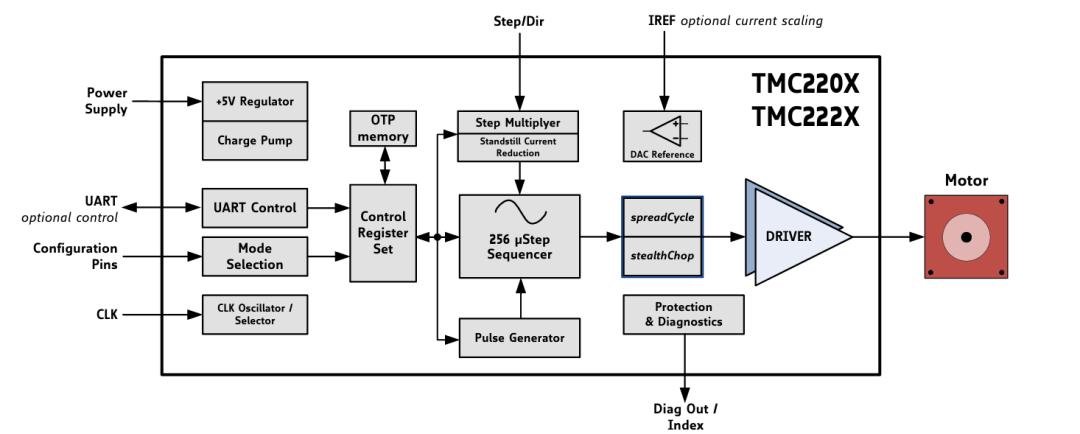
In terms of accuracy control, the closed - loop control of stepper motors has key technologies such as step verification, step - loss prevention, stall detection, and torque control. It has better stability, higher accuracy, high response, and high - speed performance, which can make up for these defects. In the 3D printer industry where accuracy is particularly important, in the face of higher - accuracy and high - speed motion control requirements, ADI Trinamic has launched a sensorless and small - volume driver solution with higher cost - performance.
TMC4361 + TMC2130/TMC5130 (low - power)
TMC4361 + TMC2160/TMC5160 (high - power)
It is worth noting that Trinamic has many other advantages. Compared with traditional motor drivers that require developers to write control algorithms themselves and embed them in the MCU, and also need to design the power - stage circuit, Trinamic integrates complex control algorithms into the hardware. Developers only need to dynamically change the register settings to achieve high - performance motors. Since there is no need to write complex arithmetic processing, it is easy to develop synchronous operations for multiple channels. In addition, the Trinamic series also provides a built - in power stage.
NXP
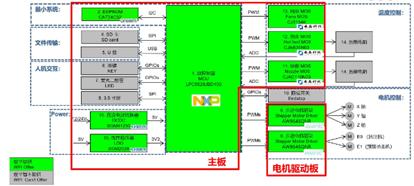
WPI, a subsidiary of WPG, previously launched a 3D printer solution based on NXP's LPC5528 chip. The core main controller of the solution is the LPC5528, a mainstream MCU under NXP, which is equipped with a Cortex - M33 core and has a main frequency of up to 150MHz. In terms of memory options, this MCU has 512KB of on - chip Flash and 256KB of RAM. In addition, the LPC5528 has rich peripheral resources, including multiple Timers, multiple PWM channels, and various communication interfaces. It supports a 16 - bit ADC and can expand various functions.
In addition, WPI also released a fully localized Klipper printing platform of "NXP RT1050 high - performance MCU + Winbond storage chip + Novosense H - bridge driver + SGMICRO power management three - piece set + JW Microelectronics voltage regulator module". Through the collaboration of five domestic chips, this solution increases the main - controller response speed by 40% and compresses the BOM cost by 30%, providing a mass - producible import - substitution option for the Asia - Pacific market.
The MCU board uses the NXP RT1050 MCU and the Winbond W25Q80 Flash. Among them, the RT1050 is based on the Cortex - M7 core, with a main frequency of 600MHz and 512KB of SRAM. The W25Q80 Flash has strong read performance.
The driver board consists of two Novosense NSD7312 H - bridge driver ICs and two SGMICRO SGM8651 operational amplifiers. The Novosense NSD7312 is a DC brushed motor driver chip. It has a built - in power N - MOSFET and provides various functions such as power - stage under - voltage protection, over - current protection, and over - temperature protection. In addition, this product can provide a peak current of