Is Vibe Coding a productivity scam?
Four months have passed since the era of intelligent agents in 2026, and the term "Vibe Coding" has been spreading by word of mouth.
Some people say that programming has become a zero-threshold job, and even programmers, once considered the most irreplaceable, are facing unemployment.
Others say that Vibe Coding is just a toy, and the code it produces is always a mess (shit mountain), and it can never replace humans.
These after-dinner complaints were brought to the forefront by a PR on GitHub and transformed into an issue worthy of deep thought in the entire AI field:
Is Vibe Coding really a productivity scam?
Back in January this year, Matteo Collina, a core contributor to the well-known JavaScript runtime environment Node.js, submitted a PR on GitHub to introduce the built-in virtual file system node:vfs to Node.js.
This kind of heavyweight update at the underlying architecture level should have naturally become a long-awaited milestone for the community.
However, what really caught people's attention was a sentence he candidly admitted in the PR description:

"I used a large number of Claude Code tokens to create this PR and have personally reviewed all the changes."
What's really terrifying is that this PR contains a whopping 19,000 lines of code, most of which were entirely generated by AI.
In the programmer community, this was like dropping a nuclear bomb into a calm lake.
Whether it was on GitHub or Hacker News, forums at home and abroad were instantly filled with debates. Supporters, neutrals, doubters, and deniers formed their own camps, each with their own opinions.
Two months later, a heavyweight response emerged.
Fedor Indutny, a former member of the Node.js Technical Steering Committee (TSC), launched a petition, which quickly went viral across the internet.
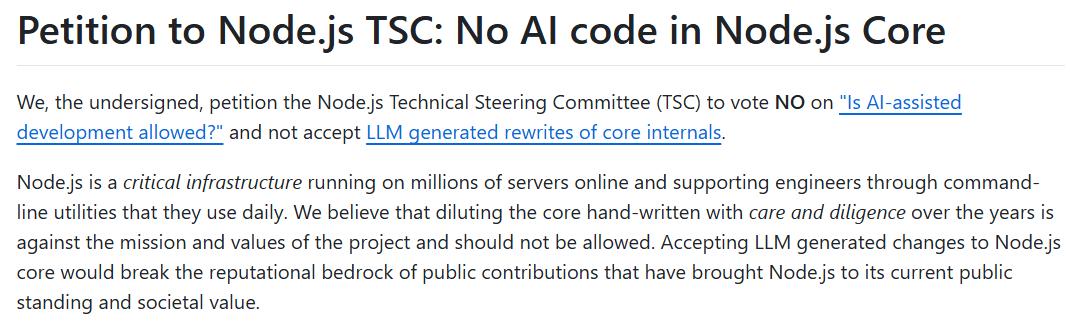
Well-known software engineering giants such as Kyle Simpson, the author of "You Don’t Know JS", and Andrew Kelley, the founder of Zig, successively signed their names. Their goal was clear:
Request a vote to ban the direct rewriting of core modules with code generated by large language models.
By this point, the issue had gone far beyond a debate about the quality of AI-generated code. It also revealed a deeper occupational crisis:
Vibe Coding is challenging the underlying logic of traditional software engineering in all aspects.
01
The Three-Stage Dilemma of Vibe Coding
When it comes to Vibe Coding, you may find the term a bit strange at first glance. But once you've used it, you'll realize that this naming is actually extremely accurate.
Developers no longer need to dwell on the meticulous crafting of each line of code syntax. They just need to describe their intentions and adjust the "vibe" to drive AI agents to achieve their goals.
Rather than calling it a newly born technology in the AI era, it's more like an inevitable product of the development of AI programming to a certain stage.
Three years ago, when OpenAI blocked East Asian IPs and people could only use the "pirated" ChatGPT - 3.5 through relays, I tried to get AI to help me with some basic financial data retrieval and analysis for my graduate courses.
At that time, AI was still very clumsy. It either couldn't find the API of the data source or made up random information. It also mixed different versions of Python syntax. The code it produced was far from "usable", and it took several rounds of debugging just to run smoothly.
Although the functionality was extremely unreliable, AI programming at that time had several very pleasant surprises:
First, its code-writing ideas were generally correct, which meant that it could choose the right technical path when the user only provided the final goal.
Second, its syntax, format, and structure were standard, without the common fundamental mistakes, misspellings, or incorrect indents that novice programmers often make.
Third, it was very proficient in calling various common libraries in Python. Users only needed to know a little Python and didn't have to look up the interface documentation line by line.
Actually, this was the prototype of Vibe Coding. These functions, which seem insignificant today, were enough to make programmers in the past overjoyed.
But now, opinions about Vibe Coding are starting to polarize.
There are tutorials on video websites everywhere teaching people how to make money with Vibe Coding. However, the contrast between the actual use and the tutorials has given programmers a hard time:
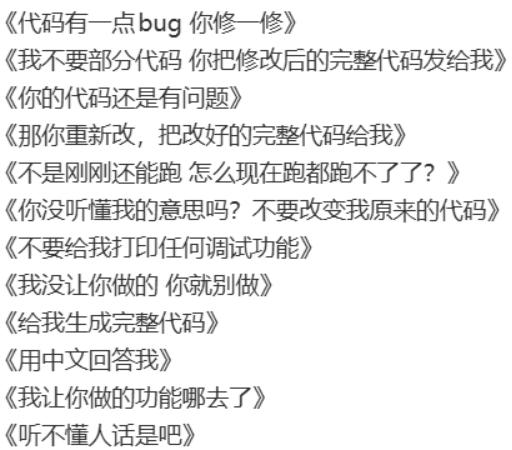
This is the most common feedback from programmers using various Coding Agents.
In actual engineering implementation, Vibe Coding is facing a cruel "Three-Stage Decline Curve":
Early stage (development period): AI shows amazing explosive power and can quickly generate small functions or sample code with a logical closed-loop, which was the "glory moment" three years ago.
Middle stage (tug-of-war period): As the system complexity increases, the coupling between modules becomes more and more subtle. At this time, humans need to intervene to find and correct the subtle logical errors in the code generated by AI, and the cost gradually becomes the same as manual coding.
Late stage (collapse period): As long contexts accumulate, the ability of AI to follow instructions drops precipitously, and the phenomenon of "correcting the wrong parts incorrectly and changing the correct parts wrongly" occurs frequently.
This also explains why, as Vibe Coding has developed, people's psychological gap has become larger and larger.
The current Vibe Coding is best at "achieving functionality", while software engineering pursues "launching finished products".
The former only requires the logic to work, while the latter requires robustness, maintainability, security, and architectural consistency to be indispensable.
Vibe Coding has almost eliminated the threshold from 0 to 0.5, but on the way from 0.5 to 1, countless developers have fallen into a dead cycle of "generate → chaos → start over".
02
When Review Becomes a Punishment
This characteristic of Vibe Coding benefits users who don't know anything about programming and casual programmers, but it has caused great dissatisfaction in the open-source community.
The core mechanism for the healthy operation of the open-source community lies in an invisible social contract:
I painstakingly write elegant code, and you conduct in-depth reviews out of respect for professional spirit.
This attitude of treating code seriously and rigorously has promoted the public dissemination and progress of technology.
However, if Vibe Coding is a shortcut that ignores the contract, then Collina's 19,000-line PR is equivalent to invalidating this contract.
After all, the code generated by users for their own entertainment with Vibe Coding doesn't have much impact on others. But these 19,000 lines of code will actually be embedded in the underlying mechanism of Node.js and used by millions of people.
It cannot make mistakes in various application scenarios and must also take efficiency into account. Therefore, it must go through multiple rounds of reviews before it can be used.
A comment from a Hacker News user hit the nail on the head:
Assuming it takes 2 minutes to review each line of code, it would take 90 working days to review these 19,000 lines. You generate code in 5 minutes with just a few words, and you expect the community administrators to spend 3 months reviewing it? This is not a matter of efficiency but a great disrespect for others.
Vibe Coding makes the cost of code production infinitely close to the price of tokens, but the review cost still increases linearly. As a result, the review process in the open-source community has become a pure "corporal punishment".
Some people may ask, why can't we let AI conduct the review to reduce the cost?
The answer is that due to the existence of the reinforcement learning mechanism, AI can't learn any useful knowledge when facing the code generated by Vibe Coding.
And human reviewers also can't accumulate any skills when faced with a flood of AI code templates. They can only exhaust their enthusiasm in repetitive work.
03
The Gray Area of the Law and the Official Compromise
Although the code generated by Vibe Coding has been defined as a "shit mountain" by most programmers and industry insiders, we have to admit that its essence is still a code work.
Just like AI-generated images, AI-generated voices, and AI-generated videos, AI-generated code inevitably has to face copyright issues.
In the United States, the judicial authorities tend to believe that pure AI-generated works are not protected by copyright.
This means that if a core project contains a large amount of AI-generated code, it may not be authorized through existing open-source licenses such as MIT or Apache.
To avoid legal risks, Indutny's petition also clearly states: The source of AI training data is questionable. We can't let the infrastructure like Node.js, which supports millions of servers, be built on stolen code and the sand of the law.
In the open-source community, the copyright issue of Vibe Coding code is just a controversy. But in closed-source commercial competition, it is a blatant encroachment of interests.
Facing the surging wave of opposition, the OpenJS Foundation, the parent foundation of Node.js, held intensive internal debates.
In the issue "Is AI-assisted development allowed? #1509", the two sides were at odds.
ljharb advocated a "one-size-fits-all" approach, banning all code that "looks like it was generated by AI". Collina countered: "Banning Copilot or Cursor in this era is like destroying the project's contribution rate."
But the result is obvious to everyone.
After all, the commercial interests behind the various Coding Plans and desktop agents that emerged like mushrooms after rain in 2026 have given the answer.
Finally, the OpenJS Foundation also announced that AI-assisted development is allowed.
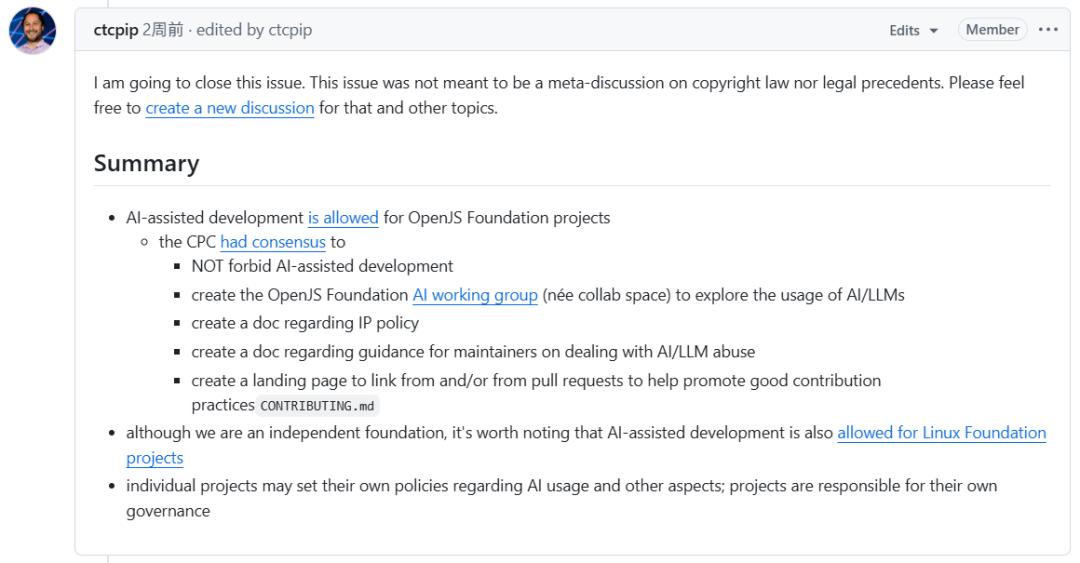
The reason is very practical. It's simply impossible to ban AI in reality because no one can prove whether a piece of code was written by a human or not.
The foundation said that in the future, it will establish an AI working group, formulate IP policies, and provide guidelines for maintainers to deal with AI abuse.
04
The Arrogance and Selflessness of Programmers
In this debate, two extreme views about programmers are intertwined.
Some people say that programmers are arrogant.
They stick to the habit of writing code by hand from years ago, look down on the mess generated by AI, and reject the productivity improvement that Vibe Coding brings to people who don't know programming.
This arrogance stems from the persistence in the craftsmanship spirit. Every line of code should be the result of careful thinking, precise and elegant.
Others say that programmers are selfless.
Without this almost paranoid evolution, there wouldn't be an open-source technology community like GitHub where people contribute voluntarily.
They know that every line of code they submit will become a burden or a cornerstone for others. So it's their obligation to make the code clean, abstractly reasonable, and easy to maintain. Not causing trouble for others is the essence of the open-source spirit.
The contradiction brought by Vibe Coding lies here: It encourages developers to deliver quickly and think later, but the rigor of the project requires resisting this unexamined "mediocrity".
A previous AI-related employment survey report released by Anthropic shows that most programmers are not actually affected by unemployment due to the impact of AI.
Now it seems that in the future, the division of labor among programmers in each enterprise will be drastically reshaped:
Some will act as AI users, using natural language to command AI to complete one-time, low-risk, and disposable tasks, such as internal tools and prototype design.
Some will act as code reviewers and integrators. They have the core competitiveness of "being able to understand and correct AI errors". They may not be the fastest at writing code, but they must have the strongest "backup" ability.
Some will act as system architects, defining specifications and building the core architecture that AI cannot predict and requires human engineering judgment.
Vibe Coding is like a mirror, reflecting the weakness of AI in current complex engineering and the confusion of programmers in the face of the explosion of productivity.
The trend it brings is irresistible, and software engineering will eventually evolve into a probability game about "intention".
The only irreplaceable asset of humans may be "the awe of certainty".
At least, behind those 19,000 lines of code, to support this digital world, we can't rely solely on tokens for now.
This article is from the WeChat official account "Silicon-based Starlight", author: Siqi. It is published by 36Kr with authorization.