When colleagues, bosses, and exes are all turned into Skills: Humanity is being repriced.
Recently, a batch of projects with the suffix ".skill" have suddenly emerged on GitHub. On the surface, they are skills, but in essence, they are encapsulating people.
Colleague.skill, Ex.skill, Mentor.skill, Boss.skill, and more variations that seem like jokes but are actually quite serious. Feed in a person's chat records, work documents, and personality tags, and out comes an AI Skill that can talk, make judgments, and collaborate in their way.
Within three days, these projects spread from GitHub to Xiaohongshu. Under the post of Ex.skill, there were 515 comments, 3,861 likes, and 2,015 collections; Mentor.skill also quickly became a place for emotional resonance.
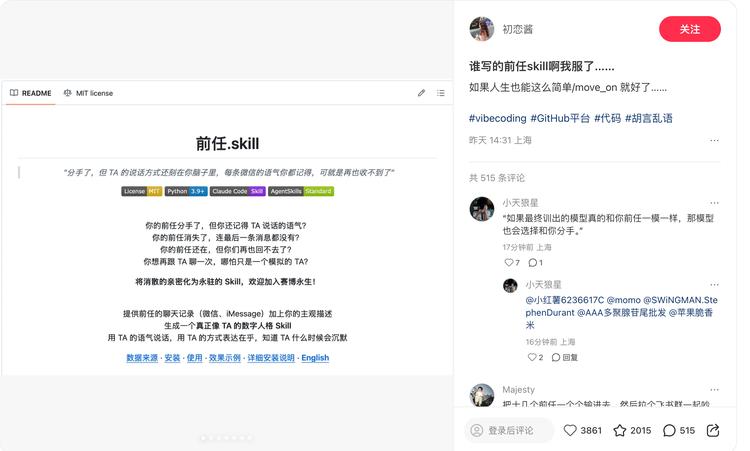
One by one, these GitHub projects have penetrated the tech circle in this way and become a topic of public sentiment.
Exes, colleagues, mentors, and even certain functions of bosses. These people, who originally belonged to relationships and roles, are being re - understood by more and more people as an "encapsulable, callable, and reusable" ability package. Give it chat records, documents, screenshots, and oral descriptions, and the AI can try to imitate a person's speaking style, work methods, and judgment habits, and finally compress this person into a skill. It sounds like a joke, but actually, there is a very serious technical route behind it.
1.
This is not just internet pranks: From Anthropic to Agent Skills
If this were just internet pranks, it would at most be a meme. The problem is that there is a very clear technical thread behind it.
Anthropic defines Agent Skills in its official engineering article as an ability module that can be dynamically discovered and loaded by an agent: in essence, it is a directory containing SKILL.md, scripts, resources, and additional instruction files, used to package certain professional knowledge, workflows, and experiences into reusable abilities. Its goal is not to create more scattered small tools, but to turn general agents into "specialized on - demand" agents. Anthropic even compares "creating a skill" to "writing an onboarding guide for a new employee". This analogy is crucial because it shows that the essence of a skill is not just fancy prompts, but the documentation of a person's procedural knowledge.
The official repository anthropics/skills also illustrates this point. It clearly states that skills are a set of instructions, scripts, and resources that Claude will dynamically load on demand for specialized tasks such as document processing, design, development, and communication. That is to say, a skill is not an accidental internet meme, but a standardized ability form actively promoted by AI platforms.
What really deserves attention is that once this framework matures, what will be packaged next will not only be "how to do something", but also "how to do something like someone". There is actually only one step from task encapsulation to personality and role encapsulation.
2.
Those who are first made into Skills are often those who once had power over you
There is a very noteworthy pattern in this batch of projects: those who are first made into skills are often not strangers or ordinary friends, but exes, colleagues, mentors, and certain functions of bosses - those who have had some influence on you in terms of emotions, work, academics, and organizational structure. Emotional power, work power, academic power, and decision - making power all appear here.
The logic of Colleague.skill is straightforward: Feed in a colleague's Feishu messages, emails, work documents, and your subjective descriptions, and split them into two layers - Work Skill is responsible for his technical specifications, work methods, and decision - making paths, and Persona is responsible for his speaking style, communication style, and behavior patterns. The most crucial point is not "how much it resembles this person", but turning a collaborative partner who originally relied on the presence of a real person into a reusable work interface. The README even directly describes this design as a "cyber immortality" - style continuation.
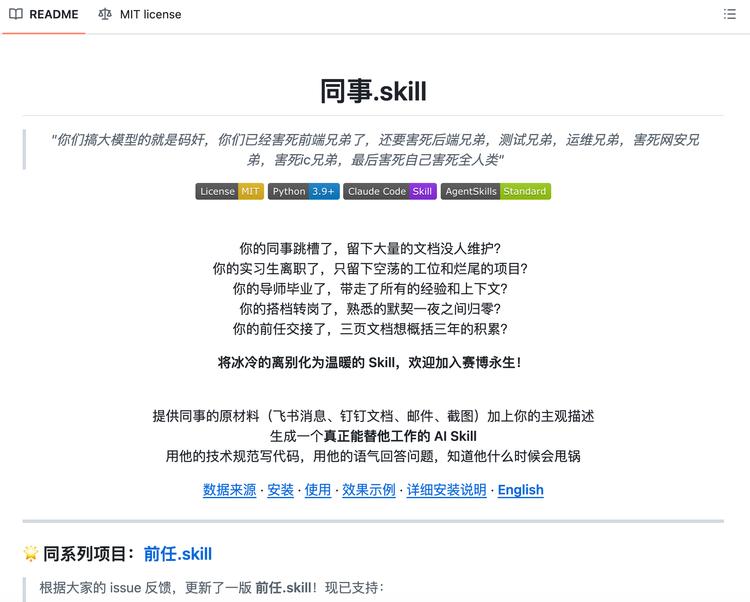
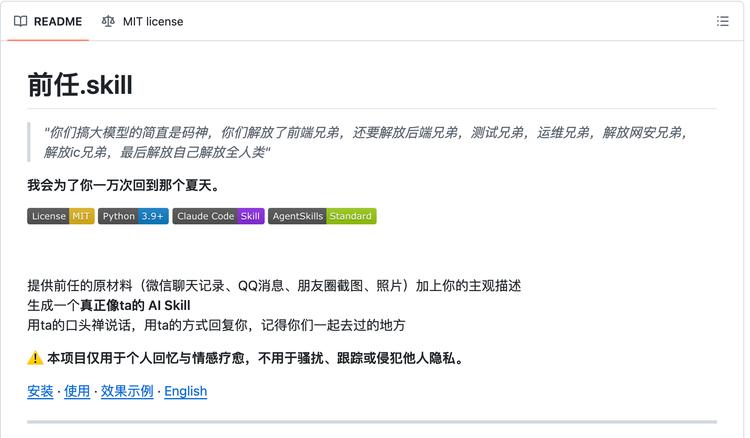
Ex.skill migrates the same structure to intimate relationships. It no longer deals with code reviews and project progress, but with chat rhythms, memory fragments, emotional responses, and interaction styles. According to the project README, it can use chat records, photos, social media, and subjective descriptions to generate a digital personality skill that "talks like them". What really makes people uneasy is not the technical implementation itself, but that it also understands the "presence in a relationship" as something that can be extracted and called.
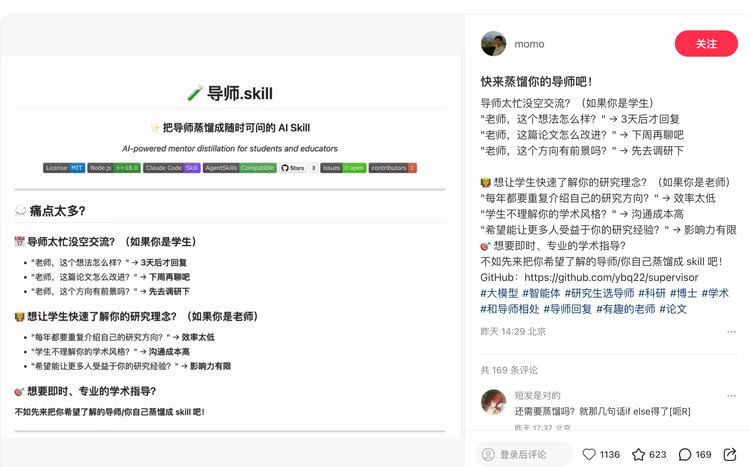
Now, even mentors are starting to be made into skills. For example, in the project Mentor.skill, the home page directly states: "Distill the mentor into an AI Skill that can be consulted at any time". It targets very specific pain points: if you are a student, your mentor is too busy to be found; if you are a teacher, you have to repeatedly introduce your research direction, academic style, and experience methods to students. This kind of "guidance", "inspiration", and "mentoring" relationship that originally highly relied on the presence of a real person is also starting to be rewritten into an encapsulable and accessible ability package at any time.
Furthermore, on GitHub, there has even emerged a direction of making "boss functions" into skills. For example, projects like boss - skill, the core is not to replicate a certain boss's tone, but to abstract the management center of "coordinating, dividing work, promoting, and scheduling multiple roles" into a Boss Agent; and skills like ceo - advisor further make typical CEO responsibilities such as strategic decision - making, resource allocation, board communication, and organizational development into a callable framework. Even bosses can be skill - ized.
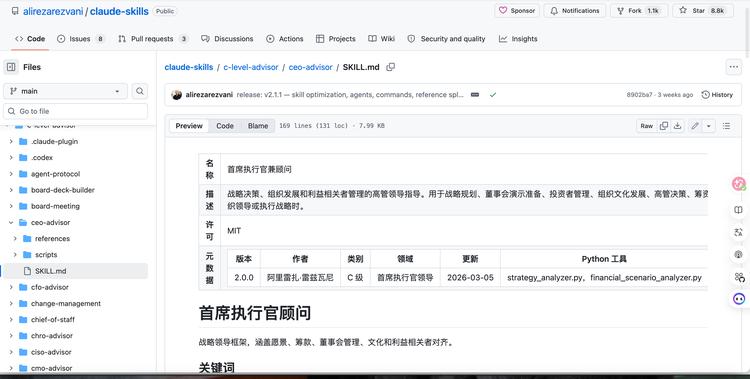
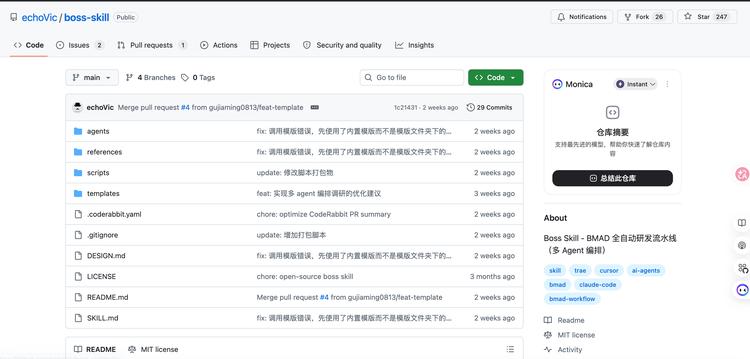
Putting all these together, we can find that:
An ex was originally a relationship; a colleague was originally a form of collaboration; a mentor was originally a form of influence; a boss was originally a power structure.
But in the narrative of skills, these are starting to be re - expressed as: what materials to input, what features to extract, what style to output, when to call, how to roll back, and how to correct deviations. Once this kind of discourse is accepted, people are no longer first seen as "irreplaceable individuals", but first as "interfaces to be organized".
This is really what deserves our vigilance. It's not that AI imitates people, but that we first learn to understand people in the way of software engineering.
3.
So how do we price humans?
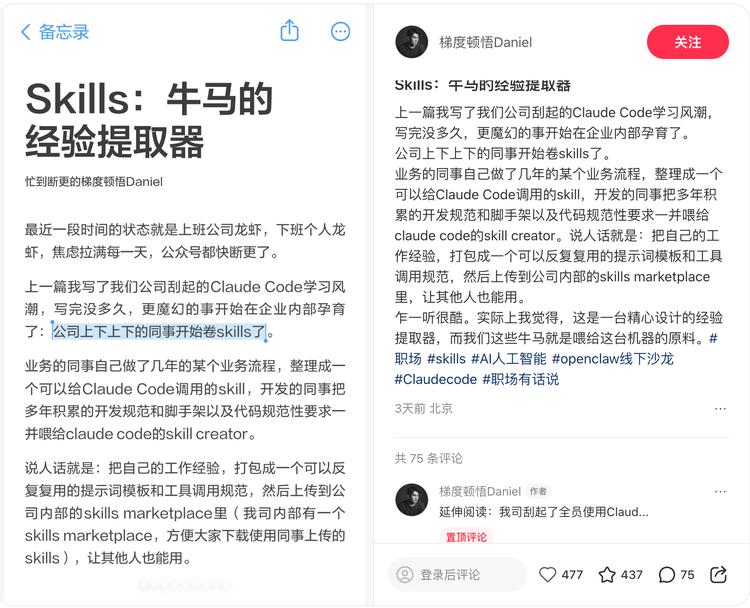
What exactly is really changed by this?
In the past, a person's value in the workplace lay in their presence and ability to get the job done. What Skill does is to break down the fact that "a person must be present": the ability can be retained while the person can leave. It means that the unit of "person" is being unpacked - you are no longer an indivisible whole, but a set of functional modules that can be priced separately. Judgment, tone, workflow, and historical context can each be extracted, encapsulated, and reused separately.
This does not mean that humans will disappear. More precisely, it means that "executing tasks in person" will become cheaper and cheaper, and what will truly be scarce will be: who can define problems, who can design processes, who can continuously calibrate the system, and who is qualified to be responsible for the results.
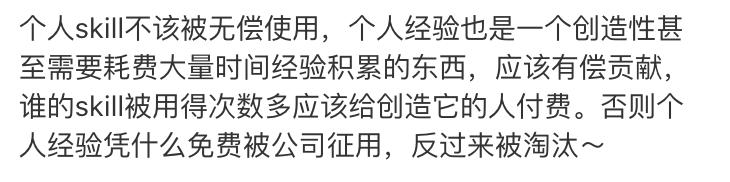
In the future, the most valuable people may not be those who are the busiest, the most hard - working, and the most able to endure, but those who can precipitate their experience, judgment, and methods into a system and continuously calibrate this system. Because that is the part that is truly difficult to be extracted at once. What can be replicated are the obvious actions, and what is difficult to be replicated is the long - term accumulated sense of choice, responsibility, and boundaries.
In this sense, what skill - ization really re - evaluates is not a certain position, but the structure of labor value.
In the past, value mainly came from "I did this thing with my own hands"; in the future, value will increasingly come from "I defined how to do it, what is considered good, and who is responsible for the problems that arise".
4.
Where are the boundaries: From technological trends to ethical issues
Of course, this matter also has its boundaries.
When Anthropic talks about skills, it clearly warns about security risks and data leakage issues, and suggests only installing skills from trusted sources and conducting careful audits of the code, dependencies, and external resources in them. This warning is already important enough for ordinary document skills, and it is even more alarming in the scenario of "people being made into skills".
Because once a person's chat records, work documents, behavior habits, and tone preferences can be distilled, the problem is no longer just "whether it can be done technically", but becomes: who owns these materials? Who has the right to organize them? Who has the right to call them? Who will define misuse and abuse? Who will bear the consequences of being misinterpreted, misused, and reproduced?
That is to say, this is not only a technological trend with a sense of the future, but also an approaching ethical issue. While we are amazed that "experience can finally be precipitated", we must also admit that what is precipitated is not only experience, but often also a person's traces, relationships, and boundaries.
Conclusion
The slogan of Colleague.skill is "Welcome to cyber immortality". This sentence is serious and also a meme, and it is becoming increasingly difficult to distinguish between the two.
It's not that tools are becoming more and more like people, but that we are becoming more and more used to understanding each other in the way of "interfaces".
By that time, humans will not disappear, but will be re - priced.
As for how much they will be worth after pricing, no one knows yet.
This article is from the WeChat official account "Silicon Star GenAI", author: Zhou Huaxiang. Republished by 36Kr with permission.