Song Gang, the "ace factory director" of Tesla, is set to join Xiaomi. Has Wang Hua been slapped in the face?
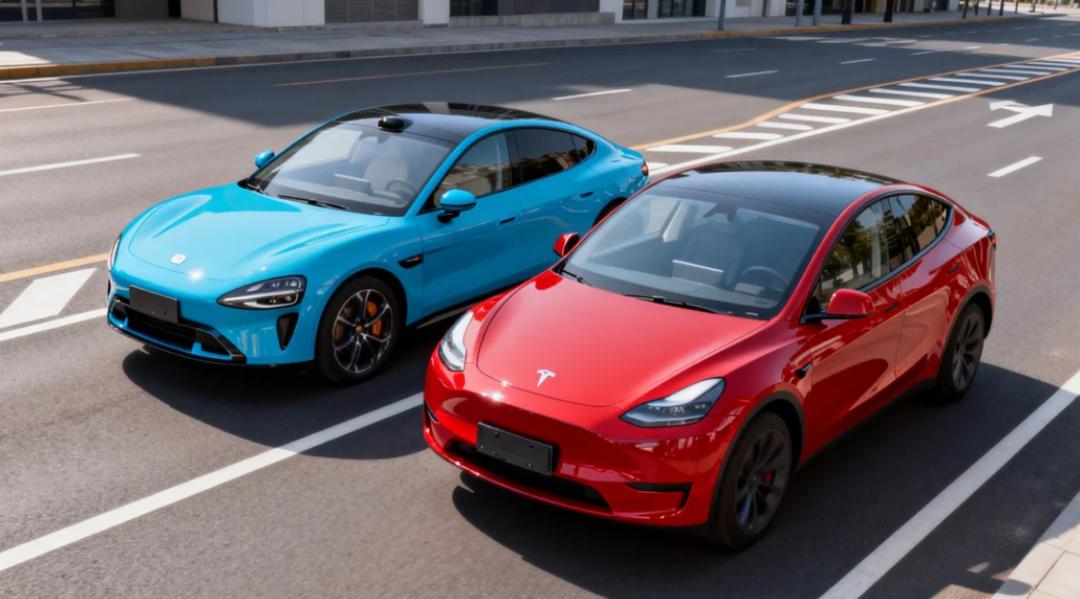
Is Xiaomi poaching talent from Tesla again?
On April 1st, according to Lanjing News, Song Gang, the former vice president of production and manufacturing at Tesla's Shanghai Gigafactory, who led the construction and capacity ramp - up of the factory, will join Xiaomi Auto.
Data shows that Song Gang once worked at General Motors and Ford. He joined Tesla in 2018 and served as the vice president of production and manufacturing at Tesla's Shanghai Gigafactory. He is known as the "ace factory director" in the industry. On December 18, 2024, Song Gang left Tesla, and five days later, he joined Envision Energy as the senior vice president of integrated supply chain.
This is not the first time Song Gang has been associated with Xiaomi Auto. In fact, when this "ace factory director" left Tesla, there were rumors that he would join Xiaomi Auto. Wang Hua of Xiaomi once posted on Weibo, "The so - called Director Song is really good, but our Director Ji at Xiaomi Auto is also excellent, which is enough!"
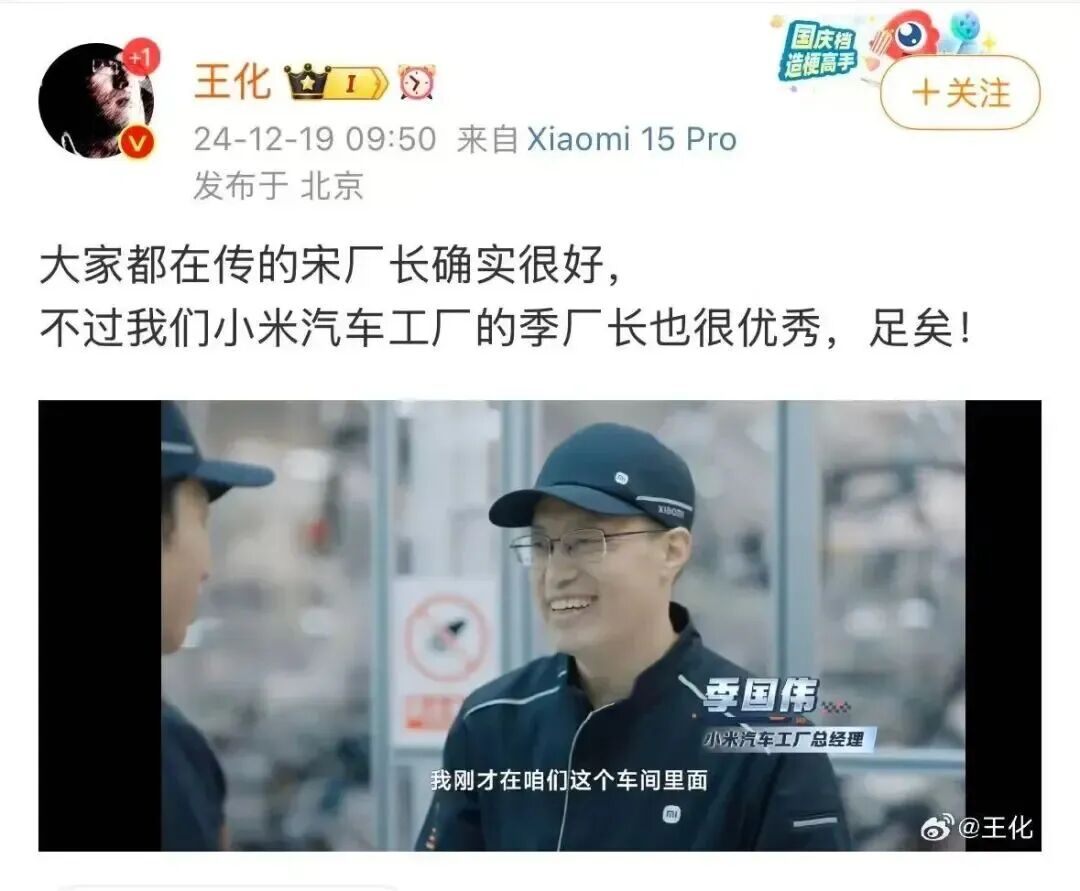
This statement was regarded as a refutation of the rumor that Song Gang would join. However, more than a year later, things seem to have come full circle. So far, Xiaomi has not made an official response.
So, what achievements did Song Gang have at Tesla? What abilities does Xiaomi Auto see in him? Why does Xiaomi recruit a large number of former Tesla employees?
01 The Tough Guy Who Created the "Shanghai Miracle" at Tesla
If we were to write a biography of figures in the history of new - energy vehicle manufacturing in China, Song Gang would definitely be a name that cannot be bypassed in the era of electrification. He is not only a manufacturing expert trained in the traditional automobile enterprise system but also the core operator who led Tesla through the "production hell" and achieved a global comeback against the odds.
Before joining Tesla, Song Gang worked at Ford and SAIC - GM successively. The characteristics of these two companies have been engraved in his genes.
As the originator of modern automobile assembly - line production, the most core legacy of the Ford system is the extreme pursuit of "standardization". How to break down the complex automobile manufacturing process into standard actions that workers on the assembly line can strictly follow is the most important knowledge Song Gang learned at Ford.
His experience at SAIC - GM gave him the "micro - operation" ability to manage a huge supply chain. As a benchmark for lean production among domestic joint - venture automobile enterprises, his work at GM allowed Song Gang to thoroughly understand the characteristics of the local supply chain: how to find suppliers, how to cut costs, and how to ensure that thousands of parts are on time for the production line rhythm.
With this background in traditional automobile enterprises, Song Gang entered the door of Tesla's Shanghai Gigafactory in 2018. At that time, Elon Musk was deeply trapped in the "production hell" of Model 3 due to the excessive pursuit of full automation, and even the "world - famous painting" of him sleeping on the factory floor emerged.
After Song Gang joined, he did not adopt Musk's utopian vision of a "fully automated and unmanned factory". Instead, he used the most rigorous and mature production - line management system of traditional joint - venture automobile enterprises to support Tesla's radical engineering design.
Under his leadership, the Shanghai factory not only created the industry myth of "starting construction, putting into production, and delivering products in the same year" but also directly increased the production capacity of Model 3 to thousands of units per week in a very short time. When Model Y was put into production, the second - phase Shanghai factory became the vehicle manufacturing base with the highest production - line efficiency and the most stable quality in the world. It's no exaggeration to say that he saved Tesla.
In addition to increasing production capacity, Song Gang also promoted the localization of Tesla's parts in China, raising the localization rate of parts at the Shanghai factory to over 95%. This not only significantly reduced manufacturing costs but also provided continuous ammunition for Musk's successive "price wars" around the world.
Before leaving Tesla, Song Gang was in charge of the four core manufacturing systems of the Shanghai factory: the first - phase (mainly producing Model 3), the second - phase (mainly producing Model Y), the battery factory, and the motor factory. He was the most important person with real power in Tesla China after Zhu Xiaotong, the president of Greater China.
Perhaps this is the reason why Xiaomi finally recruited Song Gang.
If in the first two years of Xiaomi's foray into the automobile industry, Lei Jun and Ji Guowei (the current factory director of Xiaomi Auto) solved the problem of "going from 0 to 1" by building and selling cars successfully, then in 2026, Xiaomi is facing the problem of "going from 1 to 100" in terms of large - scale growth.
To put it simply, Xiaomi is currently facing two major challenges: extreme production - capacity ramp - up and extremely difficult multi - factory coordination.
Let's first look at production capacity. Although the waiting time for orders of Xiaomi cars is no longer as exaggerated as half a year or a year when they were first launched, it doesn't mean that the production - capacity pressure in 2026 will be relieved because Lei Jun has set a high target.
According to the goal announced by Lei Jun at the beginning of the year, Xiaomi Auto's annual delivery target for 2026 is 550,000 vehicles. Based on the cumulative delivery data of about 79,000 vehicles in the first quarter, it means that from April onwards, Xiaomi's average monthly delivery volume must increase to at least 52,000 vehicles.
What does 52,000 vehicles mean? It is almost 2.6 times the current monthly average level in the first quarter and even exceeds the historical monthly peak of 50,000 vehicles set in December 2025. That is to say, every month from now on, Xiaomi Auto must operate at a record - breaking extreme level.
To handle the huge number of orders, Xiaomi has fully expanded its factory layout. Public data shows that Xiaomi's first - phase and second - phase factories in Beijing are currently operating at full capacity, with an annual production capacity between 300,000 and 330,000 vehicles. The third - phase Beijing factory, which was put into production after the Spring Festival (with a designed annual production capacity of 150,000 vehicles), and the Wuhan factory, which will be put into production in May 2026 (with a designed annual production capacity of 150,000 vehicles), are the key to achieving this year's goal.
This leads to the most critical question: how to quickly put the new factories into production? How to ensure high - quality and standardized production when all four bases are in operation?
When a single super - factory becomes a multi - base collaborative operation across regions, and when the monthly production of one or two thousand units becomes five or six thousand units, this is no longer a simple "screwing" problem but an extremely complex systematic project. How to quickly increase the yield rate of the new production line? How to manage the logistics of thousands of parts? More importantly, how to ensure quality control does not fail while sales are growing explosively?
Looking at the entire new - energy vehicle circle in China, there are very few people who can perfectly answer this question. And Song Gang is exactly the most suitable answer.
From his resume, in the later stage at Tesla, Song Gang was in charge of the four core manufacturing systems: the first - phase, the second - phase, the battery, and the motor. He knows exactly where the "pitfalls" are in multi - factory coordination and cross - regional scheduling, and he also knows how to seamlessly replicate a mature production standard to a new production line.
So, rather than saying that Director Ji is no longer "attractive", it's more that the scale of Xiaomi Auto has expanded to the stage where a higher - level manufacturing system must be introduced. Song Gang's joining is essentially an appropriate insurance policy that Lei Jun has bought for Xiaomi Auto's "large - scale battle" in 2026.
02 Starting with "Porsche Aesthetics", Loyal to the "Tesla System"
What Xiaomi wants is far more than just Tesla's "ace factory director".
According to Jiemian News, on April 1st, Kong Yanshuang, the former general manager of Tesla China, has joined Xiaomi and will replace Li Xiaorui, the former director of Xiaomi Auto, to be fully responsible for automobile sales. Kong Yanshuang joined in early March and is in the process of work handover. Currently, Xiaomi has not officially issued a notice about her official position.
Public data shows that Kong Yanshuang is a core executive at Tesla China. She has held positions such as the general manager of Tesla's South China region and the general manager of the China region, and has long led the layout of Tesla's sales system and brand promotion in the Chinese market.
This handover of the top sales position is meaningful. Li Xiaorui, who was replaced, once served as the general manager of Great Wall's Haval brand, representing the steady - paced channel - building ability of traditional automobile enterprises. He helped Xiaomi win the "from 0 to 1" opening battle. And Kong Yanshuang, who takes over, represents Tesla's direct - sales delivery system that pursues extreme floor - space efficiency and high conversion rates with a minimal SKU. Under the heavy pressure of delivering 550,000 vehicles this year, Xiaomi needs a direct - sales general who can handle "massive throughput".
In addition to these top - level sales and manufacturing executives, Xiaomi is also making precise moves in the more technical production - line technology area.
According to Electric Knowledge Home, You Hailong, the former production head of Tesla's welding workshop, may also have joined Xiaomi Auto.
Welding is a part of the four major automobile manufacturing processes (stamping, welding, painting, and assembly) that extremely tests precision, automation rate, and production - line rhythm. This also confirms that Xiaomi's poaching in the manufacturing field aims to bring over Tesla's highly efficient "core team".
This is just the recent talent recruitment. In fact, Xiaomi's "targeted poaching" of Tesla and other competitors has not started in the past few days. It has been a long - term strategy since the day Lei Jun announced Xiaomi's entry into the automobile industry in 2021.
The most typical example is Li Tianyuan, the "soul figure" who led the styling design of Xiaomi SU7 and is the chief designer of Xiaomi Auto.
As Tesla's first Chinese - born designer, Li Tianyuan was deeply involved in the exterior and interior design of Model 3 and Model Y. As soon as Lei Jun announced Xiaomi's foray into the automobile industry in 2021, Li Tianyuan quickly joined. The reason why the SU7 became popular as soon as it was released, with its minimalist lines, extremely low drag coefficient, and highly technological appearance, is the "Silicon Valley - style aesthetics" brought by Li Tianyuan, which is different from that of traditional automobile enterprises.
At the technology R & D end, which is not visible to the outside world, there is already a "Tesla - style" forest within Xiaomi. In Xiaomi's core R & D team in its early days, a large number of former Tesla engineering backbones have been recruited, whether in the underlying architecture of the three - electric system (battery, motor, and electronic control) or in the evolution of the pure - vision route for autonomous driving.
It can be said that in the long - term future, Tesla fans may be surprised to find more and more familiar elements in Xiaomi Auto's subsequent products and terminal experiences. However, this is not a simple "imitation" but an upgrade to a higher level.
What makes Xiaomi truly remarkable is its extremely strong "integration and evolution" ability. When Tesla's most efficient underlying hardware manufacturing and commercial circulation closed - loop, which has been verified by the global market, meets Xiaomi's "full - ecosystem of people, cars, and homes", the unfathomable local software and hardware supply - chain coordination ability, and Lei Jun's phenomenal user operation and marketing skills, it will surely trigger a chemical reaction where 1 + 1 is far greater than 2.
The expensive tuition fees that Tesla paid during the "production hell" and the "direct - sales exploration period" have now become the practical experience of Xiaomi's executive team. In this sense, Xiaomi Auto is rightfully "standing on Tesla's shoulders".
For the entire new - energy vehicle circle, a Xiaomi Auto with a top - notch Internet brain and fully equipped with a "steel skeleton" of Tesla's level may be the real trump card that Lei Jun plays in the most intense year of involution in the Chinese new - energy vehicle market in 2026.
This article is from the WeChat official account "Super Focus Foci", author: Bai Mo. Republished by 36Kr with permission.