From 47% to 12%, are Chinese cars facing a "policy crisis" in overseas markets?
From the high point of "crushing Japanese cars" to a cliff-like decline, and then to the "divine assist" brought by the energy crisis... In just three months, Chinese new energy vehicles in Thailand have experienced a rollercoaster ride worthy of being recorded in the business history.
In January this year, big news broke in the Thai auto market: Chinese brands, with a narrow margin of 47.34% to 47.338%, for the first time in history surpassed Japanese cars that had dominated for over 60 years! BYD firmly held the second place, and six out of the top ten were Chinese brands. Many people cheered: Is the "iron throne" of Japanese cars about to change hands?
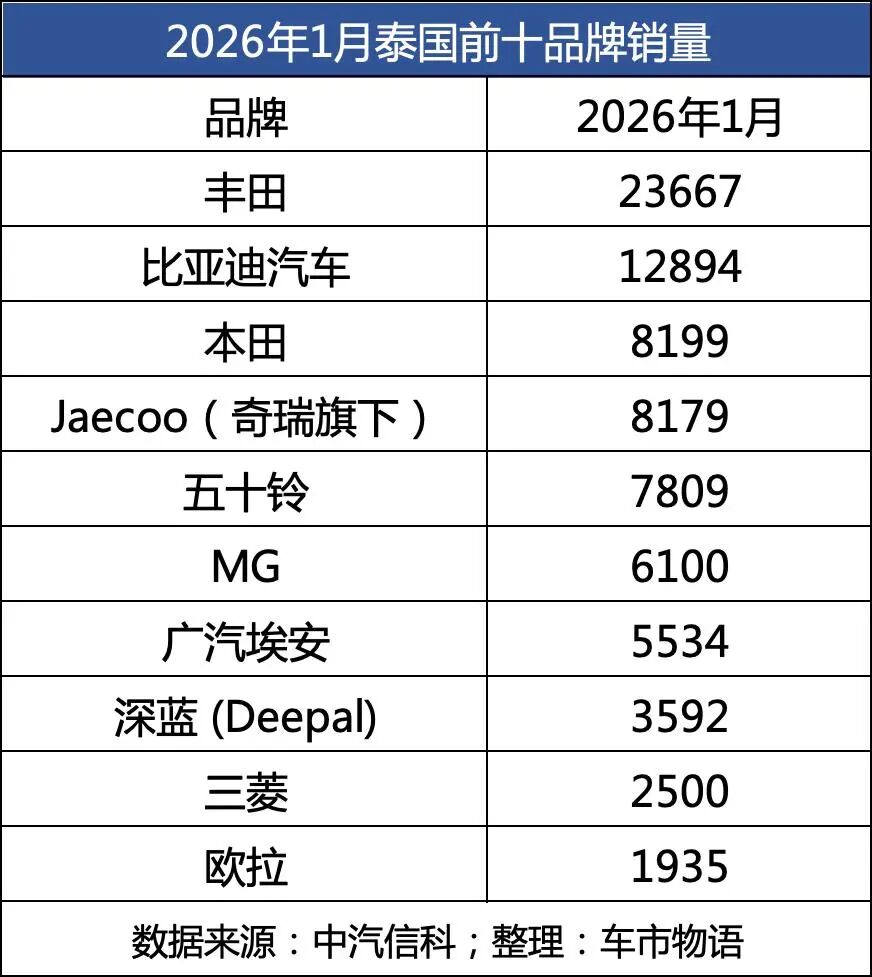
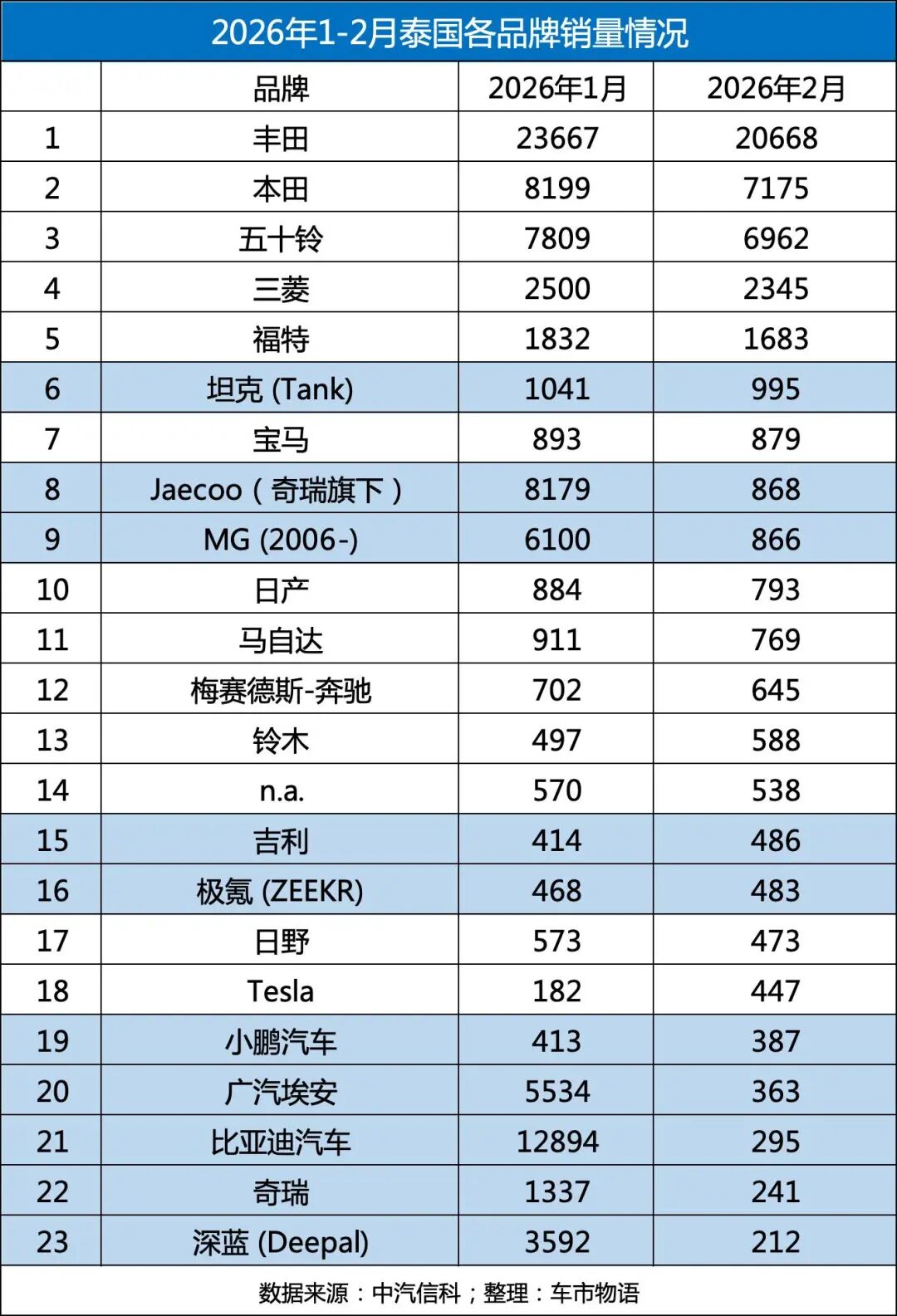
However, the ecstasy was quickly doused by the cold spell in February. As the electric vehicle subsidy policy shifted, the market share of Chinese brands plummeted from 47.3% to 12%. BYD's sales volume dropped from over 12,000 units to 295 units.
The market was in an uproar: Without subsidies, is there no hope for Chinese electric cars in Thailand?
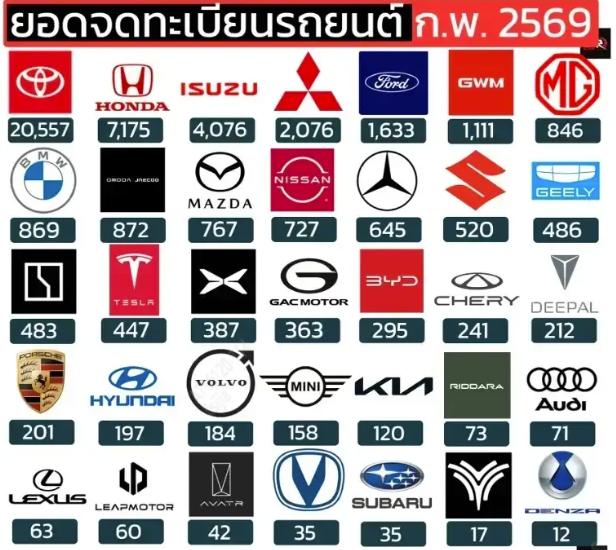
Sales chart of various automobile brands in Thailand in February 2026 (Source: car250)
Who would have thought the plot would reverse again. In March, an oil price storm triggered by the Middle East situation swept across Thailand, igniting the "survival anxiety" of car owners: Long queues formed at gas stations in the early morning. Some stations limited refueling to 500 Thai baht (about 106 yuan), and car owners had to queue up two or three times to fill up their tanks. Even more incredibly, some people took out plastic barrels to hoard oil, and even temples reported a shortage of fuel for cremation.
Amid this "fuel anxiety," the Bangkok International Motor Show next door became the "highlight stage" for Chinese brands. Orders in the first four days showed that Chinese brands occupied seven out of the top ten spots (BYD will announce its orders on the last day of the motor show).
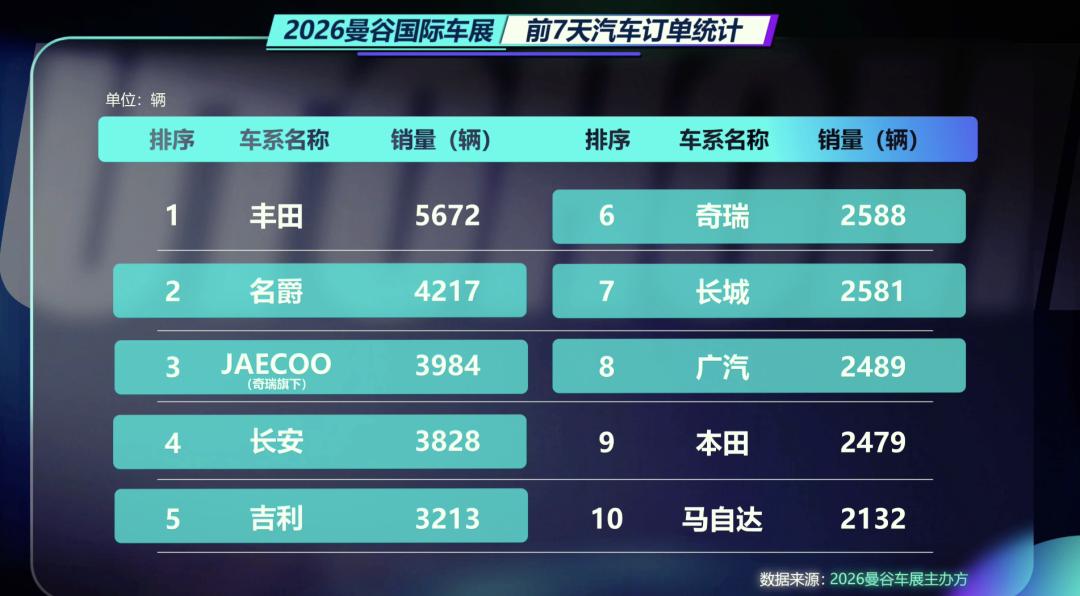
This overheated scenario gives everyone something to think about: When the policy tide recedes and the oil price stimulus fades, how can Chinese brands win a real "protracted war" in the "backyard" of Japanese cars?
Chinese electric cars face a "policy crisis"
Thailand, known as the "Detroit of Southeast Asia," is the base where Japanese car brands have painstakingly operated for half a century.
When Chinese car companies entered the market, they chose a smart path: "Changing lanes to overtake." Instead of competing in the field of fuel vehicles, they opened up the market with electric vehicles and used technologies such as intelligent cockpits and L2-level assisted driving to outperform Japanese brands.
In addition, the Thai government's "EV 3.0" policy was the biggest booster: Buyers of electric vehicles could get a subsidy of up to 150,000 Thai baht (about 31,700 yuan), and the consumption tax was directly reduced from 8% to 2%.
Driven by both products and policies, the share of Chinese brands soared from 4% in 2021 to 21.5% in 2025.
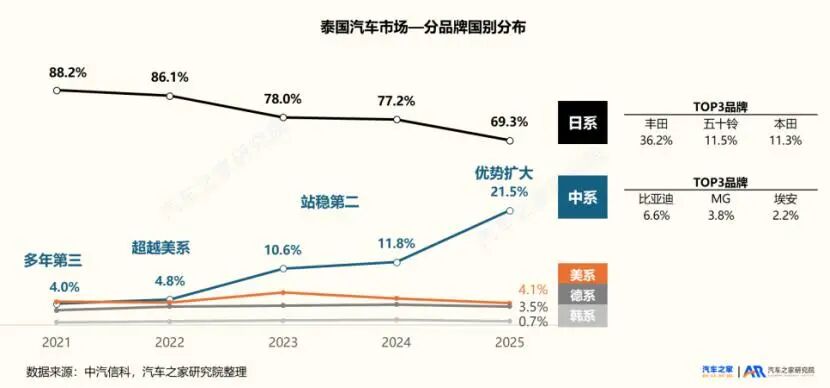
However, every fast lane has an end. In February this year, the policy shifted to EV 3.5: The "red envelopes" shrank significantly.
The maximum cash subsidy was only 50,000 Thai baht (about 10,000 yuan), and it was only applicable to locally produced models; the consumption tax on imported cars soared back from 2% to 10%.
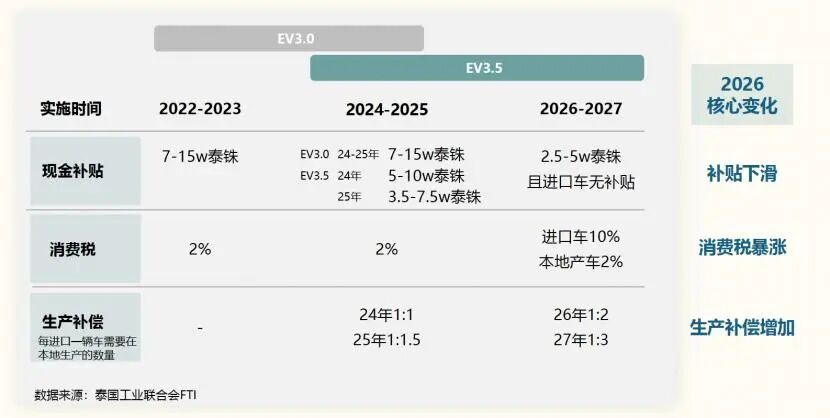
This meant that for many Chinese brands that opened up the market with imported models, the car prices rose immediately. The price of BYD Dolphin increased by more than 30% at most.
The data feedback was extremely significant: The sales volume of pure electric vehicles in Thailand in February was only 6,168 units, a plunge of 80% compared with January. It should be noted that Chinese brands accounted for more than 80% of the market share.
What's even more stringent is the "production capacity bet": The government requires car companies to exchange "local production" for "import qualifications." In 2026, for every imported vehicle, two vehicles must be produced in Thailand; in 2027, this ratio will become 1:3.
The cost of default is extremely high. Neta Auto is a typical example: Due to the actual output in 2024 being less than 25% of the promised amount, it is facing a subsidy recovery of more than 2 billion Thai baht (about 420 million yuan), and the brand has been severely hit.
This cold water has awakened a fact: Growth driven by subsidies is like a sandcastle that will collapse when the tide recedes. The product strength of Chinese cars has been verified, but they must get through the difficult "policy weaning period."
Combination punches for breaking through in the Thai market
Facing the strict new policy, the strategy of Chinese car companies is very clear: Use local manufacturing to obtain long-term qualifications.
The first move is "production capacity suppression": As of 2025, the planned annual production capacity of Chinese car companies in Thailand has soared to 550,000 vehicles. Senior executives of BYD, GAC, Great Wall and other companies clearly stated in communication with us that they have fulfilled the production capacity commitments in the EV 3.0 stage and have prepared sufficient ammunition for the competition under the new policy.
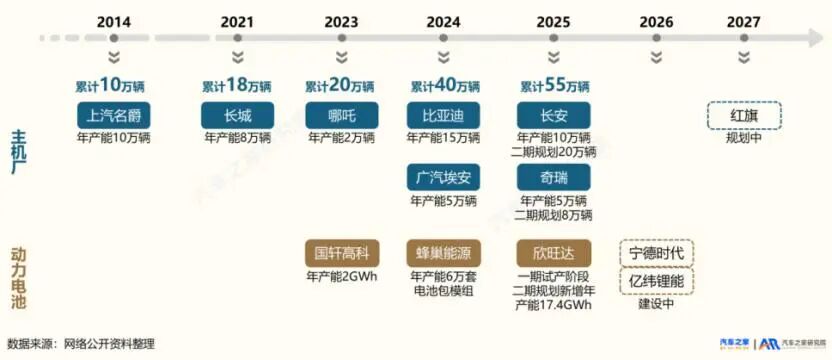
The second move is "internalizing the supply chain": The new regulations require that starting from July 2026, the imported part of the battery cost should be reduced to less than 10%.
This has forced the Chinese industrial chain to "go south" collectively: BYD and SAIC have built their own battery pack production lines, and giants such as CATL and Guoxuan Hi-Tech have landed in Thailand through joint ventures. Thailand is upgrading from a vehicle assembly center to a new energy manufacturing base in Southeast Asia.
The third move is "power switch": In response to the slow construction of overseas charging piles and the reduction of subsidies, Chinese brands have begun to turn to hybrid and plug-in hybrid vehicles on a large scale.
At this year's Bangkok Motor Show, Great Wall simultaneously launched the pure electric and hybrid versions of ORA 5; BYD brought more than 40 models covering all energy solutions.
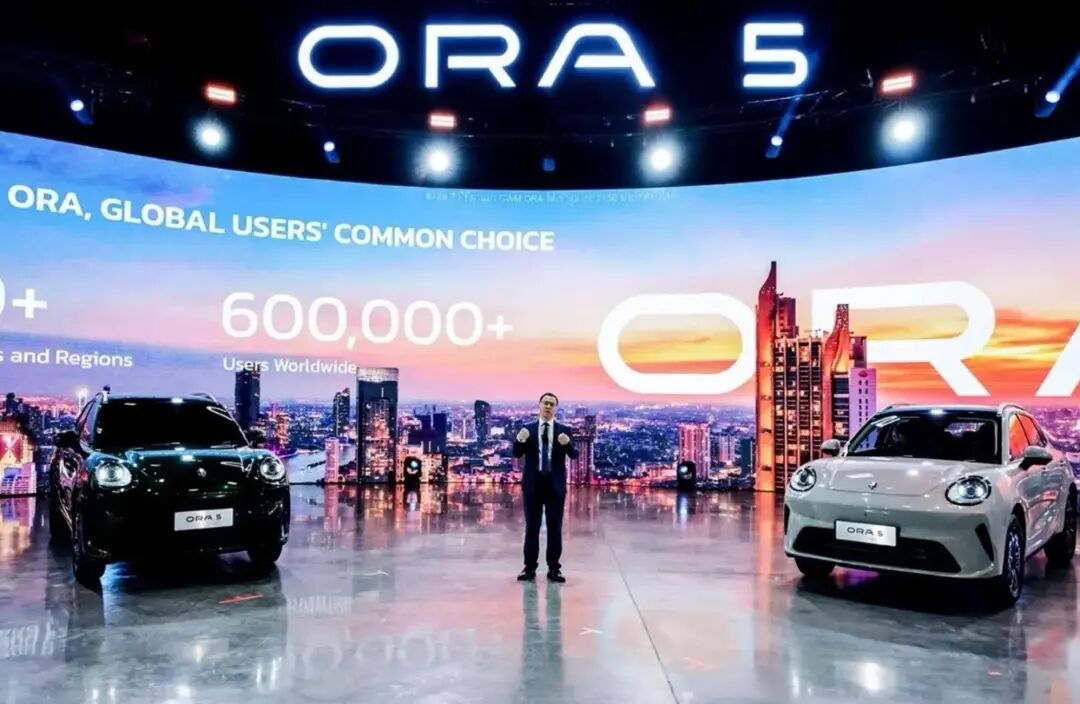
As Yang Weiqi, the international vice president of Great Wall Motors, said at a forum hosted by Autohome, the goal of Chinese brands should not be restricted by the "electric" label, but to become providers of full-scenario travel solutions.
There is a clear business logic behind the strategic adjustment. Ke Yubin, the general manager of BYD Thailand, said in a conversation with us: "The consumption tax on the three PHEV models we produce in Thailand has dropped from 8.8% last year to 5.5% this year. This is a better development for the entire market."
With precise pricing, BYD set the starting price of the locally assembled Seal DM-i at 599,900 Thai baht (about 126,000 yuan), directly entering the territory of Toyota and Honda fuel vehicles; the Dolphin model further attracted the market with a 15% price cut.
The ultimate challenge: Become a "local"
However, capturing market share is only the first step. Going from 0 to 1 can rely on a hit product and policy subsidies, but going from 1 to N and truly shaking the 60-year dominance of Japanese cars, Chinese brands face a more fundamental challenge: How to win the hearts of Thai consumers and establish all-round trust.
The strongest moat of Japanese cars is that they have spent 60 years integrating themselves into the Southeast Asian life. In any corner of Thailand, you can find shops that repair Toyota and Honda cars, with sufficient and cheap spare parts. This ubiquitous after-sales service constitutes the deepest competitive barrier.
And this is precisely the biggest shortcoming of Chinese brands at present. Some car owners complained that they may have to wait for half a year for a spare part of a Chinese electric car. There are few after-sales service outlets, the technical training lags behind, and the residual value rate of second-hand cars has not been established.
We conducted an in-depth nine-day survey last year and communicated with more than 20 people from 8 car companies, industry associations, local dealers, etc. We found that the core of the second half is "ecological construction." Friends who are interested can read the special report: A 9-day visit to 8 car companies and more than 20 people to see the path of Chinese cars in Thailand behind the filter.
Generally speaking, when selling cars overseas, we are not only selling products but also establishing an efficient after-sales network, a localized supply chain, and a deeper brand and cultural integration.
In this breakthrough battle in the "backyard" of Japanese cars, the second half may truly determine the pattern for the next decade. Let's wait and see.
This article is from the WeChat official account "Autostinger" (ID: autostinger), author: Peng Fei. Republished by 36Kr with permission.