Q1 Venture Capital Report: 72.8% Invested in Early-stage Projects, 48.7% State-owned Capital Entered the Market, and Hard Technology Attracted 70% of Investments
Introduction: The Spring Tide is Surging, and Hard Technology Leads a New Cycle
In 2026, China's venture capital market is standing at the intersection of a new round of technological revolution and industrial transformation. With the in - depth reconstruction of the global industrial chain, the accelerated process of domestic substitution, and the transition of artificial intelligence from the laboratory to industrialization, the primary market is showing an active trend different from the past.
The first quarter has always been the investment barometer for the whole year. The layout strategies of institutions at the beginning of the year often indicate the investment mainlines for the whole year.
This report is based on the complete investment and financing data of IT Juzi Database from January to March 2026. It systematically analyzes the market logic behind 2,865 financing events and the disclosed amount of 256 billion yuan from nine dimensions, including the panorama of financing events, monthly fluctuation characteristics, industry track distribution, investment stage migration, regional capital pattern, currency structure change, participation of state - owned capital, trends of mainstream players, and observation of funded enterprises.
The report strives to find a balance between data granularity and trend judgment, providing a clear decision - making reference for market participants.
Data Description:
This report only counts the equity financing obtained by startup companies registered in China in the primary market, excluding IPO and post - listing financing.
Data source: IT Juzi ©itjuzi.com
Statistics time cutoff: March 31, 2026
I. Market Panorama: Quantity Increase and Price Stability, Confirmation of Confidence Restoration
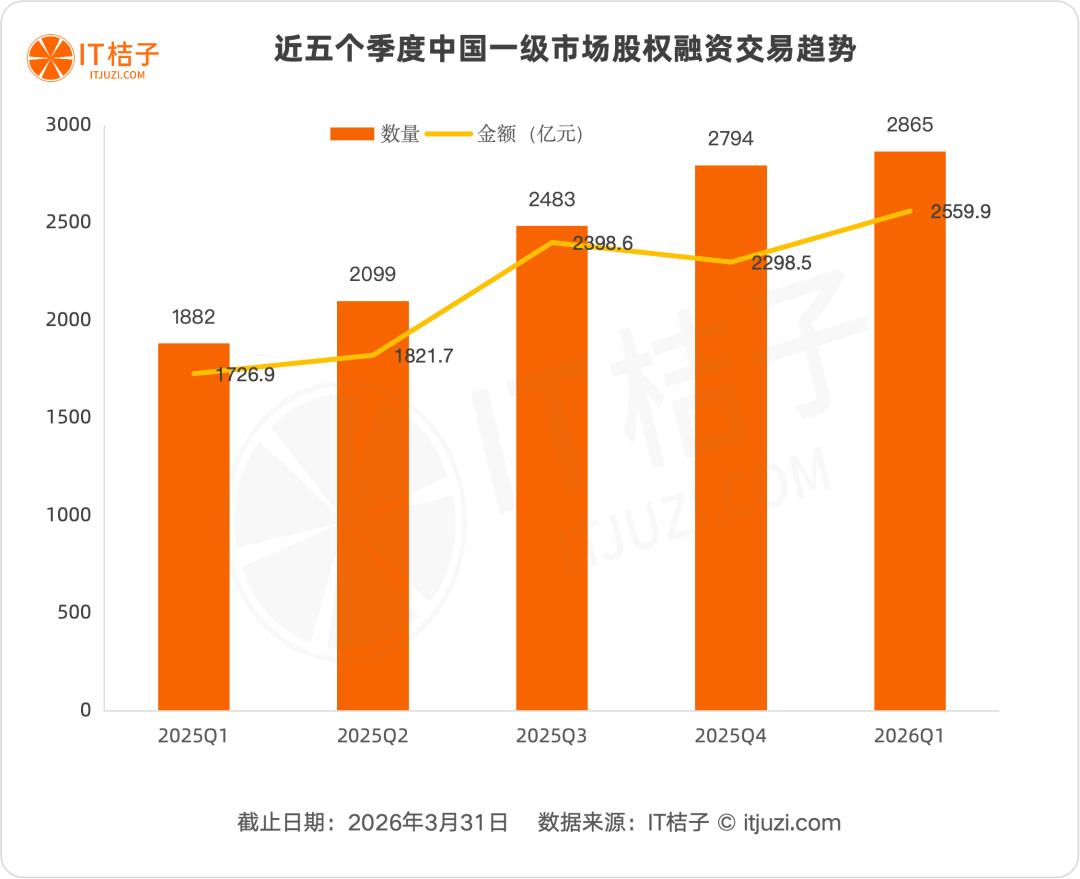
In the first quarter of 2026, a total of 2,865 financing events occurred in China's venture capital market, a quarter - on - quarter increase of 2.5% and a year - on - year increase of as high as 52%. The total disclosed financing amount reached 256 billion yuan, a quarter - on - quarter increase of 11.4% and a year - on - year increase of 48%.
In terms of the single - financing scale, the average financing amount increased to 89 million yuan (an increase of 15 million yuan compared with Q4 2025), and the median single - financing amount reached 30 million yuan (significantly higher than the annual median of 20 million yuan in 2025).
The positive year - on - year and quarter - on - quarter growth of financing events marks that the market activity has officially entered the restoration channel. After two years of in - depth adjustment, institutions showed a more positive investment willingness at the beginning of 2026, and the market's attention and participation in innovation and entrepreneurship projects have significantly recovered.
The simultaneous increase of the average single - financing amount and the median reveals that the structural differentiation is deepening:
On the one hand, the valuation center of high - quality projects has moved up, and the market is willing to pay a premium for technological barriers and commercialization potential.
On the other hand, funds are accelerating to concentrate on top - tier projects, and the financing environment for mid - tier and lower - tier projects has not improved significantly. The strengthening of this "Matthew effect" requires entrepreneurs to build clearer moats in terms of technological differentiation or commercialization speed.
II. Track Map: Hard Technology is the Absolute Mainline
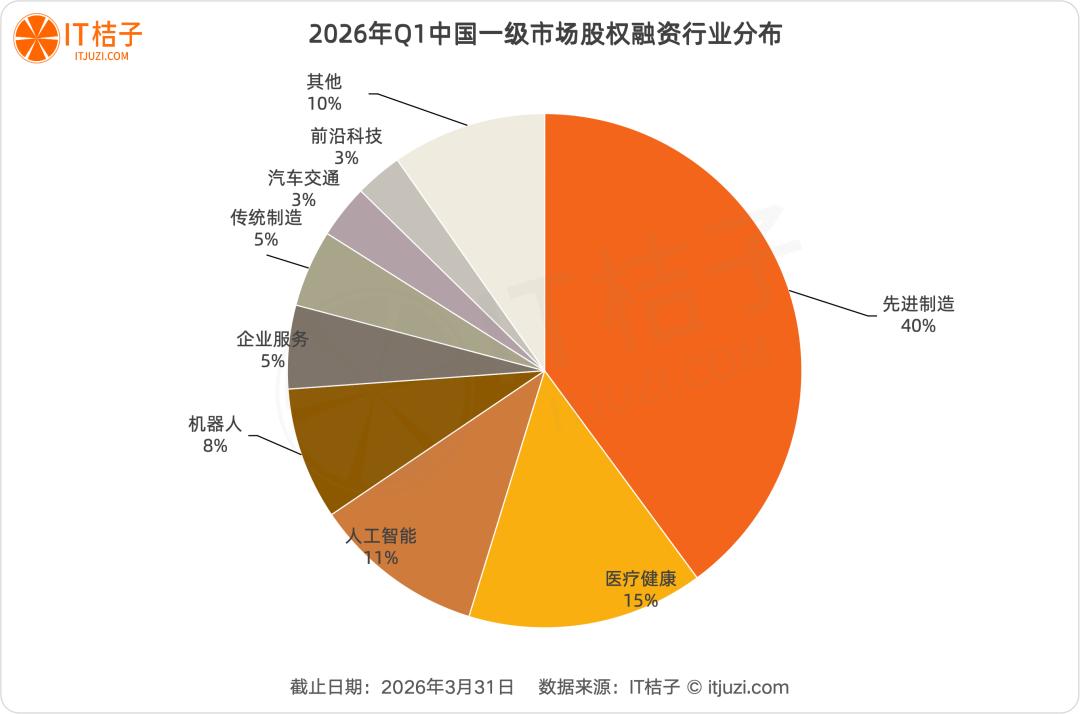
From an industry perspective, advanced manufacturing ranked first with a 40% event share, becoming the most attractive track this quarter.
Behind this data is the industrial reality that domestic substitution has changed from "optional" to "mandatory" - the financing density of projects in fields such as semiconductor equipment, industrial software, and high - end CNC machine tools has significantly increased. At the same time, the demand for intelligent upgrading has promoted the in - depth integration of traditional manufacturing with AI and the Internet of Things, forming an investment derivative logic of "advanced manufacturing +".
The medical and health field maintained a high - frequency financing trend driven by the dual wheels of innovative drug exports and domestic substitution of high - end medical devices. It is worth noting that pipeline maturity has become the watershed for valuation: companies with overseas clinical data or FDA/NMPA breakthrough therapy designations have significantly higher financing amounts than projects in the early concept verification stage.
The artificial intelligence track exploded at both ends of the AIGC application layer and large - model infrastructure. Different from the "basic model fever" in 2024, in Q1 2026, funds flowed more to AI Agents, industry - specific large models, and underlying computing power optimization tools with vertical scenario implementation capabilities. The ability to form a commercial closed - loop has become the core indicator for institutional due diligence.
The robotics industry welcomed the catalysis of the "embodied intelligence" era, with intensive financing for projects related to humanoid robots, industrial collaborative robots, and core components (reducers, force sensors). This track is characterized by "dominance of early - stage projects and rapid increase in single - financing amounts", reflecting the valuation jump brought about by technological breakthroughs.
Other notable directions include: the integration of SaaS and AI Agents in enterprise services, intelligent driving solutions and solid - state batteries in the automotive and transportation field, and quantum computing and commercial space in frontier technology. These fields together form the Q1 investment landscape with "hard technology as the mainstay and model innovation on the margins".
III. Stage Migration: Coexistence of Early - stage Activity and Late - stage Concentration
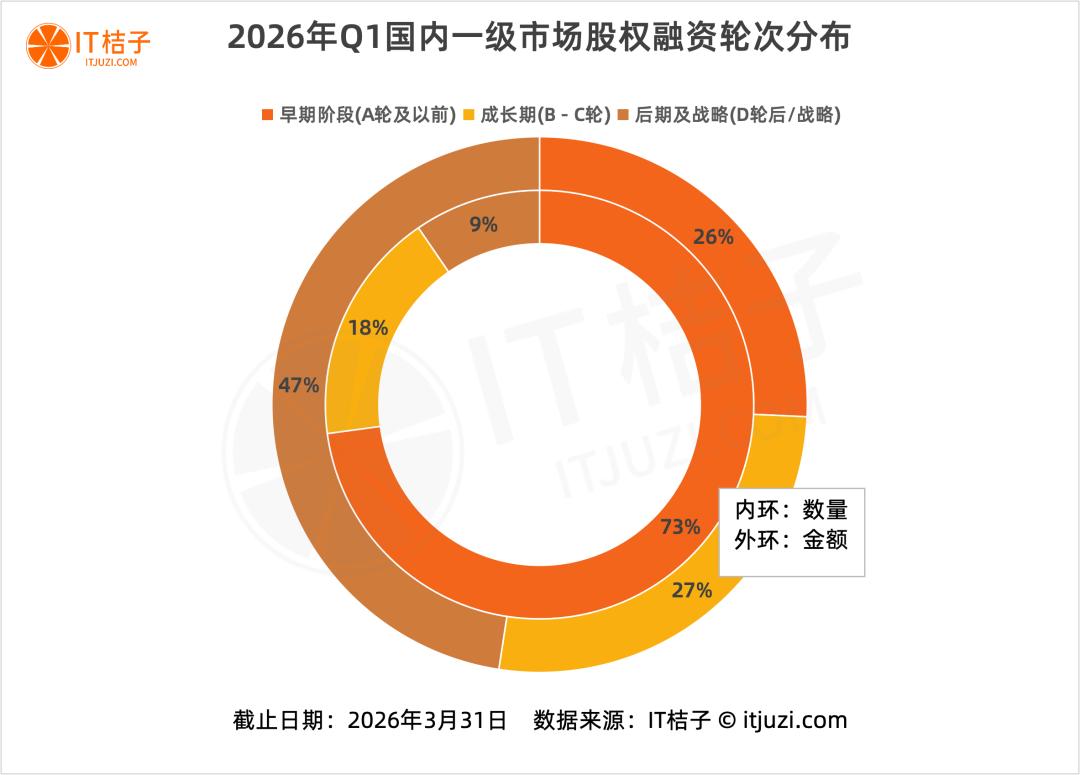
In the first quarter of 2026, early - stage projects accounted for 72.8% of the events but only contributed 25.7% of the amount. This "large quantity, small amount" structure verifies that the market's risk preference is being restored - institutions are willing to bet at earlier stages in exchange for future excess returns. Especially in the AI and robotics tracks, the proportion of angel - round projects is significantly higher than the historical average, indicating that technological paradigm changes have spawned a large number of new teams and new opportunities.
Investment in the growth stage showed the characteristic of "valuation restoration". After the valuation adjustment in 2024, the valuation system of projects after the B - round became more rational in Q1. Institutions were more selective when choosing targets, requiring clear revenue growth or technological barriers. As a result, the gap between the event share (17.6%) and the amount share (26.7%) at this stage narrowed.
The "small quantity, high proportion" in the late - stage and strategic stages (9.6% of the number of events corresponding to 47.6% of the amount) reveals the extreme concentration of funds on top - tier giants. Unicorn and quasi - unicorn companies often receive single - financing amounts in the billions, mainly for capacity expansion, mergers and acquisitions, or pre - IPO preparations. This "head - siphoning" effect makes the financing environment for late - stage projects better than that for growth - stage projects, forming a unique "dumbbell - shaped" market structure.
IV. Regional Pattern: Industrial Clusters Determine Capital Density
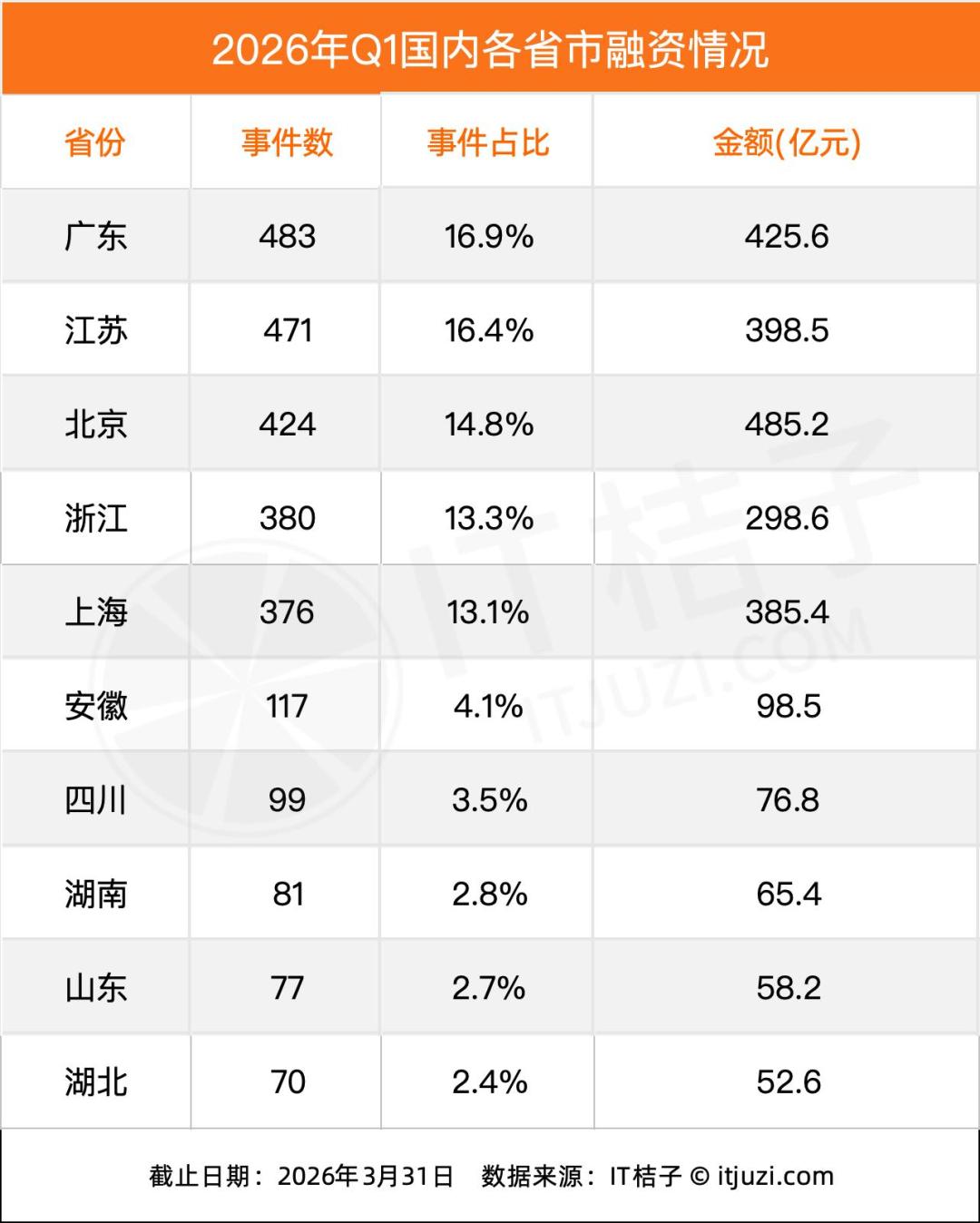
The five provinces and municipalities of Guangdong, Jiangsu, Beijing, Zhejiang, and Shanghai together accounted for 74.5% of the event share and 76.3% of the amount share. The regional concentration of venture capital activities remained at a high level. However, this concentration is not simply a "monopoly of first - tier cities" but shows distinct characteristics driven by industrial clusters:
Guangdong, relying on the Shenzhen - Dongguan - Foshan corridor, has formed a complete supply chain in the fields of robotics, semiconductors, and new energy, attracting a large amount of strategic investment and industrial capital.
Jiangsu, with the advanced manufacturing and biomedicine foundation of carriers such as the Suzhou Industrial Park and Nanjing Jiangbei New Area, has become a gathering place for growth - stage projects.
Beijing maintains an absolute advantage in "high - end and sophisticated" fields such as AI large models and commercial space. High - valuation projects have pushed up its amount share (18.9%) higher than its event share.
The cross - border e - commerce and intelligent manufacturing in Zhejiang and the integrated circuits and innovative drugs in Shanghai reflect the in - depth integration of regional characteristic industries and capital.
It is worth noting that although the event share of central and western provinces such as Anhui, Sichuan, and Hunan (10.4% in total) has increased compared with previous years, their amount share (8.9%) lags behind, indicating that projects in these regions are still mainly early - stage and small - scale financing, and have not yet formed large - scale late - stage project clusters.
V. Capital Structure: The Return of US - dollar Capital under the Dominance of RMB
In the domestic venture capital transactions in Q1 2026, the share of RMB financing events remained stable at around 97%, continuing its absolute dominant position for the past five quarters, indicating that the internal circulation ability of funds in China's venture capital market is continuously strengthening. However, the structural changes in US - dollar funds deserve high attention:
The "small quantity, high price" strategy of US - dollar capital: Although it accounts for only 2 - 3% of the number of events, it contributes 7 - 16% of the amount, and the single - financing scale is 4 - 6 times that of RMB financing.
The acceleration of US - dollar capital in Q1 is obvious: The amount share jumped to 15.8%, reaching a new high in five quarters, and the average single - financing amount was close to 500 million yuan.
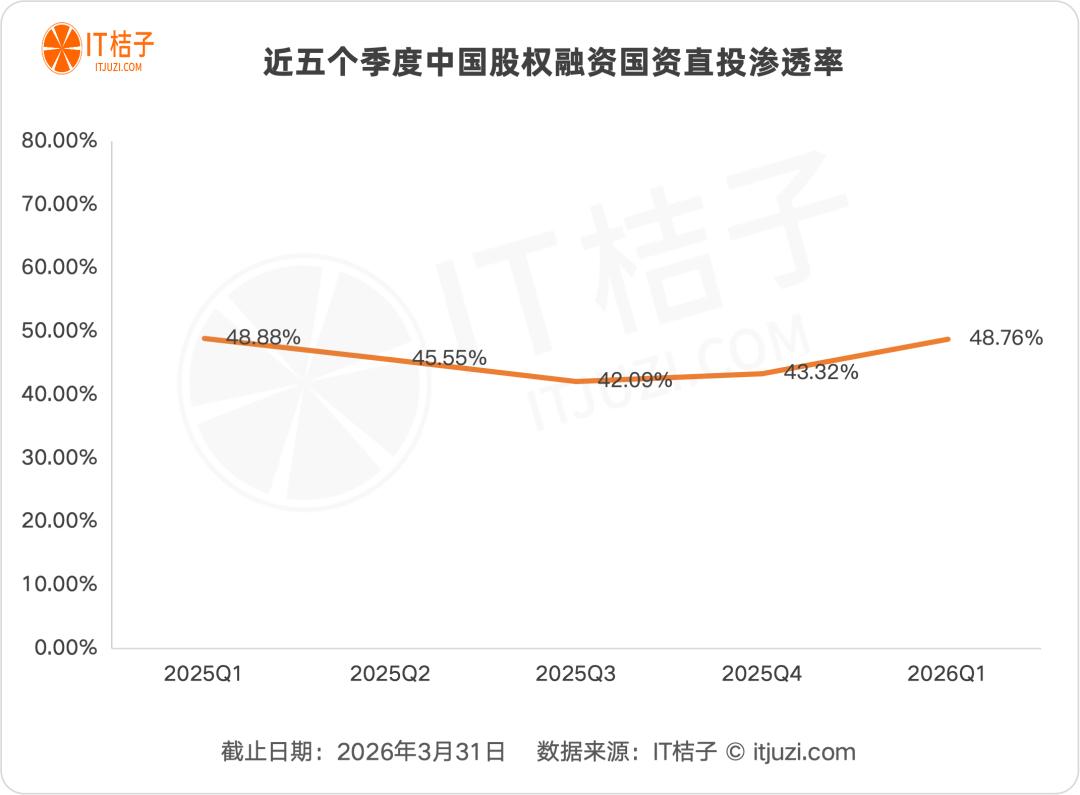
The participation of state - owned capital showed a slight "V - shaped" trend. From Q1 to Q3 2025, the share of state - owned capital decreased from 48.88% to 42.09%, reflecting the recovery of market - oriented forces. However, it began to rise in Q4 2025 and reached 48.76% in Q1 2026, not only increasing by 5.44 percentage points compared with Q4 2025 (43.32%) but also exceeding the level of the same period in 2025.
Behind this strong rebound is the concentrated investment of government - guided funds and state - owned enterprise industrial funds at the beginning of the year, as well as the active layout of state - owned platforms in strategic fields such as semiconductors and new energy. In total, the average share of state - owned capital in the past five quarters was 45.60%, indicating that state - owned capital and market - oriented forces have formed a "balanced" pattern in the venture capital market, rather than a simple seesaw relationship.
VI. Player Profile: State - owned VCs are Aggressive, and the FA Market is Differentiated
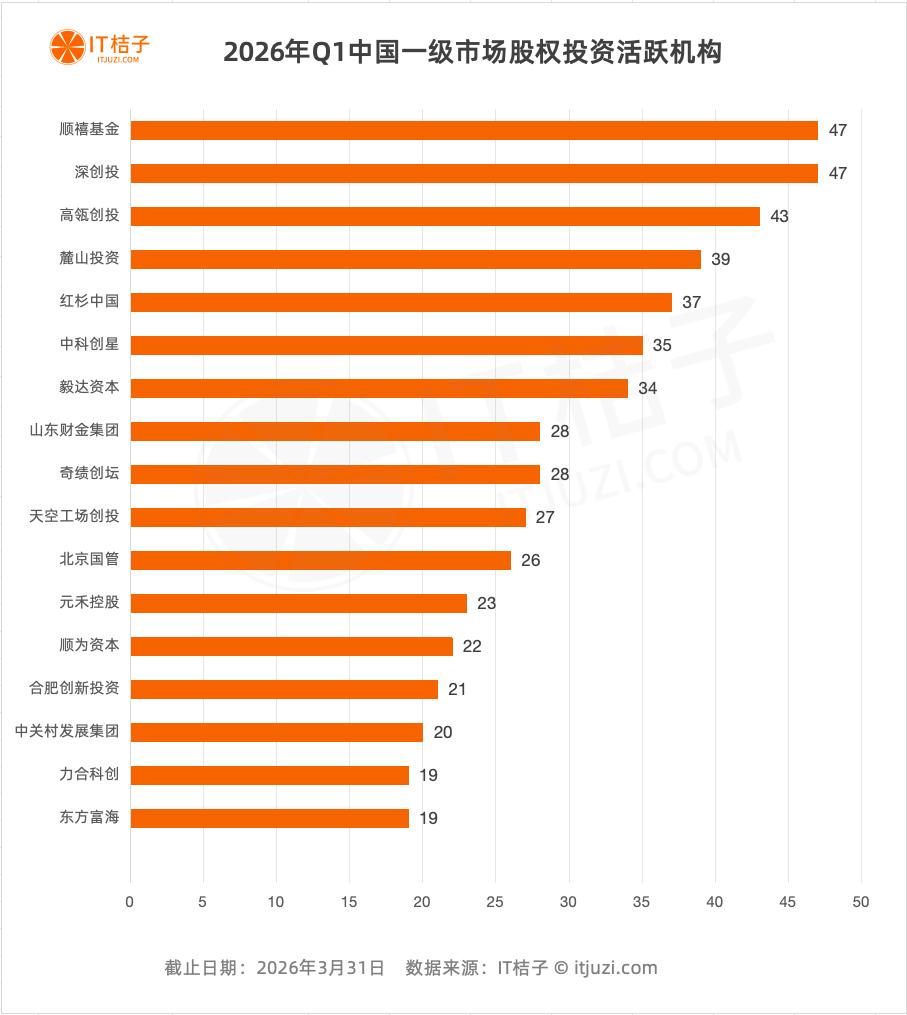
Among the top 20 active investors in the first quarter, 11 were state - owned institutions, forming a balanced situation with market - oriented institutions. Shenzhen Capital Group and Shunxi Fund tied for first place with 47 investments each, showing the aggressive stance of state - owned VCs in Q1. Their investments were concentrated in "choke - point" fields such as advanced manufacturing, semiconductors, new energy, and intelligent robots.
Market - oriented leading institutions such as Hillhouse Capital and Sequoia China focused more on frontier fields such as AI, robotics, and healthcare, diversifying risks through multi - track layouts. Overall, "going all - in on hard technology" has become the common choice of various institutions, and investment opportunities in the consumer Internet have been marginalized.
The FA market showed an obvious trend of vertical differentiation and head concentration:
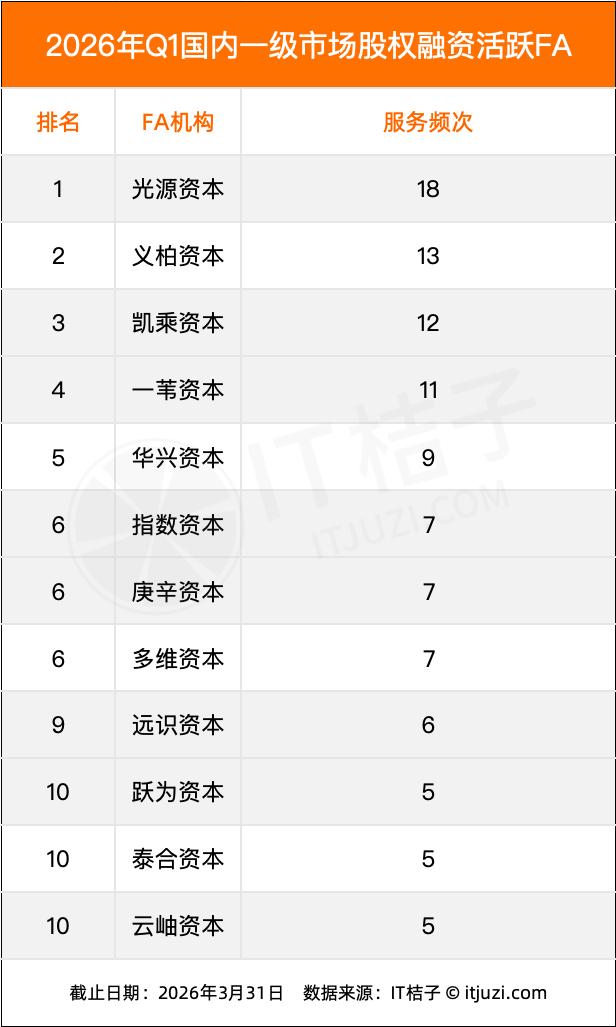
Note: This data only counts the publicly available market data. The data shows that
In all transactions this quarter, the FA penetration rate was 7.1%.
In the equity investment transactions in the first quarter of 2026, Light Source Capital ranked first with 18 services and had a significant advantage in ultra - large - scale transactions (such as the new round of 2.5 billion yuan for Galaxy General Robotics and the Series C financing of 300 million US dollars for Aishi Technology), reflecting its in - depth layout in the fields of AI, robotics, and new energy.
Yibai Capital ranked second with 13 transactions. Representative cases this quarter included the D++ round of 5.037 billion yuan for Interstellar Glory and the new round of 1 billion yuan for Thunderbird Innovation.
Kaicheng Capital focused on healthcare, and Yiwei Capital delved into hard technology. Both had more than 10 transactions this quarter, indicating that FA institutions are building moats through verticalization.
In addition, IT Juzi observed that the top 5 FAs in this quarter accounted for 38.2% of the market share. Although the Chinese FA industry is in the process of continuous fragmentation and development, the industry still has a certain degree of concentration.
VII. Enterprise Lifecycle: Structural Opportunities in the New - Old Alternation
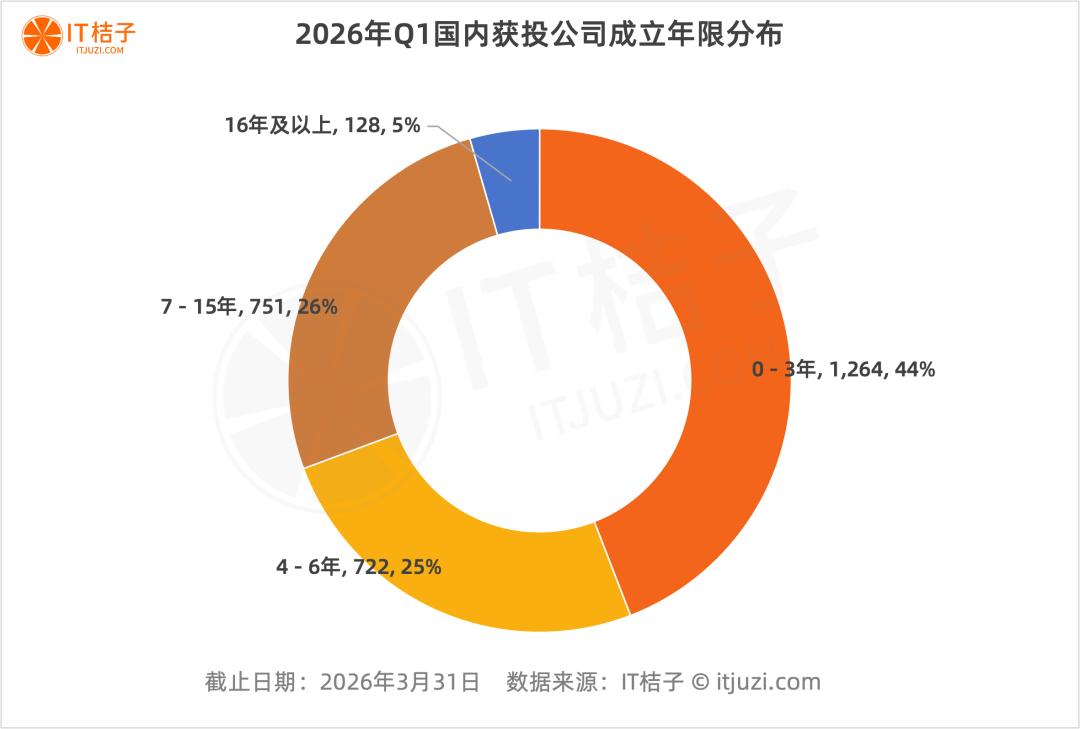
Divided by the establishment years of the funded companies in the first quarter, the market showed an obvious "youthful" feature:
0 - 3 years (new companies) accounted for 44%: They were the absolute main force in early - stage investment. Nearly half of the financing events came from startups established within 3 years, mainly in the angel round. The explosion of the AI and robotics tracks enabled a large number of new