The competition in the domestic PC market is fierce, and Huawei's quarterly growth rate has once again surpassed Lenovo's.
Image source: Jiemian Image Library
On April 2nd, a report released by data agency Omdia showed that in the fourth quarter of 2025, the overall shipment of China's PC market reached 11.5 million units, remaining basically flat year-on-year. The weakening demand on the consumer side was in sharp contrast to the strengthening demand from commercial and government procurement, and the market structure was accelerating its differentiation.
Specifically at the brand level, Huawei ranked second in the domestic PC market with a shipment of 1.3 million units and an 11% market share, with a year-on-year growth rate of 16%, once again surpassing Lenovo in terms of growth rate. This result not only marks that Huawei's PC business has completely emerged from the adjustment period, but also reflects that China's PC market has shifted from scale competition to value competition.
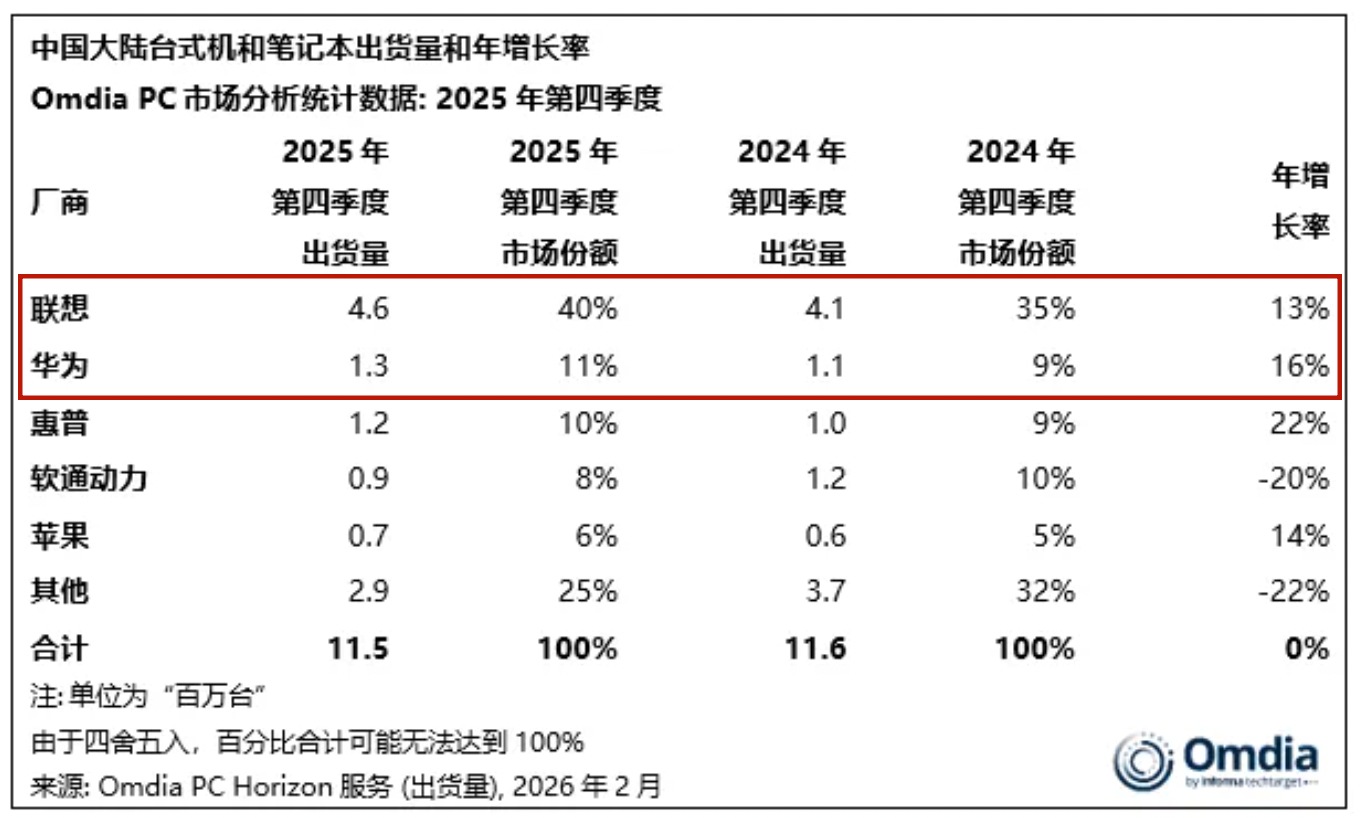
Image source: Omdia
Lenovo continued to lead the market in that quarter with a shipment of 4.6 million units and a 40% share, with its share increasing by 5 percentage points compared to the same period last year and a year-on-year growth of 13%, maintaining a stable output amidst the overall market fluctuations.
As the long - term leader in the global PC industry, Lenovo firmly occupies the dominant position in the market with its global supply chain, full - category coverage, and advantages in sinking channels. Its PC business still contributes stable cash flow and profits in the latest group financial report.
In contrast, without a large - scale traditional PC channel foundation and under continuous pressure from the external environment, Huawei achieved high - growth for consecutive quarters by relying on the synergy of the Hongmeng ecosystem, high - end product positioning, and breakthroughs in the government and enterprise market.
Jiemian News' query of Omdia's PC data in the past year found that in the first quarter of 2025, Huawei's growth rate in the Chinese mainland PC market also exceeded Lenovo's. Huawei's year - on - year growth was 8%, while Lenovo's declined by 3%. In the second and third quarters, Lenovo's growth rate was higher than Huawei's.
In the fourth quarter of 2025, Huawei's growth rate exceeded Lenovo's again. Although in terms of the overall share, Huawei's 11% share still has a large gap compared to Lenovo's 40% achievement, Huawei has surpassed HP and become Lenovo's most core competitor in the domestic PC market.
HP ranked third with a shipment of 1.2 million units and a 10% share, with a year - on - year growth rate as high as 22%, showing the most outstanding performance among international brands, indicating that its adjustments in both the commercial and consumer tracks have taken effect. iSoftStone shipped 900,000 units in that quarter, with an 8% share, a year - on - year decline of 20%, showing a phased contraction. Apple ranked fifth with a shipment of 700,000 units and a 6% share, with a year - on - year growth of 14%.
The pattern of the top five brands is relatively stable, but the growth rate differences are huge, which means that the market is no longer a general upward trend with synchronous rises and falls, but a new pattern where the strong get stronger and structural opportunities are prominent.
Omdia's latest report also includes tablet data. In the fourth quarter of 2025, 9.1 million tablets were shipped in China, a year - on - year increase of 10%, significantly better than the performance of the PC market. Huawei ranked first with 2.4 million units and a 26% share, and Apple followed closely with 2.3 million units and a 25% market share, forming a duopoly pattern.
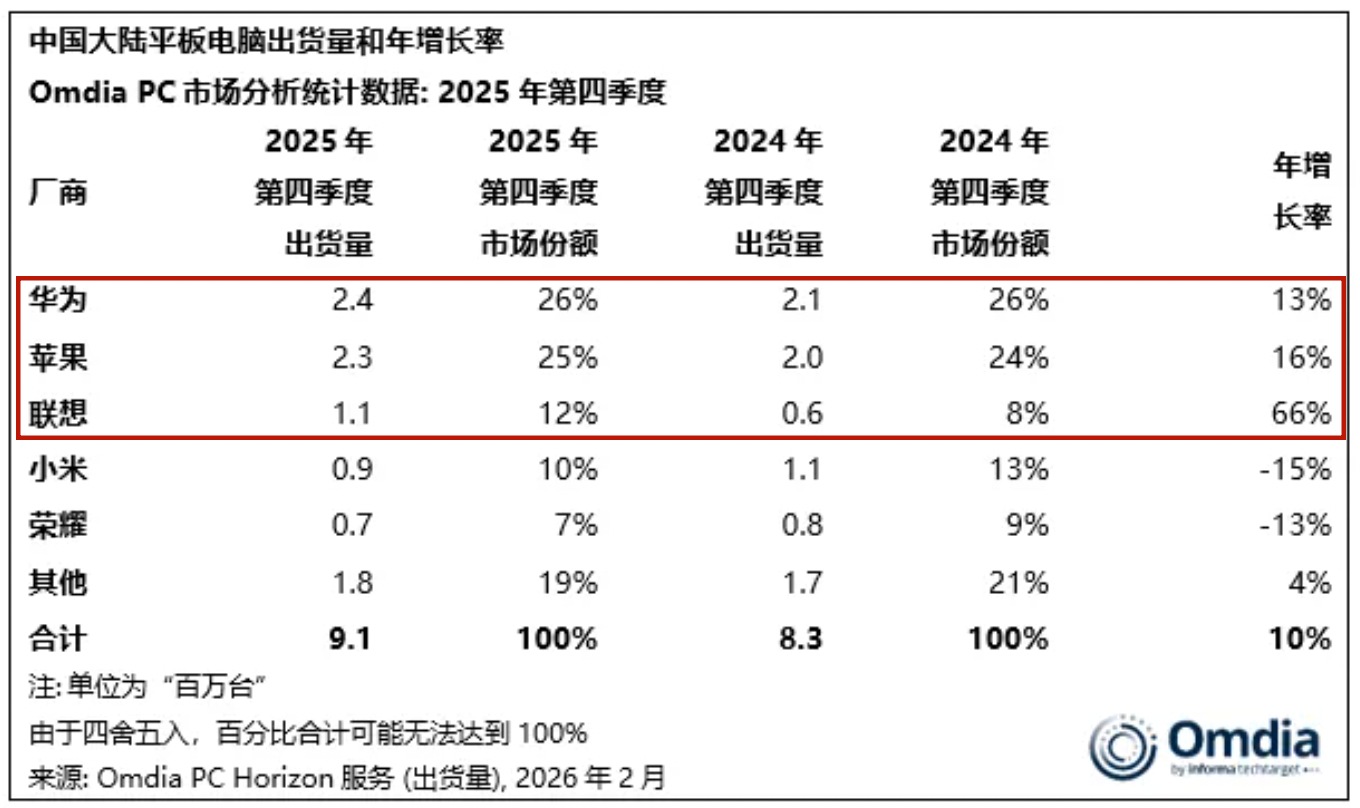
Image source: Omdia
Lenovo shipped 1.1 million tablets, with a 12% share, a year - on - year surge of 66%, becoming the fastest - growing manufacturer. Xiaomi and Honor ranked fourth and fifth with 10% and 7% respectively, but their annual growth rates declined by 15% and 13% respectively.
In terms of the whole - year performance, in 2025, the shipment of China's PC market increased by 6% year - on - year to 42.1 million units, mainly benefiting from the strong commercial demand and the relatively stable performance of the consumer market in the first half of 2025. The performance of tablets was better than that of PCs, with the annual shipment increasing by 14% to 36 million units, thanks to the support of consumer subsidy policies and the expansion of commercial application deployments.
As the subsidy intensity weakens and the material cost (BOM) rises, especially the increase in memory cost, Omdia currently predicts that China's PC shipment in 2026 will decline by 10% year - on - year to 37.9 million units. Among them, the decline in the consumer market will be more obvious, with an expected year - on - year decline of 12%. Meanwhile, after the high base in 2025, the tablet shipment is expected to decline by 11% in 2026 to 32 million units.
Xu Ying, a senior analyst at Omdia, said: "In 2025, the subsidy policies that promoted the growth of PC demand began to be adjusted in 2026. The overall subsidy intensity has narrowed from about 30% last year to about 15%. In addition, more strict implementation methods, such as provincial quotas and phased subsidy distribution, will also limit the concentrated release of demand within a single quarter. Meanwhile, the large - scale subsidies in 2025 have advanced and overdrawn some demand. Against the background of rising component costs and overall material cost inflation, it will be more difficult to achieve continuous growth in 2026. The superposition of multiple factors will make 2026 a challenging year for China's PC market and its entire ecosystem."
This article is from Jiemian News, author: Song Jianan. Republished with permission by 36Kr.