Is BYD approaching a "critical moment" as it sells more but earns less?
Recently, BYD released a financial report with the highest revenue in its history.
803.96 billion yuan, this is BYD's annual operating revenue in 2025. The figure is quite impressive, as it is the first time the company has crossed the 800 - billion - yuan threshold. However, when looking at the other side of the financial report, the figures are not as eye - catching.
The net profit was 32.62 billion yuan, nearly 7 billion yuan less than last year, a year - on - year decline of nearly 19%. This is the first time in nearly four years that BYD has seen a decline in profitability.
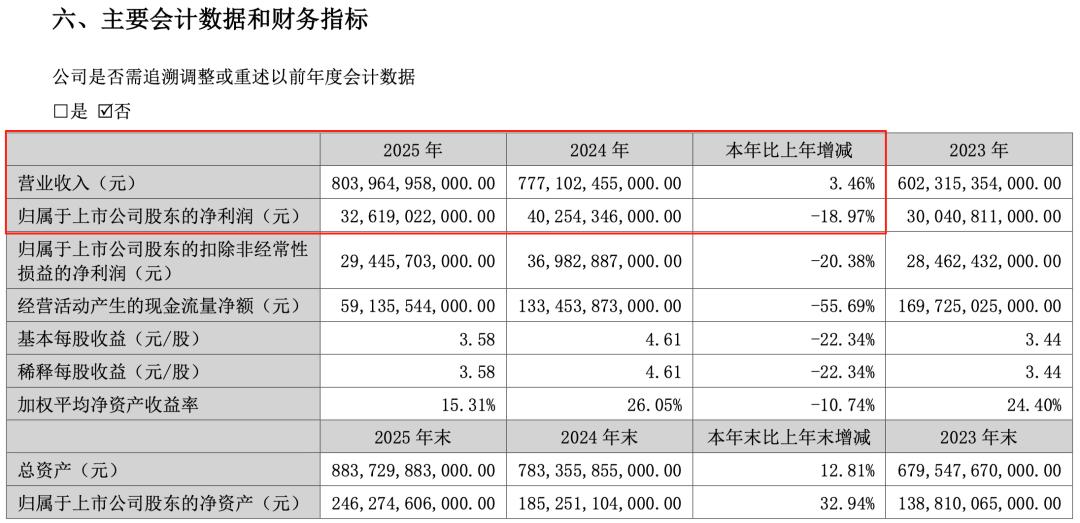
Picture/Partial revenue data of BYD in 2025 Source/Screenshot from Internet, New Energy Outlook
BYD sold more cars but earned less money.
The gross profit margin was also squeezed to 17.74%, the lowest in five years. The penetration rate of new energy vehicles in the domestic market has exceeded half. The market is not short of people buying cars, but rather who can stabilize prices.
In the words of Wang Chuanfu, the industry is going through a cruel "elimination round". Behind this financial report with 800 - billion - yuan revenue, what kind of structural pain is this leading Chinese new energy vehicle company actually experiencing? At the beginning of 2026, the sales volume from January to February plummeted by more than 30% year - on - year. Does this indicate that BYD's "critical moment" has arrived?
1. From "Earning Margins" to "Chasing Payments": Slowing Cash Flow and Inventory Backlog
An increase in revenue does not equal an increase in profitability.
BYD's 2025 financial report clearly illustrates this point. The annual revenue increased by 3.46%, but the net profit decreased by nearly 19%. This gap is the mark left by the price war.
Based on the data of the automotive business revenue of 648.646 billion yuan and the annual sales volume of 4.6024 million vehicles, BYD's average selling price per vehicle has dropped to 141,000 yuan, a year - on - year decline of 2.42%. The fact that each car earns less money is an unavoidable reality for BYD. Even though it has the most complete vertical integration ability in the industry, manufacturing most components from batteries to chips by itself, it still can't withstand the pressure brought by the "involution" of the entire industry.
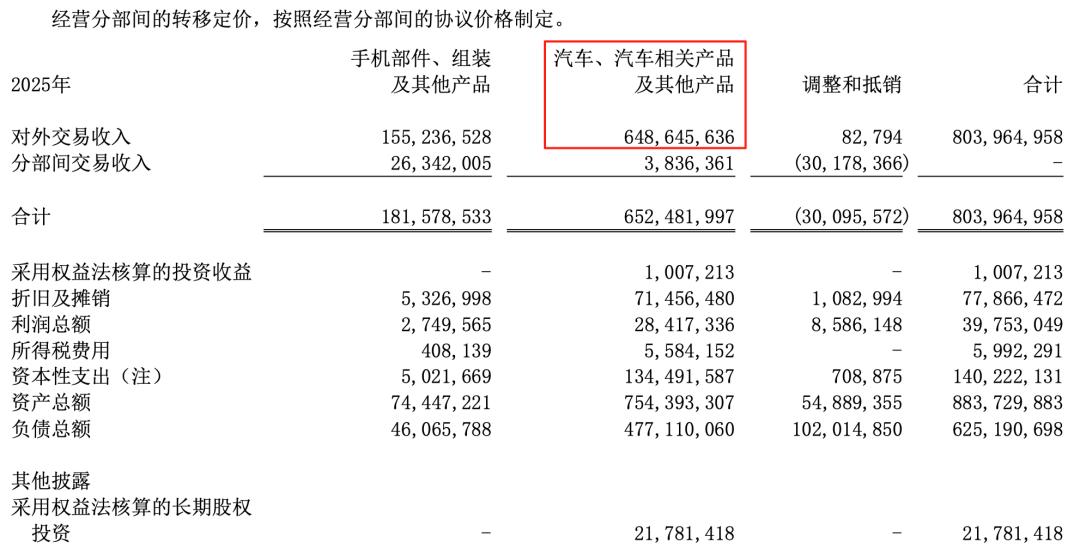
Picture/Automotive business revenue of BYD in 2025 Source/Screenshot from Internet, New Energy Outlook
A more concerning signal than the decline in profit is hidden in the cash flow.
In the first three quarters of 2025, the net cash flow from operating activities of BYD decreased by 27.42% year - on - year. By the end of 2025, this decline had widened to 55.69%.
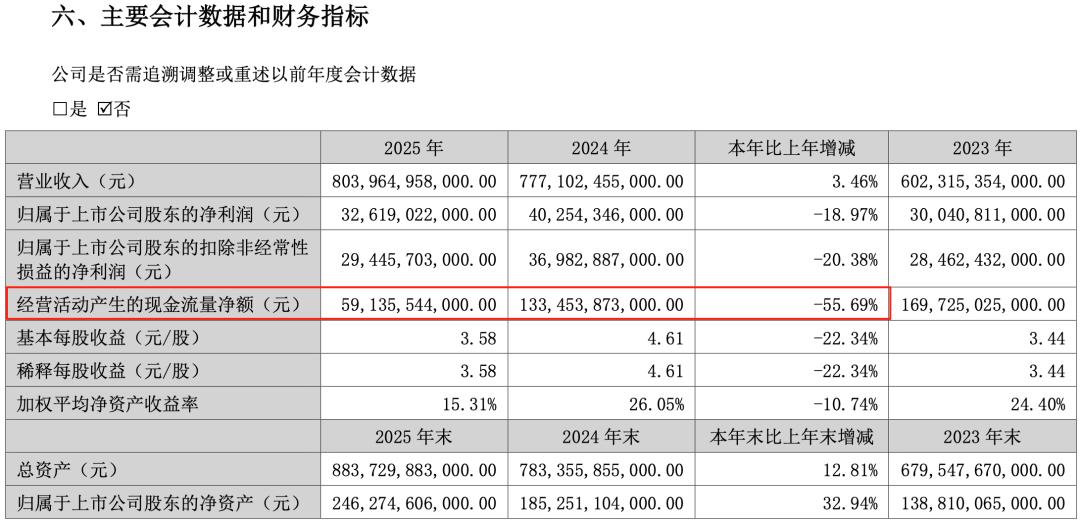
Picture/Net cash flow from operating activities of BYD in 2025 Source/Screenshot from Internet, New Energy Outlook
This is not just a problem of "money being harder to earn", but more importantly, "money not being able to come back". For example, a person's blood circulation is slowing down. Although the body still looks strong, the hands and feet are already starting to feel cold. Cash flow is the blood of an enterprise. A slowdown in the flow rate means a decrease in the efficiency of capital turnover.
Why is this happening?
On the one hand, the investment in the supply chain is increasing. BYD has actively shortened the payment terms with suppliers and used more cash payments to ensure a more stable supply of parts. This is a good thing, but it is a real drain on its own cash flow.
On the other hand, inventory is piling up rapidly. BYD's inventory turnover days were 72 days, compared with 58 days for the whole year of 2024, a difference of exactly two weeks. This doesn't mean that cars aren't selling, but there are indeed more cars in the warehouse than before.
In 2026, this pressure began to become more obvious.
On March 1st, BYD released its production and sales data for February this year. The sales volume in February was 190,190 vehicles, a year - on - year decrease of 41.1%; the cumulative sales volume from January to February was 400,241 vehicles, a year - on - year decrease of 35.8%, both hitting the largest decline since 2022.
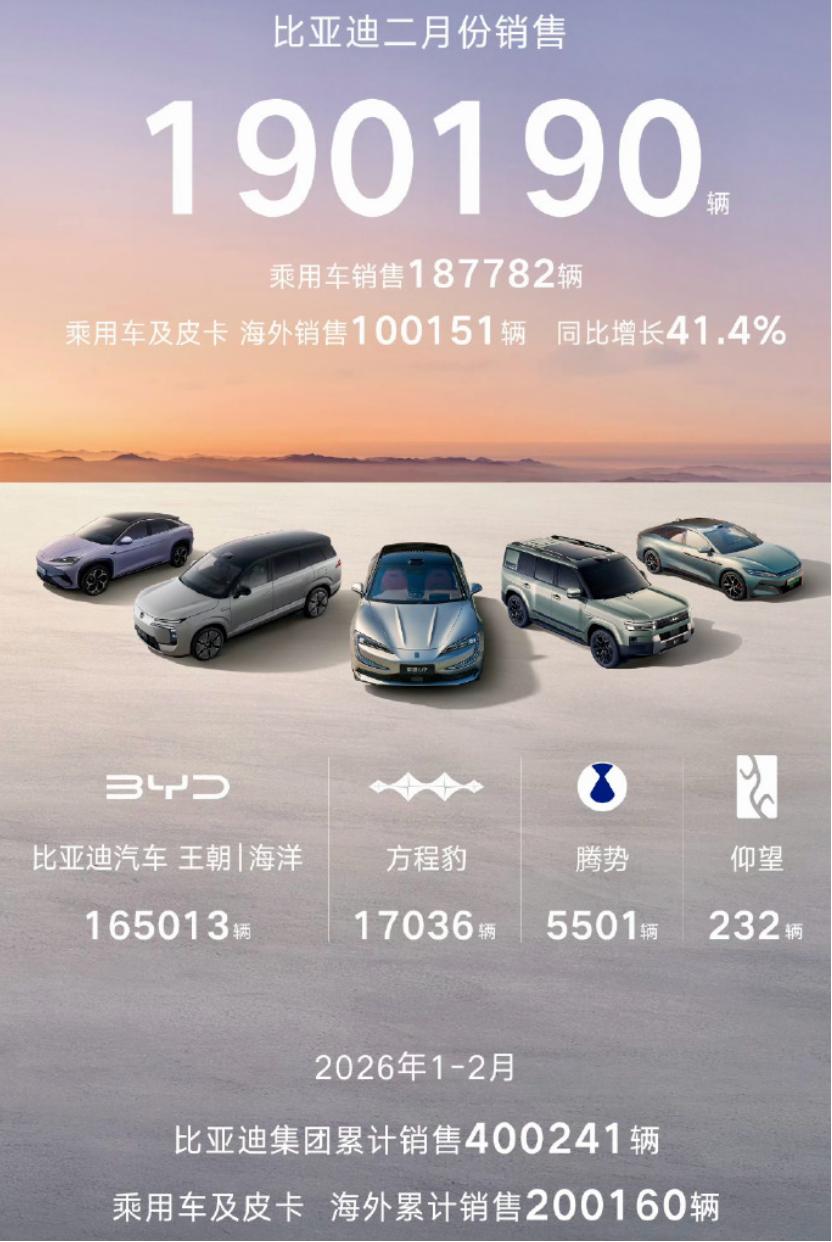
Picture/BYD's sales volume in February 2026 Source/Screenshot from Internet, New Energy Outlook
This means that its inventory turnover rate will further decrease, and cars will stay in the warehouse for a longer time. In order to recover funds, BYD will probably be forced to maintain the strategy of "trading price for volume" in the first half of 2026. This will directly squeeze the already meager profit per vehicle, creating a cycle that is not easy to break.
Changes are also taking place in the supply chain. Although BYD has resumed some cash payments and improved its previous practice of "extending payment terms", in the context of declining sales, its bargaining power with upstream suppliers will be tested.
In the past, due to BYD's large order volume, suppliers were willing to accept lower unit prices. Now, if sales continue to be sluggish, this pressure will spread through the entire supply chain like a domino effect, even affecting the supply stability of parts. After all, if the price is squeezed too low, suppliers will also have a hard time. This balance is becoming delicate.
2. The Defender Caught in an Endless War: The Loosening of the "One - Dominant" Pattern
In January 2026, a piece of data shocked the automotive industry: Geely Automobile's total sales volume that month was 270,167 vehicles, while BYD's was 210,051 vehicles. Geely overtook BYD. This trend continued in February, with Geely selling 206,160 vehicles.
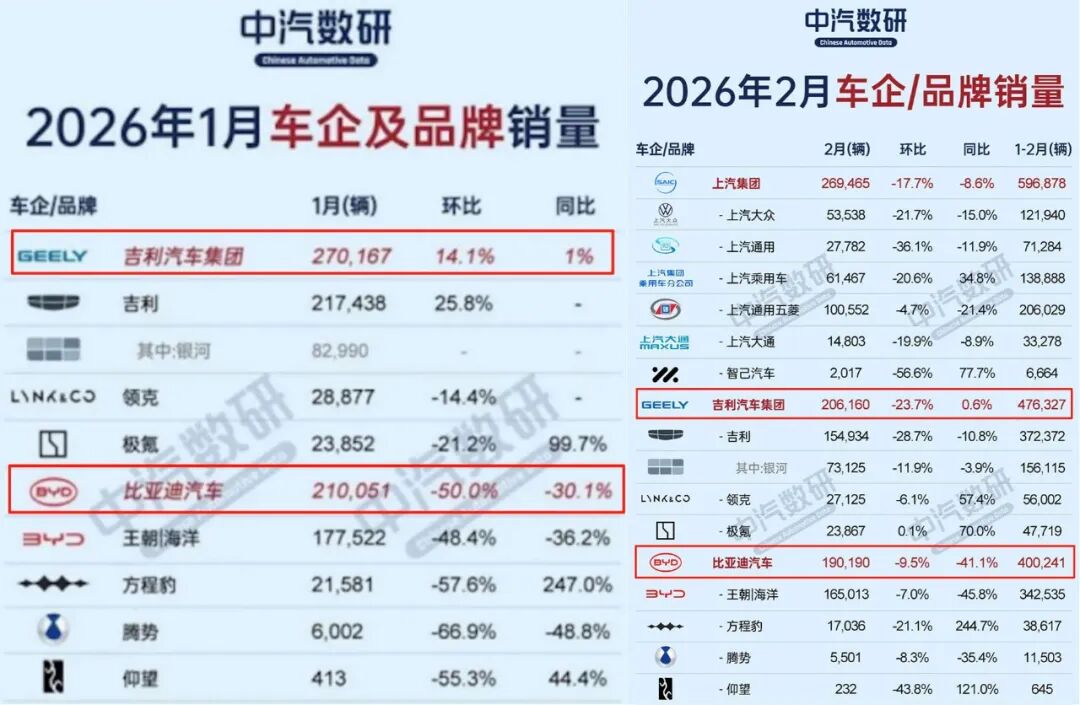
Picture/BYD's sales volume from January to February 2026 Source/Screenshot from Internet, New Energy Outlook
Although BYD may regain the top position, this signal is highly symbolic. It marks that the domestic new energy vehicle market has entered a new stage of "two - power competition and multiple - strong coexistence" from the "one - dominant" situation.
The truth behind BYD's declining sales volume needs to be analyzed in detail.
There are indeed short - term factors. The Spring Festival holiday in 2026 affected the sales rhythm. More importantly, the new energy vehicle purchase tax policy changed from "full exemption" to "half exemption". Many consumers rushed to buy cars before the end of 2025, and the demand was pre - exhausted.
However, the deeper problem is that the domestic market is shifting from "incremental dividend" to "stock game". BYD has a deep penetration in the core price range of 100,000 - 200,000 yuan, and the incremental space has become limited.
At the same time, the competitive landscape of the industry has deteriorated sharply. It is not an exaggeration to describe BYD's situation as being "attacked from both sides".
Looking upwards, in the market above 200,000 yuan, brands such as Xiaomi, Huawei - affiliated brands, and Li Auto are strongly seizing market share. These brands have significant advantages in intelligence and user ecosystem. BYD's high - end brands - Denza, Yangwang, and Fangchengbao - only sold a total of 397,000 vehicles in 2025, accounting for less than 10% of the total sales volume. The brand premium has not been fully established, and the path to break through to the high - end market is not easy.
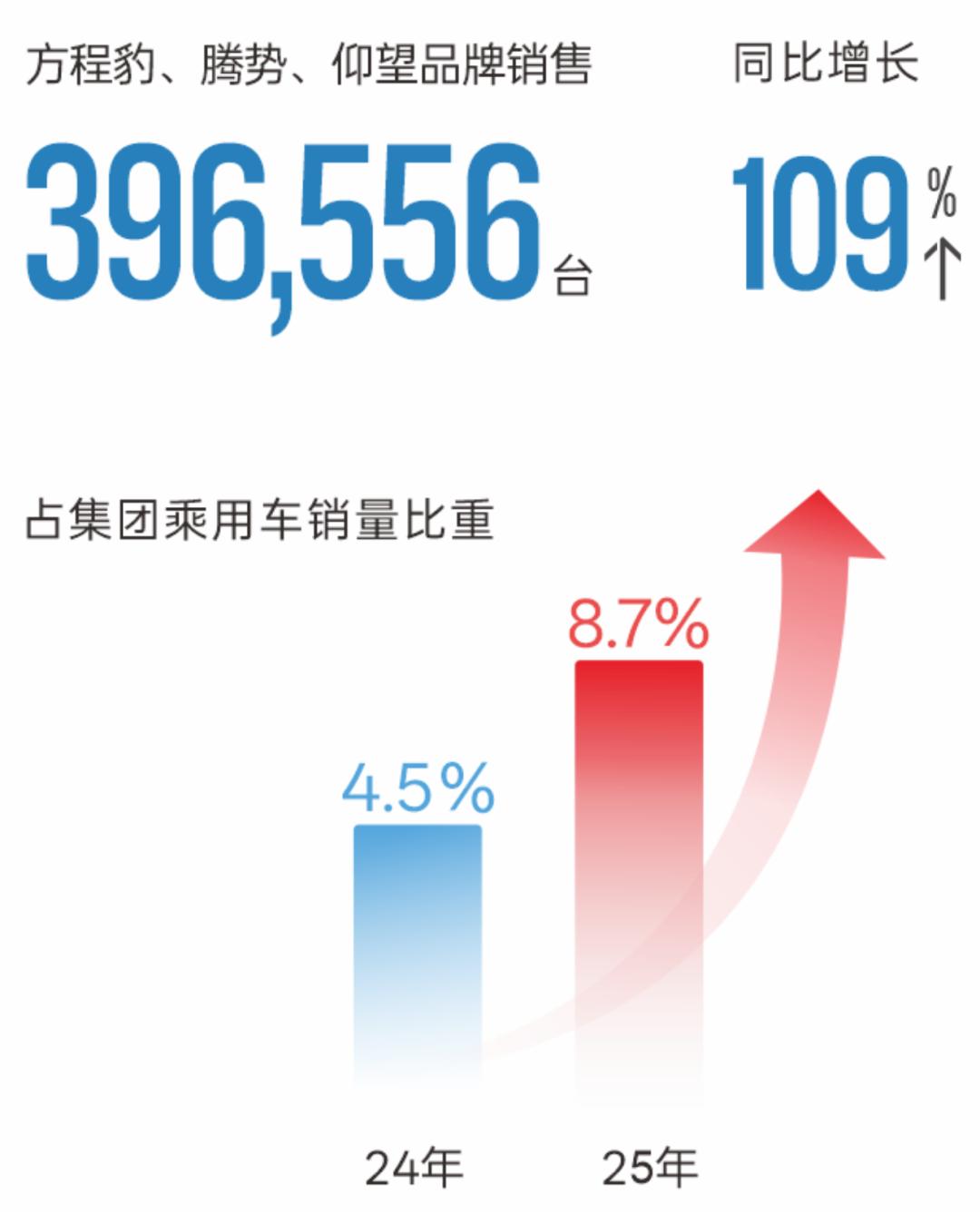
Picture/Sales volume of BYD's high - end brands in 2025 Source/Screenshot from Internet, New Energy Outlook
Looking downwards, the basic market in the 100,000 - 150,000 - yuan range is also being disrupted. Geely's Galaxy series, Chery, Leapmotor, and price - cut joint - venture brands such as Toyota and Volkswagen are "besieging" fiercely. Geely's Raytheon hybrid technology is almost as good as BYD's DM - i, and the technological gap has almost disappeared. Geely Xingyuan sold more than 460,000 vehicles last year, directly competing with BYD's Seagull and Dolphin series.
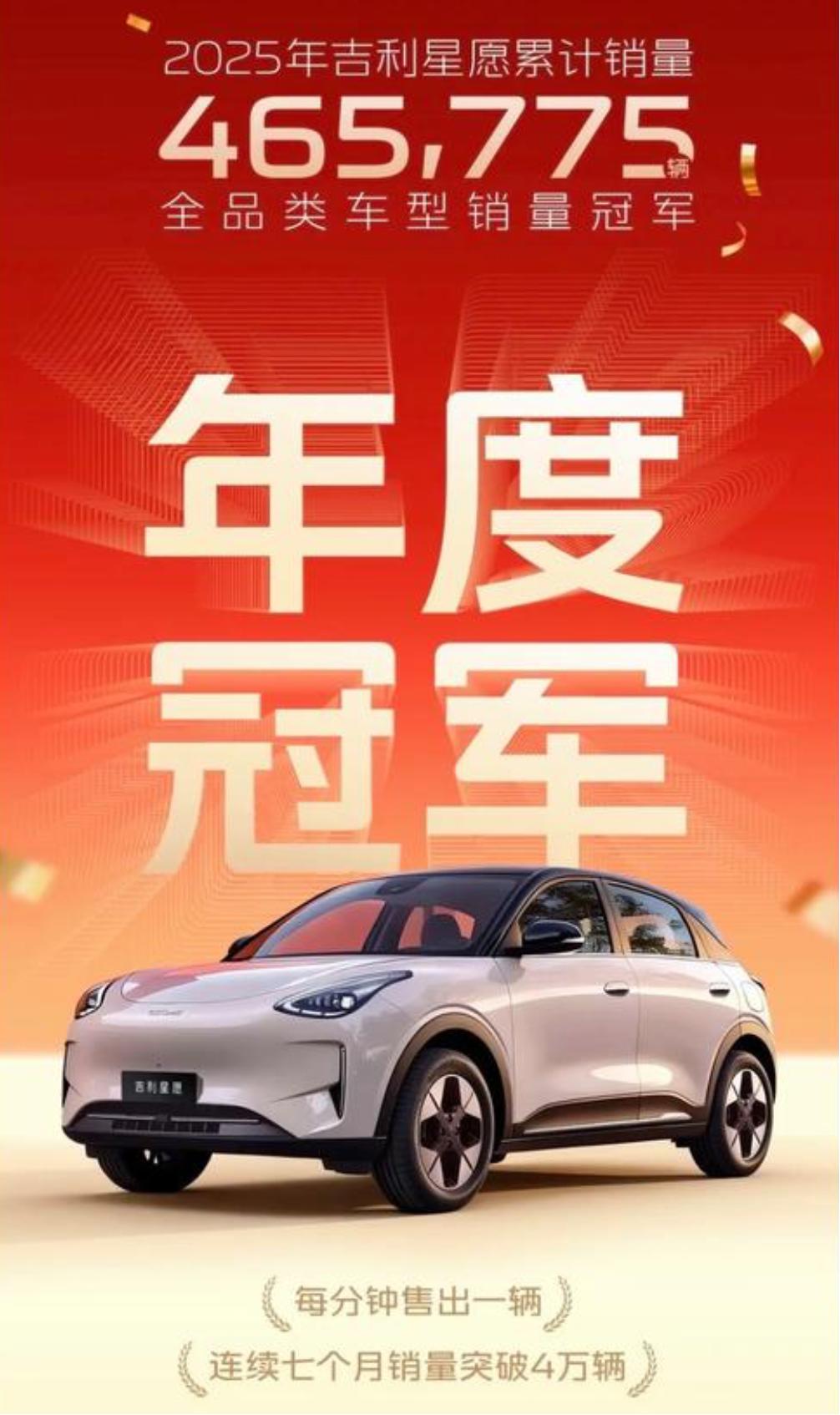
Picture/Sales volume of Geely Xingyuan in 2025 Source/Screenshot from Internet, New Energy Outlook
BYD is transforming from an "aggressor" to a "defender".
In the past few years, it has rapidly expanded with its technological and scale advantages, achieving a leap from a chaser to an industry leader. However, now it needs to deal with three fronts simultaneously: price competition, technological investment, and globalization challenges.
In 2026, BYD may not be able to maintain its previous explosive growth, and its market share will probably continue to be eroded by competitors. BYD's "monopoly" advantage is weakening.
This doesn't mean that BYD is going to lose, but rather that the rules of the game have changed. The question has shifted from "whether to buy BYD" to "why buy BYD", and consumers have more choices.
3. Double Bets on Strategic Shifts: Seeking Profits Overseas and Technological Pressures
The greater the pressure in the domestic market, the more important the overseas market becomes.
In February 2026, the proportion of BYD's overseas sales exceeded that of the domestic market for the first time, reaching 52.9%. This is a historic turning point, meaning that BYD sold more cars overseas than in the domestic market.
Selling cars overseas is indeed more profitable. The average selling price per vehicle is higher than in the domestic market, with a gross profit margin of over 28%, and the profit per vehicle is more than twice that of the domestic market. In 2025, BYD exported 1.05 million vehicles, a year - on - year increase of 145%. In 2026, BYD has set a target of selling 1.3 - 1.6 million vehicles overseas.
This means that 2026 will be a crucial year for BYD's globalization. Resources will be significantly tilted towards overseas - the Hungarian factory and the Brazilian factory will be put into production, and its self - built fleet will be put into operation.
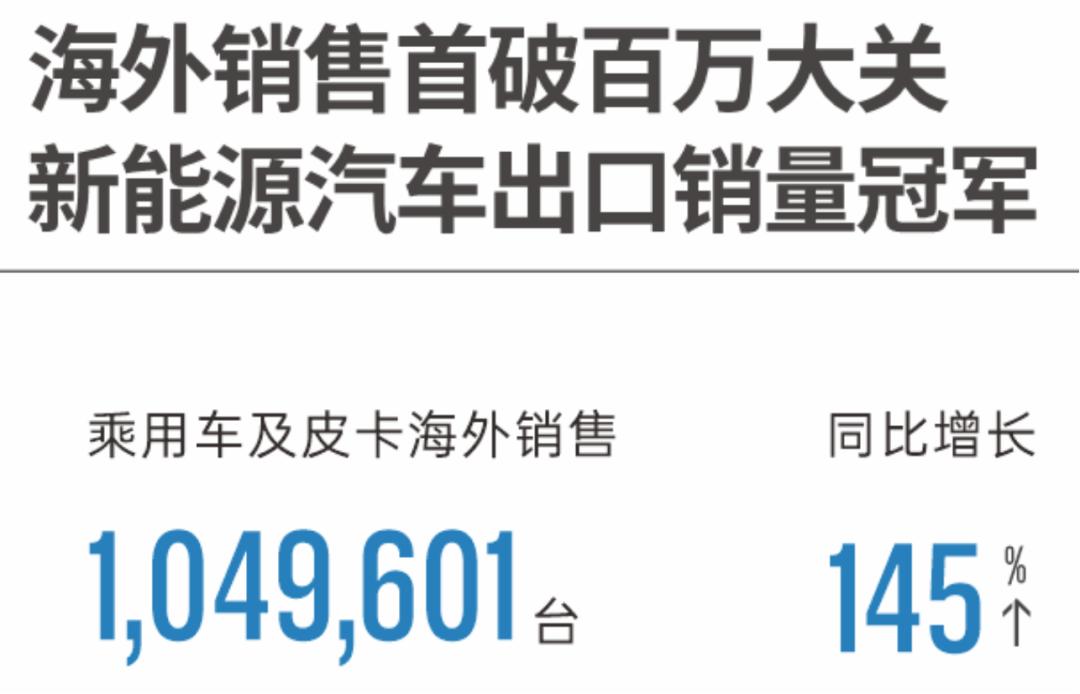
Picture/BYD's overseas sales volume in 2025 Source/Screenshot from Internet, New Energy Outlook
However, the overseas market is not a paradise. Although the EU's anti - subsidy investigation has temporarily slowed down, policy risks still exist. If tariff barriers are implemented, BYD's profit margin in Europe will be significantly compressed. The number of overseas after - sales service points is less than one - third of that in the domestic market, and users may have to wait a long time to repair their cars. These are all hidden costs.
BYD's overall profit level in 2026 will highly depend on the performance of the overseas market. If there is a policy "black swan" event overseas, its profit growth will face huge risks.
At the same time, the technological front is also under pressure. In 2025, BYD's R & D investment reached a record 63.4 billion yuan, a year - on - year increase of 17%, almost twice the net profit. The huge R & D investment was mainly converted into intelligent driving technology, long - range plug - in hybrid technology, the second - generation blade battery, and flash - charging technology.
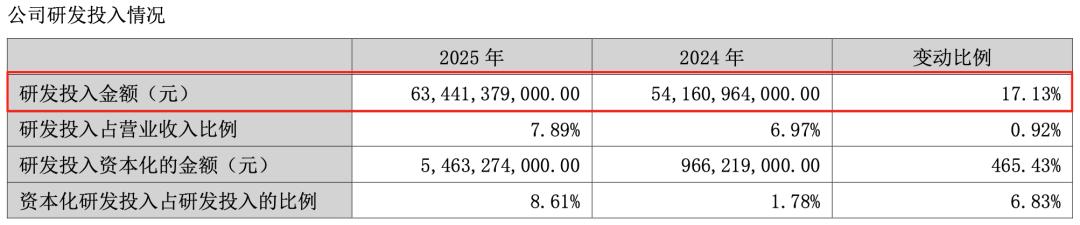
Picture/BYD's R & D investment amount in 2025 Source/Screenshot from Internet, New Energy Outlook