Is your "Lobster" still working well? Professor LIN Yankai from Renmin University: OpenClaw is like the early Linux, and the real competition has just begun.
In the past few months, it has been hard to avoid a name in the AI field —— OpenClaw. This project has gained explosive attention in a very short time: hundreds of thousands of stars, astonishing Token consumption, and the rapid follow - up of almost all major tech companies. On the surface, it seems like another phenomenon - level AI product. However, upon further examination, a more thought - provoking question emerges —— what exactly does the emergence of OpenClaw mean? Is it truly a technological breakthrough, or a signal of some deeper - seated changes?
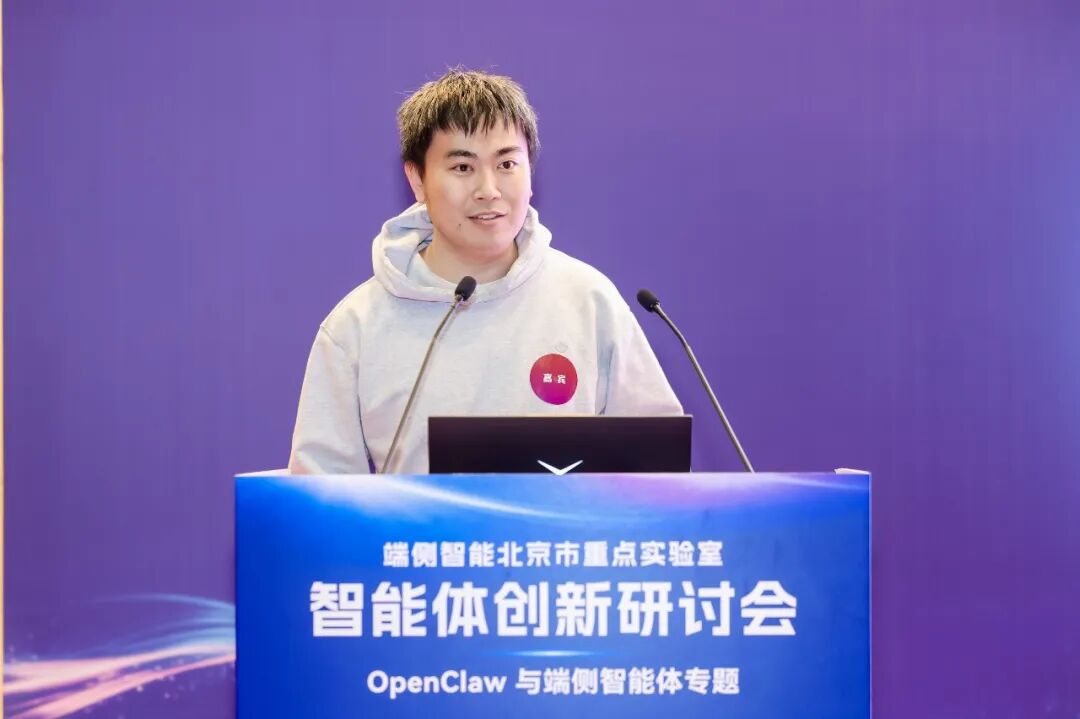
Recently, the Innovation Seminar on Agents of the Beijing Key Laboratory of Edge - side Intelligence was held at Tsinghua Science Park. Eight industry and academic guests gave speeches, delving into topics from various dimensions such as underlying technical issues, technological evolution trends, edge - cloud collaboration paradigms, security issues behind the technology, and Agent management practices. The seminar centered around the technical logic behind OpenClaw and its future development trends.
Lin Yankai, an associate professor at Renmin University of China, presented a report titled "Observing the Development Trends of Agent Technology from OpenClaw" at the seminar, answering three fundamental questions: First, what stage has the current agent technology reached? Second, where are its real core bottlenecks? Third, how will this technological path evolve in the next one to three years?
He conducted a hierarchical analysis from the system architecture, interaction execution methods, to the base model and multi - agent collaboration, restoring the real state of the technology. He put forward a somewhat "counter - intuitive" judgment —— OpenClaw is not a breakthrough in underlying algorithms. Instead, it enables large - model capabilities to cross the "usability threshold" through engineering integration, making agents truly usable. It is more like an early prototype of an agent operating system, redefining the usage paradigm of AI in terms of unified models, tools, and interaction methods. Its explosion is essentially the result of the resonance between model capabilities and the engineering system at the same time point.
Meanwhile, Lin Yankai provided a systematic understanding of the core bottlenecks, pointing out that OpenClaw also exposes the core bottlenecks of current agents in terms of reliability, long - task execution, Token cost, memory system, and autonomous evolution.
Finally, he pointed out that the key to the future development of agents is no longer just making the model more powerful, but achieving a leap from single - point capabilities to system capabilities through edge - cloud collaboration, protocol standardization, and multi - agent systems.
The full text of the speech is as follows:
Today, I'd like to use the recently very popular agent project OpenClaw to discuss a question with you: What stage has the current agent technology reached, and what are its core bottlenecks? Where will we go next? I'll try to talk less about products and more about technology, including some of my thoughts.
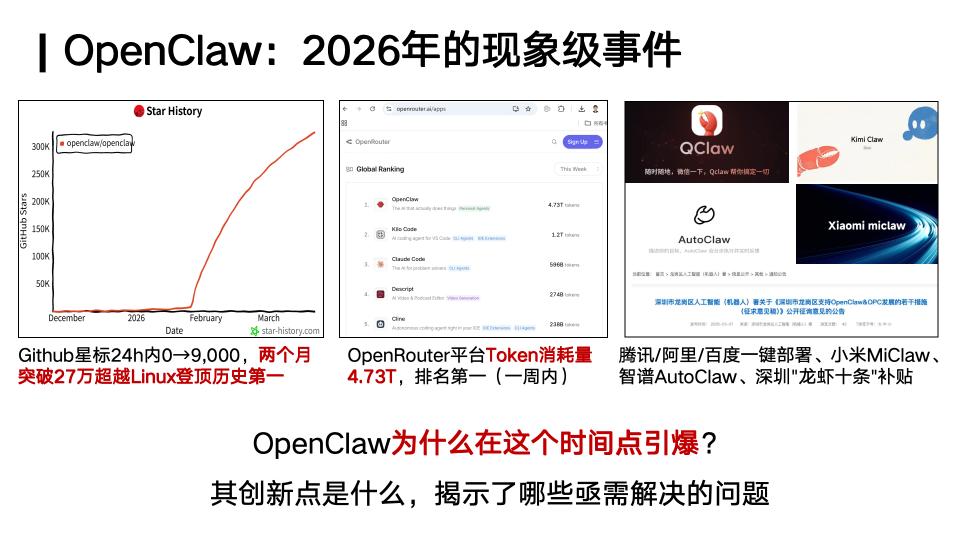
First, let's look at some data. After OpenClaw became a sensation, it got 9,000 stars in 24 hours and exceeded 270,000 stars in two months, even surpassing Linux to become the project with the most stars in history. This is the Token consumption of OpenClaw on OpenRouter that I captured. It consumed 4.73T in a week, more than the sum of all the others behind it. Meanwhile, almost all major domestic tech companies are following up. Today, WeChat has also integrated Lobster. It's extremely popular. Many cities have also introduced some policies regarding OpenClaw.
Today, I'm not here to discuss whether it's popular or not. I want to discuss three technical questions: Why did it explode at this particular time? Is there any real innovation from a technical perspective? What problems need to be solved from its perspective?
The essential reason for OpenClaw's popularity is the "usability revolution"
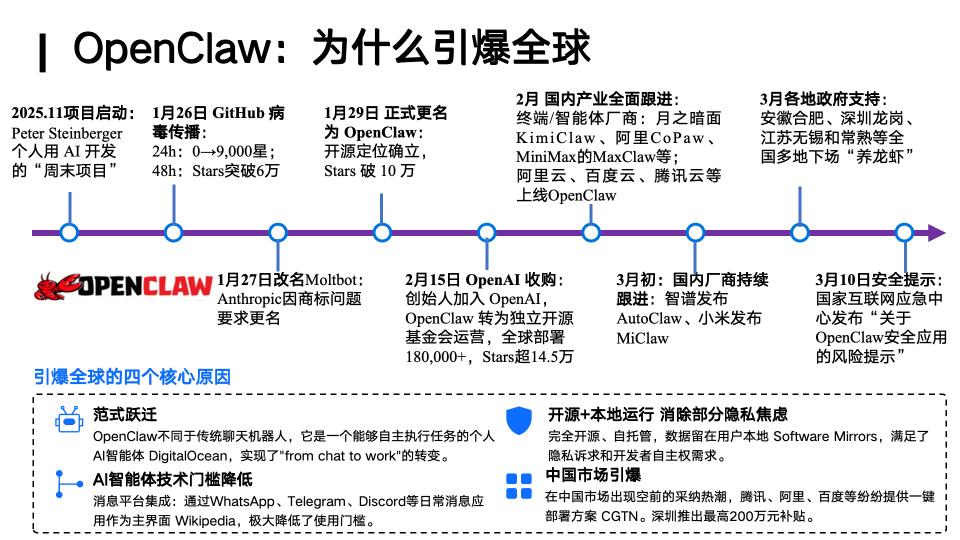
From the project's launch to exceeding 200,000 stars and the founder joining OpenAI, it's only been three or four months for OpenClaw. And it's only been about a month since it became popular. Why is it so popular? In my personal view, it's because it greatly lowers the user's threshold of use. Different from traditional chatbots, it is an AI agent capable of autonomously executing tasks. Although similar things like AutoGPT and XAgent emerged after the appearance of large models, OpenClaw truly enables ordinary people to easily use it.
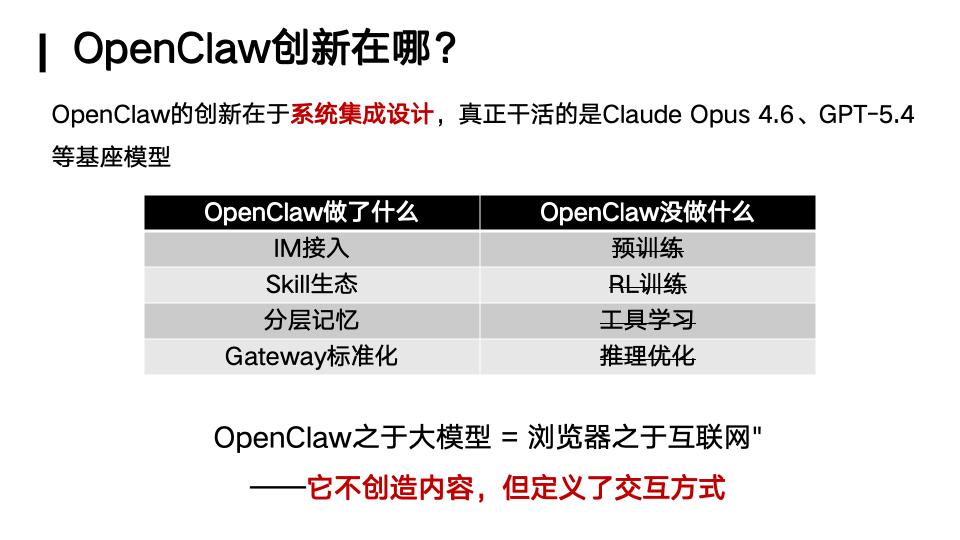
Here, I'll give you a bold statement: From the perspective of AI and large - model technology innovation, OpenClaw actually doesn't have much innovation. It's the use of existing technologies. It doesn't train models, improve inference algorithms, or do underlying tool learning. What it does is the integration of IM communication platforms, local deployment architecture, hierarchical memory, and the standardization of Gateways. These are all excellent software engineering designs, but there is no breakthrough in the core algorithms.
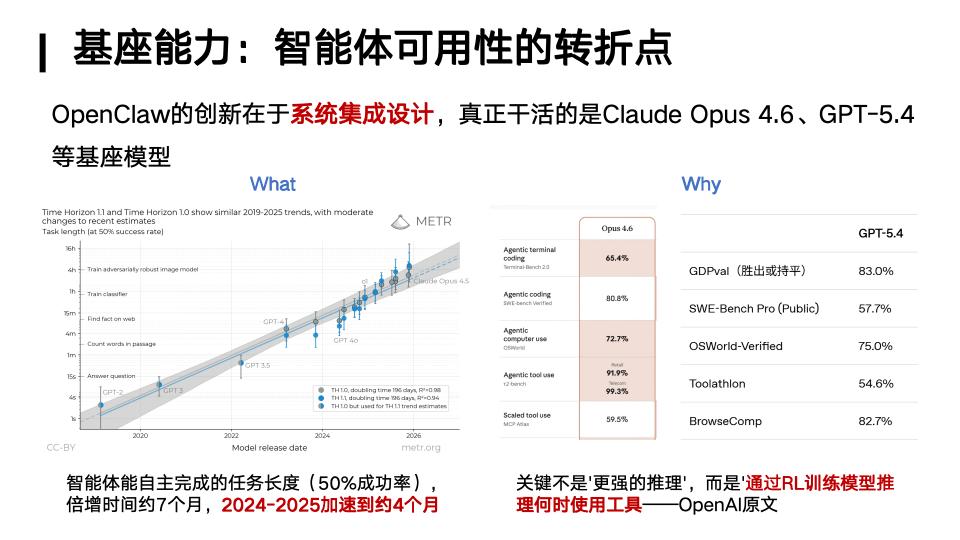
We can see that what really does the work in the system and provides us with a good experience are the base models it integrates, such as Claude Opus 4.6 or GPT - 5.4. I think the significance of OpenClaw to large models is a bit like that of browsers to the Internet —— it doesn't create content itself, but it redefines the user's interaction method, enabling non - technical people to smoothly apply large models to their work.
Precisely because OpenClaw doesn't make many changes to the underlying algorithms, it becomes a very good sample for technical analysis. Its success can show us which technologies are relatively mature (such as the tool - calling and execution capabilities of base models), and at the same time, it can expose which technologies are currently lacking (such as the system's reliability, the transfer ability of memory models, and the immaturity of edge - cloud collaboration).
Today, I use OpenClaw as an entry point to systematically examine the current state of technologies at different levels in the entire agent technology, what the core bottlenecks are, and some research directions that I think we can pursue.
Let's look at a set of statistical data. This shows the length of tasks that agents can complete autonomously with a 50% success rate since the emergence of large models. After the appearance of large models, the doubling time was about 7 months, and in the past one or two years, it has accelerated to about 4 months. The graph on the right shows Claude Opus4.6 and GPT - 5.4 that I mentioned earlier. They have made qualitative leaps in code capabilities and tool - calling capabilities compared to the previous versions.
OpenClaw is the prototype of an agent operating system
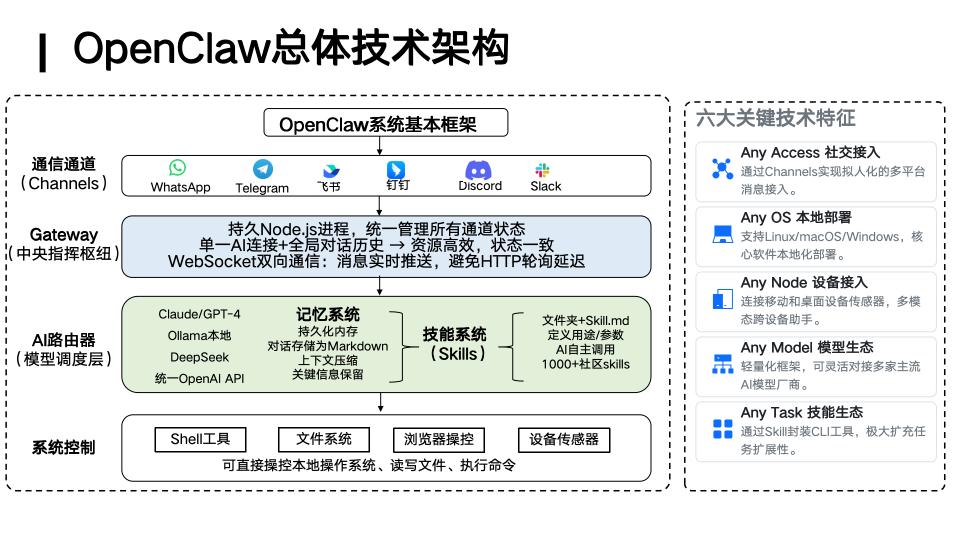
The overall technical architecture of OpenClaw is very simple and clear, ranging from the underlying system control to the Agent loop system, then to the upper - layer standardized encapsulation and information flow management, and finally connecting to various channels exposed to users. Why is it so good to use? It's because of its six key technical features —— this is not my idea. I heard someone mention it in another report, and it's a very good summary: social integration, local deployment, device integration, model ecosystem, and skill ecosystem. These features make it highly compatible with underlying models, various users, different devices, and complex tasks.
From a software engineering perspective, OpenClaw has three very core designs.
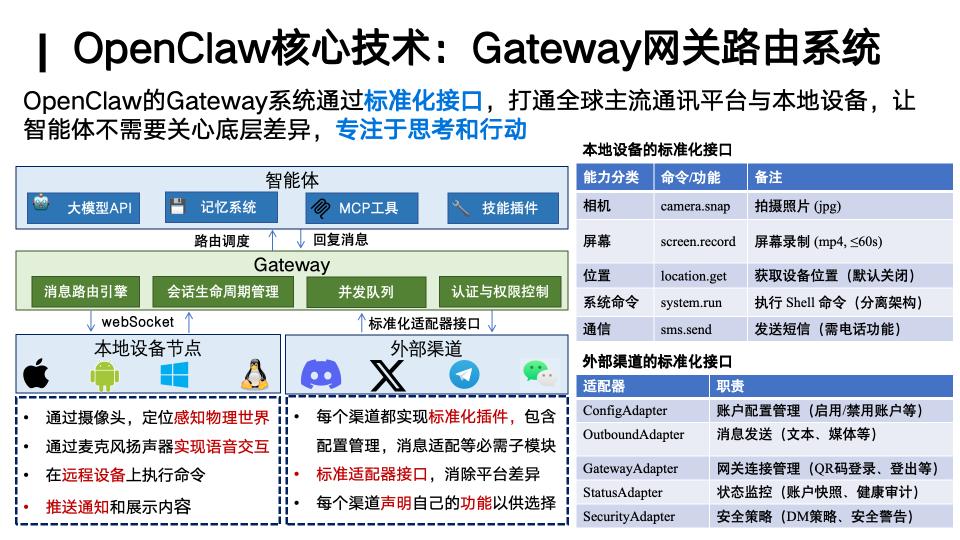
The first is its Gateway system. It adopts a three - layer architecture in a hierarchical form, allowing different external devices or IM software to be uniformly routed and scheduled to the agent layer through the Gateway. In this way, the agent itself doesn't need to care about the platform through which the user is communicating or what the external hardware is. It only needs to focus on the docking of the underlying API and the top - layer interface.
The second is its hierarchical memory mechanism.
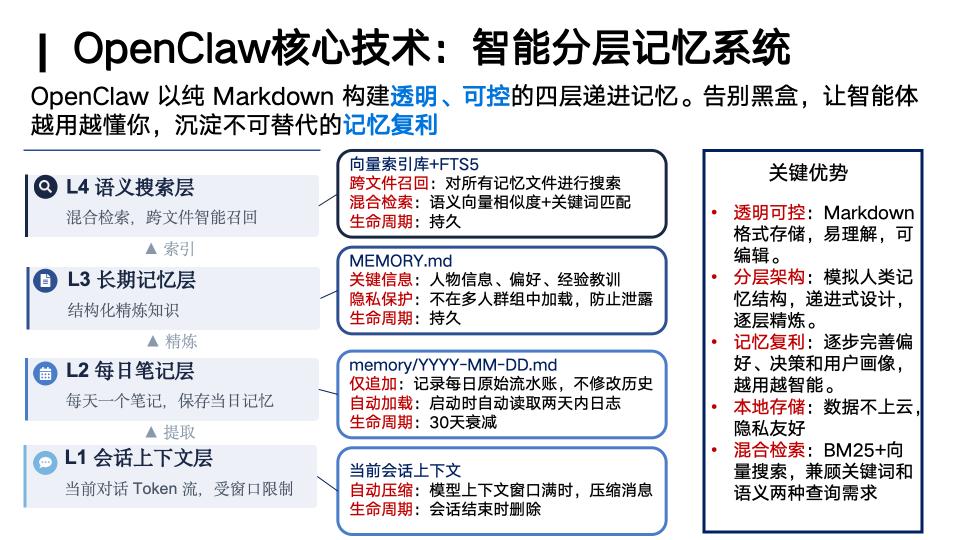
OpenClaw has a very simple memory mechanism. Although it's simple, it's very practical. We've seen similar designs in AutoGPT or other agent simulation systems before.
The bottom layer (L1) is the context of the current session, belonging to short - term memory. When the context window is almost full, the messages will be automatically compressed, and its lifecycle ends when the session terminates.
The second layer (L2) is similar to daily notes or a log. It will automatically read the logs of the past two days and has a 30 - day decay period.
Above that is the long - term memory layer (L3). It will summarize the underlying information and extract long - term personal information, preferences, and lessons learned.
The top - most layer (L4) is semantic intelligent retrieval based on files, with the core purpose of achieving personalization. Through this agent memory architecture built on large models, the system can "understand you better the more you use it" and "get better results the more you use it".
The third is the compatibility with Claude's skill ecosystem. You can see it's a three - layer loading. The first layer helps the model quickly understand the functions of skills through names and descriptions, enabling rapid skill retrieval. The second layer is its detailed workflow, which allows the model to know how to handle different tasks. For example, it can know the general workflow of this PPT or other things. This skill - based method enables the agent to perform highly specialized tasks. The last layer consists of some related resources.
The above three points are what I think are the most valuable parts in terms of engineering after analyzing OpenClaw.
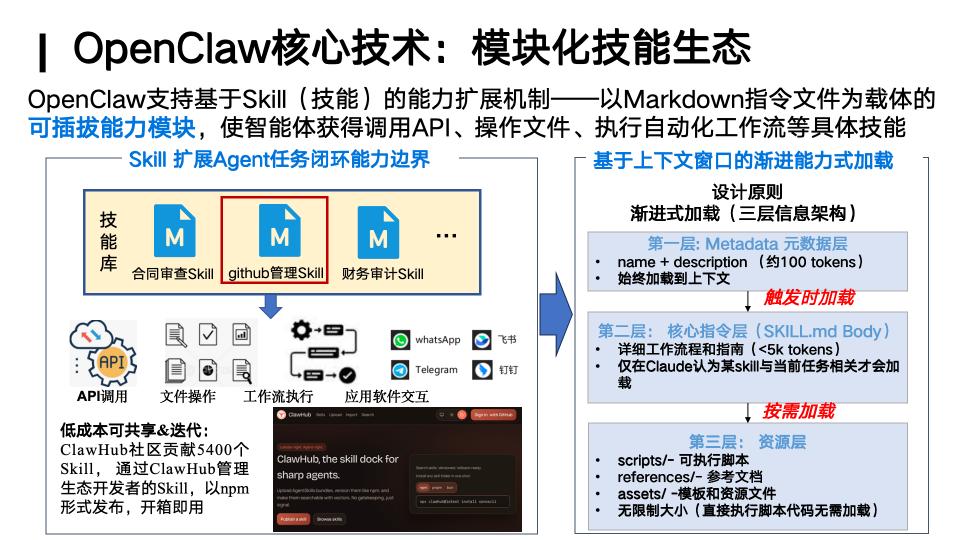
After talking about the overall architecture of OpenClaw, from my personal perspective, I'd like to put forward a conjecture or judgment. Actually, I think OpenClaw shouldn't be regarded as a software or a so - called application, but rather an early prototype of a future agent operating system.
I read a very interesting article that mentioned just as Linux enables all hardware and software to run under the same set of standards, what OpenClaw is trying to do now is to make all AI models, messaging platforms, and all tools run under the same set of standards. This is exactly what an OS should do.
It provides a unified abstraction upwards to shield the differences in the APIs of different large models; it manages resources downwards, such as managing skill plugins and message channels; and it provides scheduling through the gateway in the middle. Its four - layer architecture —— the LLM abstraction layer, Agent loop, runtime, and Gateway —— highly corresponds to the classic layering of an operating system.
Recently, I've also often discussed with others that the code of OpenClaw actually lacks a strong team for maintenance. As more and more people use AI - generated code to modify and maintain it, its current state is like the very rough state of early Linux. The whole code is very bloated, and it's even in a state where one person can't review it. The entire architecture is not mature yet. I think this is also one of the intentions of its founder to join OpenAI. He hopes to rely on the strength of a large company to complete the reconstruction of the current prototype and the product - level OS.
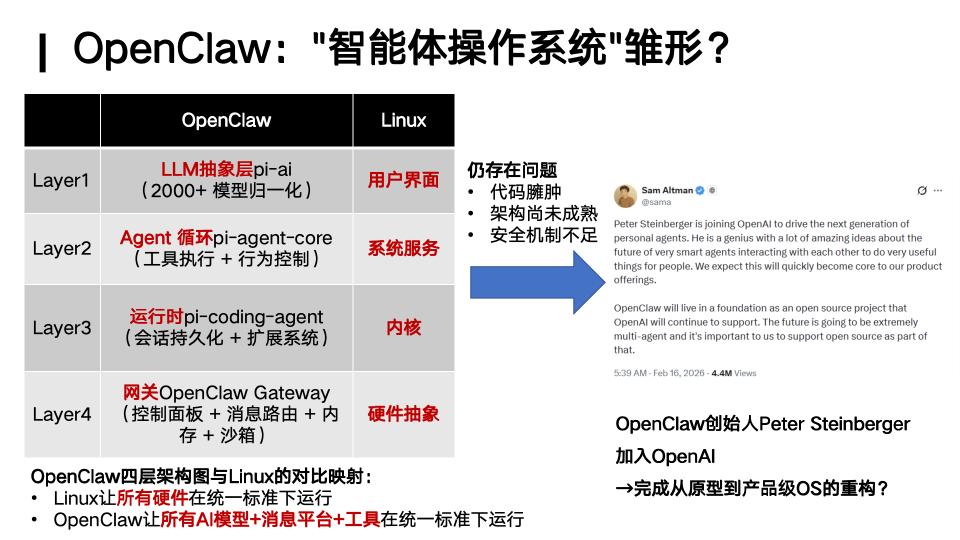
Currently, OpenClaw only solves the problem of running one Agent on one machine for one person. In the future, all edge - side devices will become Agents, and the future requirement is for hundreds of Agents to work collaboratively in a distributed environment. This requires thread management, service discovery, and behavior auditing, which OpenClaw doesn't have yet. This is why we can see that the current ecological competition is taking place at the framework layer, the protocol layer, and the future orchestration layer. It can be said that in the future, model tools and applications must be adapted to such frameworks and protocols to be effectively used.
I also released some agent models last year, but the response was not as expected. Why? I don't even want to use them myself. First, their capabilities haven't reached the level of Claude. When I write code myself, I use Claude. Second, when I released them, even some geeky users who could configure the API for our models still preferred to use ollama for inference, probably because they thought ollama was already a very good framework.
However, agents have their own operating framework, and our models need to run well under the framework we design. This means that in the future, with the existence of OpenClaw, users will directly use OpenClaw to use your model. If they try it and it's not good, they'll think the agent model you released is bad. This is very important. If there is such a thing in the future, perhaps OpenClaw, perhaps something new based on OpenClaw, or something else, our models