Dialogue with Tang Wenbin of Yuanli Lingji: I don't like to say things I don't believe, nor can I become someone I don't want to be.
Text by | Fu Chong
Edited by | Su Jianxun
After a year of entrepreneurship, Tang Wenbin still bears the marks of his time at Megvii. In our conversation, he often mentioned the word "essence" – a "popular word" within Megvii.
After graduating from Tsinghua University's "Yao Class", Tang Wenbin, along with his classmates Yin Qi and Yang Mu, founded Megvii Technology in 2011. In this iconic AI 1.0 enterprise, people liked to inquire about the "essence".
During the 14 years of entrepreneurship at Megvii, Tang Wenbin experienced the complete ups and downs of the AI 1.0 wave. From the rapid business expansion to repeated failures in going public, these experiences also polished his understanding of the "essence".
Regarding the most important reflection on Megvii, Tang Wenbin believes that the business scope should not be over - expanded. Instead, one should first concentrate all efforts to thoroughly develop a business with the greatest advantage.
Yin Qi, who recently took on the role of Chairman of Jieyue Xingchen, also made a similar statement in a recent interview – the business model is essentially about the process of elimination. After seeing the hype, people are clearer about one thing: it's better to figure out what not to do than to do many things.
In March 2025, Tang Wenbin founded Yuanli Lingji, a company focusing on embodied intelligence. In his second venture, Tang Wenbin is better at doing subtraction.
In the past year, Yuanli Lingji didn't compete with the industry in terms of order volume, nor did it rush to tell a "hardware - software full - stack" story to boost its valuation.
In its first year, Yuanli Lingji mainly focused on model development and AI infrastructure work such as data, framework, and evaluation. In Tang Wenbin's view, these are the foundations that determine the iteration efficiency.
The iterative ability to "always stay ahead" is a more essential competitiveness compared to "a short - term lead".
When asked if he would face pressure from investors due to the "slow" pace, Tang Wenbin told Intelligent Emergence: "Some companies have indeed achieved good returns through some flashy methods. We were also confused about whether to do the same. But later, we figured it out. I don't like to say things I don't believe in, and I can't become someone I don't want to be."
He summarized his changes over the years into three stages: the blind confidence of "a newborn calf not afraid of tigers", the confusion of "not knowing how to do many things" after being taught by reality, and the current "modest confidence" – knowing what he knows and clearly understanding what he doesn't know.
Using AGI general robots to open an era of extreme productivity abundance is Tang Wenbin's current aspiration. However, this time, the focus is more down - to - earth: as the model's capabilities improve, unlock scenarios one by one, and first achieve a commercial closed - loop in the logistics business where he had accumulated experience during his time at Megvii.
The following is the conversation between Tang Wenbin and Intelligent Emergence, with the content organized by the author.
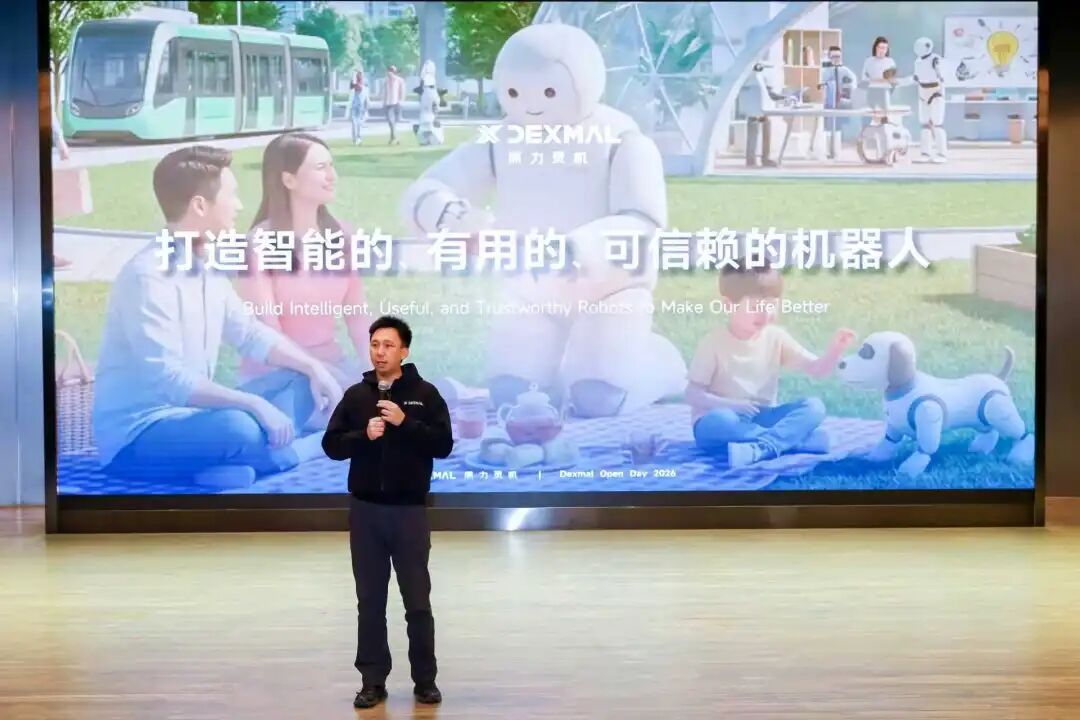
△Tang Wenbin, CEO of Yuanli Lingji. Photo provided by the interviewer.
The first year of entrepreneurship, keyword: iteration
Intelligent Emergence: When looking back on the first year of Yuanli Lingji's entrepreneurship, what's the first word that comes to your mind?
Tang Wenbin: Iteration. In the past year, many things have changed – technological understanding, data solutions, scenario selection, financing rhythm, etc. Just like historical experiences, the changes in embodied intelligence are also faster than we expected.
What we are facing today is still an area full of unknowns. In today's embodied intelligence industry, the essential competitiveness of a company is not how far ahead it is today, but how high its iteration efficiency is. Those who can discover and correct problems more quickly in the face of changes are more likely to stay ahead.
Intelligent Emergence: The core creative team of Yuanli Lingji comes from Megvii. After more than a decade of entrepreneurship at Megvii, do you still think there are many unexpected changes in the current entrepreneurship?
Tang Wenbin: Yes, even though we have accumulated a lot of experience and lessons from the AI 1.0 era.
During our time at Megvii, we gradually solved problems in fields such as computer vision, autonomous driving, and large - scale models. Now, we have entered the field of embodied intelligence. Every time we are in a new field, we don't know the clear path. However, every time in history, we've realized that the frequency of technological changes is faster than we expected.
The same is true for the embodied intelligence industry we are currently involved in. We are still solving many unknown problems, which requires us to quickly iterate our ideas.
Intelligent Emergence: Do you still feel excited about starting a new business? If so, where does it come from?
Tang Wenbin: I think whether it was at Megvii or now in the robotics entrepreneurship, it's all about "doing a better job in solving the problems that the world needs to be solved". This is what we call the excitement of engineers, which is "I can solve this problem".
Since my time at Megvii, I've formed a simple concept called "technical belief and value pragmatism". Simply put, we are not creating new demands. For example, creating a robot for emotional companionship at home is creating a new demand. But what we are currently doing is using better tools to solve existing problems, such as using robots to replace the complicated and dangerous work that humans used to do in industrial scenarios.
Intelligent Emergence: This might be a very pragmatic positioning, but doesn't it sound less "sexy"?
Tang Wenbin: I think it depends on how you define "sexy". I believe that in our daily life and production, there are a large number of problems that can be solved in a better way. Solving these objectively existing problems can generate great value, whether it's commercial value, social value, or user value.
If we really create AGI general robots, humanity will enter an era of extreme productivity abundance. This high - tech expectation itself is a vision like a vast expanse of stars and seas.
Find the right scenario and unlock the "data deadlock"
Intelligent Emergence: At the current stage, what do you think is the essential problem of embodied intelligence?
Tang Wenbin: It's the model. Only when the model is powerful enough can scenarios be unlocked, and the breakthrough point of the model lies in data.
Data is essentially about eliminating uncertainty. The truly valuable data is the Outlier data. Only when the robot enters the real - world scenario does it have the opportunity to make mistakes, encounter more "wrong questions", and reduce uncertainty.
Intelligent Emergence: There are many methods for data collection now. There are data collection factories, and many embodied intelligence companies develop tools like data - collecting gloves and chest - mounted cameras for humans to collect data during actual work. What's your data collection method? Don't you develop your own data collection tools?
Tang Wenbin: We also have our own data collection tools, and we also buy external data collection tools and data. But tools are just methods, and these solutions are not essential.
The essential approach is to let the robot start the data flywheel in the real - world scenario and collect Failure Cases. Just like the data in autonomous driving, the data of smooth operation is not scarce. The truly valuable data is the takeover data, that is, the data when the autonomous driving algorithm fails, which is what AI really needs to learn.
The current methods, whether it's tele - operation or human - centered videos and data - collecting gloves, are actually simulating scenarios, but they are not collecting the data of the robot's real interaction with the physical world in the work scenario. That is to say, through such data, developers don't know where the robot will actually make mistakes based on today's logic.
Intelligent Emergence: Without entering the scenario, there won't be the Outlier data you mentioned. Without diverse data, a good model that can work in the scenario can't be trained – this is a "deadlock". How to unlock this deadlock?
Tang Wenbin: We need to find scenarios that match the current capabilities of the robot. At this stage, we should regard the robot as an apprentice, not a highly - expected full - time worker.
We've summarized several conditions for finding scenarios: First, fault - tolerance – the consequences of making mistakes are not serious, or someone can handle them; Second, tolerance for rhythm – the time it takes for the robot to complete a task is not fixed, but if it takes longer, the task process won't collapse; Third, long - term operation – otherwise, the cost - effectiveness for the customer won't be worthwhile; Fourth, generalizability. If the task is too specific, non - standard automation can basically handle it.
Intelligent Emergence: You said that Yuanli Lingji is mainly focusing on the logistics scenario now. Is it because it has better fault - tolerance?
Tang Wenbin: Logistically, it may seem that there is no room for error. For example, if you order a bottle of Coke and don't receive it, that's a mistake, and the customer will complain. But there are many process links in logistics, which can be made fault - tolerant through system design: let the robot do it first, and if it fails, humans can take over.
Moreover, the rhythm requirements in logistics are not that strict. There are about two to three batches of work a day. As long as these batches are completed, it doesn't matter whether it's finished at 9 o'clock or 10 o'clock, and it won't have a significant impact on the overall situation.
Intelligent Emergence: So is your strategy for scenarios "laying eggs along the way"?
Tang Wenbin: My model ultimately aims for general capabilities. It's not that I'm targeting a specific scenario. Instead, as the model's capabilities improve, some scenarios will be gradually unlocked.
So, rather than "laying eggs along the way", I prefer to describe the current relationship between the model and scenarios as an "angle relationship". The horizontal axis represents scenarios, and the upward - slanting ray represents the model's capabilities. The two are not completely separate, nor do they coincide from the beginning. As the model becomes stronger, the scenarios it can cover will increase, and this angle will become smaller and eventually tend to be consistent.
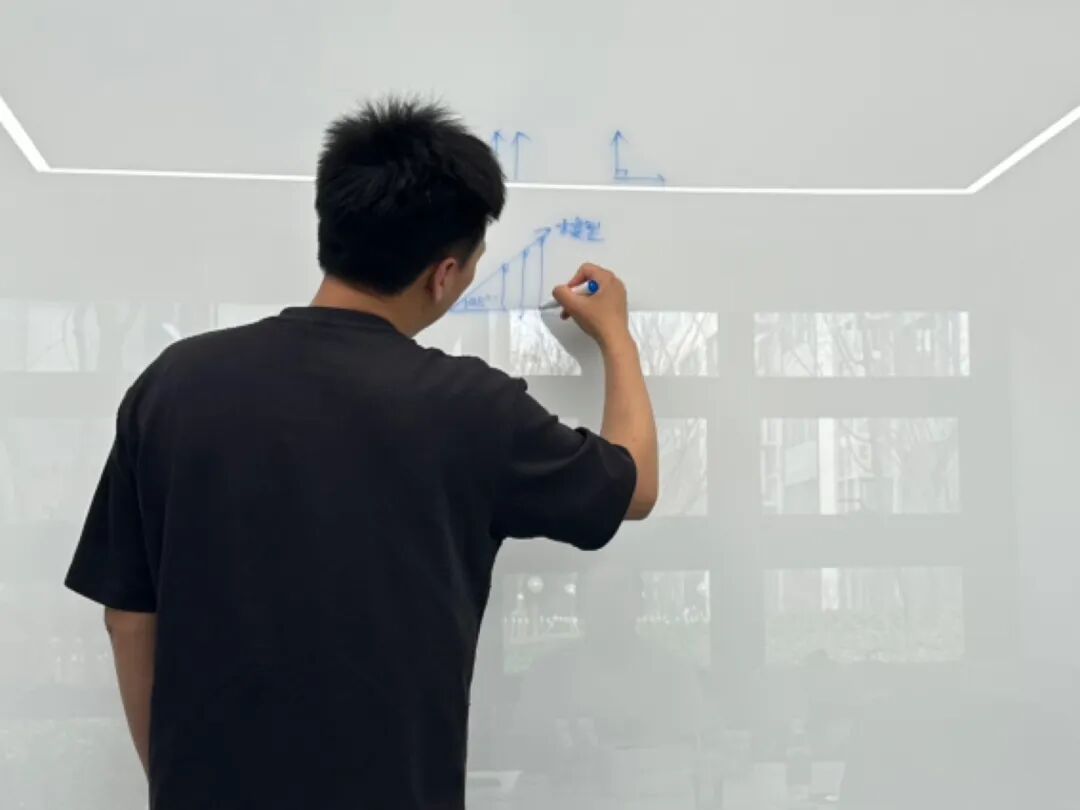
△Tang Wenbin drew an "angle diagram" of the model's capabilities and scenario unlocking on the blackboard. The horizontal axis represents scenarios, and the upward - slanting ray represents the model's capabilities. The improvement of the model's capabilities will ultimately be reflected in the scenarios. Photo taken by the author.
"Hardware - software full - stack" is not the essential issue for measuring valuation
Intelligent Emergence: During your time at Megvii, you focused on the logistics scenario. Will the solutions and products you offer to customers be different after founding Yuanli Lingji?
Tang Wenbin: Simply put, whether it was the logistics robot business we did at Megvii or the solutions many of our peers are currently offering, they essentially solve the "transportation" problem. That is to say, the robots mainly replace human "legs".
However, the more complex "hand movements" have not been well - solved. For example, grasping, picking, picking up, putting down, and packing still rely heavily on manual labor. Now, with Yuanli Lingji, we hope to gradually enable the model to handle these hand - related operations and integrate them with the existing systems to form a complete set of solutions.
Intelligent Emergence: Will Yuanli Lingji develop the hardware for the "hand" itself?
Tang Wenbin: The "hand" is actually a broad concept. We call it the end - effector. A two - finger gripper is one type, a three - finger one is another, and there are also four - finger and five - finger ones.
I don't think one configuration can cover all scenarios. In some scenarios, a three - finger hand can complete the task, and it's cheaper than a five - finger hand. So, rather than whether to make the hand, the more essential thing is to clarify the scenarios you serve and what you really need.
Intelligent Emergence: If you don't develop your own hardware or if you're not a so - called "hardware - software integrated" full - stack company, will it affect the valuation?
Tang Wenbin: I don't think this is an essential issue. Whether to develop hardware is essentially just a means. The key is to see what problems you want to solve.
If a certain hardware link is strongly related to our core structural design and product mainline, and the existing supply chain can't meet the requirements, then of course we'll consider doing it ourselves. But if external manufacturers are willing to cooperate on customization and can meet our requirements, then I don't have to do everything myself. After all, a company's most precious energy should be focused on more differentiated areas.
So, the core is not "whether you must do it yourself", but whether you have the ability to do it. If you don't have this ability at all, you're easily controlled by the supply chain. But if you have the ability, you can make an active choice – which parts to do yourself and which to hand over to partners. Just like Apple, it doesn't produce everything by itself.
The best embodied intelligence model should be exposed to physical - world data from Day 1
Intelligent Emergence: At the DM0 press conference, you emphasized that it's an "embodied native model" and also conducted data fusion training with Jieyue Xingchen. Is this your "non - consensus"?
Tang Wenbin: It's not so much a non - consensus as something that others can't do.
We believe that the best embodied intelligence model should start to be exposed to physical - world data from Day 1. Training with a mixture of three types of data – Internet data, autonomous driving data, and robot data – can raise the upper limit of the model.
However, these three types of data are in the hands of different companies – Internet companies, autonomous driving companies, and robot companies. Only a few large - scale companies like Tesla and Xiaomi have all three types of data at the same time.
We can do it because we have a deep - seated trust with Jieyue Xingchen. This is not just a technical issue. It requires in - depth trust between cooperating companies in aspects such as data pricing, asset ownership, and computing power sharing.
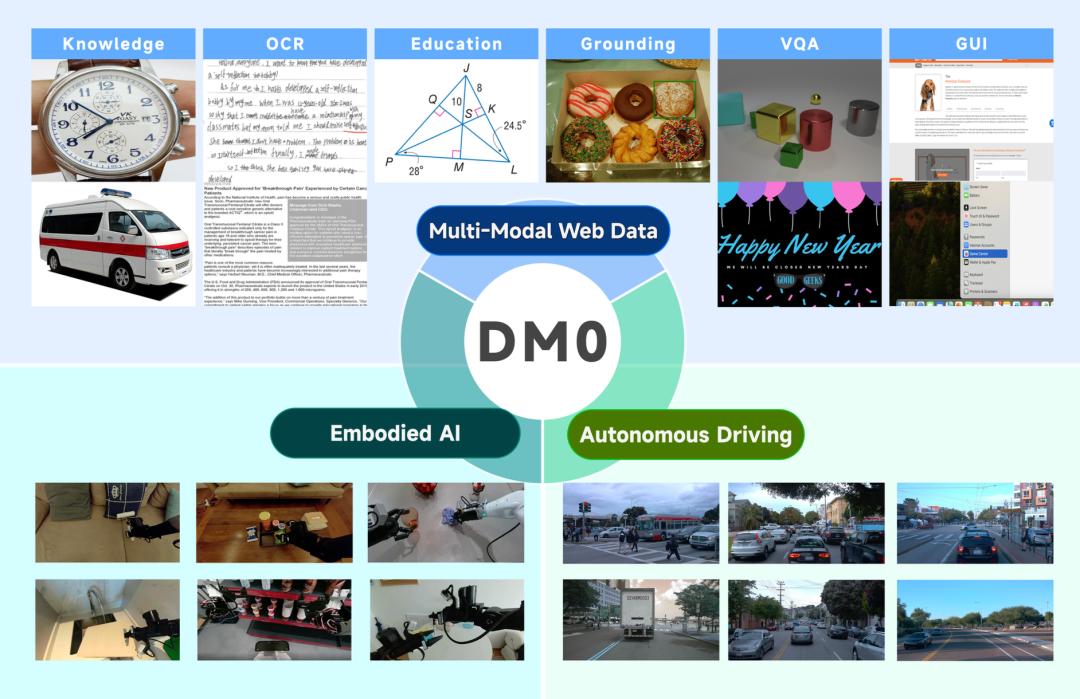
△The Yuanli Lingji DM0 model involves multi - source mixed training of three types of data: Internet, autonomous driving, and embodied data. Photo provided by the interviewer.
Intelligent Emergence: Why should the best embodied intelligence model be exposed to physical - world data from Day 1?
Tang Wenbin: You can first imagine the model as a junior high school graduate who has received nine years of cultural education and then is sent to train in sports for three years to become a "sports school student". This student didn't start training in sports from a young age, so their physical fitness has a