Using confidential computing to solve the "last mile" of "Lobster" security, Qinghua-affiliated Jinghua Confidential Computing completed an angel round of financing worth tens of millions of yuan.
Recently, Jinghua Cryptographic Computing (Beijing) Technology Co., Ltd. (hereinafter referred to as "Jinghua Cryptographic Computing"), a leading domestic technology company focusing on high-performance AI cryptographic computing, announced the completion of an angel-round financing of tens of millions of RMB. This round of financing was led by Shengjing Jiacheng Venture Capital, with listed companies Guolian Co., Ltd. (603613), Boyan Technology (002649), and existing shareholder Innoch Capital following the investment. Light Source Capital, as the early incubator, continues to serve as the financial advisor.
The funds from this round will be mainly used for the continuous R & D of the high-performance AI cryptographic computing platform, the high-reliability and typical scenario verification of dedicated cryptographic computing chips, as well as the large-scale commercial implementation in high-sensitivity data scenarios such as government and enterprise, finance, healthcare, law, and consumer sectors and brand IP construction.
The Core Obstacles to the Large-scale Implementation of AI Agents: Permission Security and Data Security
With the rapid global popularization of AI Agent products represented by OpenClaw, the security issues of enterprise-level AI applications are evolving from marginal topics to core industry propositions. In the view of Lin Xiuchun, the founder of Jinghua Cryptographic Computing, the key bottlenecks currently hindering the large-scale implementation of Agents are concentrated in two dimensions.
Firstly, it is permission security. Different from traditional software tools, Agents have the ability of autonomous decision-making and execution. The "over - permission" behavior of AI in file operations often occurs within milliseconds and is completely beyond the user's perception. Once an effective "execution isolation" mechanism cannot be achieved at the technical level, Agents may become potential data risk exposure points in the internal network.
Secondly, it is data security. When executing tasks, Agents usually need to push a large amount of private data to cloud models for inference. This means that an enterprise's business secrets are not only at risk of direct exposure on the public network but may also be permanently embedded in the memory bank of large models, becoming "data that can never be deleted". The cost of this "naked data running" is unbearable for any institution pursuing stable development.
These two major problems together form a "trust desert" in the process of Agent implementation. Currently, the industry is at a contradictory critical point: on the one hand, there is a huge temptation of efficiency improvement; on the other hand, there is a devastating risk of security hazards. To truly introduce "Lobster" (presumably a product or concept) into enterprises, trust must be reconstructed from the bottom up. This is also the core market gap that high-performance cryptographic computing technology urgently needs to fill.
After Three Eras of Evolution, the AI Cryptographic Computing Track is on the Eve of Explosion
The issue of AI data security did not emerge suddenly. With the leap of computing paradigms, it has undergone a dangerous mutation from the edge to the core and from the explicit to the implicit.
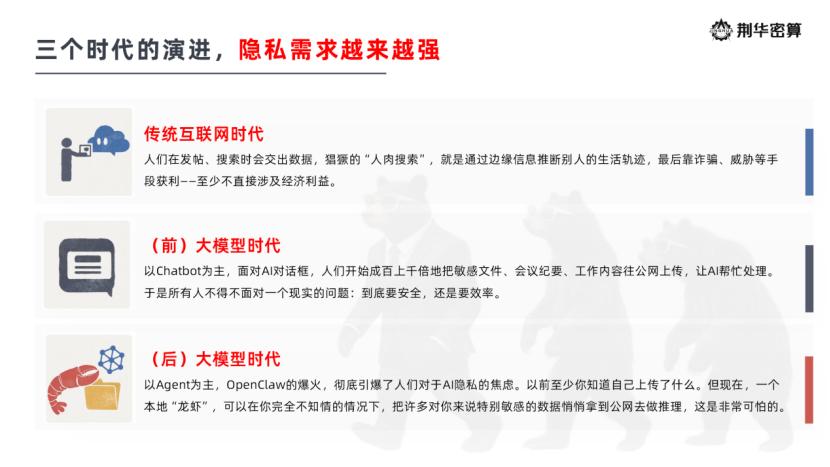
In the traditional Internet era, privacy threats were mainly manifested as "human flesh search" based on public information, inferring people's life trajectories using marginal information, and finally profiting through means such as fraud and threats. The scope of harm was relatively limited.
In the (pre -) large - model era dominated by Chatbots, users began to upload a large number of sensitive files, meeting minutes, and work content to the public network. The "dilemma between security and efficiency" has become a common problem for enterprises and individual users.
In the current (post -) large - model era dominated by Agents, the nature of the risk has changed fundamentally - Agents have the ability of autonomous thinking and action and can take highly sensitive local data to the public network for inference without the user's knowledge at all. Once a data breach occurs, the victim is often unaware. Sensitive information is permanently embedded in the large - model database, and the leaked content is no longer limited to social media but extends to all work and life data stored in the user's device.
This evolutionary path reveals a clear market logic: the stronger the AI capabilities, the more urgent the demand for underlying security infrastructure. Jinghua Cryptographic Computing's business strategy is based on this judgment. It first focuses on in - depth implementation in scenarios with strong privacy requirements such as finance, healthcare, and government affairs, builds product credibility through real - business verification, and then achieves large - scale penetration after market awareness matures.
Industrial Capital Enters the Market, and Upstream - Downstream Collaboration Accelerates Commercial Implementation
In this round of financing, the participation of two listed companies, Guolian Co., Ltd. and Boyan Technology, is particularly noteworthy. Both are not just financial investors but enter the market with clear industrial resources and business collaboration logic.
Guolian Co., Ltd. is a B2B e - commerce and industrial Internet platform company. It was established in 2002 and listed on the main board of the Shanghai Stock Exchange in 2019. It brings together a large number of physical enterprise customers in the critical period of intelligent transformation, which constitutes the core potential market for cryptographic computing products.
Boyan Technology's main business focuses on helping Chinese enterprises adapt their products to overseas markets, pass compliance reviews in various countries, and build local operation systems. The security issue of cross - border data flow is a high - frequency core pain point for its customer group, which precisely matches Jinghua Cryptographic Computing's product capabilities.
Jinghua Cryptographic Computing will jointly build a secure computing power ecosystem that does not rely on overseas closed - end agreements with the two listed companies. This in - depth coupling from the underlying algorithm to industry scenarios marks that AI cryptographic computing has officially entered the explosive period of "large - scale penetration" from "experimental research".
Abandon General Computing, Focus on AI Intelligent Computing
The Jinghua Cryptographic Computing team, in collaboration with Professor Ren Ju's Laboratory at Tsinghua University, has launched a hard - core attack on security issues in the AI era.
The team has abandoned the optimization of general scenarios and instead focused on AI computing. After a long - term technological "marathon", through a complete reconstruction of AI computing operators, it has not only achieved independence from GPU - TEE and full compatibility with domestic heterogeneous GPUs but also reduced the time - performance loss of cryptographic computing in AI scenarios by 3 - 4 orders of magnitude (about a thousand times). While reaching an available level, it has achieved "usable but invisible" with zero - precision loss in the entire process of data transmission, storage, and calculation.
In the direction of "hardware - software integration" engineering, the team has achieved a key breakthrough. The pre - researched dedicated cryptographic computing chip has been verified on FPGA. From relying on overseas commercial hardware to relying on open cryptographic standards and fully independent computing power, Jinghua Cryptographic Computing has built a very deep technological moat.
This also marks that domestic computing power now has the key ability to efficiently run large models with hundreds of billions of parameters in an absolutely secure encrypted environment. This not only builds an indestructible security defense line for enterprise data at the micro - level but also breaks the industry's "impossible triangle" where it is difficult to achieve "security", "efficiency", and "versatility" simultaneously at the macro - strategic level. It fundamentally fills the key shortcoming of the domestic AI computing power ecosystem.
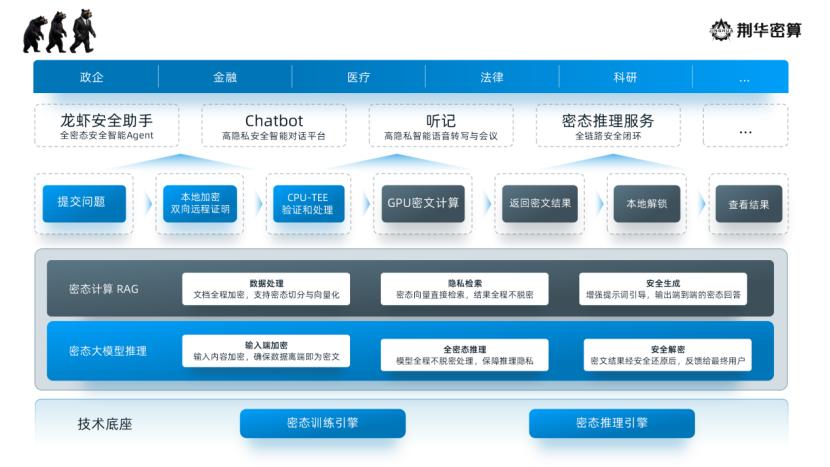
In terms of product layout, Jinghua Cryptographic Computing provides high - level local private - domain deployment solutions for industries with high data sensitivity, building a cryptographic computing protection system covering the entire process of "input - inference - output"; for developers and C - end users, it launches a cryptographic inference platform and "Lobster Security Guard", supporting plug - and - play across platforms and multiple terminals; at the same time, for high - value private - domain data fields, based on the cryptographic training engine, it realizes the rental - style sale of data in real ciphertext form. The first batch of commercial implementation scenarios cover industries such as government and enterprise, finance, healthcare, law, and scientific research.
Relying on the practical experience accumulated by the team in cross - border data security projects involving hundreds of millions of people, Jinghua Cryptographic Computing is currently promoting cryptographic computing pilots with several leading institutions and accelerating in - depth cooperation with industrial investors in this round to explore more business possibilities.
Liu Haofei, the founding partner of Shengjing Jiacheng Venture Capital, said: "No matter how advanced the technology is, efficiency will always be restricted by security, and security capabilities must keep up with technological development. Jinghua Cryptographic Computing has significantly shortened the time of traditional cryptographic computing in the production environment, making cryptographic computing highly likely to become the mainstream path for privacy computing in the era of general artificial intelligence. As an established venture capital institution, in addition to providing early - stage financial support, Shengjing Jiacheng will also rely on resource networks such as Tsinghua alumni to continuously connect with industrial parties and help Jinghua Cryptographic Computing develop at a high speed."
Huang Xinxin, the person - in - charge of the incubation business of Light Source Capital, said: "AI has penetrated into everyone's life and work. In the rapidly developing AI era, security issues have evolved from 'forward - thinking' last year to 'well - known to everyone'. We are very honored to have accompanied the Jinghua Cryptographic Computing team, which has the deepest accumulation in the field of domestic cryptographic computing and inference, since the early days of the AI wave. We have also witnessed the continuous breakthroughs in the team's productization. We look forward to the Jinghua Cryptographic Computing team becoming the guardian of the entire AI data security."