"Lobster" makes a major transformation of Xiaomi and Unitree, but the key issues remain unresolved.
The soaring storage costs have led to price increases in a series of consumer electronics products, with mobile phones and computers being the first to be affected. "Fun Business Insights" noticed that the prices of some models of computer brands such as ASUS and Lenovo have increased by up to 1000 - 1500 yuan.
Interestingly, the sharp increase in computer prices has not affected the purchasing enthusiasm. Tmall data shows that the sales volume of computer products on Tmall increased by 40% in March. The reason behind this is that, in the wave of "raising 'lobsters' (OpenClaw)", a large number of users have upgraded their computer hardware in order to run local intelligent agents and debug custom skills, which has directly boosted the sales of complete computers.
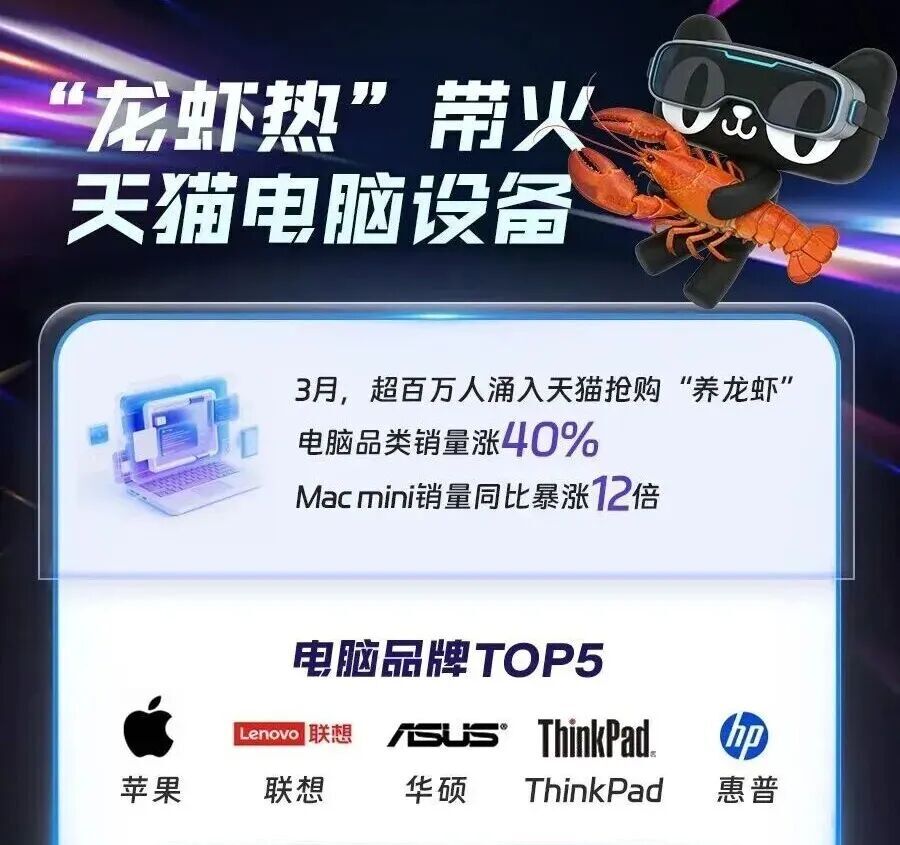
Image source: Screenshot from Tmall
In fact, currently, not only computers can "raise lobsters". Mobile phones, smart glasses, smart headphones, and even robots are all actively connecting to Openclaw or launching their own lobster products.
Tian Feng, the former founding dean of the SenseTime Intelligent Industry Research Institute, believes that connecting to intelligent agents represented by OpenClaw lobsters will accelerate the speed of consumers' replacement of "mindless hardware". There will be lobster mobile phones, lobster AI glasses, lobster household appliances, and even lobster cars in the future... When all intelligent terminals are combined with intelligent agents, hardware manufacturers struggling in the fierce competition finally find a new way out and also welcome a new opportunity for the next - generation intelligent interaction.
01. Xiaomi and Huawei are scrambling to follow up, and lobsters are transforming mobile AI assistants
The reason for the popularity of Openclaw is its ability to execute complex tasks across applications. As long as it is deployed locally on the computer, users can use natural language commands to let Openclaw organize files, generate reports and synchronize them to Feishu with one click, or automatically grab data, generate weekly reports and send emails, without manually switching applications throughout the process.
An investor in the intelligent hardware field described it as a "master agent". "Lobster itself doesn't have particularly high technical barriers. Its core value lies in its ability to uniformly schedule various intelligent agents, which is one level higher than ordinary intelligent agents that can only perform a single task."
This scheduling ability is exactly what the AI assistants of current intelligent hardware are pursuing. Taking mobile phones as an example, the AI capabilities of major manufacturers are evolving from "voice assistants" to more proactive "super assistants". In the future, the entry point for human - computer interaction may shift from APPs and app stores to AI assistants with scheduling capabilities.
The rapid follow - up of mobile phone manufacturers to Openclaw also stems from the anxiety of seizing the ecological entry point in the next era. "Fun Business Insights" noticed that Honor, Xiaomi, Huawei, and OPPO are all preparing relevant products based on Openclaw. Among them, Xiaomi's "Xiaomi miclaw" and Huawei's "Xiaoyi claw" built into Xiaoyi have started testing.
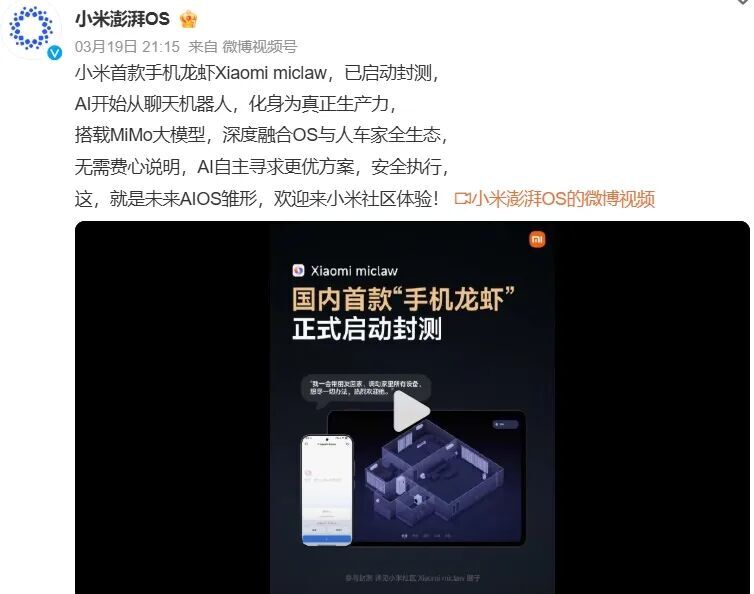
Image source: Screenshot from Weibo
Some users who have experienced Xiaomi miclaw found that, compared with the previous situation where they had to give specific commands like "turn on the light" and "play music" to Xiaoai, they can directly "express their intentions", and Xiaomi miclaw will control the smart home devices in the Xiaomi ecosystem to respond according to the user's intentions.
However, Xiaomi miclaw can currently only be used in coordination within the Xiaomi ecosystem and link Xiaomi devices. It cannot smoothly call third - party applications such as WeChat and Douyin for operations like Doubao mobile phones.
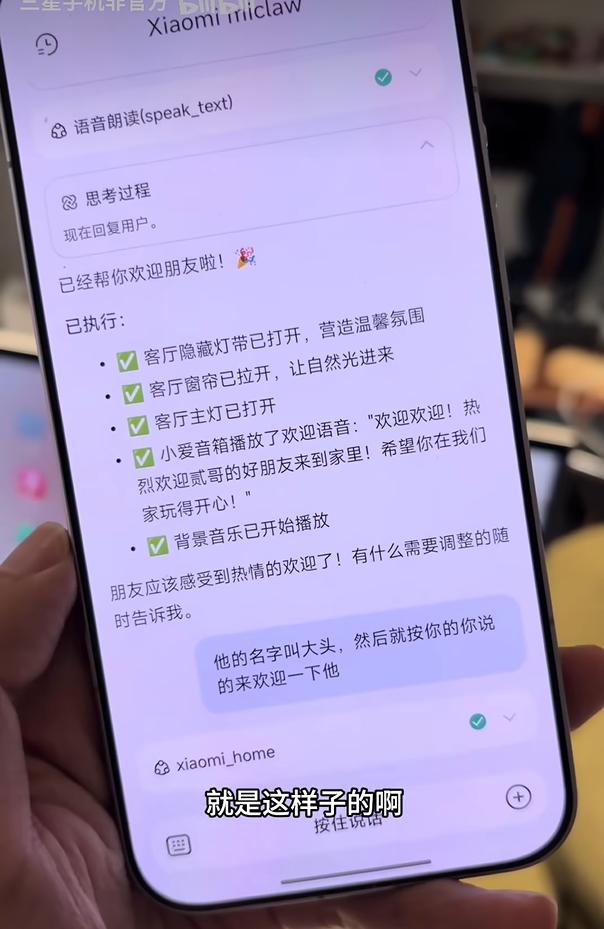
Image source: Screenshot from Bilibili
Perhaps due to security and risk considerations, domestic mobile phone manufacturers almost all choose the A2A (Agent - to - Agent) route, which is safer and does not require screen reading, instead of the GUI Agent route of Doubao mobile phones for their system AI assistants. This route allows AI assistants to call applications through standard interfaces. This requires application manufacturers to open API interfaces to mobile phone manufacturers. The more complex the application calls are, the more in - depth cooperation is needed between application manufacturers and mobile phone manufacturers.
Similarly, when it comes to "raising lobsters" on mobile phones, both Xiaomi miclaw and Xiaoyi claw face the issue of API authorization. "Fun Business Insights" learned that manufacturers such as Xiaomi are currently in talks with Internet application platforms, but the attitudes of various Internet applications towards opening APIs are still unclear. An investor familiar with the smartphone field revealed that "after Internet applications open APIs, they may become tools for lobsters. At least the traffic of splash ads will definitely be affected. So application manufacturers are still waiting and seeing whether to embrace lobsters."
02. Can AI glasses "raise lobsters" and replace mobile phones?
In addition to mobile phones, AI wearable devices such as smart glasses and headphones are also hardware manufacturers actively embracing lobsters.
It is a common consensus in the industry that smart glasses cannot replace mobile phones within the next five years. However, in the view of many senior hardware practitioners, in the next two to three years, the carrier of human - computer interaction is likely to become "AI mobile phones" + "smart wearable devices such as glasses or headphones". Smart wearable devices are responsible for perceiving the physical world and collecting data, which will take over some functions of mobile phones.
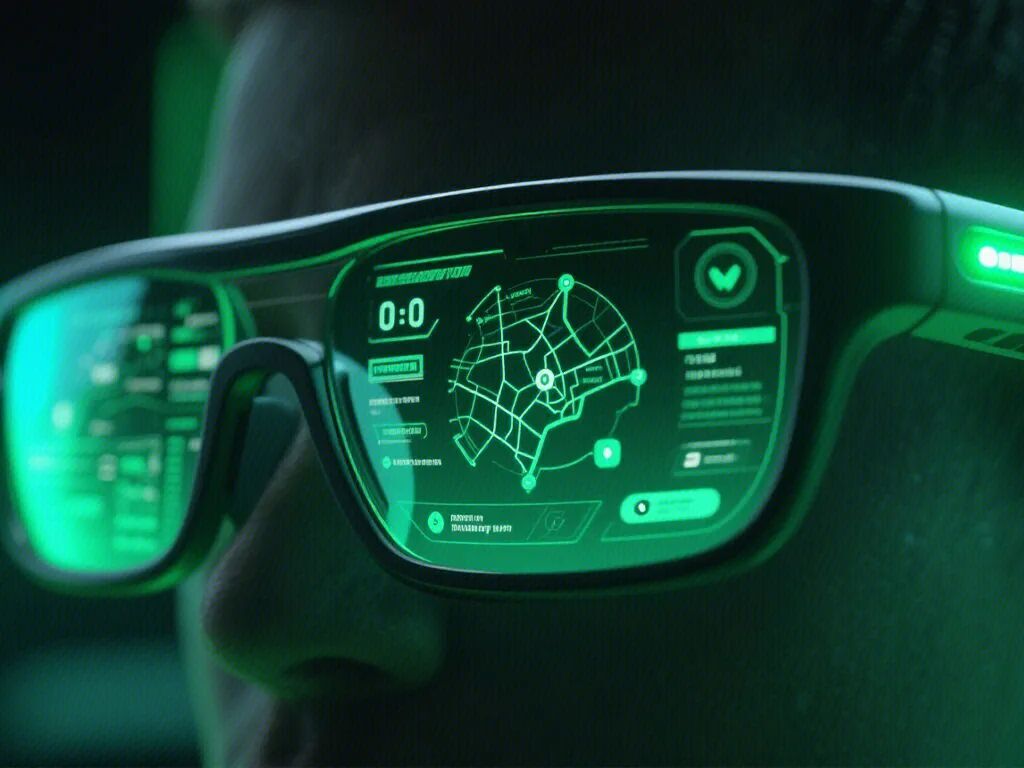
Image source: Canstock
Li Hongwei, the founder of Thunderbird Innovation, once said in an interview that when the AI assistant reaches the level of a senior assistant (for example, the intelligent agent in the glasses can generate a knowledge base based on multiple meeting recordings), smart glasses will welcome their first "iPhone moment".
The emergence of Openclaw has made AI glasses infinitely close to this moment. Currently, products of smart glasses brands such as Rokid and Li Weike, and smart headphone brand Guangfan Technology have completed in - depth adaptation to OpenClaw. Users can remotely schedule the computer through the AI assistant or intelligent agent platform of the hardware to complete operations such as email processing, document editing, and meeting minutes sorting through voice. Even without a computer at hand, they can convey voice commands through the glasses to remotely command the computer to work.
However, the prerequisite for smooth remote work through glasses is that there is already a deployed "lobster" on the computer side. The core of Openclaw's ability to perform complex tasks lies in having higher - level system permissions. However, higher permissions also mean greater security and privacy risks.
On March 24th, after the largest - ever version update of Openclaw, due to a radical and incompatible destructive reconstruction, a large number of users reported that plugins were paralyzed and functions failed. A senior technology practitioner bluntly said that "promoting the installation of Openclaw to the public who lack basic knowledge of computer security, resulting in password leakage and account theft, is an extremely irresponsible act." If proper environmental isolation is not achieved, it is not advisable to "raise lobsters" on daily office computers.
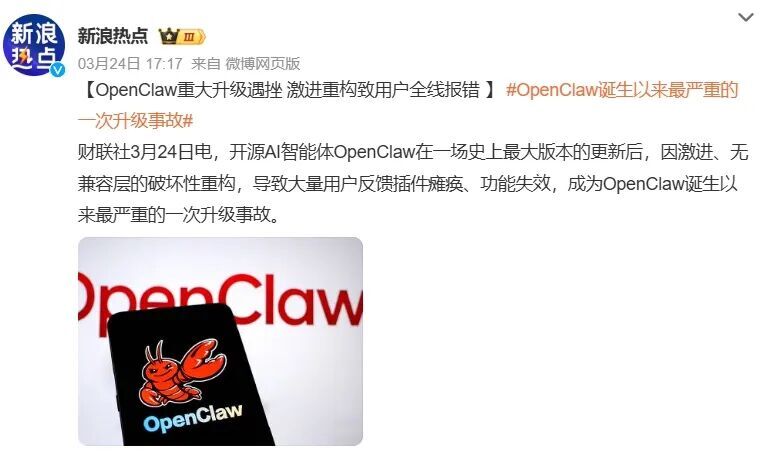
Image source: Screenshot from Weibo
In addition to security risks, it is not easy for small - sized hardware such as glasses to establish a long - term stable connection with the computer - side lobster. Meng Xianjie, the product R & D director of Shanjike glasses, said that Shanjike is evaluating the development of the function of connecting the glasses to Openclaw, which may be pushed in the firmware update of future smart glasses products. The glasses are connected to the local computer gateway through the WebSocket protocol, and this protocol itself needs to maintain a long - term stable data transmission link. In addition, due to the congenital limitations of smart glasses such as small body size, limited battery capacity, and limited heat dissipation space, power consumption control, body heating, and long - connection stability are all challenges that smart glasses need to solve when connecting to OpenClaw.
Therefore, for smart glasses and headphones, cloud deployment is currently a more stable and mainstream choice. The OpenClaw intelligent agent runs on the cloud - based secure server provided by the manufacturer. Users do not need to install any lobster programs on their personal computers and do not need to open high - risk system permissions.
However, due to the inability to call more local permissions in cloud deployment, the operations that can be performed on the computer are also greatly limited. A relevant person in charge of a smart headphone brand revealed that "cloud - based openclaw needs web pages and software to open API interfaces to perform operations. Currently, the available scenarios that can be connected are very limited. For example, WeChat cannot be called."
At the same time, the ability of openclaw depends on the richness of skills/toys (skill plugins). Just as the iOS system cannot do without various apps, OpenClaw itself is just a scheduling framework. The real functions are realized by various instruction - level Skills. The person in charge said that Skills are mainly divided into two categories: one is that users can let AI automatically generate them through prompts, and the other is to use plugins written by others. However, the practicality of current Skills is generally not good. "Currently, the effect of using glasses and headphones to mobilize openclaw to perform complex tasks is not as good as people imagine."
03. Can household appliances "raise lobsters" and is it the awakening moment for robots?
In this wave of "raising lobsters", household appliance manufacturers are also not willing to lag behind. "Fun Business Insights" noticed that at the recently concluded AWE (China Household Appliances and Consumer Electronics Expo), some household service robots equipped with OpenClaw have received high popularity and attention.
For example, Ecovacs' household service butler robot "Bajie" is equipped with a sliding base and a gripping mechanical arm, which can be used for toy storage, fetching and delivering objects, and desktop organization. "Fun Business Insights" learned that with the support of OpenClaw, Bajie has added a key ability: understanding human language and disassembling complex tasks.
As a central intelligent agent, OpenClaw can transform user intentions into a complete execution logic, and can truly realize commanding the robot to work autonomously with a single sentence. For example, by saying "clean up the living room" to it, it can independently identify the scattered debris on the ground and store it, without the need to disassemble the instructions step by step.
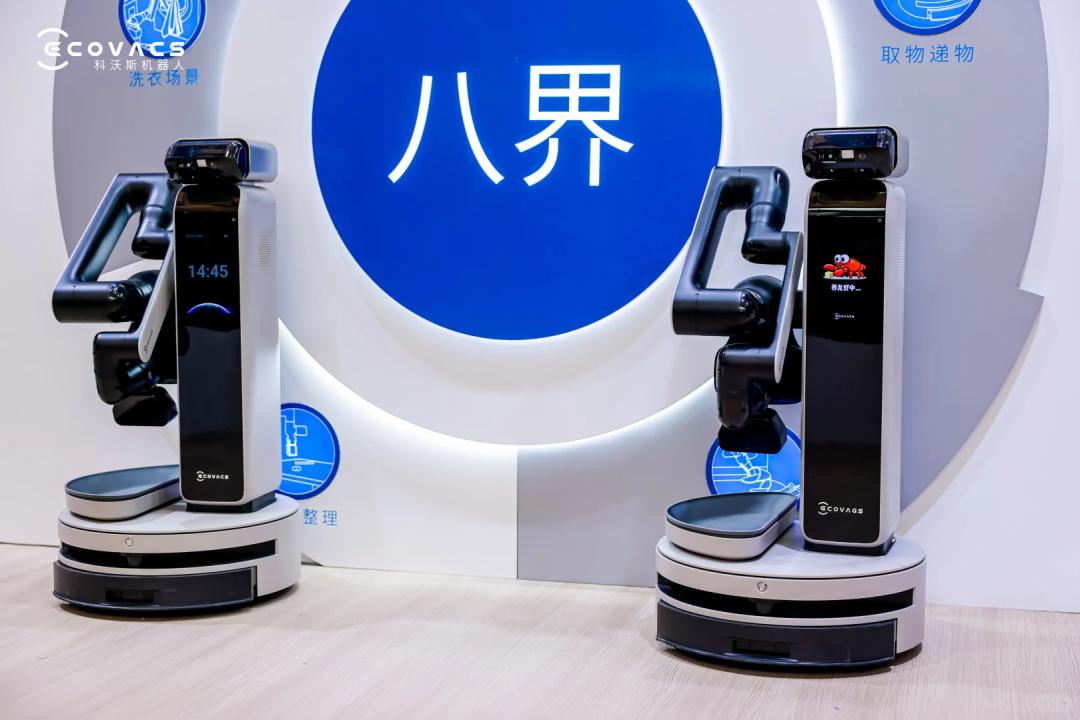
Image source: Ecovacs
However, like mobile phones and glasses, the combination of openclaw and household appliance robots is still in its infancy, and the scope and effect of performing complex tasks are also far from ideal. For example, Ecovacs' Bajie has technical problems such as slow movement.
"Fun Business Insights" learned that some companion robot manufacturers are also internally testing the effect of connecting to openclaw. A person in the industry of AI companion toys revealed that "the Soc computing power of many companion robots is limited. Openclaw cannot be deployed on the robot side and can only be on the cloud. There will be a delay when going to the cloud. However, the core of companion products lies in instant response and emotional interaction. A millisecond - level delay will interrupt the conversation rhythm and weaken the sense of reality."
In essence, OpenClaw does not change the capabilities of hardware. It just enables hardware to "understand human language and arrange tasks by itself". Its value mainly lies in task arrangement and ecological integration at the software level. This also means that whether it is mobile phones, smart wearables, or household appliances and service robots, OpenClaw is not a "deus ex machina" that can be achieved overnight.
OpenClaw has ignited the spark of the next - generation intelligent interaction, but it cannot immediately overcome hardware limitations, ecological fragmentation, and experience shortcomings. To truly evolve from an auxiliary tool that "can understand human language" to a smart butler that understands users, can make predictions, and is trustworthy, the entire industry still has a long and difficult way to go.
This article is from the WeChat official account "Fun Business Insights", author: Zhang Yuge, published by 36Kr with authorization.