AI Health Community: A City-Level Model for AI Healthcare Emerges

AI medical service revenue accounts for 90%, and the number of members exceeds 1.666 million. WeDoctor has taken the lead in achieving a closed - loop AI medical business model.
While others are still exploring the commercialization of AI in healthcare, WeDoctor has already presented its answer. The biggest "contributor" behind this is the AI - enabled Health Service Community (HSC) business. Digging deeper into this model, we can find that beyond its commercial value, it has greater social value: it solves the global problem of medical reform, builds an "AI + health management" platform with the compound organizational ability of "AI + human", and constructs a value delivery system for medical insurance, commercial insurance, enterprises, families, and individuals.
The HSC, short for "Health Service Community", is a new product in response to medical reform and the development of the AI medical industry.
Since 2020, WeDoctor has carried out in - depth cooperation with the Tianjin municipal government to jointly explore the construction of the HSC. Starting in 2025, this model began to spread from Tianjin to the whole country.
In just a few months, many places such as Fuzhou, Hangzhou, Wenzhou, Yinchuan, and Hainan have successively joined hands with WeDoctor to build the "HSC". After five years of in - depth development in one city and replicating the model in five cities in one year, the expanding map of WeDoctor's AI - enabled HSC is emerging.
In 2026, the HSCs in places like Yinchuan, Wenzhou, and Fuzhou have quickly entered the substantial stages of regional pilot projects, hospital construction, and platform building. On the 6th of this month, the Yinchuan HSC launched a pilot project in Yongning, and this model has landed at the grass - roots level in an important area of medical reform.
For WeDoctor, this undoubtedly represents a huge room for imagination. In the US medical market, Cityblock, a health service provider for low - income elderly patients with chronic diseases, has a valuation of up to 41 billion yuan and is regarded as a "disruptor" of the US medical system. Its logic of practicing "value - based healthcare" coincides with that of WeDoctor. With a larger population base and a bigger demand market in China, WeDoctor uses the HSC as a fulcrum to explore a more locally adaptable and sustainable path for the transformation of medical services.
In a highly competitive and barrier - laden track, WeDoctor has completed the layout in multiple cities in one year, and its growth and valuation logics are being re - evaluated.
Solving the Global Problem: The "Eastern and Western Answers" of WeDoctor and Cityblock
In the United States, Medicare and Medicaid, which cover the elderly and low - income groups, are facing huge medical insurance payment pressure. How to curb the rising costs without reducing the service quality has always been the core problem of medical reform.
Cityblock is the key to breaking the deadlock: it targets the "dual - eligible" population with the most complex medical needs and establishes a full - cycle proactive health management system. Its core logic lies in "prevention is better than cure" - by doing a good job in front - end prevention and management, it reduces the expensive hospitalization and emergency treatment at the back - end, thus reducing the total medical cost.
Looking back at the domestic situation, this business logic of "paying for health outcomes" is similar to the "HSC" model built by WeDoctor in China.
Currently, China's medical system is also troubled by the dual structural contradictions of "imbalanced resource allocation" and "high medical insurance payment pressure". On the one hand, patients are overly concentrated in high - cost large - scale hospitals, resulting in the long - term idleness and marginalization of primary medical resources; on the other hand, the over - medical treatment induced by the traditional "fee - for - service" model persists, further increasing the long - term payment risk of the medical insurance fund.
In this context, the "HSC" has emerged as a systematic solution that balances resource allocation and cost control. This model aims to use medical insurance as the financial impetus, deeply integrate hospitals and primary medical resources in the region through a digital and intelligent platform, and reconstruct a new medical service ecosystem centered on "health management" rather than simply "treatment - oriented".
Specifically, this ecosystem includes four main parties: medical institutions, doctors, patients, and management departments such as health and medical insurance. Driven by WeDoctor's AI General Hospital and intelligent agents such as "AI doctors, AI pharmacists, AI health managers, AI intelligent controllers, and WeDoctor Mini", the AI - enabled HSC reconstructs the core capabilities of primary medical services from three aspects: "strengthening primary care, plugging loopholes, and managing health".
In terms of the final effect, the AI - enabled HSC has achieved the results of "two increases and one decrease": an increase in patients' health indicators, an increase in primary service capabilities, and a decrease in the growth rate of medical insurance expenditure. If we analyze the AI - enabled HSC in detail, it improves the utilization rate of medical resources, and the improvement of residents' health reduces future medical expenditure. Together, they reduce the medical insurance payment pressure in the long - term. WeDoctor's profit essentially comes from the "reduced medical cost", that is, the share of the difference between the cap of the "capitation payment" of medical insurance and the actual expenditure. Notably, it has reversed the game relationship among medical institutions, doctors, patients, and management departments such as health and medical insurance, achieving a win - win situation for all four parties.
In addition, the "HSC" model naturally meets the industrial development demands of local governments for the digital economy and artificial intelligence.
The reason is that the "HSC" itself is a difficult task with high thresholds. Different from other platforms focusing on informatization, WeDoctor has not stopped at technology application but has pioneered a systematic "AI - enabled HSC" model. Facing the current situation of numerous "data islands" in the medical field, this model uses the "AI General Hospital" as the central brain, relying on the matrix of "4 + 1 intelligent agents" including AI doctors, AI pharmacists, AI health managers, AI intelligent controllers, and WeDoctor Mini, to build an intelligent service network covering the whole process of "prevention, diagnosis, treatment, management, and health". Through the dual - wheel drive of institutional mechanism and technological innovation, this system not only breaks through the data barriers inside and outside the hospital but also deeply empowers the regional medical service system.
In the practice of "AI + health", WeDoctor especially emphasizes the human - machine collaboration model of "AI + health managers". Through the AI health management intelligent agent, a real - life health manager can efficiently manage 2,600 patients simultaneously, with a 3.5 - fold increase in human - efficiency ratio, achieving a closed - loop service of "online early warning + offline intervention". The mindset of users that "consult the health manager first for medical treatment, medication, and health management" is taking shape, and WeDoctor is undergoing a qualitative change from the initial "fulfillment executor" of users' health to the "central control platform".
Behind this is the support of WeDoctor's self - developed large - scale model. Different from general large - scale models that only meet daily health consultations, WeDoctor's self - developed technology focuses on the in - depth integration of real clinical diagnosis and treatment data and clinical decision - making paths. In serious medical scenarios that require professional judgment, it can provide high - quality evidence - based references. WeDoctor has not only obtained 5 national filings for AI algorithms but also holds exclusive licenses for more than 70 AI invention patents, building a solid technological barrier at the levels of data elements and algorithm computing power.
Overall, the "HSC" model pioneered by WeDoctor and recognized and promoted at the national level is a practical and feasible solution for achieving a win - win situation among the government, medical insurance, residents, digital and intelligent platforms, and medical institutions.

A Replicable High - Quality Model: Tailoring to Local Conditions and Implementing City - Specific Policies
The "HSC" is a powerful means to maximize social benefits, but building the "HSC" is by no means easy. As the main implementer of building the "HSC", the digital and intelligent platform needs to have in - depth data governance, precise medical resource allocation, and full - cycle comprehensive operation capabilities.
From the perspective of the internal region, the non - equilibrium of resource endowments of institutions at all levels and the diversification of residents' demands require the platform to accurately understand the supply - demand situation and achieve efficient resource allocation; from a cross - regional perspective, the step - like differences in financial strength, digital infrastructure, and medical heritage in different places determine that the "HSC" must output customized strategies according to local conditions.
This means that WeDoctor has long transcended the role of a simple technology hardware and software supplier and has become a deep co - builder of regional medical reform. In terms of top - level design, it is deeply involved in policy - making and medical insurance payment reform, promoting mechanism changes from the source; in terms of core capabilities, it builds a competitive barrier with "AI + health management" as the engine.
It is this "configurable" core capability system that forms the foundation for WeDoctor's cross - regional layout, enabling it to accurately output solutions according to the strategic demands of different cities. This ability is fully reflected in WeDoctor's customized solutions for different cities: In the pilot project in Ouhai, Wenzhou, the focus is on the industrial leadership of "data elements".
The China (Wenzhou) Data Security Port, located in Ouhai District, Wenzhou City, is known as the "Xiaogang Village" of the market - oriented reform of data elements and is an important pilot project for Zhejiang to deepen the construction of "Digital Zhejiang". WeDoctor jointly builds a national medical and health data element application center with it, promoting the construction of the AI - enabled HSC, AI cloud pharmacy, and traditional Chinese medicine in - hospital preparation base. At the front - end, it drives the upgrade of health management services through data elements to achieve more precise personalized services; at the back - end, it connects with pharmaceutical industry resources to form a closed - loop of "data + service + industry", creating a national demonstration of "artificial intelligence + medical health" industrial upgrading and people's livelihood services driven by data.
In the cooperation with Yinchuan City, the emphasis is on the strategic upgrade of paradigm shift.
As the first national "Internet + medical health" demonstration area, Yinchuan has a profound policy and digital infrastructure foundation and is at a critical node of upgrading from "Internet +" to "artificial intelligence +". WeDoctor cooperates with the Yinchuan Health Commission and the Medical Insurance Bureau. Relying on Yinchuan's advantages in policy, industry, and digital infrastructure in the field of "Internet + medical health" and WeDoctor's leading technologies such as intelligent auxiliary diagnosis and AI chronic disease assessment, it constructs a digital and intelligent full - population health management system, promoting the transformation from a single "disease - management" model to a comprehensive "people - management" model, achieving precise diagnosis, treatment, and management of patients with chronic diseases, and jointly creating a "Yinchuan sample" of the digital HSC.
The most important feature of the cooperation on the HSC in multiple cities is that: Based on the general framework of the HSC, each city has obtained a "customized" solution.
This conveys a key development strategy of WeDoctor: that is, to pay attention to high - quality development strategies tailored to local conditions during the expansion process, rather than simply replicating the model.
This is also an embodiment of the company's long - termism - Healthcare is a long - term and promising track, and the "HSC" that meets market demand is the foundation for the company to obtain long - term benefits.
Imagination Beyond "City Expansion"
In the first half of 2025, WeDoctor presented an impressive report card: the total revenue reached 3.08 billion yuan, with a year - on - year growth rate of nearly 70%. In terms of structure, the revenue from the health management membership service of the "HSC" soared to 2.389 billion yuan, a year - on - year increase of 131%, completely replacing the traditional cloud pharmacy business (revenue of 450 million yuan, a year - on - year increase of 11%), and establishing its position as the core growth engine of the company. From the development trend, it is not difficult to predict that in the second half of 2025, WeDoctor will still maintain a high - growth trend with a revenue growth rate of over 100%.
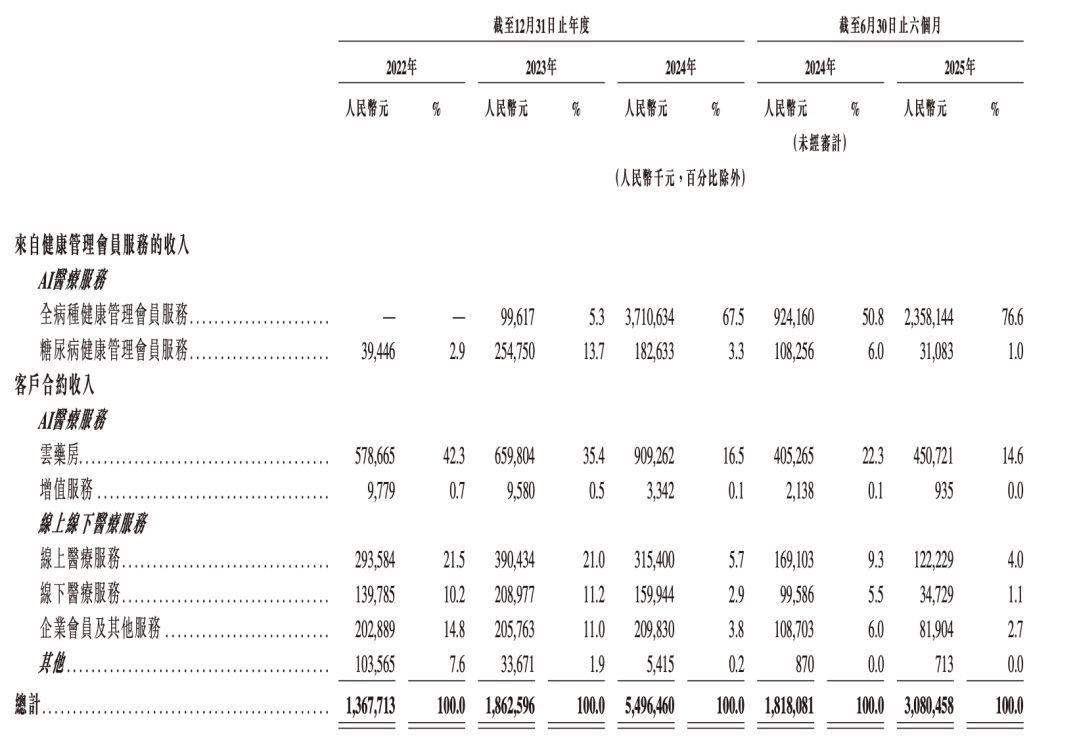
In terms of regional contribution, Tianjin is undoubtedly the "ballast stone" of WeDoctor's performance. According to CCTV reports, WeDoctor has provided health management services to more than 1.666 million users in the Tianjin HSC. Behind this data is the successful construction of a closed - loop operation of "two increases and one decrease" by WeDoctor in Tianjin:
First, the health indicators of patients have significantly improved. From June 2024 to June 2025, the core control indicators of patients with hypertension, coronary heart disease, stroke, and diabetes in the four regions managed by WeDoctor's HSC have all significantly improved.
Second, the service capabilities of primary medical institutions have improved. According to the data of the Tianjin municipal government, the number of outpatient visits to primary medical institutions in Tianjin in August 2024 increased by 23% year - on - year. As of June 2025, 44 primary medical institutions and 11 secondary and above hospitals in the four regions included in WeDoctor's HSC have been connected to carry out full - disease health management services.
Finally, the medical insurance expenditure has decreased. According to the company's disclosure, in the first half of 2023, 2024, and 2025, WeDoctor's AI tools intercepted 100 million, 223 million, and 298 million yuan of suspicious or problematic claims for the Tianjin medical insurance fund respectively. The medical insurance rejection rate has dropped from about 0.52% in the first half of 2021 to about 0.05% in the first half of 2025.
It is not difficult to find that residents, medical service institutions, and medical insurance have all benefited from the HSC.
Tianjin's success provides a practical basis for WeDoctor's expansion in other regions. In the short - to - medium term, regional expansion is the direct source of revenue growth. As mentioned above, in the eyes of local governments, the "HSC" has gone beyond a simple medical reform model and has become an important means to promote the upgrading of the regional medical and health industry and seize the opportunity in the development of data elements and artificial intelligence.
In the future, "AI + health management" will serve as a super bridge connecting the supply and demand sides: at the front - end, it will meet the diversified health needs of individuals, families, and enterprises; at the back - end, it will connect with professional service providers such as hospitals, pharmaceutical companies, and insurance companies to deliver high - quality health management services. This is the core value of WeDoctor's expansion from Tianjin to the whole country - transforming the proven "AI + health management" capabilities into replicable and scalable city - level solutions.
However, the imagination of the capital market goes far beyond "expanding territory", but lies in in - depth value mining:
On the one hand, with the