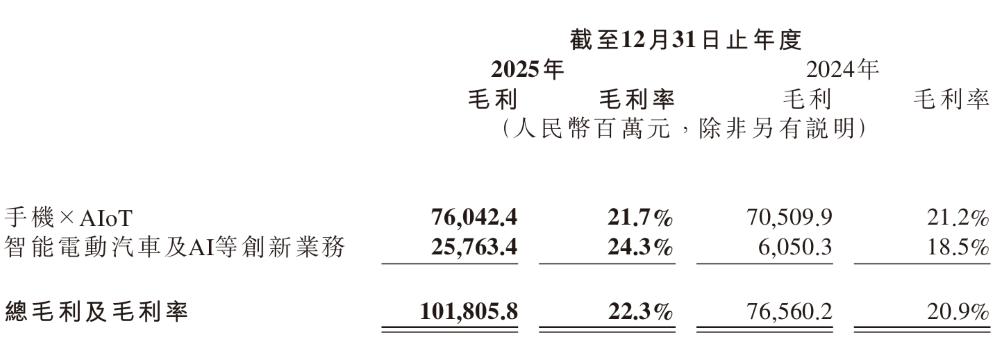
With revenues exceeding 100 billion and an operating profit of 900 million, Xiaomi Auto delivered its results in 2025.
Xiaomi's automotive and AI business segment achieved positive operating income for the first time. Lu Weibing: The assisted driving version using XLA will have an OTA update in May.
According to CheDongXi on March 24th, just now, Lu Weibing, partner, president of Xiaomi Group, president of the mobile phone department, and general manager of the Xiaomi brand, along with Lin Shiwei, vice president and chief financial officer of Xiaomi Group, responded to questions regarding Xiaomi Group's plans and expectations for 2026 during a conference call.
In the intelligent electric vehicle business segment, Lu Weibing and Lin Shiwei mainly answered four questions related to the automotive business:
1. Order situation of the new SU7: The progress of locked orders has exceeded that of the previous generation SU7. The reason for not releasing the number of large deposits is that the locked - order data can better reflect the actual situation.
2. Profit and profit targets: Currently, the intelligent electric vehicle and AI and other innovative businesses are an integrated segment. Xiaomi will continue to increase investment in AI this year.
3. Issue of rising raw material prices: The proportion of memory in the vehicle's BOM is relatively low, and the impact is relatively smaller compared to mobile phones.
4. Progress of assisted driving: Plans, models, and relevant chips have all been deployed. The assisted driving version using the XLA model will have a complete OTA update in May.
Based on the financial report data, in the whole year of 2025, the revenue of Xiaomi Group's intelligent electric vehicle and AI and other innovative business segment was 106.1 billion yuan, among which the revenue from intelligent electric vehicles was 103.3 billion yuan, a year - on - year increase of 223.8%.
Meanwhile, in 2025, Xiaomi Group's intelligent electric vehicle and AI and other innovative business segment achieved positive operating income (gross profit minus operating expenses) for the first time. The operating income in 2025 was 900 million yuan.
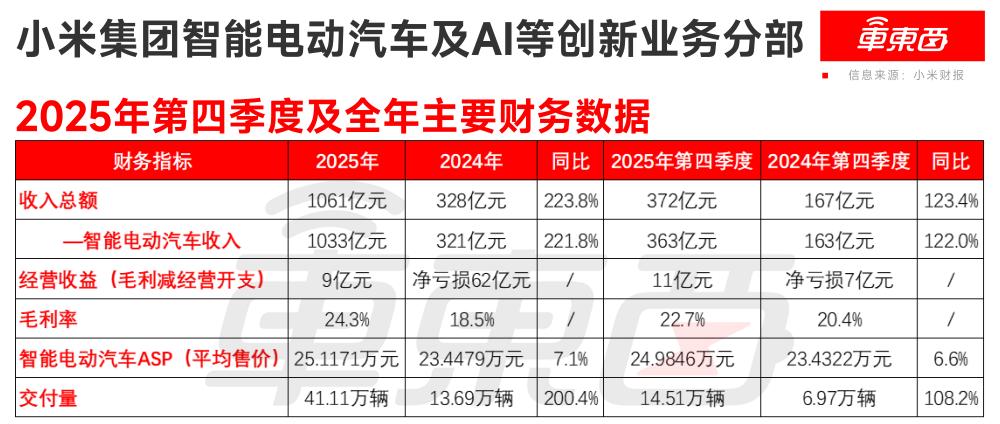
Financial data of Xiaomi Group's intelligent electric vehicle and AI and other innovative business segment in 2025
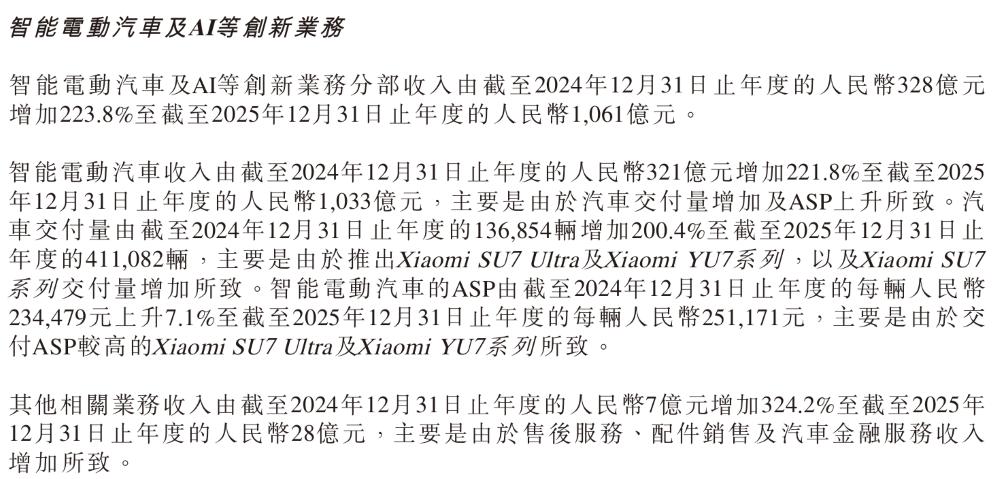
In terms of sales volume, in 2025, Xiaomi Group delivered 411,100 vehicles (411,082 units), an increase of approximately 274,200 vehicles compared to 136,900 vehicles (136,854 units) in 2024, a year - on - year increase of 200.4%.
01. The XLA model will be fully installed in vehicles in May, and the reason for not releasing the number of large deposits is explained
During the earnings conference, Lu Weibing and Lin Shiwei mainly answered four questions related to the automotive business. The following is a transcript of the Q&A session related to the automotive business during the earnings conference. CheDongXi made some readability adjustments without changing the original meaning.
Question 1: The new - generation Xiaomi SU7 was successfully launched last week. During the communication with investors after the launch, it was noticed that some investors believe that Xiaomi no longer released the large - deposit data of the new car this time and only released the locked - order data, implying that the large - deposit situation did not meet expectations. Another group of investors believes that Xiaomi has adopted a more rational and calm sales strategy, so the stable - state sales volume of the new - generation Xiaomi SU7 will be better. Could the management share their views and interpretations of these two viewpoints?
Lin Shiwei: After the launch of the Xiaomi SU7 last week, we have observed several phenomena from the user side. Firstly, more than 50,000 users have gone for test drives in three days. We have also released two figures: 15,000 locked orders in 34 minutes, and the number of locked orders exceeded 30,000 three days after the launch.
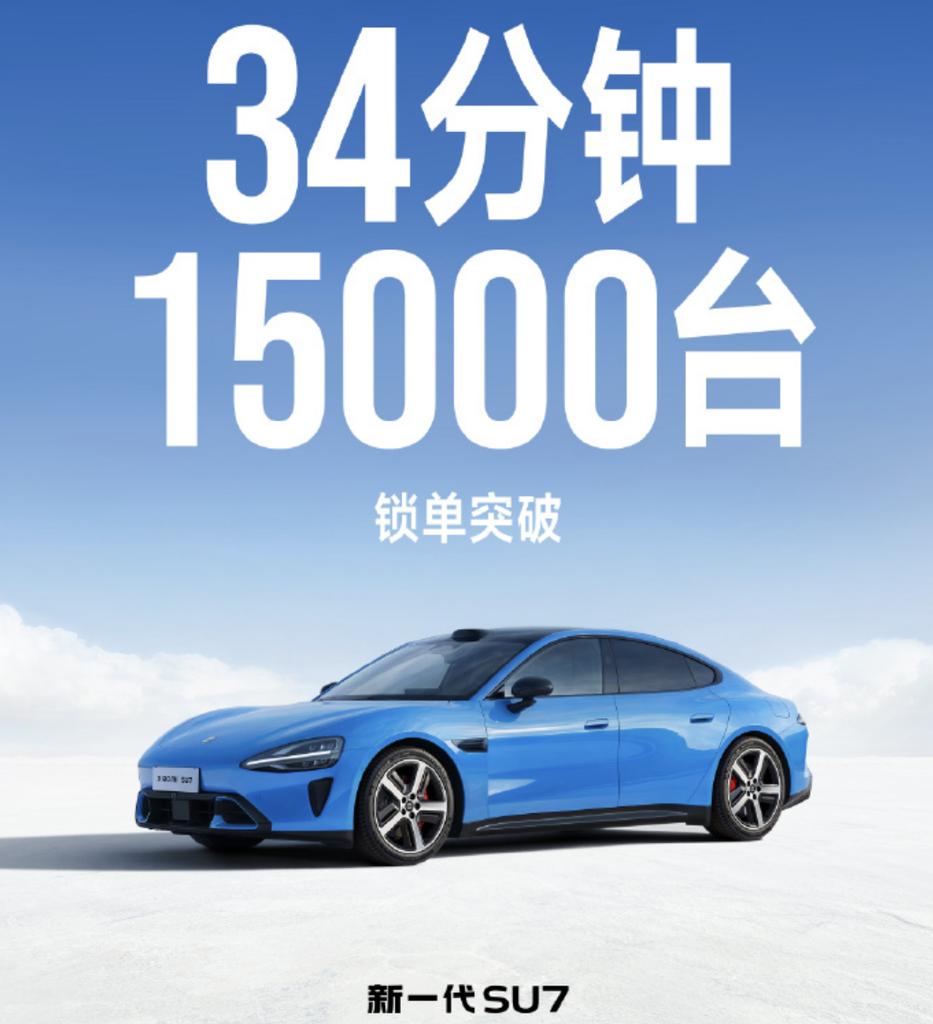
15,000 locked orders for the new - generation Xiaomi SU7 in 34 minutes
We have also fulfilled our promise of "launch and deliver". We started delivering cars on the fourth day because we had produced a considerable number of vehicles in advance to ensure that we could solve the problem that users of the previous generation had to wait a long time to pick up their cars. We also pre - produced many cars for our first - batch users. So, I think we are making iterations based on our experience with the first generation.
Why do we only release the number of locked orders and not the number of large deposits? I think for us, locked orders are a fairer way to view the situation, rather than talking about orders, reservations, small deposits, or large deposits.
After all, locked orders mean that users have definitely decided to pick up the car. After locking the order, the production cycle begins. We believe that locked orders may be a more fair data to assess our current actual situation. So, we have made this change, which may be different from the industry, but we will adhere to this approach.
Now, I would like to take this opportunity to report some situations about our users' locked orders. We have noticed some differences compared to last time. Many investors have asked whether the new locked - order users are from our previous - generation users or new users. In fact, we can see that most of them are new users. After all, many users do not change their cars within two years, so we can see that we are continuously expanding our user base.
Secondly, the proportion of female users is higher than that of the previous generation. We have also noticed that among iPhone users, the figure for the first - generation SU7 was about 50%, while for the new - generation SU7, nearly 60% are iPhone users.
Another point is that the progress of locked orders has exceeded that of the previous generation SU7. We have also noticed that users are very supportive of our optional configurations. Nearly 60% of users have chosen to pay for the optional colors.
So, we can see that compared to the penetration rate of the previous generation, whether it is the speed of locked orders, the proportion of female users, the proportion of iPhone users, or the selection of different colors, the penetration rate is higher than that of the previous generation.
Question 2: It is noticed that the company's overall automotive business achieved profitability in 2025. Considering the launch of the new - generation SU7 and subsequent plans, what are the profit and profit targets for the automotive business for the whole year?
Lin Shiwei: In 2025, we delivered more than 410,000 vehicles, significantly exceeding our initial target of 300,000 vehicles. At the beginning of this year, Lei Jun also set a target of delivering 550,000 vehicles this year. So, I think we expect growth in the automotive business in 2026 compared to 2025.
Of course, the market may face a little pressure this year, but we are still full of confidence in models like the YU7 and the new SU7. This is the first point.
Secondly, regarding the profit target, as you know, this segment is called the automotive and AI and other innovative business segment, which also includes our investment in AI and our investment in new fields. So, we cannot simply consider this segment as just the automotive business; it also includes other new businesses.
But at present, it is the stage of new - business investment. In terms of AI, we will continue to increase investment this year, including in our previous segments.
So, for this whole segment, I think it should be viewed from two aspects. One is the automotive business, and the other is the investment in AI and new businesses. This segment achieved very good results last year. For this year, I think it will be the result of the growth in the automotive business plus our investment in other aspects.
Question 3: The increase in material costs will put some pressure on the gross profit margin of the automotive business this year. I wonder if Xiaomi has any principles to perform better than its peers or any principles to ensure profits.
Lu Weibing: Although the absolute value of memory in the vehicle is quite large, its proportion in the vehicle's BOM is relatively low. Although it is affected, I think the impact is relatively smaller compared to mobile phones.
Question 4: Are there any new updates on the development of intelligent driving, especially in terms of intelligent driving capabilities and self - developed chips?
Lu Weibing: Regarding intelligent driving, I think you have all seen the support of our XLA model for intelligent driving. We also had a section in the launch event to introduce our XLA. The most complete OTA update of this version will be around May.
However, based on the results of our internal test drives, we think it is very, very good. Since I basically drive the SU7 and YU7 alternately, and I am also a very frequent user of assisted driving, I think the usage rate is very, very high.
Personally, every time I encounter what I think are problems during use, I will submit them to our team, and there are many such cases.
I can fully feel that our intelligent driving is progressing step by step. And I think for our intelligent driving, whether it is our intelligent driving plan, model, or even relevant chips, we have relevant deployments. The end - to - end integration will definitely provide users with a better experience.
02. Revenue in 2025 increased by 221.8% year - on - year, and more than 410,000 new vehicles were delivered
From the earnings conference, we can feel that Xiaomi Group's executives are very confident in the automotive business segment of Xiaomi Group. Naturally, this is supported by the strong performance of Xiaomi Group in the 2025 financial report.
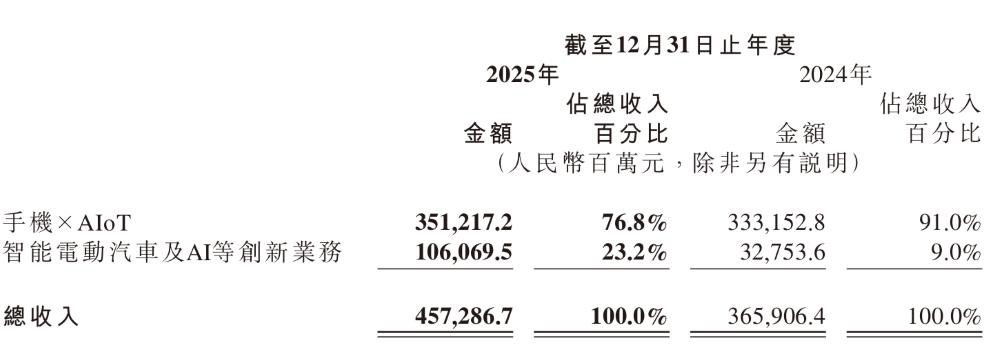
According to the full - year performance announcement of Xiaomi Group in 2025, Xiaomi Group's full - year revenue in 2025 was 457.3 billion yuan, a year - on - year increase of 25.0%. The adjusted full - year net profit was 39.2 billion yuan, a year - on - year increase of 43.8%.
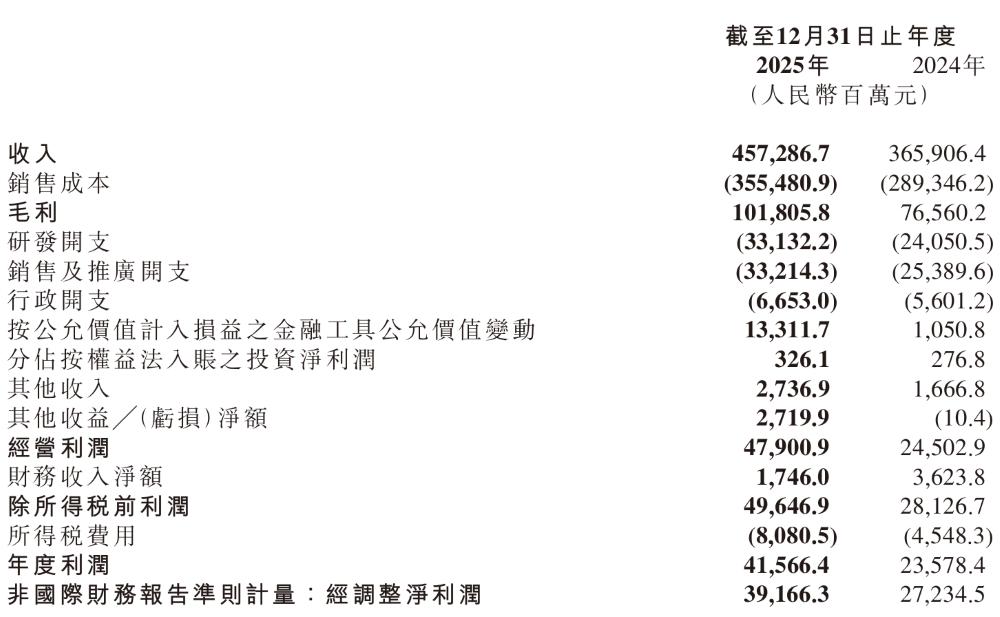
Full - year performance of Xiaomi Group in 2025
Specifically, for Xiaomi Group's intelligent electric vehicle and AI and other innovative businesses, the total annual revenue in 2025 was 106.1 billion yuan, an increase of 73.3 billion yuan compared to 32.8 billion yuan in 2024, a year - on - year increase of 223.8%.
Revenue proportion of each business of Xiaomi Group in 2025
In 2025, the intelligent electric vehicle and AI and other innovative businesses accounted for 23.2% of Xiaomi Group's total revenue, an increase of 14.2 percentage points compared to 9.0% in 2024.
Among them, the revenue from intelligent electric vehicles in 2025 was 103.3 billion yuan, an increase of 71.2 billion yuan compared to 32.1 billion yuan in 2024, a year - on - year increase of 221.8%. Xiaomi stated that this was mainly due to the increase in vehicle delivery volume and the rise in ASP (average selling price).
Revenue of Xiaomi's intelligent electric vehicle and AI and other innovative businesses in 2025
Looking at the single - quarter data, in the fourth quarter of 2025, the revenue from Xiaomi Group's intelligent electric vehicles was 36.3 billion yuan, an increase of 20 billion yuan compared to 16.3 billion yuan in the fourth quarter of 2024, a year - on - year increase of 122.0%. Xiaomi stated that this was mainly due to the increase in vehicle delivery volume and the rise in ASP (average selling price).
In terms of profit, in 2025, Xiaomi Group's intelligent electric vehicle and AI and other innovative business segment achieved positive operating income (gross profit minus operating expenses) for the first time. The operating income in 2025 was 900 million yuan. In 2024, the adjusted net loss of Xiaomi Group's intelligent electric vehicle and other innovative business segment was 6.2 billion yuan.

Operating income of Xiaomi's intelligent electric vehicle and AI and other innovative business segment in 2025
In the fourth quarter of 2025, the operating income (gross profit minus operating expenses) of Xiaomi Group's intelligent electric vehicle and AI and other innovative business segment was 1.1 billion yuan, while in the fourth quarter of 2024, it was an adjusted net loss of 700 million yuan.
In terms of gross profit margin, in 2025, the gross profit margin of Xiaomi Group's intelligent electric vehicle and AI and other innovative business segment was 24.3%, an increase of 5.8 percentage points compared to 18.5% in 2024. Xiaomi stated that this was mainly due to the delivery of the Xiaomi SU7 Ultra and Xiaomi YU7 series, as well as the increase in the gross profit margin of other related businesses.