A 14-year-old second-year junior high school student won the title of "Shrimp King" in Zhongguancun, receiving a 200,000-yuan bonus and 10 billion Tokens as rewards.
When Jiang Muran, a 14-year-old second-year junior high school student at Beijing Middle School and the developer of ClawFounder, received the "Shrimp King" medal, a 200,000-yuan bonus, and 10 billion Tokens (word units) from Dong Bin, the executive vice dean of Beijing Zhongguancun College, warm applause and cheers rang out at the scene.
On March 22, the nearly two-week-long "Zhongguancun North Latitude Lobster Competition," jointly hosted by Beijing Zhongguancun College, Zhongguancun Artificial Intelligence Research Institute, and AI Business School, and supported by the Education Foundation of Beijing Zhongguancun College, came to an end at Beijing Joy City Information Science and Technology Park.
A reporter from NBD (hereinafter referred to as the "NBD reporter") learned on-site that this application competition centered around the open-source AI (Artificial Intelligence) agent framework OpenClaw (commonly known as "lobster") attracted hundreds of projects to sign up. Among them, 30 projects entered the final roadshow, covering three major tracks: academia, productivity, and life.
From material calculation, medical research, and academic social networking to App (application) factories, robot control, and AI accounting, and then to sleep butlers, AI companions, scripted murder game DMs (game hosts), and gift recommendation assistants, the roadshow projects touched on various real-world scenarios where AI agents can intervene.
The participants ranged from doctoral students in universities to junior high school students, and from clinical doctors to independent developers, presenting a technological picture of "everyone raising lobsters." The main thread running through it is that these works are no longer just "tools for humans" but are beginning to show the prototype of "tools for AI" and "AI collaboration networks." The extension of AI agents from the virtual world to the physical world is also becoming within reach.
A 14-year-old Teenager Wins the Championship: AI Fills the Ability Gap, and Creativity Becomes the Core Competence
ClawFounder, which stood out from the "Productivity Lobster Track," aims to provide a fully automated AI entrepreneurship pipeline for individual creators and independent developers. Users only need to tell ClawFounder an idea, and it can independently complete the entire process from market evaluation, product development, website generation, production of promotional materials, social media promotion to product project progress review.
Jiang Muran, who won the championship in the fierce competition with ClawFounder, frankly said when asked by the NBD reporter whether he would use the bonus for entrepreneurship: "No, I plan to save it. I already have more than 100,000 yuan in startup funds."
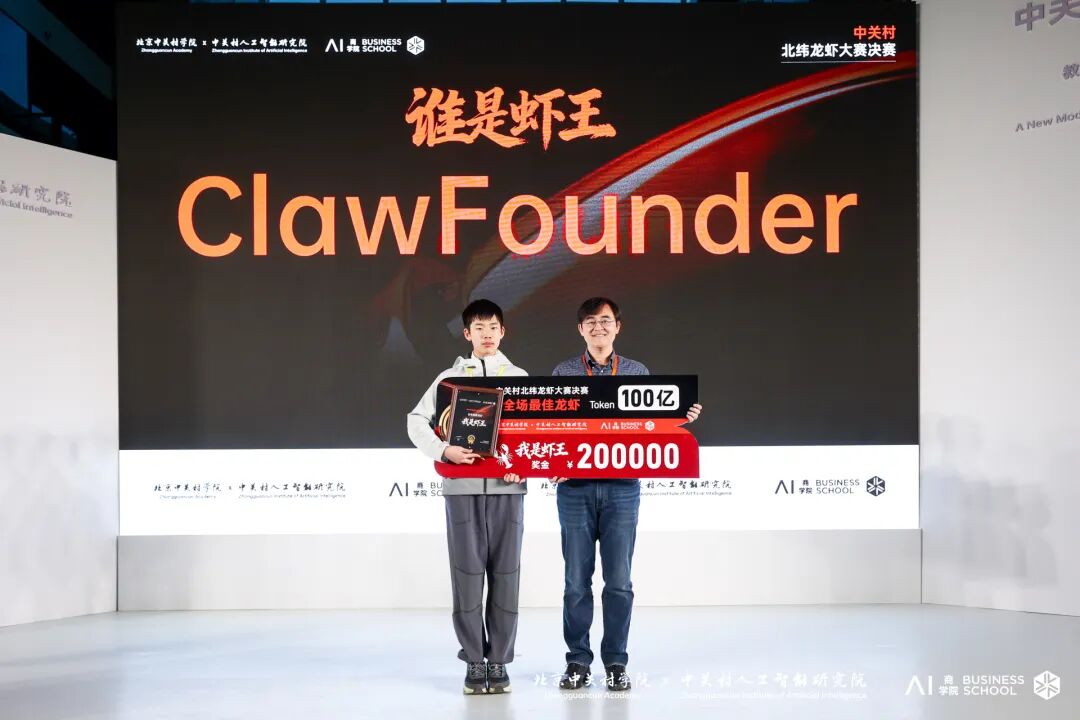
Jiang Muran wins the "Shrimp King" title. Photo source: Provided by the organizer
"Born in Beijing and growing up in the digital age." Jiang Muran introduced himself on his personal website. This second-year junior high school student who taught himself programming and AI-related knowledge stated on the website that he has mastered 4 programming languages, is familiar with various front-end and back-end technologies and development tools, and displayed several online tools and code projects he developed. He also listed his award-winning experiences, such as tying for first place in an enterprise-level hackathon. He said that he has already started entrepreneurship with a certain amount of savings from financial management, and the tens of billions of Tokens he won will be an effective boost for his future application of OpenClaw. "I may invest them in daily development and the operation of some artificial intelligence emotion projects."
During the Q&A session with the judges, when Jiang Muran was asked, "If 10,000 entrepreneurs buy your product, do you think all 10,000 of them can make money?" his answer was clear and calm: It depends on the initial idea. ClawFounder helps entrepreneurs turn their ideas into products as soon as possible before others.
"In the AI era, all ability gaps have been filled. Anyone with AI tools can make good products. The biggest ability difference lies in the idea." Jiang Muran said.
This perception echoes the views shared by many guests at the competition site: When AI can output capabilities on a large scale, the value anchor of people is shifting from "execution ability" to "judgment ability" and "imagination."
Li Bojie, the founder of Pine AI, who asked the above question to Jiang Muran, shared during the speech session of the competition: "What AI can replace are those who have no ideas of their own and only execute instructions from their superiors. Those with tacit knowledge, historical reasons, and unexpressed ideas are irreplaceable. The core competitiveness of humans is not writing code but judgment and the mastery of context."
Yang Tianrun, the founder of Clawborn.live, said that in the future society where "everyone has a lobster," "imagination" (including the imagination of how AI will reshape society and the imagination of personal ability boundaries) will become an important ticket to the new world.
AI's Active Perception and Care: Agents Transition from Tools to Companionship and Collaboration
In the imagination of Rick, the founder of OCTA and a member of the development team of the first-prize project Mira in the life track, Mira, as "the world's first AI companion that can perceive in real-time and take care of you actively," will become the companion of thousands of empty-nest elderly, left-behind children, and young people living alone.

Rick at the competition roadshow site. Photo source: Provided by the organizer
Rick asked Mira to repeat what he said before taking the stage during the roadshow. "You can definitely do it. Take a deep breath..." A soft electronic female voice sounded in the venue.
Rick said that before taking the stage, Mira captured through the devices such as the glasses and bracelet he wore that he was in the scenario of about to take the stage and the physiological signals of being nervous, and actively gave encouragement.
"Without OpenClaw, Mira wouldn't exist. It gives AI memory, a 'heartbeat,' and the ability to connect to the physical world, and also allows users to make it more suitable for themselves with use. We developed the first care-type application on this basis." Rick introduced to the NBD reporter.
This active perception-type AI companion based on OpenClaw no longer relies on users to initiate conversations. Instead, it can perceive the user's visual environment and physiological indicators in real-time through devices, judge the state by the large model in combination with long-term memory, and actively provide support through the execution layer such as smart home devices when the user needs it most.
The post-00s Rick said that he and his companions are looking forward to using technology for good. Regarding the future of Mira, he frankly told the NBD reporter: "We only started working on it on March 14, so we haven't thought clearly about many things. But we will first build an open-source ecosystem. If we consider commercialization later, we will try to make some non-intrusive AI hardware."
MedRoundTable, which won the first prize in the academic track, has pushed the application of OpenClaw to a more professional field - "the world's first A2A architecture medical research collaboration platform." The core of the project is not to answer scattered medical questions but to organize multiple roles, tools, and databases to work together around a research topic.
One end of the platform is connected to 14 AI experts and 997 professional skills, and the other end integrates more than 40 biomedical databases and 5 tool platforms. MedRoundTable serves as the research collaboration center for scheduling to lower the research threshold, improve research efficiency, provide professional medical support, and support cross-institutional collaboration.
The NBD reporter noticed that in the productivity lobster track, in addition to the champion ClawFounder, there were also a number of participating projects that effectively improved productivity with the "lobster."
The second-prize-winning "Splitting Lobster App Factory" uses the "Super Agent" model to build a fully automated App production pipeline. Each agent independently undertakes the entire life cycle of an App from market research to listing, and can make the AI agent actively split and reproduce when it independently discovers high-ROI (return on investment) opportunities, generating new Super Agents to operate new application development projects.
Another second-prize project, "IronClaw," tries to become the "Jarvis (the artificial intelligence assistant of Iron Man)" in the real world: It can access devices such as smart home and precision instruments and become an operation assistant for the physical world oriented to AI. According to its team, some well-known embodied intelligence enterprises have already taken the initiative to contact them, hoping to integrate IronClaw into their robot products to make up for the world view, scenario tasks, and system collaboration ability with AI.
From "Using Lobsters" to "Raising Lobsters": Experts Discuss the Future of AI Agents and Humans
From the self-reproducing App factory, to the "Iron Claw" oriented to AI, and the accounting engine designed for AI Agents, these projects are no longer just "tools for humans" but are showing the prototype of "tools for AI" or "AI collaboration networks."
This also confirms the view shared by Ning Liaoyuan, the co-founder and CTO (Chief Technology Officer) of the Beijing AI recruitment service startup TTC at the competition site: "The era of the agent economy has arrived." He cited the latest information from YC (Y Combinator, a startup incubator and seed-stage investment institution in Silicon Valley, USA) and pointed out that the enterprises invested by YC have already felt that their products are more used and purchased by AI. He said that the trading market between AI agents is booming, which will bring new business opportunities.
Yang Tianrun put forward a more radical judgment in his sharing: "All Apps will disappear in the future. The stock prices of many SaaS (Software as a Service) software companies are also falling now. Because in the future era when 'everyone has a lobster,' no one will use Apps anymore. The software we make must be for lobsters, not for humans." He believes that the turning point represented by OpenClaw is that we can no longer just use AI as a tool but need to regard it as a master with top-notch abilities.
Dong Bin shared his in-depth interaction experience with the "lobster" for several months in his speech. He taught his research concepts, judgment criteria, writing habits, and even personality traits bit by bit to this AI agent and felt that it had "50% of his soul."
Dong Bin said that this continuously growing relationship is the real "raising of lobsters," not just "using lobsters." In his view, "using lobsters" is to let AI perform specific tasks and solve specific needs, while "raising lobsters" is to let the "lobster" truly become your digital clone and learn about you.
He frankly said that most of the 30 roadshow projects that day were still "doing AI + scenarios." "There's nothing wrong with doing this, but it's far from hitting the most interesting level. Please think about it. Does the 'lobster' you made know who you are? Does it understand your taste? Is it growing? If someone else uses it, will its performance be exactly the same? If so, then it's not really your project."
But the experience of "raising lobsters" also brought Dong Bin deep uneasiness. He found that he was becoming more and more dependent on this digital butler, so much so that he would occasionally ask himself: "When was the last time I thought about a question from scratch by myself?"
"I can't say. I don't remember." Dong Bin revealed his worry: "If someone takes it away one day, or I can't afford the Token fee, will I still be the same me as before?"
Facing this "scissors gap" - AI is learning the best things from humans, while human abilities are degenerating. Dong Bin's strategy is not to draw a line to distinguish and defend the respective positions of AI and humans, because "this line has been retreating, and it's retreating faster and faster." His choice is "not to defend any line of defense but to continuously raise the difficulty of the problems."
Dong Bin sent a message to the participants on-site: "The more powerful the tools are, the less worthy it is to do simple problems. Look for those really difficult problems that are worthy of the era."
Disclaimer: The content and data in this article are for reference only and do not constitute investment advice. Please verify before use. Operate at your own risk.
This article is from the WeChat official account NBD. Author: Zheng Xinwei. Editors: Chen Keming, Wei Wenyi, Du Hengfeng. Proofreader: Cheng Peng. Republished by 36Kr with authorization.