I discovered a new business closed-loop in OpenClaw.
At the NVIDIA GTC 2026 conference held this week, Jensen Huang officially introduced NemoClaw — the enterprise-level "Lobster." in his speech.
From the rapid follow - up of major domestic companies to the entry of the world's most powerful computing giants, this project "crafted" by an independent Austrian developer over the weekend has completely triggered a "national lobster - raising" wave from Silicon Valley to Zhongguancun.
There's no need to elaborate on the popularity of OpenClaw. But the more important question is: "What's next?"
When the growth rate of an open - source project exceeds that of all infrastructure projects (such as Linux, Android, or large models themselves), it usually means there is a new track that has not been fully priced by investment institutions.
On March 15, 2026, Chen Shi, an investment partner at Fengrui Capital, participated in the live broadcast of Tencent Technology's "Viewing Trends from the Lobster's Popularity: The Industrial Logic and New Opportunities Behind the Agent Era" and shared his views on the reasons for OpenClaw's popularity and its subsequent evolution. In his view, OpenClaw intuitively represents AI truly breaking out of the chat box. It is not just the emergence of a tool but also represents the arrival of the Agentic AI industry's critical point, and this process is irreversible.
We've organized this sharing to try to answer the following questions:
- Why do major companies' collective entry into the "lobster" business essentially mean seizing the traffic entrance of the Internet?
- Why did OpenClaw explode at this particular time?
- Why didn't American users set off a "national lobster - raising" wave?
- Why is OpenClaw the only product that occupies the open - domain + endless - end quadrant?
- Why is the next entrepreneurial opportunity concentrated in vertical scenarios?
- What are the business logic insights brought by OpenClaw?
From "Talking" to "Doing": Why is the explosion point of intelligent agents now?
OpenClaw is no longer just a pure technological hotspot but has broken through to the consumer side. If we look back at this process, we'll find that the popularity of the "lobster" was jointly promoted by multiple factors.
The All - powerful Spring Festival
Remember DeepSeek around this time last year? China's Spring Festival is "all - powerful." For example, last year's DeepSeek and this year's lobster both became popular during the Spring Festival holiday. It's precisely the long holiday that gives people time to calmly experience the technology.
More importantly, it's a cognitive leap. For a long time, AI was regarded as a "window - dialogue" tool. When the lobster can operate the computer autonomously across windows, the impact of this "cognitive gap" is huge — users seem to jump directly from a chat box into a magical world of autonomous operation.
Before the lobster, there were already several well - received Agent - type products in the industry. For example, Anthropic's Claude code and Claude Cowork are very successful and amazing products. However, perhaps considering factors such as security and fault tolerance, these products are relatively serious and restrained in terms of positioning and functional design, limited to a small number of vertical scenarios and not targeting a broader open - world scenario. I personally like to use these two products and often recommend them to friends and colleagues around me.
So, I initially underestimated the lobster, thinking it was just Claude Code with remote access.
Popular in China, Cold in the US?
To verify this difference in users' cognition, I specifically wrote a program using Claude Code to collect 30 media reports from both China and the US. I took the first 30 keywords from each report to analyze the different reactions of Chinese and American media and users to the lobster.
The results show that Chinese users are more inclined to raise it as a "pet." They are most concerned about its functions and "how to raise it well," being optimistic and exploratory, and also having FOMO fear.
In contrast, American users are much more conservative. More than half of the top ten keywords are related to risks, privacy, and API permissions. This difference in mentality makes the lobster much more popular in China than overseas.
The "Three - in - One" of Underlying Technologies
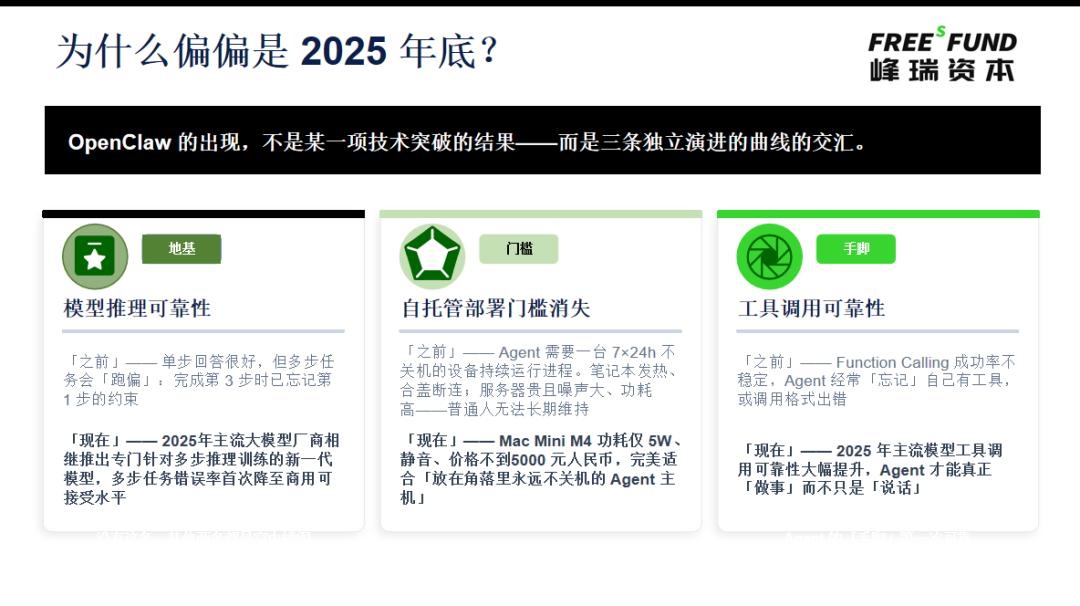
The explosion of OpenClaw is not accidental. It is the intersection of three independently evolving technological curves at the end of 2025 that allows this product to cross the functional and commercial thresholds, jointly forming a stable triangle to support the operation of the Agent:
1. Foundation (Reliability of model inference): The iteration of the new - generation inference model gives the Agent a smart brain that won't "go off - track" in long - term tasks.
2. Threshold (Popularization of deployment): The popularization of low - power hardware (such as Mac Mini M4) makes the cost of the 7×24 - hour resident Agent host affordable for the general public.
3. Hands and feet (Reliability of tool invocation): Function Calling (tool invocation) and Computer Use have significantly improved the success rate, allowing the Agent to truly have "hands and feet" that can do work and handle affairs for the first time.
Open Domain, Endless End
But objective environmental factors only play a facilitating role. To clarify why OpenClaw has become the critical point of Agentic AI, we must return to the product logic itself.
To break down this logic, we examine Agent products from the dimensions of "open domain/closed domain" and "with an end/endless end." You'll find that OpenClaw occupies a quadrant that no one has ever set foot in before.
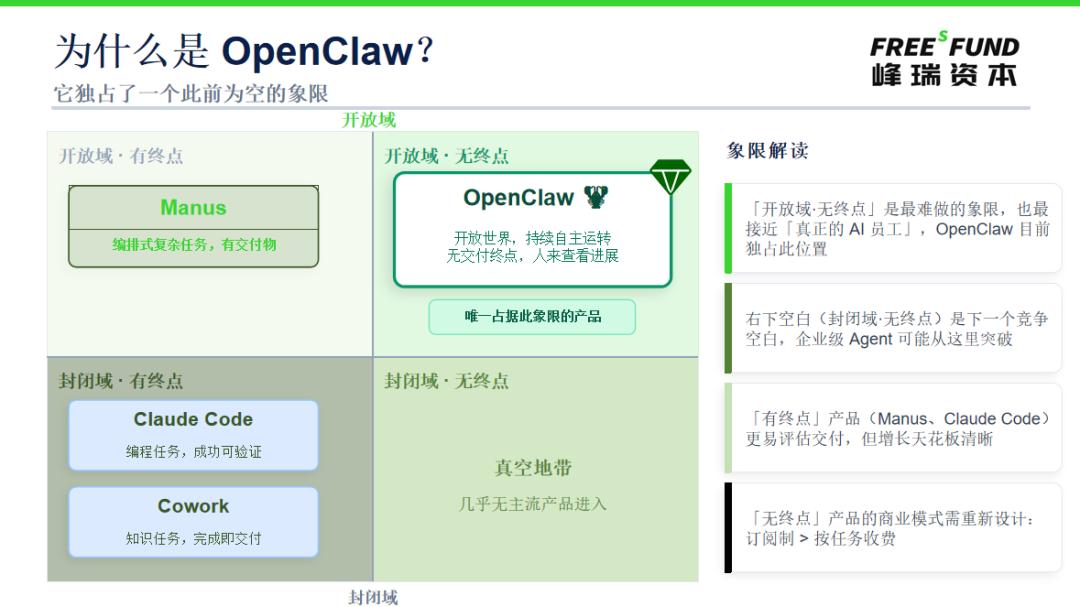
1. Closed domain · With an end (bottom - left corner): The representative products are Claude Code and Claude Cowork.
They are limited to code programming or internal enterprise processes. Each task has a clear deliverable, and once submitted, the process stops.
2. Open domain · With an end (top - left corner): The representative product is Manus.
Although it needs to collect data from various places in the open environment and the tasks are relatively complex, it still ends with a specific result (such as a program, a page, or a research report). Once delivered, it's over.
3. Open domain · Endless end (top - right corner): This is the territory exclusively occupied by OpenClaw.
It operates autonomously in the open world 24/7, 365 days a year. It has no delivery end, and people only need to check the progress.
Vacuum Zone: Entrepreneurial Opportunities in the Closed Domain · Endless End
Although products with an "end" like Manus or Claude Code are easier to evaluate for delivery, their growth ceilings are relatively clear. In contrast, the "open domain · endless end" quadrant exclusively occupied by OpenClaw, although extremely challenging, is also the closest to what we understand as a "real AI employee."
But in this quadrant chart, there is a single blank area: Closed domain · Endless end (bottom - right corner). It's very likely that the next enterprise - level or vertical - field Agent will emerge here.
Currently, mainstream products have hardly entered this quadrant, but this is precisely the opportunity left for developers and entrepreneurs. Applying the logic of "resident, endless end" to a vertical, closed field has two natural advantages:
1. Higher success rate: In a specific industry, the accuracy of the Agent in handling tasks will be significantly improved.
2. Easier to build a security fence: Compared with the completely open world, the security of the closed domain is easier to ensure, which also meets the rigid needs of the B - side market.
When the Agent becomes a long - term online "resident employee," its impact on software, hardware, and Internet traffic entrances will be "earth - shattering." Next, let's talk in detail about where this upcoming industry impact will occur and where the subsequent entrepreneurial opportunities lie.
The Dimensionality Reduction Strike and New Order of the Whole Industry Pattern
When the Agent becomes a 24/7 "resident employee," the original industrial logic will be completely reconstructed. This change is redefining the industry rules of software, hardware, the Internet, and embodied intelligence in a dimensionality - reduction strike manner.
The New Battlefield of Software and Hardware: From OS to Agent Runtime
In the next operating - system - level war, the battlefield has shifted to Agent Runtime.
You may all remember that important news. On February 15, OpenAI announced that it had hired Peter Steinberger, the founder of OpenClaw, to lead the field of personal artificial intelligence agents.
The industry generally speculates that OpenAI's goal is to create an "AI - version Android." Although this is currently just speculation and a linear extrapolation analogy, it also shows an extremely certain trend: The new - type AI Agent software runtime has become a must - fight territory for all.
If we compare it with the development process of the mobile Internet, the current AI nodes are very similar to the stage when Android or iOS was just born between 2007 and 2008. But we must clearly recognize that the explosion logic of the AI era is completely different from that of the Internet. The marginal cost of the Internet is almost zero, but there are expensive Token fees behind AI.
The current business situation is that the price of Tokens is not the same for everyone. When model manufacturers develop applications themselves, the cost is much lower than that of external startups. This cost asymmetry will greatly squeeze the entrepreneurial space of non - model manufacturers.
In addition, the 24/7 Agent also poses new challenges to hardware.
In the past, when evaluating chips, we looked at the "peak computing power." But now, the evaluation standard is shifting to the "continuous inference ability" under low - power and long - standby conditions. Therefore, edge inference chips (such as NPUs) may see an explosion because the "resident Agent" needs a "heart" that can breathe for a long time, rather than "muscles" that can burst instantly.
Impact on the Internet: Seizing the Traffic Entrance
In the Internet field, the Agent will be placed in front of all software and become a new traffic entrance.
When the Agent becomes the middle layer, the traffic funnel will be cut off in the middle, and the traditional business model will face failure: Users no longer look at advertisements and no longer care about brand stories. For example, you may choose to buy things in Li Jiaqi's live - streaming room because you trust him. But if you hand over the task of "buying a pack of tissues" to the Agent, the Agent will only calmly make evaluations and judgments, such as price and quality.
Here is a case: Walmart.
At the NRF conference in early 2026, Walmart announced that it would directly embed its core shopping process into Google Gemini. This means that users no longer need to open Walmart's app or website. Instead, they can simply say in the dialog box, "Help me replenish next week's tissues," and the Agent will automatically retrieve historical orders, compare real - time inventory, and complete one - click payment.
John Furner, the CEO of Walmart in the US, said bluntly: "The shift from traditional web/app searches to Agent - driven commerce is the next major evolution in the retail industry." A report from McKinsey shows that by 2030, driven by AI tools and "agent - based commerce," the potential scale of the global retail market is expected to reach $3 trillion to $5 trillion.
But this also brings a social and ethical danger: If your Agent is more advanced and smarter than mine, how can I "buy this cheap pack of tissues"?
Impact on Embodied Intelligence: From "Remote Control" to "Active Perception"
For embodied intelligence, OpenClaw has verified the feasibility of the "active perception" paradigm at the software level. Previously, robots were long stuck in the "waiting for instructions" remote - control mode. OpenClaw, through its built - in "Heartbeat mechanism," enables AI to wake up regularly, perceive the environment, and make autonomous decisions.
For example, someone once installed OpenClaw in the "brain" of a robotic dog, and then it started to move around in the physical world, observe autonomously, and complete tasks.
This means that models like VLA (Vision - Language - Action) may also have a similar design mechanism in the future, rather than just an instruction - response architecture. Currently, the middleware connecting the perception layer and the large - model inference layer is still a technological blank and is the most worthy infrastructure - level opportunity to focus on at present.
Searching for the New Continent: Why are Vertical Scenarios the Destination for "Resident Agents"?
After seeing the scope of this industry - wide "earthquake," we must think: On the ruins and new soil, where is the future entrepreneurial direction?
In my opinion, the answer is more likely to be the vertical field.
There is a widely circulated joke in the VC circle: VCs invest in high - tech projects every day, but they still have to manually paste invoices when reimbursing themselves. Even in the highly digitalized finance and accounting fields, there is still a lack of truly intelligent software support that can handle trivial matters in a closed - loop manner.
This kind of "invoice - pasting" pain point may be the best entry point for vertical Agents. In a closed vertical scenario, the boundaries of tasks are clear, it's easier to build a security fence, and the success rate and premium space of the Agent will be much higher than those of general - purpose tools.
Seeking an Ecological Niche in the "Unequal Competition" of Big Companies
A cruel fact is that 80% of the current AI industry's application - layer revenue is divided between OpenAI and Anthropic, the two model manufacturers. Model manufacturers not only make money by selling Tokens but also have a strong impulse to enter various industries themselves. In the future, some pillar - or platform - level opportunities will probably be occupied by model manufacturers themselves.
For application - layer entrepreneurs, if they are persistent in the general direction, they will inevitably face unequal competition with large models in the medium and long term. Therefore, a more practical strategy is to keep an appropriate distance from the basic large models and look for opportunities in vertical or in - depth industries. As I often say, don't worry too early about the "end - game positioning." First, find a way to "get on the table" and adjust during the execution process.
The Logic of "Laying Eggs Along the Way" and "Scaffolding" on the Entrepreneurial Road
Since this year, whether in Silicon Valley or in China, the market's attention to pure technology narratives has been declining. People value real business returns more.
1. Achieve "laying eggs along the way": In the process of moving towards the final vision, revenue must be generated at the intermediate stage to ensure that the team has a continuous cash flow to move forward, rather than being overly obsessed with the end - game and sitting idle waiting for a "singularity" to arrive.
2. The product is the "scaffolding": The essence of the Agent is the organization and arrangement at the engineering level, also known as "context engineering" or "Harness engineering." Entrepreneurs should try to build on existing frameworks and development paradigms so that the product can naturally upgrade with the iteration of the model, rather than piling up complex capabilities outside the model. Otherwise, once the model is upgraded, the original system has to be redesigned.
Reconstruction of the Business Model: Farewell to "