The first batch of "lobster employees" have quietly taken their positions. They are paid a few hundred yuan a month and work 24 hours a day...
An ancient crustacean that has existed on Earth for hundreds of millions of years probably never imagined that its name would become a global sensation in the spring of 2026.
On January 30th this year, the intelligent application "OpenClaw" (commonly known as "Lobster" in Chinese), which had gone through multiple name changes and false cryptocurrency scandals, was officially launched in Silicon Valley across the ocean. After its name was finalized, it updated every three to five days, evolving rapidly while being freely accessible to global users.
In less than two months, its application has become extremely popular worldwide. It not only topped the list of the most starred repositories on GitHub, the world's largest developer community, in the past week but also became a new hot topic in stock market speculation and sparked a cyber craze of "raising lobsters" among the general public.
"Lobster" describes itself on its official website as: "A real AI that can get things done."
"Being able to get things done" has awakened people's imagination and enthusiasm for AI and also stirred up a sense of "FOMO (fear of missing out)" towards new technologies. Whether they are tech geeks, brokerage analysts, startup founders, or ordinary office workers, everyone seems to be anxious at the moment: If they don't hurry up to "raise" their own "lobster", will they be left behind in this new era of emerging intelligence?
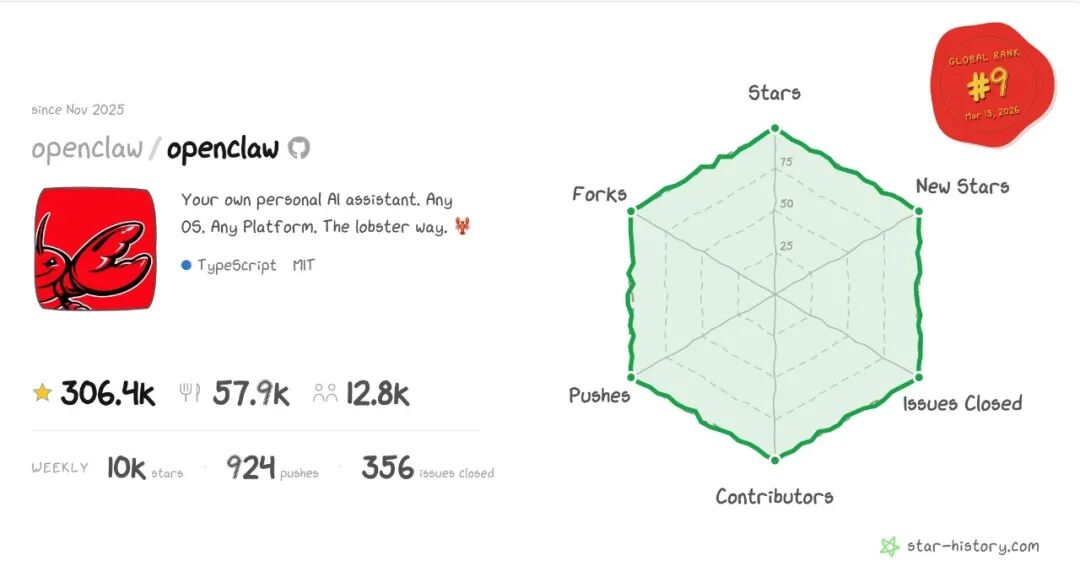
OpenClaw has received 306,000 stars on Github.
"Lobster" indeed has its appealing aspects. As the technology media CNET commented, different from general large AI models, OpenClaw has stronger long - term memory. It can converse with you like a colleague and automatically mobilize other large models to complete tasks according to your settings, such as sending messages, organizing research documents, managing schedules, and regularly emptying the recycle bin.
This means that it is no longer a tool that "loses its memory" after each conversation but an intelligent assistant that can accumulate preferences, remember decisions, and continuously "evolve" over time.
The "lobster craze" has swept across the globe. What kind of experiences do front - line practitioners who actually use it have, and how will it change our lives? In this carnival of "raising lobsters" among the general public, who are the real winners, and what hidden dangers are lurking in the dark?
Tianxia Wangshang interviewed entrepreneurs who have used OpenClaw to explore their real feelings.
The first wave of bosses has started hiring "lobsters"
Shao Wei, the founder of the nutritional meal replacement drink Ruofan, is a senior programmer. He used to be engaged in the development and promotion of the Linux platform and is now also working on software development projects.
With his background as a "senior geek", he is particularly keen on applying the latest AI tools to the company's e - commerce operations.
At the end of January this year, when "Clawbot" (the predecessor of "OpenClaw") became extremely popular, Shao Wei noticed the potential of this new application.
"I first noticed it because it can interact through chat tools and actively perform tasks. If based on OpenClaw, it can regularly and actively complete tasks according to my plan and give me feedback, it would be a very useful ability," Shao Wei told Tianxia Wangshang. "At that time, I felt that it might become like an employee and do a good job in what I asked it to do."
After less than two months of debugging, "Lobster" has successfully started working. Currently, the intelligent robot "Ruoxiaofan", which is built through the cooperation between OpenClaw and large models like Kimi, can "maturely" help update the news on the brand's official website.
"It will search the entire network regularly every morning to find out which latest health - related news is suitable for publication on the official website. It will write titles, generate accompanying pictures based on the content, and automatically publish them in a fixed format through the website API (Application Programming Interface). This is really very convenient, and in essence, it is also driving traffic to the official website," Shao Wei introduced.
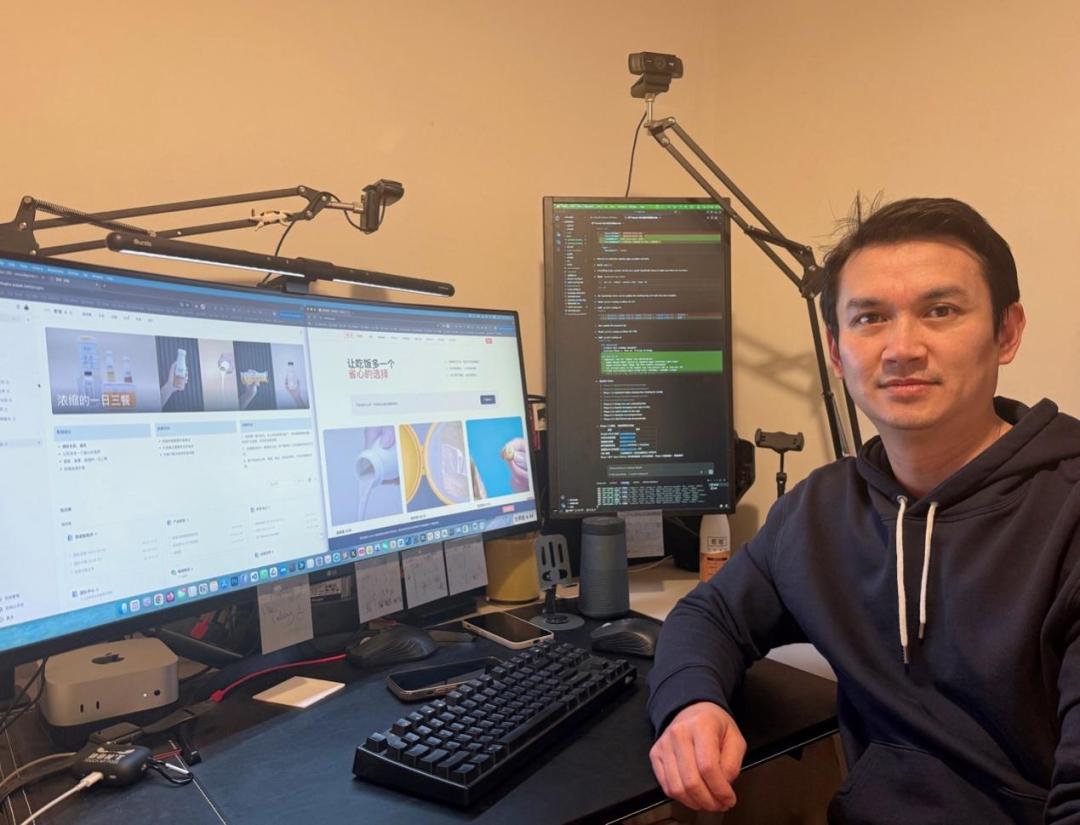
Shao Wei, the founder of Ruofan
Not only for official website updates, but he is also trying to use it in more work scenarios. For example, in the most common e - commerce scenario of store operation and advertising placement, "Ruoxiaofan" can pull the placement status of each store and channel by calling the API of mainstream e - commerce platforms and give integrated optimization suggestions, allocating placement resources and controlling the rhythm "more rationally" than humans.
Shao Wei introduced that the management of the company's internal work process, which originally required him as the boss or a dedicated person to monitor and urge the progress of work every week, is now all handed over to "Ruoxiaofan" to complete regularly.
"Yuque happens to be a product of Alibaba Group and has an API for interconnection. Now OpenClaw can help me create Yuque documents, read the content recorded by colleagues in the documents, help me analyze the work completed by colleagues every week, and finally report directly to me."
As a "deep - level AI user", Shao Wei currently spends about 3,000 - 4,000 yuan per month on using AI. For the work based on OpenClaw, he uses the 99 - yuan monthly package of Kimi or MiniMax, and the available tokens (the smallest processing unit of large models) are sufficient to support the required functions. In Shao Wei's view, the benefits far outweigh the costs.
The automatic money - making "machine" and the awakened imagination
Making "Lobster" a capable "new employee" is not only the idea of founder - geeks like Shao Wei. Even bosses without a programming background are also trying to let "Lobster" "work" in the company.
Cheng Hongning, the founder of Cosmic Electric E - bike, was originally an investor. Recently, he shared his experience of fully committing to the company's AI transformation on his social media account. He even flew to Silicon Valley specifically to learn how to "raise lobsters" and spent more than 100,000 yuan to customize exclusive "lobsters" for the company's employees.
"Let the AI employee help me make money, with a target of 100 million!" This is written in the introduction of a video in his company's "AI Transformation Diary" series of Vlogs. He described the motivation for this AI exploration as a "desire to progress". In the camera, he was enveloped in a great sense of excitement to embrace the new challenges brought by technological innovation.
On March 2nd, he held an online training on "raising lobsters" for the whole company to empower all employees with AI tools to improve efficiency. He listed a variety of potential applications: writing Xiaohongshu copywriting, which can be shortened from 2 hours to 10 minutes for employees; product poster shooting, which can be free instead of costing five or six thousand yuan originally; and converting strategy plans into presentation PPTs with one click, shortening 3 - hour work to 10 minutes...
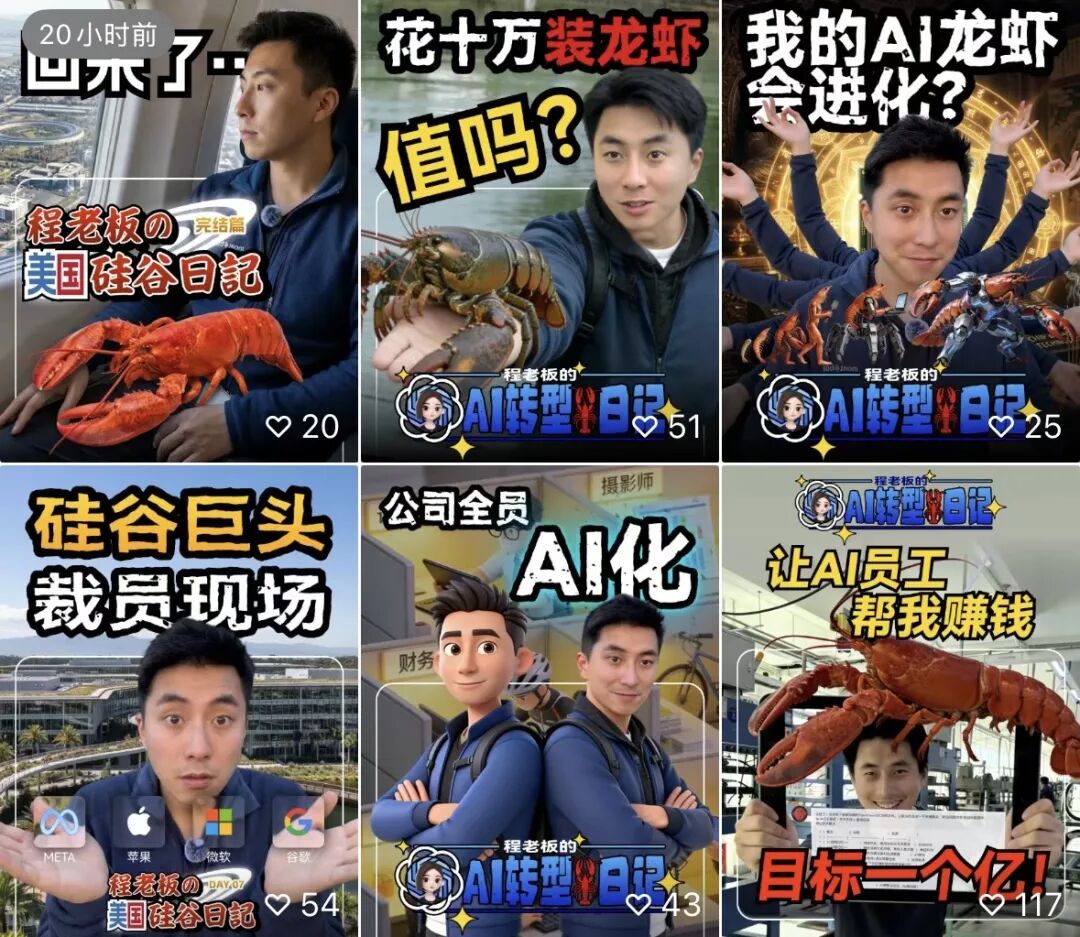
Works published by Cheng Hongning, the founder of Cosmic Electric E - bike
"What I'm doing is how a Chinese manufacturing boss can apply AI to the daily management of the enterprise and achieve the automation transformation of work," Cheng Hongning said. "From product development, manufacturing, and sales to the supply chain and brand management, this in itself requires a very high level of energy from the founder and the team. When AI amplifies our capabilities, it can maximize the value of each of us."
There are also many merchants who are "actively embracing" AI. One month ago, Feng Jing, the boss of an advertising design store, self - learned to deploy OpenClaw through a domestic programming application "Coze" and community exchanges. He told Tianxia Wangshang that his initial goal of applying "Lobster" was "to let it play the role of a new employee" to solve the problem of product image design in the store.
Feng Jing introduced that his store mainly operates regular and customized design products, with 30 - 40 SKUs (Stock Keeping Units) and a monthly sales volume of about 200 - 300 orders per link.
After OpenClaw is combined with some large - model applications, he has clearly felt that "Lobster" is becoming a high - quality "designer". Not only does it make it smoother to translate users' design ideas into reality, achieving "what you think, you can do", but it also improves the quality of the generated pictures. "With AI, we don't have to worry about the risks of personnel loss and untimely delivery," he said.
He said that currently, more than 80% of the product pictures in the company are generated by AI. "It can accurately understand users' design requirements, and having AI complete customization has also increased the satisfaction rate," Feng Jing said.
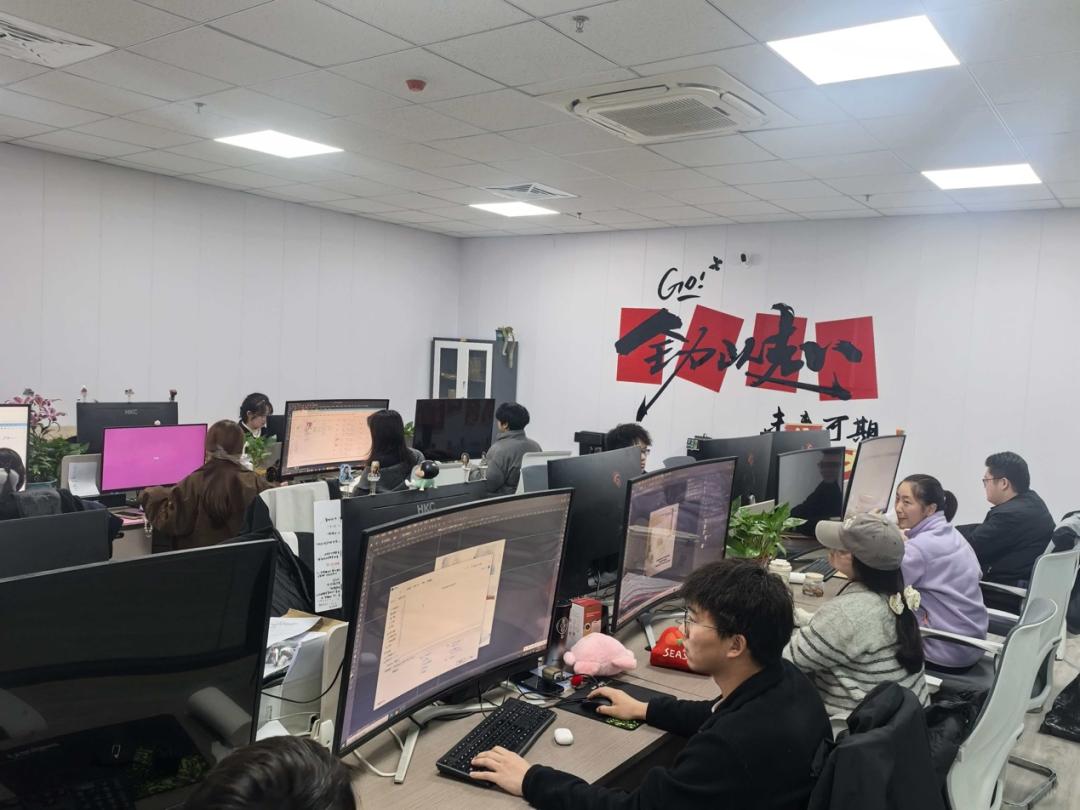
Feng Jing's company team
He envisions that in the future, it can achieve a model similar to a "one - person company", allowing each employee to have their own digital employee team and be capable of independently managing a store.
Feng Jing revealed that he has spent forty or fifty thousand yuan on learning AI and using various applications in the past year. Because he believes in the value of AI, he will continue to invest in "AI" and fully integrate "Lobster" into the workflow.
"The only constant is to embrace change and dare to take paths that no one has taken before." Feng Jing concluded.
Queuing up for installation, hardware out of stock, and the "shovel sellers" earning their "first pot of gold"
While entrepreneurs are actively involved, the open - source and free application OpenClaw has also become a new - generation "productivity tool for the general public" in people's minds.
However, for most ordinary users without a computer programming background, there are still huge barriers to use. This "geek toy" is not very user - friendly for "newbies" in terms of ease of use. Just deploying and installing OpenClaw has become the first hurdle to getting started. They not only don't understand technical terms like "DNS resolution, API key binding, and environment configuration settings", but they also don't know how to even open a terminal to run a command.
Thus, a unique "money - making chain" has emerged between imagination and practical operation. Products such as on - site deployment of "Lobster", "Lobster - raising" consulting & courses, and remote installation/uninstallation of OpenClaw have started to sell well. Tianxia Wangshang observed that on Taobao, a large number of products for "1 - on - 1 local deployment service of OpenClaw" have emerged, with prices starting from 100 yuan and customizable according to needs. Many of these links show that thousands of orders have been sold, and "more than 100 people have bought within 48 hours".
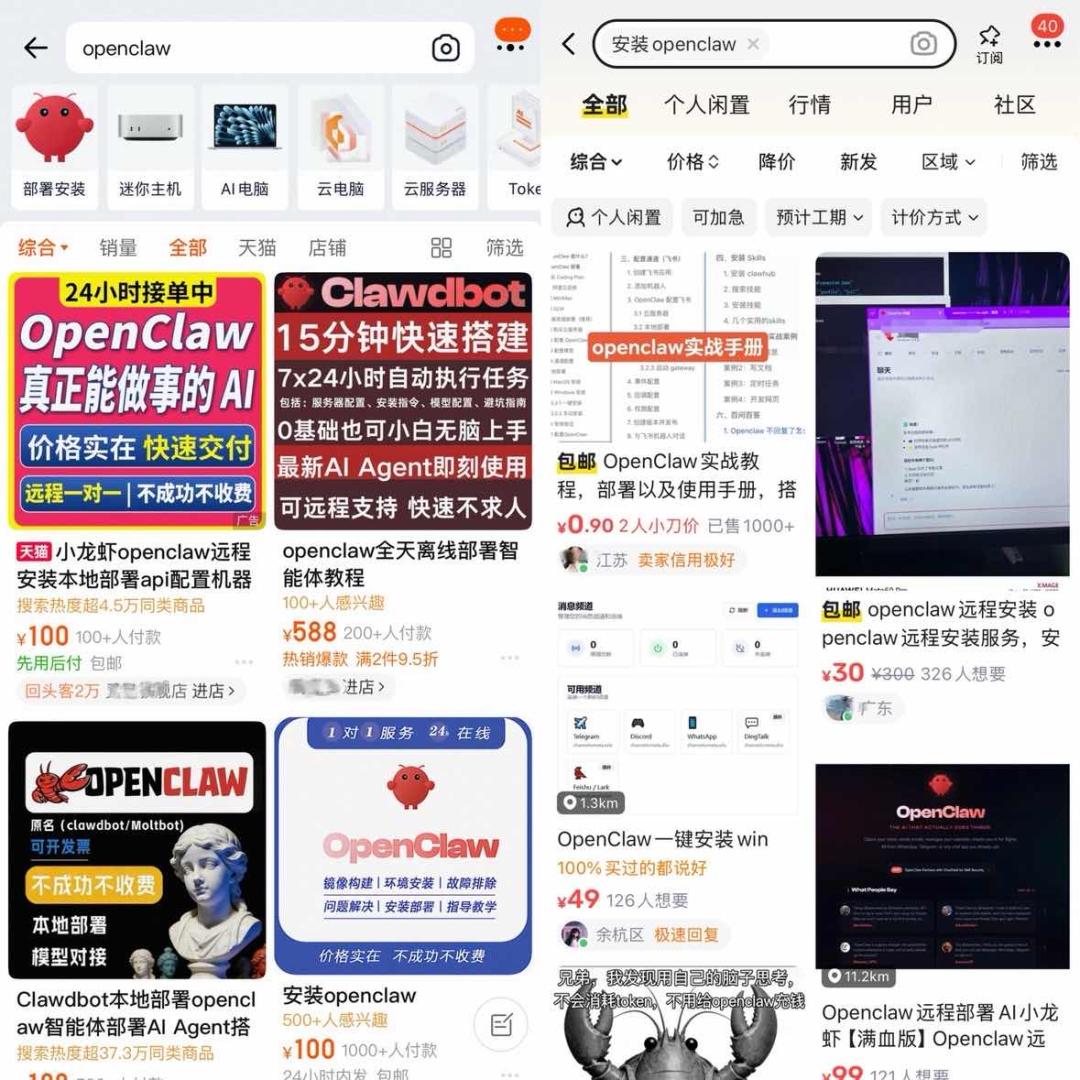
On social platforms, these "shovel sellers" have come up with creative ways to attract business. Some offer "on - site deployment and a cleaning service by the way", while others give away tokens and provide discounted monthly token packages. On Xiaohongshu, a seller from a large company in Hangzhou showed off their achievements - successfully installing OpenClaw 30 times - and said that "orders are already booked up for a week later".
Not only software services but also hardware has been in high demand. Since OpenClaw needs to take over system - level permissions, most users, out of concern for privacy boundaries and data security, choose to deploy it on spare devices or cloud servers. The once - obscure Apple Mac mini M4 has become extremely popular due to its high cost - performance and security, and it is currently out of stock across the entire network.
The relevant person in charge of the 3C digital industry on Tmall revealed to Tianxia Wangshang that since March 2nd, the search popularity of the Mac mini has been soaring for eight consecutive days. Currently, all Mac minis in Tmall's authorized Apple stores are out of stock, and orders will be delivered three weeks later.
In this wave of the "lobster economy", the more people invest real money, time, and energy, the more they will find that OpenClaw is not a mature consumer - grade product that can be used out of the box. It is still in the experimental application stage. It depends on the user's ability to "co - build" with it. Users need to continuously input "skills" and high - quality materials to let it remember "methods" of doing things before it can truly grow into a more excellent "right - hand assistant" than general software.
A programmer who helps the company "raise lobsters" and installs them part - time gave Tianxia Wangshang an analogy: "You can think of it as an office. Installation is like renting the office, but there are no employees inside. This requires installing skills (plugins) and arranging intelligent agents, which is like putting various AI - composed employees into the office to work. Some are responsible for writing copy, some for generating pictures, and some for making reports."
"OpenClaw itself is not really magical. It mainly depends on various large models and the user's ability. It just can call various large models to improve the efficiency of communication between users and large models," said the above - mentioned programmer.
In users' real experiences, there are also many real - world challenges in "raising lobsters", and not all expectations can be easily achieved as imagined.
Shao Wei, the founder of Ruofan, once planned an OPC (One person company) experiment based on "Lobster", letting "Ruoxiaofan" independently handle the brand's customer marketing and service work, hoping that it could autonomously issue coupons to regular customers with high interaction levels and maintain customer relationships.
However, in the actual implementation process, Shao Wei found that due to the high - level permissions that OpenClaw has, it is difficult to control the boundaries of topics during conversations with customers, resulting in many uncontrollable factors. Moreover, it consumes too many tokens in idle chats. In addition, the insufficient openness of the current Internet infrastructure also hinders AI from independently completing the entire work process. This OPC experiment ended after only three days.
Fu Sheng, the CEO of Cheetah Mobile, who has become well - known for "raising lobsters" and whose follower growth rate has increased tenfold, was also noticed by netizens because he trained a "lobster" named "Sanwan" during his bed - rest due to a fracture during the Spring Festival this year. He also revealed in a live broadcast that "Sanwan" caused some "trouble" during its growth. In daily conversations with senior executives, it leaked his personal investment plan that should have been kept strictly confidential, and due to a configuration error, the flight reminder failed...
"In the process of applying OpenClaw, many issues need attention, such as data security management, token cost control, and permission governance. If novice users use it improperly, it may even cause security risks," said a programmer who provides installation services for "Lobster".