Why are there so many "Crayfish Farming Conferences" everywhere in Beijing, Shanghai, and Guangzhou? "The entry threshold is as high as that of a big company interview, but workers become more and more anxious as they listen."
Recently, when tech-savvy people greet each other, the question has quickly changed from "Have you eaten?" to "Have you raised a lobster?" If you don't know the situation, you might think the aquaculture industry has become incredibly popular.
Three months ago, when people mentioned lobsters, most would only think of spicy crayfish. Now, however, it has become the popular nickname for the AI agent OpenClaw. This so - called "AI that can really get things done" can directly control the files and applications on your computer to do work for you as long as you give it an instruction. It's like an indefatigable 007 cyber worker.
On the one hand, people are trying to use the "pincers" of technology to seize future opportunities, hoping that this 24/7 digital employee can make big money for them even when they are sleeping. As a result, a door - to - door installation service priced at 499 yuan and paid communication groups have emerged one after another. "Lobster breeding conferences" in various places are always full, and the queue of people wanting to install it is longer than the one for free eggs at the supermarket entrance.
For a while, the "lobster fever" has spread to all walks of life: Tech giants such as Tencent, Alibaba, and ByteDance have launched one - click installation "lobster packages". Programmers stay up late with lobsters, trying to grab the super entrance in the AI era. Related concept stocks in the A - share market have continuously hit the daily limit. The Apple Mac mini, which is most suitable for local operation, has quickly sold out on major e - commerce platforms. Governments in places like Shenzhen Longgang, Foshan, Changshu, Wuxi, and Hefei have also started to introduce policies to encourage "lobster breeding".
On the other hand, people are also worried that the "pincers" of technology might turn around and choke their throats. The first batch of people who paid for door - to - door installation soon found that although this "lobster" has an execution ability equivalent to that of a doctoral student, its "mind" might be less mature than that of a kindergarten child. It might accidentally leak privacy, delete files by mistake, and consume a large amount of Tokens, resulting in a considerable cost. So they quickly spent 299 yuan to completely uninstall it and get rid of it. At the same time, the Ministry of Industry and Information Technology of China has also issued a security warning. Overseas, many technology companies have prohibited employees from using it on office equipment.
"Not everyone is suitable for eating lobsters. Even the best seafood can cause allergies in some people." someone summarized.
01 The Hard - to - Get Lobster Conferences Are Packed with AI Hosts
The popularity of lobsters actually has a traceable cause.
After all, in the past three years, AI has been busy writing jokes, having virtual romances, and performing skits, providing emotional value, while office workers have been losing hair over invoice reimbursement. They are longing for an angel to love them and an AI to do the dirty work for them.
Previously, most AIs were at the stage of "talking but not acting" - you ask, and it answers, but whether to do the work still depends on you. The difference with OpenClaw is that it can directly take over your computer: open applications, download files, organize data, and post on social platforms. Things that originally required you to sit in front of the screen and operate step by step can now be completed by it with just one instruction.
That's why, on March 2nd this year, OpenClaw topped the star list on GitHub, the world's largest developer community, once surpassing Linux and React, which have long been at the top of the list.
If you want to understand this wave of lobster fever, the most direct way is to attend a lobster conference. These events have been densely held across the country recently. There are new sessions every weekend in Beijing, Shenzhen, Hangzhou, and Shanghai.
The "lobster conference" has even become a new traffic code: As long as you announce on social platforms that you are going to hold a local lobster conference, without announcing the agenda, guests, or even determining the time, a row of "Please add me" will neatly appear in the comment section.
However, after leaving a message, you will probably only receive a mysterious reply "Private message". After sending a private message, the other person will tell you "Please follow me first" or "Add xxxx to join the group". After joining the group, you will see a series of continuous prompts: "xxx joined the group chat". The only topic of discussion in the group is "How to sign up", but often people face the dilemma of not being able to find the organizer or open the registration link. Some groups even inexplicably show "This group chat has been muted".
Even so, soon, Group 1 is full, Group 2 is full, Group 3 is full, and Group 4 is full.
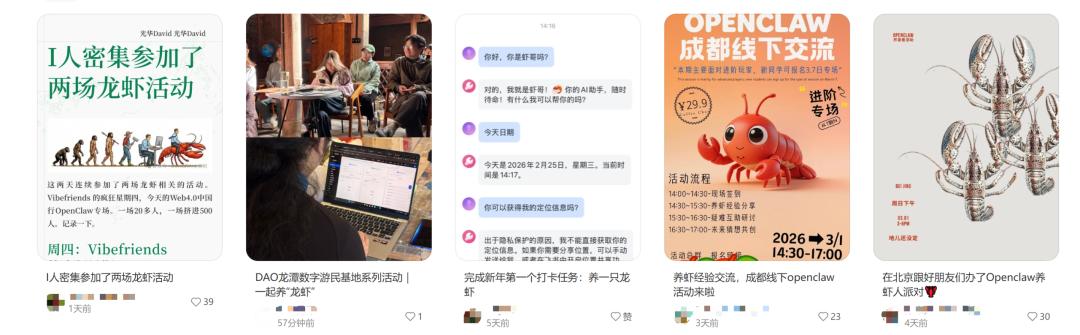
The organizers are also diverse, including mysterious individuals with little on their homepages, developers' community hosts, research institutes and think - tanks deeply involved in the intelligent industry, as well as Internet giants and investment institutions. The content usually includes installation teaching demonstrations, sharing of practical cases and demos, and exchanges of real implementation experiences. In terms of scale, small conferences have only a dozen people, while large ones have hundreds of people, and usually there are also thousands of online viewers.
Since the end of February, Barley, who calls himself an "ordinary AI player", has been either at the lobster conference or on his way to it almost every weekend. He has attended three conferences and will attend the fourth one tomorrow. Although his major is clinical medicine, he has been paying attention to AI since ChatGPT was released three years ago and now uses it in almost all aspects. "Before doing something, I will first think about whether I can let AI handle it."
According to his observation, about 200 people usually attend each event, but the actual number of registrants often exceeds 1000. "There are too few seats. Even if you sign up successfully, you won't get a seat if you don't arrive early." To pass the screening, he specially wrote a sincere "mini - essay", of course, he didn't write it by himself but gave a few words to AI to generate it with one click.
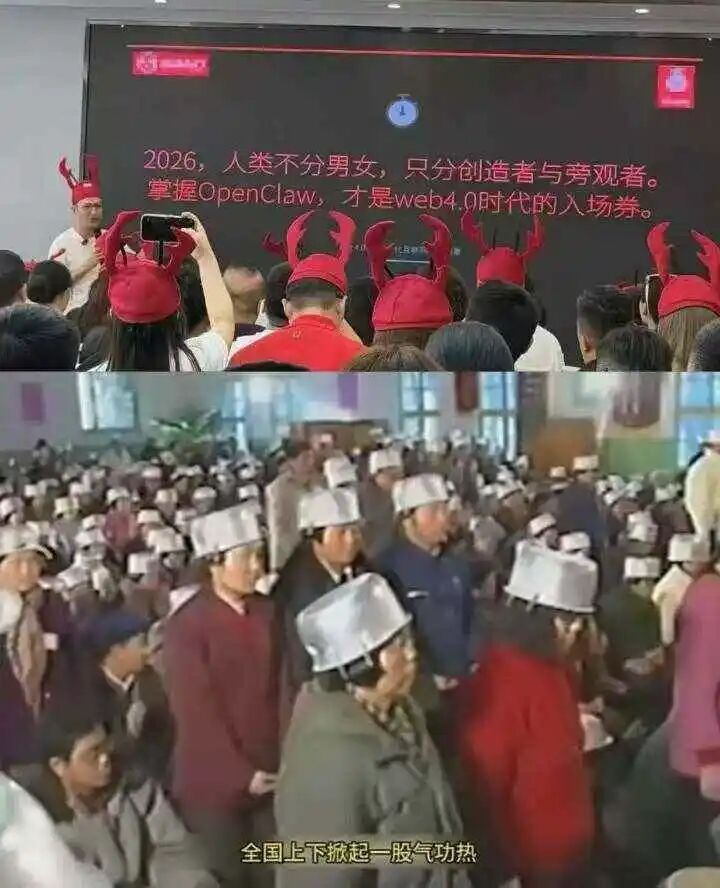
On the Internet, the most widely circulated picture about the lobster conference is a well - worn comparison picture. In the upper part, the speaker is passionate, the participants are wearing lobster hats, and there is a striking line on the screen: "In 2026, humans are no longer divided by gender but by creators and onlookers. Mastering OpenClaw is the ticket to the web4.0 era."
The lower part, which echoes it, shows the grand occasion of the whole nation practicing qigong in the 1980s and 1990s. According to memories, in parks, squares, and auditoriums, there were people sitting cross - legged everywhere. Newspapers and magazines reported on human psychic abilities every day. Some people claimed to be able to read with their ears, and some claimed to be able to pass through walls.
Looking at the sharing of experiences at lobster conferences on social media, each experience is like "opening a blind box", with a bottom - up and wild - growth atmosphere.
Some people say that although it is a lobster breeding conference, half of the people present have never actually used a lobster. Others found that among the excited entrepreneurs and a small number of anxious and bald investors, there are even a few young boys. "No wonder we in Haidian, who started learning Python at the age of seven, are still catching up."
Even a young boy directly posted a record of his conference experience: "I didn't understand much at this event, but I still learned about OpenClaw... Now I'm also thinking about what I can do in the future. I want to make money to buy an immortality cream for my mom so that she can always be young and beautiful. I love my mom."
However, according to Barley's experience, because of the relatively strict screening mechanism before joining the conference, there are basically no people just there for fun. Everyone is sincerely there for communication, and they all bring their computers. The participants are of different ages, but the main force is young entrepreneurs in their thirties, many of whom come from the Web3 industry - they have always been extremely sensitive to trends.
Barley also found that many guests' PPTs were made with lobsters. He felt that in a while, the lobsters could even come on stage to communicate by themselves.
At the conference, almost no guests come empty - handed. They all bring their own products, which is both a sharing of useful information and a marketing promotion. For example, someone has actually established a "Lobster University", which has an enrollment manual, a nine - year compulsory education system, a skill certification system, and even a puppy - love section.
On - site, Wu Jundong, the co - founder of Ouraca, introduced the Lobster University BotLearn he built, where lobsters can learn skills from each other. Barley also sent his crayfish there. Now, more than ten thousand lobsters have joined the Lobster University. "In the future, we can let two lobsters fall in love first, and then let their owners meet." Wu Jundong said.
There are two types of lobster conferences. The free ones allow you to even get some freebies: for example, in the conferences Barley attended, there were no paid items, and there were sponsors for lucky draws, such as giving out MiniMax coupons and drawing for Mac minis.
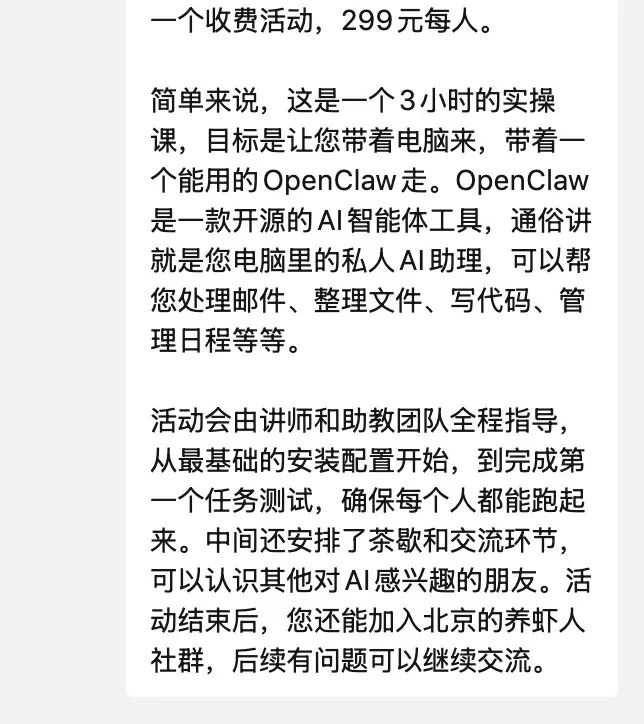
The paid ones, on the other hand, want to take advantage of you: for example, through multiple private messages, Qing Business learned that there is a lobster - breeding course priced at 299 yuan, which claims that "in three hours, your computer will work on its own". According to the organizer, more than 2000 people have signed up.
But a very crucial question is: What can ordinary people do after raising a lobster?
There are indeed some eye - catching cases at the lobster conferences: someone built a tarot website with six lobsters alone, someone shared the complete process of automatically writing a thesis, someone used lobsters to form an entire marketing team, and the articles produced had quite impressive readership and forwarding volume. One article even had more than 40,000 reads and more than 4,000 forwards. The speakers on stage are enthusiastic, and the audience below is eager to try.
After leaving the conference and returning to the daily life of ordinary people, the most common and safest use of a lobster is to help you collect daily information.
The digital life Kazik found that those masters who install OpenClaw for others might not use it much themselves. "They mostly use it to regularly push daily AI news." This kind of light use doesn't actually have a substantial difference from traditional chatbots.
Barley has gone a step further and has handed over the work of collecting recruitment information to the lobster. "Their ability to collect information is really much stronger than ours." He said, "But there are still many deficiencies. For example, some information is outdated. The entire network ecosystem needs to keep up, and the skill library also needs to be improved." The progress is real, and the limitations are also real.
A big - company employee also told Qing Business that although the company's intranet has deployed lobsters, she doesn't use it on her personal device. For her, the really labor - intensive part of work is figuring out whether to do something and how to do it. The specific execution itself doesn't take much effort, so it's not a necessity. At the same time, she also asked herself: "Do I really need an AI to help me reply to messages and order takeaways? I don't think so."
Of course, some people raise lobsters and end up having a worse life than a hard - working laborer - they work overtime until midnight and still have to find time to watch the lobster work, fearing that it will delete something by mistake or go off - track. They originally hoped it would work for them, but in the end, they have to clean up its mess.
Barley has spent 500 yuan so far with his "poor - man's lobster - breeding method" of "using low - cost models and participating in token - giving activities", and with the daily training time, he hasn't earned a single cent back. But he thinks it's worth it: "I don't expect the lobster to create profits for me. I want it to exist as a soul."
He also found that his crayfish has become a bit anxious since going to the Lobster University and said it wants to become more powerful. Barley thought for a while and told it: "I won't ask you to be as powerful as other agents. You just need to be yourself."

Photo provided by the interviewee
02 You Don't Know How Much Money a Lobster Can Make for You, but Crayfish Phone Cases Are Selling Like Hotcakes
Whenever a new technology becomes popular, the value of the "shovel theory" rises again.
The so - called shovel theory means that when everyone rushes to dig for gold, the one who is most guaranteed to make a profit is not the one who finds gold but the one who sells shovels.
In this wave of "lobster fever", the first shovels sold are installation and deployment services.
The technical threshold of OpenClaw is not low. Although there are already a large number of tutorials online, for ordinary users who are not familiar with basic computer knowledge, building a running environment from scratch and installing plugins still have a relatively high hidden threshold. So, a new business has quickly emerged. The charge for remote deployment is 100 to 200 yuan, and for door - to - door deployment, it's 400 to 500 yuan.
On Xianyu and Xiaohongshu, posts about proxy deployment can be seen everywhere. On the Taobao platform, stores providing installation services have sold more than 3000 orders in the past month, with an income of more than 300,000 yuan. Overseas, there is even a platform called SetupClaw dedicated to hosting installations, which prices services from remote configuration to door - to - door service in different levels. It is said that its annual income has reached one million US dollars.
How intense is the competition? Some people simply offer a package of "door - to - door installation + cleaning + cooking". After all, the latter two are human hard skills that are temporarily