This track no longer offers opportunities to "the poor": Don't even think about Series B without a billion.
Within just two weeks after the Spring Festival Gala, robots have once again dominated the headlines. This time, it's not about the dazzling performances on the stage but a deluge of financing news.
According to incomplete statistics from Rongzhong Finance reporters, the humanoid robot industry (including components) has completed at least 18 financing rounds, with a total amount exceeding 13 billion yuan. Data from IT Juzi shows that since the beginning of 2026, a total of 88 financing events have been publicly disclosed in the field of embodied intelligence in China, with a total financing amount exceeding 20 billion yuan.
What's even more astonishing is that judging from the financing situation in recent months, the Series A financing of robots has reached the 1-billion-yuan threshold, and the Series B financing amounts are mostly in the range of 1 billion yuan and above. Generally, a 1-billion-yuan scale usually appears in the Series C or later rounds, but this time it has become the basic threshold for star robots.
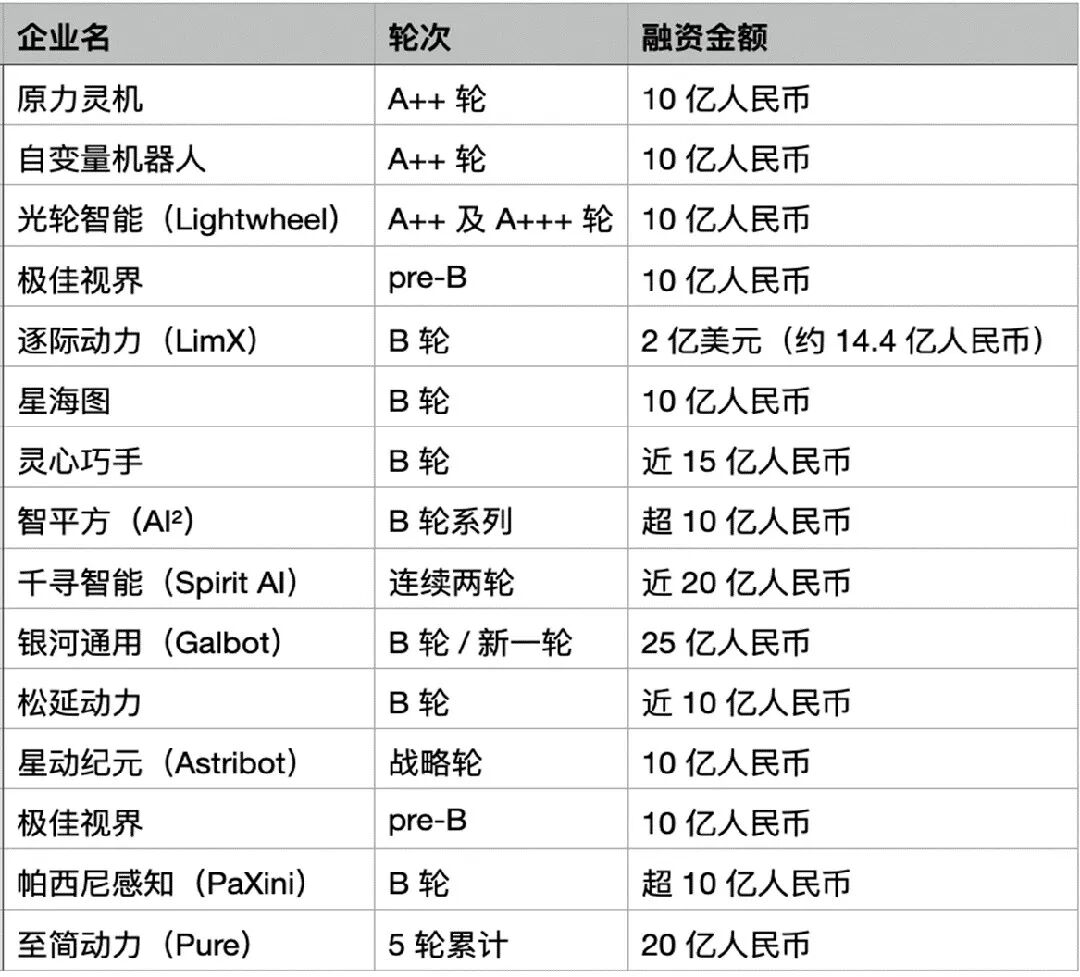
(Chart made by Rongzhong Finance)
This naturally makes people wonder: Is the humanoid robot track truly promising, or are investors just blindly following the trend? In the view of the reporter, this 1-billion-yuan threshold is a line drawn by investors with real money. Crossing this line means that the enterprise may have the conditions for a commercial closed-loop and has the ticket to the next stage.
The 1-Billion-Yuan Threshold
In 2026, the Chinese robot track is no longer a "small-scale" startup incubator.
At the end of 2025, Yuanli Lingji exceeded 1 billion yuan in Series A financing, setting a new high for Series A financing and becoming the first domestic embodied intelligence enterprise centered around models. In just over two months since the beginning of the year, the market has been bombarded with news of large-scale financing. On February 2nd, LimX Dynamics announced the completion of a $200 million (approximately 1.44 billion yuan) Series B financing. This round of financing attracted e-commerce and cloud computing giants, top global hard-tech VCs, leading players in the automotive manufacturing industry chain, and multiple local government industrial guidance funds, including Alibaba, Sequoia China, SAIC Investment, Lenovo Capital & Incubator Group, and Shenzhen Capital Group.
On February 23rd, AI²Robotics announced the completion of a Series B financing of over 1 billion yuan. The investors in this round of financing come from a wide range of fields, including Internet and AI giants, leading central state-owned enterprises, leading players in the Tesla ecosystem, strategic partners in specific scenarios, "deep-pocketed" PE funds, leading securities firms, and local funds, such as Baidu, CRRC Capital, Yuxin Technology, Senkylin, Yunbai Capital, and Guotai Haitong. The lineup is extremely impressive.
On March 2nd, Galbot announced the completion of a 2.5 billion yuan Series B financing. The investors in this round of financing have extremely strong backgrounds and can be regarded as the "national standard" in the field of embodied intelligence. They include national industrial investment funds, energy and petrochemical giants, top state-owned commercial banks, and local strategic investment platforms, such as the National Artificial Intelligence Industry Investment Fund (the third phase of the national large fund), Sinopec, Bank of China, Industrial and Commercial Bank of China, and the Beijing Artificial Intelligence Industry Guidance Fund.
In addition, a number of players such as Xinghaitu, Lingxin Qiaoshou, and LimX Dynamics have all exceeded the 1-billion-yuan mark. It can be seen that in the field of embodied robots, 1 billion yuan has basically become the "threshold" for Series B financing.
2025 was regarded as the first year of mass production of robots, and the financing for robots at that time could also be described as overwhelming. In just the first two months of this year, the total financing amount has exceeded 13 billion yuan, approaching one-third of the total amount in 2025. It can be seen that after the boost from the Spring Festival Gala, the humanoid robots this year are even more energetic.
From the perspective of investors, industrial capital and state-owned capital have become the main forces in this round of financing.
In summary, Meituan has invested in Galbot, LimX Dynamics, Independent Variable Robotics, Qianxun Intelligence, Zhijian Dynamics, and Xingdong Jiyuan. It has almost invested in all leading robot body companies, aiming to secure all possibilities for future unmanned delivery and intelligent warehousing. ByteDance has invested in Independent Variable Robotics (leading investor) and Galbot. Logically, it focuses on algorithms, making a small number of but extremely accurate investments, mainly targeting teams with end-to-end large model algorithms that can directly generate synergies with ByteDance's AI laboratory.
In addition, Songyan Dynamics has the investment of CATL behind it. LimX Dynamics has the support of JD.com and SAIC. Baidu Strategic Investment and CRRC Capital also appear on the shareholder list of AI²Robotics. These are all typical cases of in-depth participation of industrial capital.
The presence of state-owned capital is also becoming more and more active. There is the Beijing Guosheng Fund behind Songyan Dynamics, the Chengdu Science City Venture Capital and Kesheng Fund behind AI²Robotics, and the National Artificial Intelligence Industry Investment Fund (the third phase of the large fund) behind Galbot.
When the "national team" that controls national strategic resources and industrial lifelines starts to invest real money, it means that the humanoid robot track is no longer a "bubble in the wind" chased by capital but is becoming a tangible cornerstone in the transformation and upgrading of China's manufacturing industry. Perhaps this is the confidence for many investors to place their bets.
As for the use of Series B funds, the answers of most of these robot companies seem to be related to industrial implementation. For example, when AI²Robotics announced its Series B financing, it stated that the funds from this round of financing will be mainly used to maintain the leading position of the GOVLA embodied large model and, on this basis, drive the iteration of the AlphaBot series of robot products and the expansion of the production line. Lingxin Qiaoshou also said that the funds raised in the Series B will be invested in the R & D of core product technologies, the ramping up of production capacity, and the construction of full-stack base capabilities. Some people believe that 2026 will be the first year of large-scale implementation of embodied robots "from the laboratory to the factory".
To achieve large-scale implementation, funds are a very important prerequisite. Therefore, investors are willing to place heavy bets in the Series B. 1 billion yuan is a watershed set by capital. Crossing it means that the enterprise has the possibility of large-scale implementation and entering the finals of the robot industry. The 1-billion-yuan Series B is not only a round of financing but also a ticket to the next stage.
Behind the "10-Billion Game", the Model Becomes the Latecomer's Advantage
After the financing threshold in the field of embodied intelligence has generally crossed the 1-billion-yuan level and the valuations are approaching the 10-billion-yuan mark, the aesthetic logic of capital has undergone a fundamental shift. In the long-term technological race, getting funding is just the "ticket to enter", and the real moat is no longer simply the depth of algorithms or hardware parameters but the general intelligence of the "brain", the infrastructure of the architecture, and the extremely practical engineering implementation ability.
In the early days of the robot track, investors were often attracted by precise mechanical structures, high-torque joints, or flexible dexterous hands. However, with the increasing maturity of the supply chain, core components such as motors, reducers, and actuators are gradually becoming modular and standardized, and the differential advantages of hardware are being quickly leveled.
Previously, Yuanli Lingji said in an interview with Rongzhong Finance: "Currently, the core shortcoming of robots in the real environment is not the lack of motor torque or hardware degrees of freedom but the lack of 'intelligence' (lack of physical intuition and poor generalization ability)."
It is reported that Yuanli Lingji is an embodied intelligence enterprise established in March 2025. It focuses on the R & D and industrial implementation of full-stack robot hardware and software technologies. It has proposed the "embodied native" technology route and released core products such as the embodied native large model DM0, the open-source development framework Dexbotic, and the mass production workflow DFOL. The company has completed nearly 1 billion yuan in financing led by Alibaba, NIO Capital, etc.
This "lack of intelligence" mentioned by Yuanli Lingji is manifested in the lack of physical intuition and generalization ability of robots. A robot that can walk smoothly on a clean floor in the laboratory often stops working due to perception failure or decision-making collapse when it enters a real factory with variable lighting and piled-up debris.
Therefore, in 2026, investors reached a strong consensus: the real moat at this stage is the "general intelligence of the brain and the infrastructure of the architecture". Yuanli Lingji said that the differential advantages of hardware will be gradually leveled, and only the embodied native model with cross-model generalization ability can be compatible with various hardware and adapt to thousands of scenarios. This path of "unlocking scenarios with the model and defining hardware with scenarios" makes "model first, body later" the core card of leading enterprises.
In the game at the 10-billion-yuan level, investors have become extremely calm. They no longer pay for beautiful demo videos but look for enterprises with the following three "hard capabilities" with a magnifying glass:
Full-stack self-research and mass production delivery capabilities: Key components such as joints, dexterous hands, actuators, and chassis must have full-stack self-research capabilities, which is the basis for ensuring not to be "held back" by the supply chain. However, self-research is only the first step. More importantly, it is the engineering system ability. "The inference must be real-time enough, the whole machine must be stable and reliable, and the safety mechanism must be perfect. At the same time, it is necessary to do a good job in these 'dirty and tiring jobs' such as cost, loss, maintenance, and deployment. Otherwise, no matter how strong the algorithm is, it cannot be implemented. Only companies that can stably produce products, have a low failure rate, and can deliver on a large scale have the first threshold to cross the cycle."
Embodied large model and real data closed-loop: What investors focus on is no longer simply the algorithm but the "intelligence in the real world" plus the "data closed-loop". "This kind of intelligence means that the robot can not only complete tasks in a controlled environment but also succeed stably in different objects and environments, and the task sequence cannot collapse. It can also interact naturally with people. More importantly, the enterprise must be able to feed back both good and bad examples from the field into the training, making the model more and more accurate. This self-evolving ability is the key to continuously widen the gap."
Real orders and commercial profitability: 2026 is the "ROI (Return on Investment) first year" for robot commercialization. Investors only invest in companies that "can make money" and no longer pay for concepts. The enterprise must prove that it can truly solve the problems in a scenario from start to finish, calculate the ROI clearly, and the delivery method can be standardized, replicated, and promoted on a large scale. Without any of these, it is difficult to stand out in this long race.
This wave of financing enthusiasm starting from 1 billion yuan and with a valuation of 10 billion yuan is not a bubble in essence but a qualitative turning point for the industry to move from 0 to 1 and then from 1 to 10. The entry of the national team and the clustering of industrial capital mean that embodied intelligence has changed from an "advanced toy" in the hands of geeks to a "productivity weapon" in the competition among big countries.
At this turning point, the ones that can survive must be the players with the most extreme combination of software and hardware. In the future, the companies that can stand out must be those that can manufacture hardware, have a strong "brain", and can run a successful business. Hardware ensures the "lower limit" of the robot, determining whether it can enter the field, while the "brain" determines the "upper limit" of the robot, determining how much work it can do and how smartly it can do it. This ultimate alignment of the "brain" and the "body" is not only a technical challenge but also a comprehensive test of the team's organizational ability, the efficiency of capital use, and the industry insight.
Capital is clearing the field in advance through an extremely high capital threshold and quickly concentrating resources on leading projects with this composite ability. For the players in this field, getting 1 billion yuan in financing is just the first step for survival. How to transform this huge sum of money into stable performance in real scenarios and a continuous stream of orders is the real "trump card" that determines life and death.
From the Assembly Line to the "Android Moment"
After crossing the capital threshold and accumulating underlying strength, the most realistic problem facing the embodied intelligence industry is: where is the first foothold for large-scale commercialization? The debate about the route of "entering factories first" or "entering families first" has gradually become clear in the market feedback in 2026.
Yuanli Lingji said that the first commercial ROI (Return on Investment) explosion point will appear in B2B factories and specific industrial scenarios. This judgment not only reveals the objective law of technology implementation but also predicts the inevitable trend of the evolution of embodied intelligence from a "single tool" to a "platform ecosystem".
The standard for scientifically evaluating scenario implementation lies in the fault tolerance rate and the degree of data structuring. The home environment is regarded as an extremely unstructured "open world" filled with a large number of long-tail scenarios (Corner Case). "There are many Corner Cases in the home environment, and C-end users have extremely low tolerance for failure. In the short term, the generalization ability of large models is difficult to support 100%."
In the home scenario, a broken cup or a wrong item retrieval instruction may lead to the collapse of user confidence. This extremely high brand risk and technical generalization difficulty make "entering households" still mostly in the exploration stage at present.
In contrast, the factory assembly line is a semi-structured environment. Here, tasks are highly repetitive, with clear boundaries and quantifiable production beats.
Enterprise customers only pay for "efficiency and cost reduction", and the ROI is easy to calculate. In the industrial scenario, even if the robot occasionally makes an incorrect operation, since the environment is controlled and there is a perfect safety mechanism, the losses caused are controllable and predictable. More importantly, by polishing the "accuracy and execution beats" in B2B factories at a high frequency, enterprises can run through the core data flywheel, which is regarded as a practical foundation for embodied intelligence to finally enter C-end families.
After getting huge financing, there has been a significant differentiation in the role settings of players. Some enterprises choose to build a vertically integrated robot benchmark, while others have a longer vision. For example, Yuanli Lingji does not pursue being a closed "vertical hardware manufacturer". Its core positioning is to be a provider of the embodied brain and an open-source builder of infrastructure (Infra) in the era of embodied intelligence. This change in positioning is essentially an attempt to upgrade from the business of "selling a machine" to an ecosystem that "defines an era".
This transformation is vividly compared to the "Android moment" or the "PyTorch moment" in the field of embodied intelligence.
Just as the popularization of smartphones cannot be separated from the open source of the Android system, the large-scale explosion of embodied intelligence also requires a set of standardized "architecture infrastructure". By releasing the embodied native development framework, establishing a global standard real-machine evaluation platform, and open-sourcing the base model and dual-arm hardware, leading enterprises are committed to breaking the industry isolation. Yuanli Lingji said that through these open-source and standardization efforts, it hopes to empower developers and hardware manufacturers in all industries and become a cornerstone ecosystem builder that promotes AI intelligence to truly take root in the physical world.
In this industrial turning point in 2026, the bombardment of capital is not creating a bubble but accelerating the industry's leap from 1 to 10. The enterprises that can truly reach the end in this long race must have three hard capabilities. First, it is the "intelligence in the real world" plus the "data closed-loop", requiring the model not only to run demos but also to succeed stably in different environments and feed back on-site data for real-time training. Second, it is strong engineering ability, being able to handle "dirty and tiring jobs" such as maintenance and deployment to ensure the real implementation of the algorithm. Finally, it is product and commercial ability, ensuring that the delivery method can be promoted on a large scale.
In summary, the 1-billion-yuan financing threshold is just a ticket to enter, and the real competition lies in who can first run through the ROI in B2B factories and who can first build the underlying infrastructure of embodied intelligence. This is not only a technological game but also a competition of business vision and ecological appeal. In the next few years, the companies that can survive and lead the industry must be those that can perfectly align the generalization ability of the "brain" with the engineering