Dreame Xinji's "Heavenly Vault" series of chips are officially in mass production, and the first space computing power box will be launched into space | The front line
Author | Huang Nan
Editor | Yuan Silai
On March 11th, Xinji Chuanyue, an ecological enterprise of Dreame, officially launched the "Tianqiong" series of chips and announced that it has achieved large - scale mass production. These chips will soon be integrated into Dreame's pan - robot product series.
Currently, the demand for AI computing power is growing exponentially at a rate that exceeds Moore's Law. Research by OpenAI shows that since 2012, the computing power required for cutting - edge AI training tasks has doubled every 3.4 months, with a cumulative increase of over 300,000 times. As large models progress from hundreds of billions of parameters to trillions of parameters, and edge - side intelligence evolves from simple perception to complex decision - making, computing power has become the core barrier in the new - generation AI competition.
However, the global supply of computing power is facing a structural bottleneck. The traditional Moore's Law is approaching its physical limit, and the increase in transistor density has slowed down; the production capacity of advanced manufacturing processes is limited, and there is uncertainty in the chip supply. More importantly, ground - based data centers are restricted by energy consumption indicators, heat dissipation efficiency, and land resources, making it difficult to support the infinite expansion of AI computing power demand.
The latest report from the International Energy Agency shows that the global data center electricity consumption will exceed 1,000 terawatt - hours in 2026, equivalent to the total annual electricity consumption of Japan. The explosion of energy consumption, difficulty in heat dissipation, and limitations in site selection have become the "triple siege" for the expansion of computing power infrastructure.
Against this background, the competition logic in the chip industry is undergoing a fundamental transformation. On the one hand, edge - side chips have been upgraded from single - function components to system - level intelligent hubs, and highly integrated SoCs have become the key carriers to support the implementation of embodied intelligence. On the other hand, the spatial layout of computing power infrastructure has begun to break through ground limitations and evolve towards an integrated space - air - ground direction. Near - Earth orbit computing power nodes have become the frontier areas where global technology giants are competing to deploy.
Wu Zhongze, former vice - minister of the Ministry of Science and Technology, pointed out at the AWE2026 Chip Industry Summit Forum that the chip industry is reshaping the way the world operates with an invisible force. In recent years, the country has continuously promoted the in - depth integration of the innovation chain, industrial chain, capital chain, and talent chain in the chip and computing power industries, providing guarantees for the high - quality development of the industry.
From an industry perspective, the explosion of edge - side intelligence is redefining the chip design paradigm. As embodied intelligence and humanoid robots move from the laboratory to the forefront of the industry, chips are no longer just components for performing calculations but the core hubs of the entire chain of perception, understanding, decision - making, and execution.
Robots need to respond in real - time in complex and dynamic environments, placing strict requirements on latency, power consumption, and reliability. Traditional general - purpose chip architectures struggle to balance performance and efficiency. This has promoted the rise of dedicated - architecture SoCs. Through the collaboration of heterogeneous computing units, functions such as perception fusion, decision - making planning, and motion control are integrated into a single chip, achieving a closed - loop of edge - side intelligence.
The first mass - produced "Tianqiong" series of chips from Xinji Chuanyue are the product of this trend. This chip uses a heterogeneous computing platform composed of a multi - core CPU, a dedicated NPU, and an independent MCU, and is one of the most highly integrated SoCs in the industry at present. According to official information, it will be installed in Dreame's pan - robot product series, supporting advanced algorithms such as lidar and AI vision fusion perception and binocular obstacle avoidance, and improving the navigation and obstacle - avoidance capabilities in complex home scenarios.
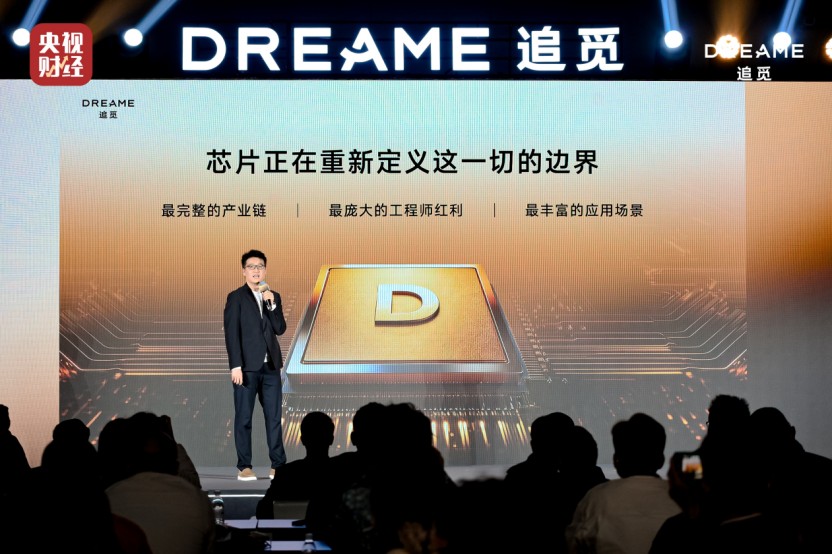
The launch of Dreame Xinji Chuanyue's "Tianqiong" series of chips (Source: Enterprise)
The difference of Xinji Chuanyue lies in that it does not start from scratch. Instead, it reuses Dreame's accumulation in intelligent algorithms, supply chain system, and real - world scenario data from tens of millions of shipments for the collaborative design of chip architecture and top - level algorithms. This "scenario - defined chip" model is becoming the key path for AI chip companies to build competitive barriers.
Meanwhile, the form of computing power infrastructure is undergoing a more profound transformation. Facing the physical limitations that ground - based data centers can hardly break through, deploying computing power nodes in the space environment is becoming a highly imaginative technological direction.
The near - Earth orbit has a natural vacuum heat - dissipation environment and a continuous and stable supply of solar energy. In theory, it can achieve higher - density computing power deployment and lower heat - dissipation costs. In addition, space computing power nodes can also provide on - orbit real - time computing capabilities for scenarios such as the global low - orbit satellite Internet, space - based remote - sensing data processing, and deep - space exploration, reducing the data transmission delay between satellites and the ground.
According to Hard Krypton, in March this year, Xinji Chuanyue's first "Yaotai" series of space computing power boxes will be launched into space to start the construction of a near - Earth orbit super - computing power center and conduct preliminary verification of the on - orbit computing power network. This also marks that Xinji Chuanyue has officially entered the industrialization stage from the R & D stage.
Currently, Xinji Chuanyue's business layout covers multiple directions, including mobile phone processors, autonomous driving chips, pan - robot SoCs, space computing power centers, and personal super AI computers, forming a full - scenario computing power product matrix. This is also highly consistent with the underlying logic of the current evolution of the AI industry, where computing power is spreading from the centralized cloud to the distributed edge and expanding towards an integrated space - air - ground direction.
From the ground to space, the reconstruction of the form of infrastructure will push the competition in the AI chip industry to an unprecedented spatial dimension.