NIO has earned the right to survive.
NIO finally achieved quarterly profitability at the end of 2025. After being listed for 8 years and accumulating losses of over 100 billion yuan, this Chinese new energy vehicle company recorded a positive net profit for the first time in a single quarter.
On March 10, NIO released its financial report for the fourth quarter and the whole year of 2025. The report shows that NIO's net profit for the quarter was 282.7 million yuan, and its operating profit was 807.3 million yuan. Under non - GAAP, NIO's adjusted net profit for the quarter was 726.8 million yuan, and its adjusted operating profit was 1.2513 billion yuan.
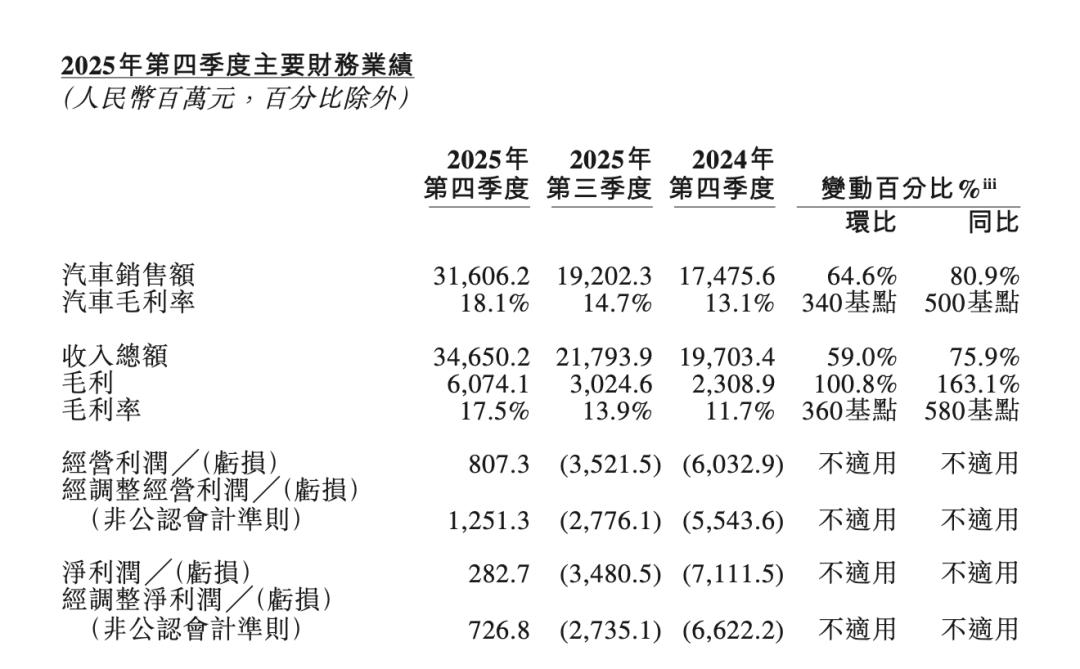
NIO's financial report for the fourth quarter and the whole year of 2025
Even though NIO failed to achieve the goal of delivering over 50,000 vehicles per month last year, other good news may be enough to cover this flaw.
In the fourth quarter of 2025, NIO's quarterly revenue, delivery volume, and total gross profit all reached record highs. Both the vehicle gross profit margin and the comprehensive gross profit margin reached new highs in three years. The company achieved positive free cash flow for two consecutive quarters and positive operating cash flow for the whole year of 2025.
After the release of the financial report, NIO's US - listed stocks soared 5% in pre - market trading on March 10 and closed up 15.38%. On March 11, NIO's Hong Kong - listed stocks also closed up more than 14%.
Li Bin couldn't hide his joy at the earnings conference call. He repeatedly mentioned the goal of achieving profitability in the fourth quarter in different occasions last year, and now he has finally fulfilled his promise. He declared that the company has officially entered the third stage of development and will start a new round of high - speed growth cycle. NIO's new business goal is to achieve full - year Non - GAAP profitability in 2026.
The fact that an automobile company finally achieved single - quarter profitability after more than a decade of establishment may not prove much. The only thing it can prove is how poorly the company has been managed in the past.
Many people used Tesla as an example to justify - Tesla also took 10 years to achieve quarterly profitability for the first time. However, Tesla was in a completely different development stage. When Tesla was founded in 2003, new energy vehicles seemed like a fantasy. When NIO was founded in 2014, Tesla had already released the Model S and Model X and had officially started deliveries in China.
Compared with its domestic new energy vehicle peers, NIO's best - ever financial report is not that impressive. NIO's vehicle gross profit margin reached 18.1% in that quarter, which is the level that Li Auto achieved three or four years ago. Xiaomi Auto achieved a vehicle gross profit margin of over 20% in the fourth quarter of 2024, just three years after starting to build cars.
However, for NIO, which has been in the red for a long time, achieving quarterly profitability for the first time at least proves that it has the qualification to survive. It's not that losses are so terrible - especially considering that Li Bin may be the CEO in China who is best at raising funds - but long - term losses will affect the market, users, and the industry's confidence in NIO.
Li Bin said in an interview with the media last year that the losses in the financial report had a comprehensive impact on them, affecting their user conversion rate, recruitment, and supply chain. So at this appropriate time, it is very important to prove that they can make a profit.
"Making a profit is not just for others to hear. We know that at this point, we need to do this to prove ourselves," Li Bin said.
How did NIO achieve quarterly profitability?
NIO is one of the Chinese new energy vehicle companies with the most losses. Since its listing eight years ago, NIO has accumulated an operating loss of 104 billion yuan, with an average annual loss of 13 billion yuan, which is about 35.61 million yuan per day. In 2023 and 2024, the years with the most serious losses, NIO's annual loss reached 22 billion yuan.
Wandian once measured NIO's money - losing speed with the price of gold, saying that the money the company lost per second was more expensive than the price of gold at the same time. "An inch of time is an inch of gold."
Even though NIO's annual loss in 2025 hit a new low in the past four years, it still reached 14.041 billion yuan. This was already the case after NIO finally achieved profitability in the fourth quarter. If only the first three quarters are considered, NIO's cumulative operating loss reached 14.849 billion yuan, with an average quarterly loss of 5 billion yuan. In comparison, NIO's annual loss was only about 4 billion yuan between 2020 and 2021.
No wonder Li Bin said internally in the middle of last year that when he first proposed the goal of achieving profitability in the fourth quarter, the proportion of people who believed in this goal might be less than 1%. Li Bin called for achieving profitability in the fourth quarter in the first quarter of last year. At that time, NIO's single - quarter loss hit a record high, with a quarterly loss of 6.4 billion yuan and a single - quarter sales volume of only 42,000 units. The company was almost at a critical juncture.
But why did NIO miraculously turn the corner after three quarters? In the past year, NIO's quarterly operating losses gradually narrowed, from 6.4 billion yuan, 4.9 billion yuan to 3.5 billion yuan, and finally achieved an operating profit of 800 million yuan in the fourth quarter, completely changing the negative voices from the outside world.
One aspect is the improvement of the sales structure. In the past few years, most of NIO's sales came from the 5566 models. In 2023, the cumulative sales of the 5566 models, including the NIO ET5/5T and NIO ES6/EC6, accounted for about 90% of NIO's annual sales. However, the sales of NIO's high - end models such as the ES8 never made a breakthrough. The second brand, LeDao L60, which NIO had high hopes for, also failed, directly leading to the departure of Ai Tiecheng.
The change occurred after the launch of the LeDao L90 and the new NIO ES8. Both abandoned NIO's previous high - end strategy and began to emphasize cost - effectiveness, boosting NIO's sales reversal in the second half of the year.
The LeDao L90 is priced at 265,800 yuan, and the price is less than 200,000 yuan if purchased with the battery rental option, which completely reversed the sluggish sales situation of LeDao. The new NIO ES8 launched in September continued the strategy of "more features without a price increase". Its starting price was about 100,000 yuan lower than the previous model, and the price dropped to 300,000 yuan if purchased with the battery rental option.
Last year, NIO delivered a total of 326,028 vehicles, a year - on - year increase of 46.9%, setting a new record. Among them, the vehicle delivery volume in the fourth quarter reached 124,807 units, a year - on - year increase of 71.7%.
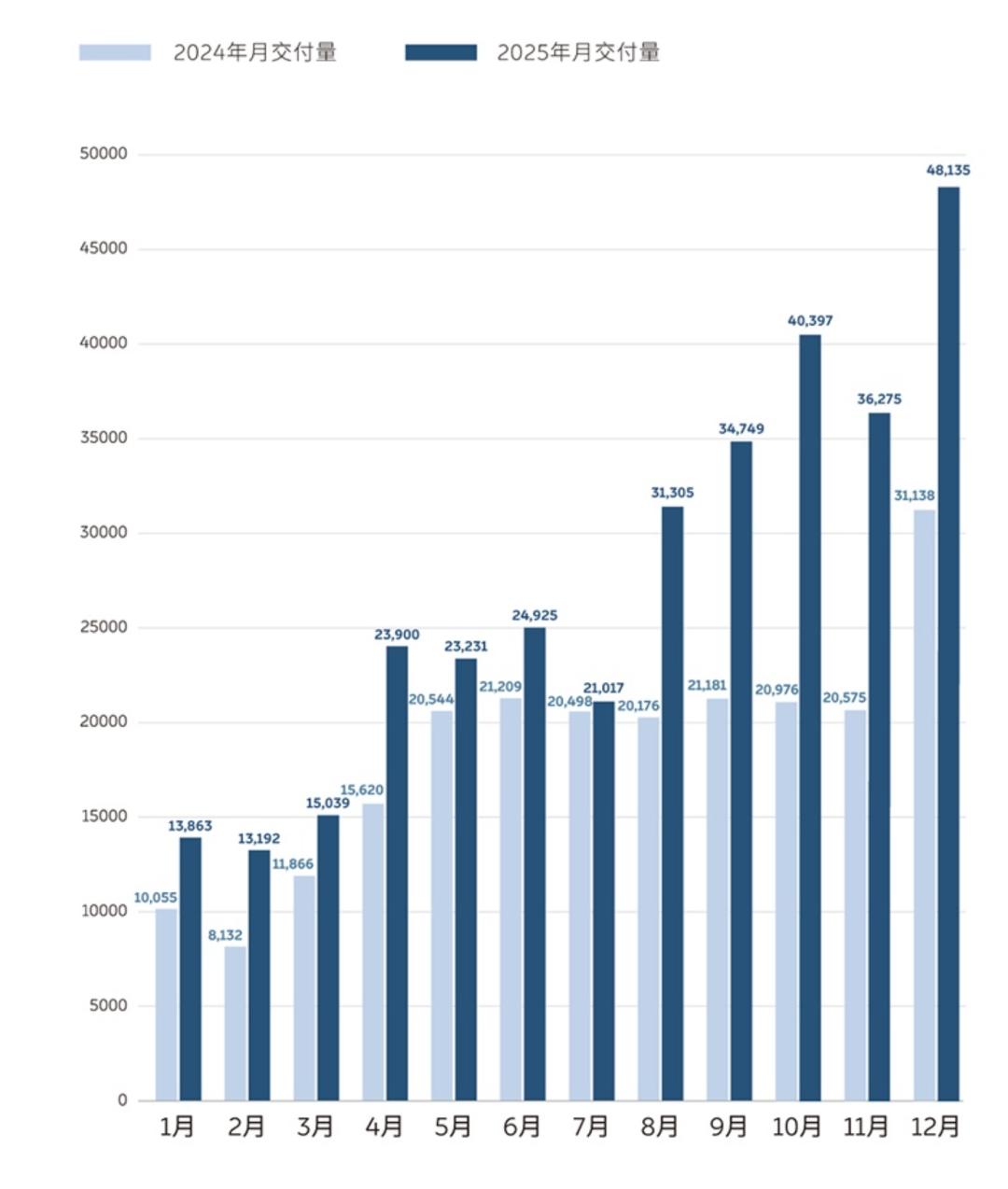
Statistics of NIO's monthly vehicle delivery volume
The NIO ES8 contributed a lot. It achieved the goal of delivering 70,000 vehicles only 160 days after its launch. According to the data of the Passenger Car Market Information Joint Conference of the China Automobile Dealers Association, the NIO ES8 won the sales championship of large SUVs and models above 400,000 yuan for three consecutive months (from December last year to February this year). The LeDao L90 also had good sales. NIO said it was the sales champion of pure - electric large SUVs in 2025.
Driven by high - end models, NIO's vehicle sales revenue in the fourth quarter of last year reached 31.606 billion yuan, a year - on - year increase of 80.9%. The gross profit for the quarter increased by 163.1% year - on - year to 6.074 billion yuan, and the vehicle gross profit margin also reached a three - year high of 18.1%, compared with only 13.1% in the same period last year.
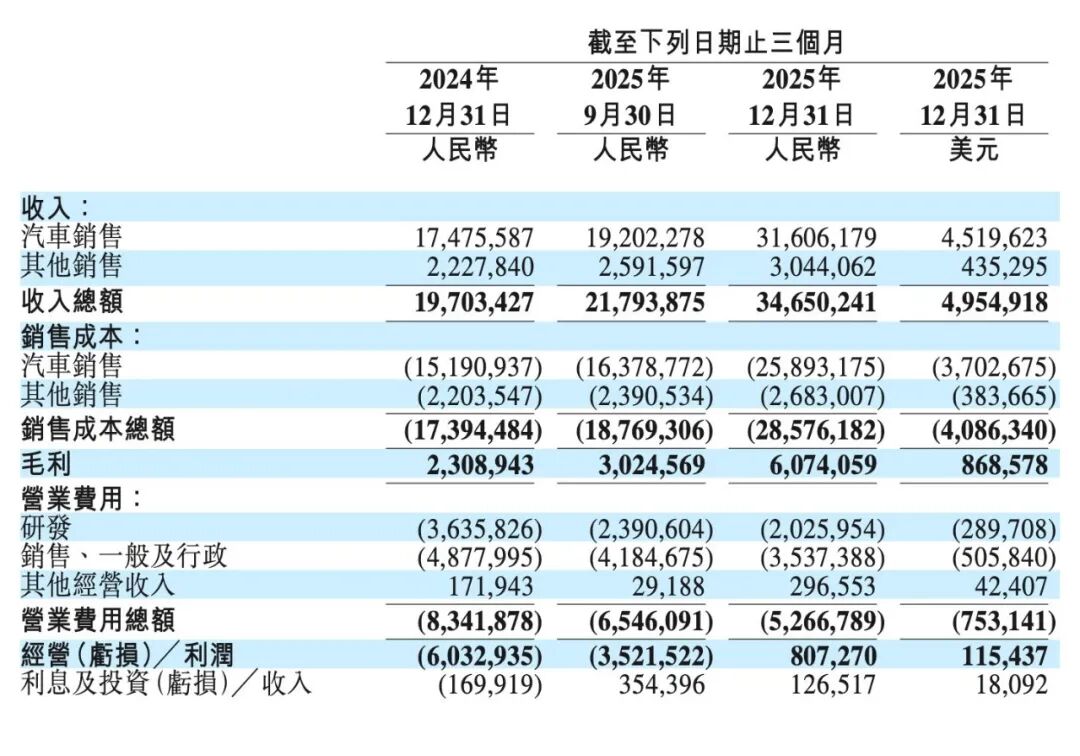
NIO's financial report for the fourth quarter and the whole year of 2025
While increasing revenue, NIO also significantly tightened costs and expenses. At the beginning of last year, Li Bin proposed an organizational change called the CBU mechanism (Basic Business Unit) internally, emphasizing cost reduction and efficiency improvement. At that time, 36Kr quoted a person close to NIO's management as saying, "The new mechanism requires that every penny invested should yield results."
Reflected in the financial report, NIO's R & D investment was continuously reduced in the first three quarters of last year. In the first half of the year, the quarterly R & D investment remained at the level of 3 billion yuan, but it was reduced to 2.39 billion yuan in the third quarter and further dropped to 2.026 billion yuan in the fourth quarter. The selling, general, and administrative expenses also continued to decline, from 4.4 billion yuan at the beginning of the year to 3.537 billion yuan at the end of the year.
Through these two measures, NIO finally achieved an operating profit of 800 million yuan in the fourth quarter of last year, achieving quarterly profitability for the first time since its listing.
A glimmer of hope for now
Achieving quarterly profitability for the first time does not mean that NIO's profitability is stable. Even Tesla, a powerful company, returned to the loss situation many times after achieving quarterly profitability for the first time in 2013.
In the highly competitive new energy vehicle market, the quality of a model can either save a company's performance or bring a severe blow.
Before 2024, Li Auto was once the top - selling new - energy vehicle brand among new forces in the Chinese market. However, with the failure of the Li MEGA and subsequent pure - electric models, Li Auto's growth stalled. Its annual sales volume in 2025 was only 406,000 units, a year - on - year decline of about 19%.
At the earnings conference call, analysts were particularly concerned about NIO's future sales growth and gross profit margin, worried about whether NIO could continue the growth trajectory of the fourth quarter of last year. They also had doubts about NIO's cost control - the profitability in the fourth quarter of last year was really abnormal for NIO.
Li Bin said that he is very confident that NIO's sales will grow by 40% - 50% in 2026. His confidence comes from the launch of large SUV models. This year, they will have a total of 5 large SUVs on sale. In addition to the NIO ES9, which is positioned as an executive flagship, a large five - seat SUV based on the ES8 platform will be launched in the third quarter, and the LeDao L80 will be launched in the second quarter, fully covering the high - end large SUV market. Large SUVs can contribute more sales and profits and have higher risk - resistance capabilities.
However, these models will not be launched until after the second quarter. In the first quarter of this year, NIO's sales volume dropped to about 20,000 units per month. NIO's sales guidance for the first quarter in the financial report is between 80,000 and 83,000 units. Considering that NIO's cumulative delivery volume in the first two months was 47,979 units, the delivery volume in March is approximately between 32,000 and 35,000 units, slightly lower than the market expectation.
However, NIO's revenue guidance is slightly higher than expected. The market believes that it is mainly driven by the high - end model ES8. NIO's CFO, Qu Yu, explained in the earnings conference call that since the ES8's delivery volume accounts for a relatively high proportion in the first quarter, they expect the gross profit margin and vehicle gross profit margin in the first quarter of this year to remain at the level of the fourth quarter of last year.
At the same time, they will continue to maintain cost control since the second half of last year. The R & D investment scale per quarter in 2026 is expected to be between 2 billion and 2.5 billion yuan, and the annual level will be similar to that of 2025. The selling, general, and administrative expenses will be controlled within 10% of the total sales revenue.
If NIO's sales can continue to grow as they did in the second half of last year, Li Bin's goal of achieving full - year Non - GAAP profitability this year may also be achieved.
In any case, for NIO, they have finally proved themselves at this stage. In the past, NIO has always adhered to the value of "long - termism". They chose to self - develop chips, build battery - swapping stations, and even self - develop mobile phone products. These investments have always been criticized for being too costly and difficult to see returns in the short term, and they have dragged down NIO's performance.
Fortunately, these investments are now showing hope with the quarterly profitability. Excluding the suspended mobile phone business, NIO's self - developed chip, Shenji, has been officially mass - produced and installed in vehicles, and it received independent financing of 2.257 billion yuan in February this year. Although NIO's battery - swapping strategy is still highly questioned, the popularity of models such as the LeDao L90 and NIO ES8 since the second half of last year may prove to some extent that the battery rental purchase method is gradually being accepted by the market.
At the same time as the release of the financial report, NIO's board of directors approved the 2026 stock incentive plan, granting about 248 million restricted shares to Li Bin. These restricted shares are divided into 10 equal batches, but they can only be vested after the company's market value and net profit reach certain targets. The first - stage target is for the company's market value to exceed $30 billion, and the final target is for the company's net profit to exceed $6 billion. The maximum term of the stock incentive plan is 12 years.
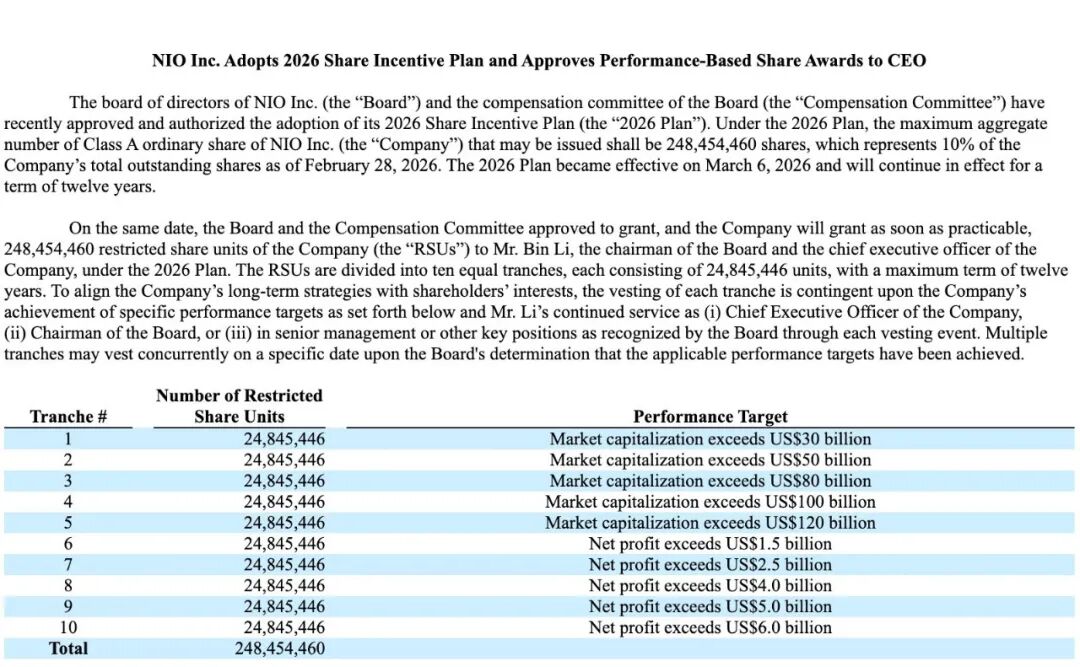
As of the close of US - listed stocks yesterday, NIO's market value was about $13.943 billion. As of December 31, 2025, NIO's current liabilities still exceeded its current assets.