Understand Micro LED CPO in One Article
There's a new "gimmick" in the field of optical communication.
Not long ago, a research report titled "Micro LED CPO Opens a New Chapter in Data Center Interconnection" caught the attention of the entire industry and the capital market.
The research report points out that Micro LED CPO has the disruptive advantages of high bandwidth, low power consumption, and miniaturization, which can reduce the overall power consumption of optical modules by 20 times. Industry experts have also predicted that this technology will redefine the architecture design of data centers and may trigger a technological innovation storm in the next few years.
Affected by this news, on March 5th, Micro LED concept stocks collectively soared. Among the top 10 gainers, 7 were "opto - electronic" concept stocks, riding high on the wave.
So, what exactly is Micro LED CPO? Is it really that powerful? In this article today, Xiaozao Jun will give you an in - depth interpretation.
Micro LED CPO = Micro LED + CPO
Micro LED CPO is actually the in - depth integration of Micro - scale Light - Emitting Diodes (Micro LED) and Co - Packaged Optics (CPO).
Neither Micro LED nor CPO is a new term. Let's start with CPO first.
A few years ago, Xiaozao Jun popularized the knowledge of CPO for everyone (What exactly is NPO/CPO?). The essence of CPO is to "move" the optical module (optical engine) from the outer surface of the switch into the heart of the switch and package it together with the AISC switching chip.
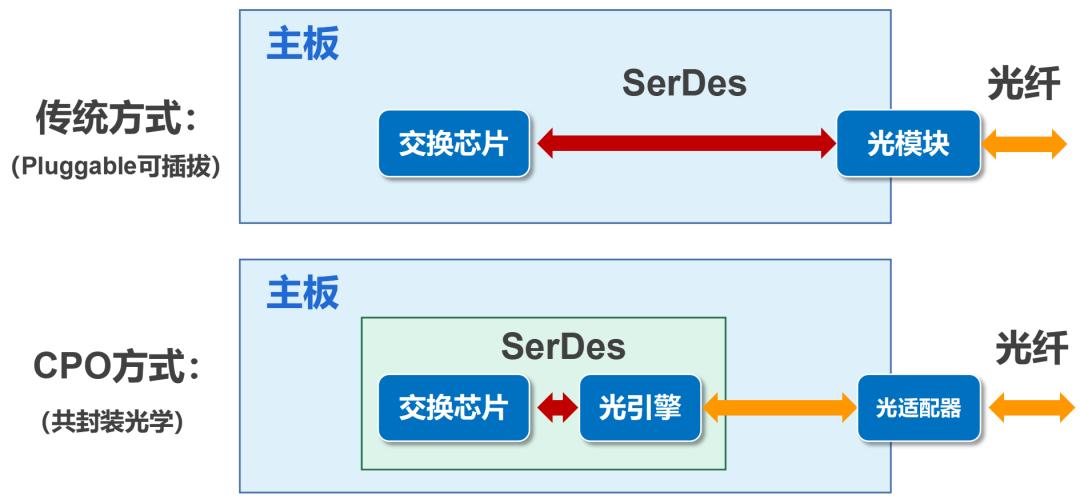
In this way, the distance of the "electrical channel (the red line in the above figure)" between the optical module and the switching chip can be shortened, thereby significantly suppressing the high - frequency signal attenuation and electromagnetic interference that electrical signals are prone to.
The "electrical channel" has always been the main factor limiting the connection rate. When the rate exceeds 1.6 Tbps, the traditional pluggable optical module solution has approached its physical limit. The signal integrity deteriorates sharply, the bit - error rate soars, and the heat dissipation and power consumption also increase exponentially.
In the past few years, the CPO technology has developed rapidly and has begun to enter the stage of large - scale commercial use. The capital market also responded early, and the relevant concept stocks have shown obvious increases since 2024.
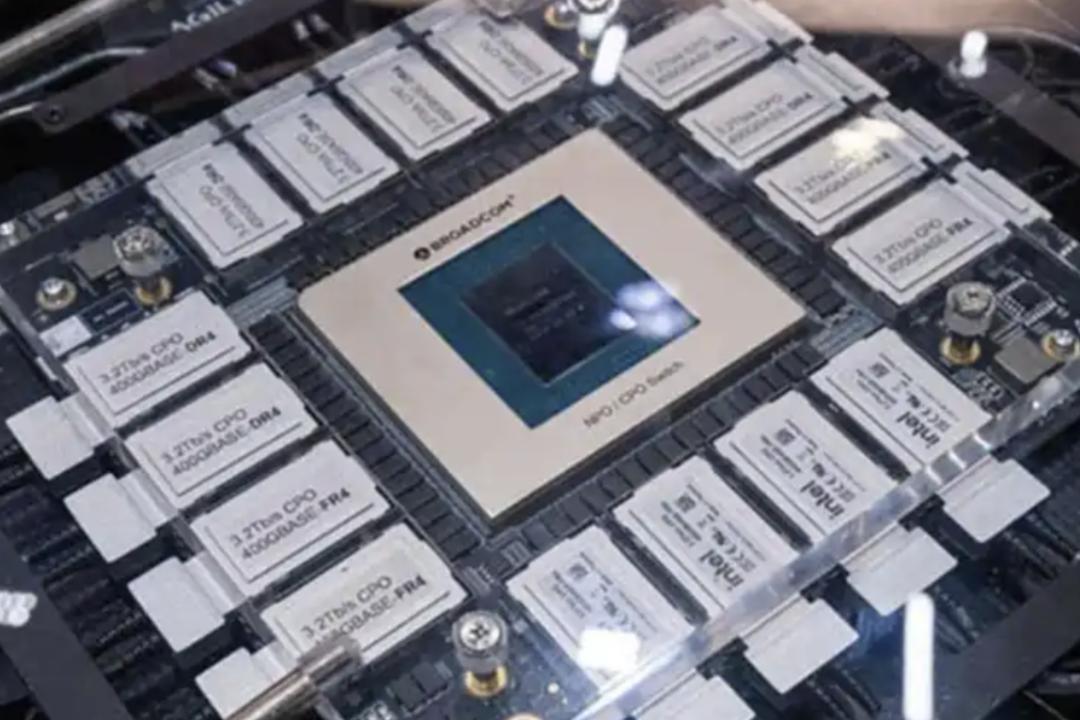
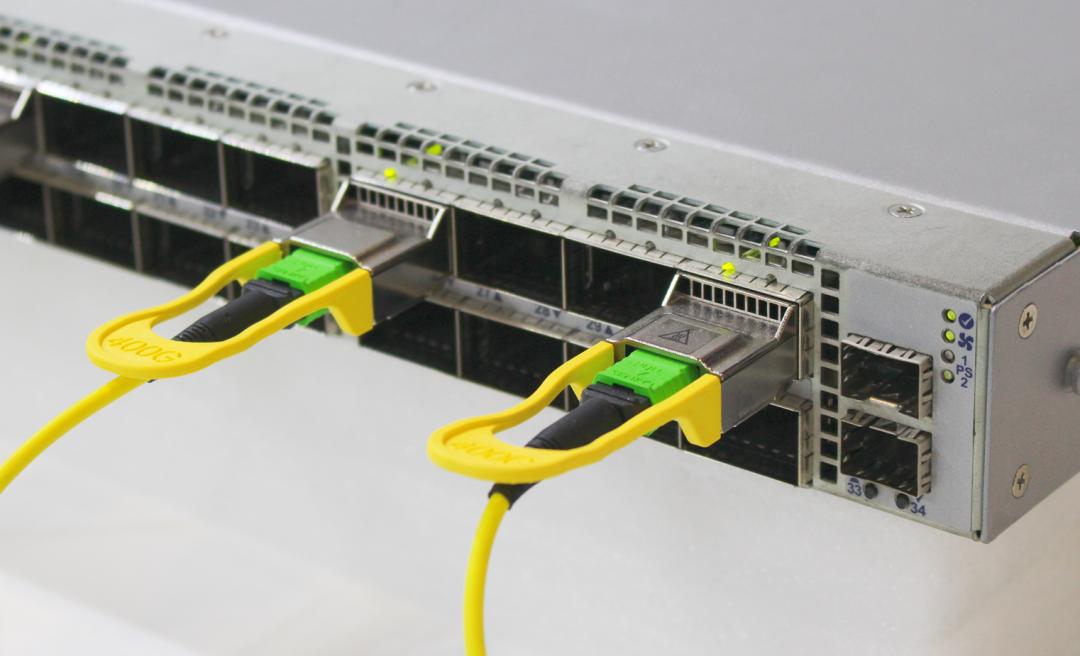
Physical picture of CPO
Now, let's take a look at Micro LED. In fact, the key to the popularity of Micro LED CPO this time lies in Micro LED.
What comes to mind when you first see Micro LED? Of course, it's the display. All along, the liquid - crystal displays we use have adopted technologies such as LCD and LED.
Micro LED is a more advanced LED technology. "Micro" means "tiny". Micro LED is a self - emitting pixel array technology that shrinks LEDs to less than 5 microns. Each pixel is independently driven, has no backlight, and has a response speed in the nanosecond range.
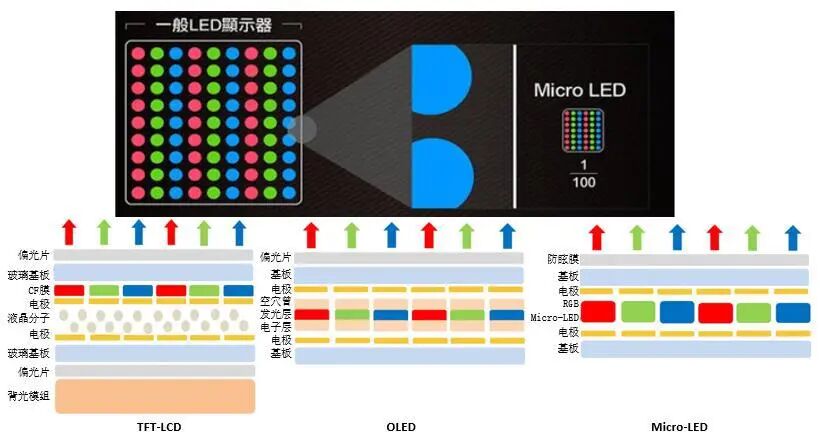
It was the well - known Apple Vision Pro that brought Micro LED from the laboratory into the public eye. To put it simply, Micro LED was originally developed for AR/VR.
Later, experts found that the micron - scale pixel size, nanosecond - level response speed, and ultra - high luminous efficiency of Micro LED provide an excellent light source foundation for optical interconnection - a smaller light - emitting area, a lower driving voltage, and a higher modulation bandwidth, which can increase the generation efficiency of optical signals by an order of magnitude.
As Xiaozao Jun has popularized before, an optical module is actually for emitting and receiving light and converting optical and electrical signals.
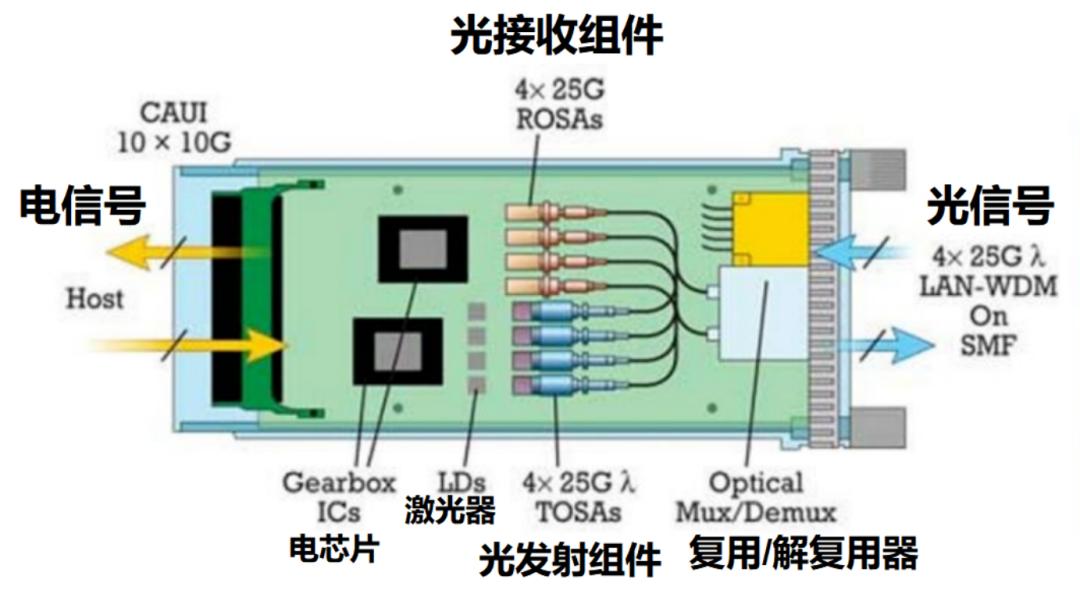
Composition of an optical module
Traditional optical modules use edge - emitting lasers (EEL) or vertical - cavity surface - emitting lasers (VCSEL). These lasers are large in size and high in power consumption, and their modulation efficiency and energy efficiency can no longer meet the needs of the era.
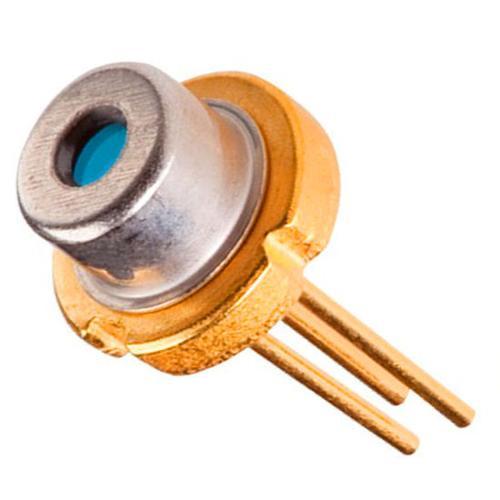
VCSEL laser
Although the silicon - photonics solution can improve the integration to a certain extent, there are also problems in terms of light - source coupling efficiency and wafer - level yield.
As we all know, with the explosive growth of AI, the demand for the construction of intelligent computing centers is very strong. In intelligent computing centers, there are large - scale computing clusters that require high - speed, low - latency, and low - power interconnection between chips.
Nvidia's copper - cable solution uses all electrical signals, which has extremely high costs and power consumption and a very short transmission distance (a few meters).
The optical interconnection solution of traditional lasers also has very high power consumption per module. In a large - scale data center, the power consumption of optical modules alone accounts for more than 25%, which seriously affects the overall energy efficiency and cost.
The emergence of Micro LED provides a better solution.
According to the latest research data, taking a 1.6 Tbps optical communication product as an example, the power consumption of a traditional optical module is as high as 30 W. If the Micro LED CPO solution is adopted, the overall power consumption is expected to be significantly reduced by more than 95%, dropping to about 1.6 W.
Data from some institutions also shows that the power consumption per channel of the optical interconnection solution based on Micro LED can be reduced to 1/10 of the traditional VCSEL solution and 1/5 of the silicon - photonics solution, and the integration density of the optical engine can be increased by more than 3 times.
This is a very amazing improvement in energy efficiency, which can greatly relieve the power consumption and heat - dissipation pressure of intelligent computing centers and significantly reduce the operating costs.
If a 100,000 - GPU cluster uses Micro LED CPO for all inter - rack interconnections, it can save 15 million kWh of electricity per year, which is equivalent to reducing about 12,000 tons of carbon emissions.
Why is Micro LED so powerful?
Micro LED is just a change of light source. Why does it bring such a big improvement?
Let's analyze it from the underlying principle.
A traditional laser is like a "large searchlight", while Micro LED is an array of hundreds or even thousands of "miniature flashlights".
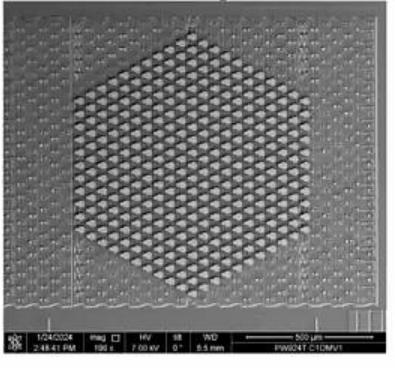
Micro LED emission array
These Micro LEDs are less than 50 microns in size and are integrated and packaged with the CMOS drive circuit, which can achieve a higher - density parallel optical emission.
Each Micro LED corresponds to an independent data channel, which reduces the rate requirement of a single channel. It only requires an extremely low driving current of μA (microampere) and uses simple direct NRZ modulation (no additional modulator is required). For example, for a 128 - Micro LED array with a rate of 4 Gbps per channel, the bandwidth can exceed 400 G.
The multiple optical signals emitted by the Micro LED array are collimated and focused by a special lens and then coupled into a multi - core imaging fiber for parallel transmission.
At the receiving end, the optical signals are converted back to electrical signals through a CMOS - integrated PD (photodetector) array. The entire process does not require complex WDM (wavelength - division multiplexing) or high - speed SerDes, and the power consumption is directly reduced to 80 fJ/bit (at the transmitting end, before FEC forward error correction). (fJ = femtojoule, 1 femtojoule = 10^{-15} joule.)
In contrast, traditional lasers are larger in size (millimeter - level), have a high laser threshold current, and the driving current is about 200 mA or more. They also need to be paired with a high - power TIA (transimpedance amplifier) and a DSP (digital signal processing chip), and the energy consumption is generally higher than 1.2 pJ/bit (pJ = picojoule, 1 picojoule = 1000 femtojoules). Even with the silicon - photonics solution, the energy consumption reaches 400 fJ/bit.
Micro LED has an extremely high carrier recombination efficiency, and there is almost no heat loss during the photon generation process. It has a faster response speed, higher modulation efficiency, and more than 3 times the photon utilization rate. In addition, it has excellent compatibility with the CMOS process, enabling high - density monolithic integration of optical devices and completely avoiding the parasitic losses and thermal resistance bottlenecks caused by multi - level packaging in traditional optical modules.
Micro LED has a wider operating temperature range and can output stably from - 40°C to 125°C (it can still maintain more than 90% of the light output at a high temperature of 85°C) without the need for TEC temperature control.
In contrast, traditional lasers show obvious wavelength drift and efficiency attenuation above 85°C and must rely on high - power thermoelectric cooling.
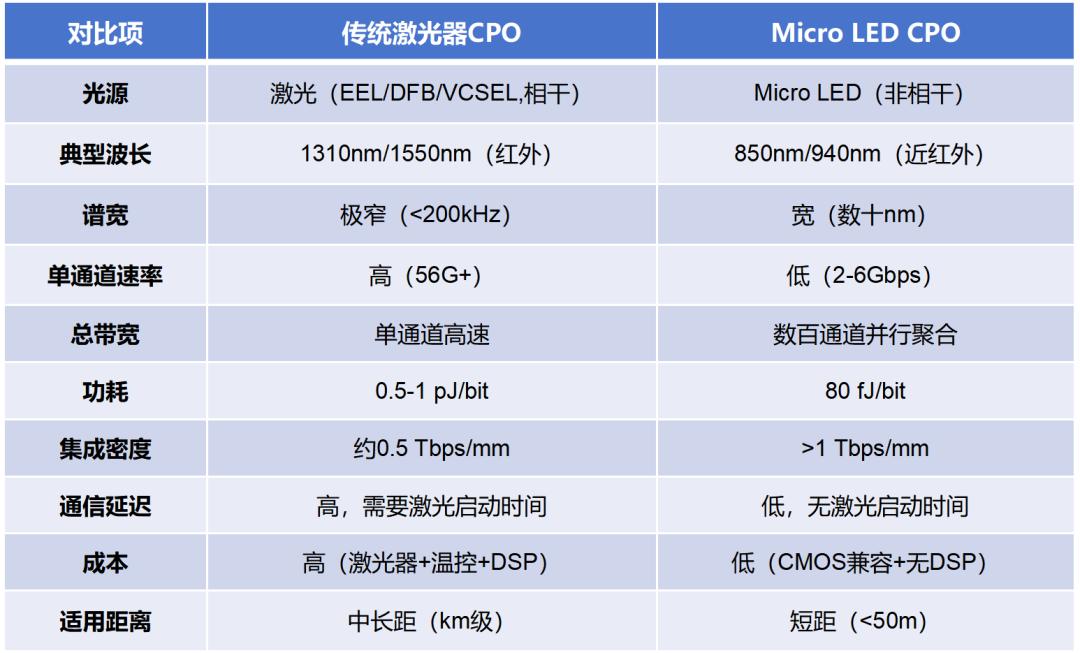
Micro LED and the CPO architecture are a perfect match. The low - heat - consumption characteristic of Micro LED just solves the heat - dissipation problem caused by the high integration of CPO. And the ultra - short electrical interconnection path provided by CPO can fully exert the nanosecond - level modulation potential of Micro LED.
In the past, limited by the modulation bandwidth and thermal management bottleneck of VCSEL, CPO had to make repeated compromises among rate, power consumption, and packaging density. Now, with a lower driving voltage, smaller thermal resistance, and higher photon conversion efficiency, Micro LED has truly released the physical potential of the CPO architecture.
Many people in the industry call "traditional laser + CPO" CPO 1.0, and define "Micro LED + CPO" as CPO 2.0. It is no longer just a physical migration of the interconnection architecture, but also a paradigm shift in optoelectronic device and system - level design.
Micro LED still faces many challenges
Micro LED CPO is very powerful. However, it is not an easy thing to truly achieve commercialization. There are still many challenges in terms of core technology, process flow, and industrial support.
The Micro LEDs used for optical interconnection are very different from display - grade Micro LEDs in terms of material system, wavelength matching, and yield control, and cannot be directly used.
In terms of wavelength bands, display - grade Micro LEDs mainly use the visible - light band (usually GaN - based blue - light chips), while optical communication requires specific communication bands such as 850 nm and 1310 nm, which puts completely different requirements on epitaxial materials and chip design, and greatly increases the difficulty of wafer heterogeneous integration.
In terms of modulation bandwidth, the modulation bandwidth of commercial display - grade Micro LEDs is generally within 10 GHz. For optical communication applications, to achieve a rate of more than 1.6 Tbps, a single channel requires a modulation bandwidth of more than 50 GHz.
High frequency means higher requirements for materials to ensure that the optical power, bandwidth, and linearity do not decline significantly. For InP (indium phosphide) - based Micro LEDs under 50 - GHz high - frequency driving, the junction - temperature climbing rate is 3 times faster than that of display - grade ones, which also brings thermal management challenges.
Previously, a person from a certain manufacturer revealed that the 850 - nm - band samples of Micro LED only achieved a bandwidth of 25 GHz, and the high - frequency samples above 50 GHz are still under verification.
In terms of optical coupling accuracy, Micro LED requires nanometer - level alignment, and the process tolerance is extremely low. The coupling accuracy needs to be controlled within ±1 - 2 microns; otherwise, the coupling efficiency loss can reach more than 30%.
In terms of reliability, the working environment and intensity of optical interconnection in data centers are much harsher than those of ordinary displays, and optical devices need to have stronger environmental tolerance. For example, under high - temperature, high - humidity, and long - term full - load operation, the optical power attenuation rate must be less than 0.1% per thousand hours, and the service life requirement is more than 25 years.
It is also worth mentioning the communication - distance limitation of the Micro LED CPO solution.
LEDs have a wide spectrum and large dispersion. Over long distances, there will be a large amount of optical crosstalk. Therefore, the Micro LED CPO solution is currently only suitable for short - distance interconnection scenarios (<50 meters), such as data transmission within a cabinet or between adjacent racks (internal connection of GPU clusters). For medium - and long - distance requirements such as cross - machine - room and metropolitan - area applications, traditional optical modules and DWDM technology still need to be used in synergy.
If Micro LED is mass - produced, it also involves a technical challenge called "mass transfer".
To put it simply, mass transfer is to quickly and accurately transfer millions or even hundreds of millions of micron - scale LED chips from the growth substrate to the driving - circuit substrate for display or optical communication. This process requires extremely high accuracy and efficiency. A slight deviation will lead to a decrease in yield and a sharp increase in cost.
Currently, the industry has proposed a variety of mass - transfer technology solutions, but there are still many bottlenecks in practical applications, which need further