From the 2.2 billion yuan financing, see if the chip strategies of NIO, XPeng, and Li Auto can break through
Recently, NIO Group issued an announcement stating that its chip subsidiary, Anhui Shenji Technology Co., Ltd., has completed the signing of the first - round equity financing agreement, with a financing amount of 2.257 billion yuan. The post - investment valuation is close to 10 billion yuan. This round of financing has attracted multiple state - owned capitals, semiconductor industry capitals, and market - oriented investment institutions, including Hefei State - owned Investment Group, Hefei Haiheng Investment Group, IDG Capital, SMIC Juyuan Investment, and Yuanhe Puhua Investment.
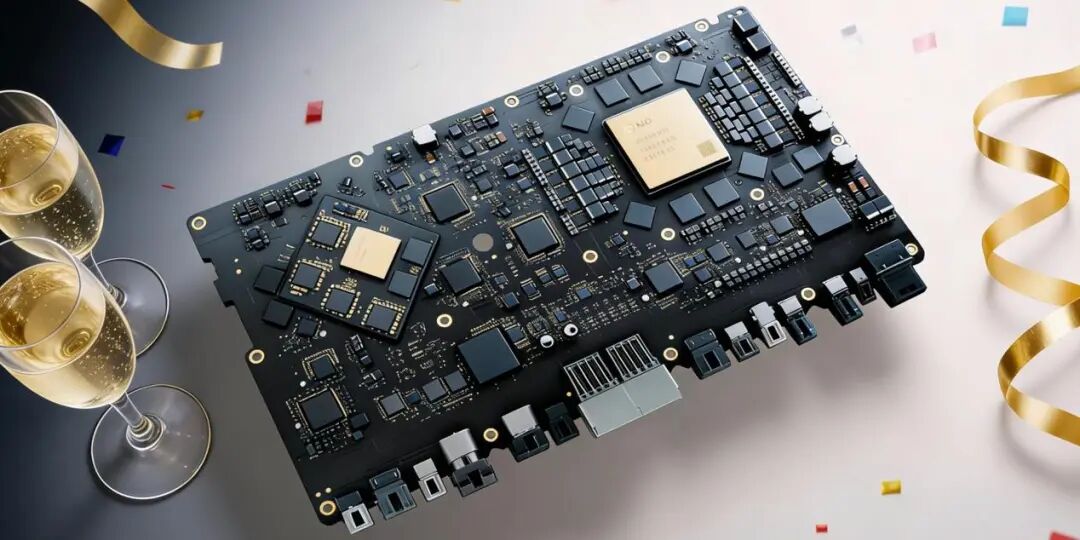
In the past three years, the intelligent driving industry has experienced a so - called "computing power competition" that seems prosperous but actually hides a crisis. Automobile manufacturers have rushed to install NVIDIA's Orin - X chips, achieving the rapid launch of intelligent driving functions by piling up general computing power. However, they have also fallen into the quagmire of homogeneous competition.
However, with the end - to - end large model fully taking over urban intelligent driving in 2025, the drawbacks of the energy - efficiency ratio of general chips have been completely exposed: high power consumption directly affects the endurance of pure - electric vehicles; the heterogeneous architecture between the software stack and the underlying hardware is difficult to match, resulting in the inference delay of the large model being unable to reach the "human - like response" in milliseconds. Against this background, the seeds of self - developed chips sown by NIO in 2021 finally reaped concentrated rewards in 2026.
This article will briefly analyze the capital logic, technological breakthroughs, and business changes behind the financing event of NIO's chip subsidiary, discuss how this financing reshapes the competitive landscape of China's automotive - grade chips, and look forward to the three certain trends in the era of "computing power sovereignty" of intelligent vehicles from 2026 to 2030.
01 The Capital Logic Behind the 2.2 - Billion - Yuan Financing
Anhui Shenji Technology Co., Ltd. was established in June 2025. As an independent entity established after NIO spun off its self - developed chip business, its legal representative is Bai Jian, the senior vice - president of NIO and the person in charge of intelligent hardware. The company's core product is the 5nm automotive - grade high - order intelligent driving chip "Shenji NX9031". Since its production in 2024, it has shipped more than 150,000 units in total and has been successfully deployed in all NIO models.
The scale of this round of financing reached 2.257 billion yuan, and the post - investment valuation is nearly 10 billion yuan, showing the characteristic of joint participation of diversified capitals. In terms of the composition of investors, there are both local state - owned capitals (Hefei State - owned Investment Group, Hefei Haiheng Investment Group), funds with semiconductor industry chain backgrounds (SMIC Juyuan Investment, Yuanhe Puhua Investment), and well - known market - oriented institutions (IDG Capital).
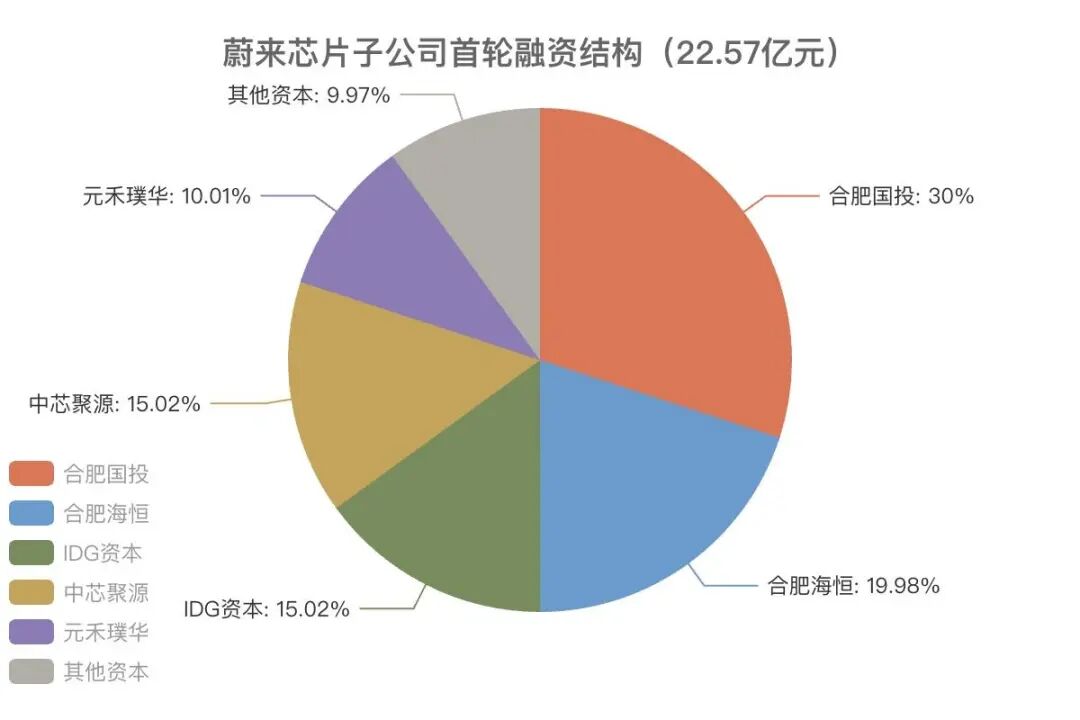
Data source: NIO's announcements and public information, for reference only
Zhang Xiang, a visiting professor at Huanghe S & T University, once said in an interview: "Shenji's ability to complete the first - round financing with a relatively high threshold shows that the capital market recognizes its technical route, mass - production ability, and application implementation progress."
Meanwhile, the participation of local state - owned capital also echoes Hefei's continuous efforts in the layout of the integrated circuit industry in recent years. As an important base for the integrated circuit industry in China, Hefei has formed a complete industrial chain from design, manufacturing to packaging and testing. The establishment and financing of Shenji further consolidate Hefei's leading position in the field of automotive - grade chips.
From a financial perspective, this round of financing marks the transformation of NIO's chip business from the "internal cultivation stage" to the "new stage of pursuing return on investment". NIO founder Li Bin once revealed that the R & D cost of Shenji NX9031 is equivalent to building 1,500 battery swapping stations. Calculated at a cost of 1.5 million to 2 million yuan per station, the total investment is between 2.25 billion and 3 billion yuan.
Introducing external investment not only helps relieve NIO's capital pressure but also forms a deep - seated binding with partners through equity - level cooperation to jointly share the high R & D costs and tape - out risks of chips.
More notably, Shenji's independent financing has opened up a channel for NIO to reshape its valuation outside the secondary market. The independent chip entity has the possibility of becoming a "Chinese - version Mobileye", which provides NIO with a new growth narrative in the context of increasingly fierce competition in the intelligent vehicle industry and pressured gross profit margins of complete vehicles.
02 Can Shenji Replace NVIDIA?
It is reported that Shenji NX9031 is the world's first mass - produced intelligent driving chip using 5nm automotive - grade process. Since its production in 2024, it has shipped more than 150,000 units in total and is fully installed in all NIO models such as ET9, ES6, EC6, and the new ES8. The core value of this chip is not simply the piling up of computing power but the architecture - level optimization for intelligent driving scenarios through the self - developed image signal processor (ISP) and neural network processing unit (NPU).
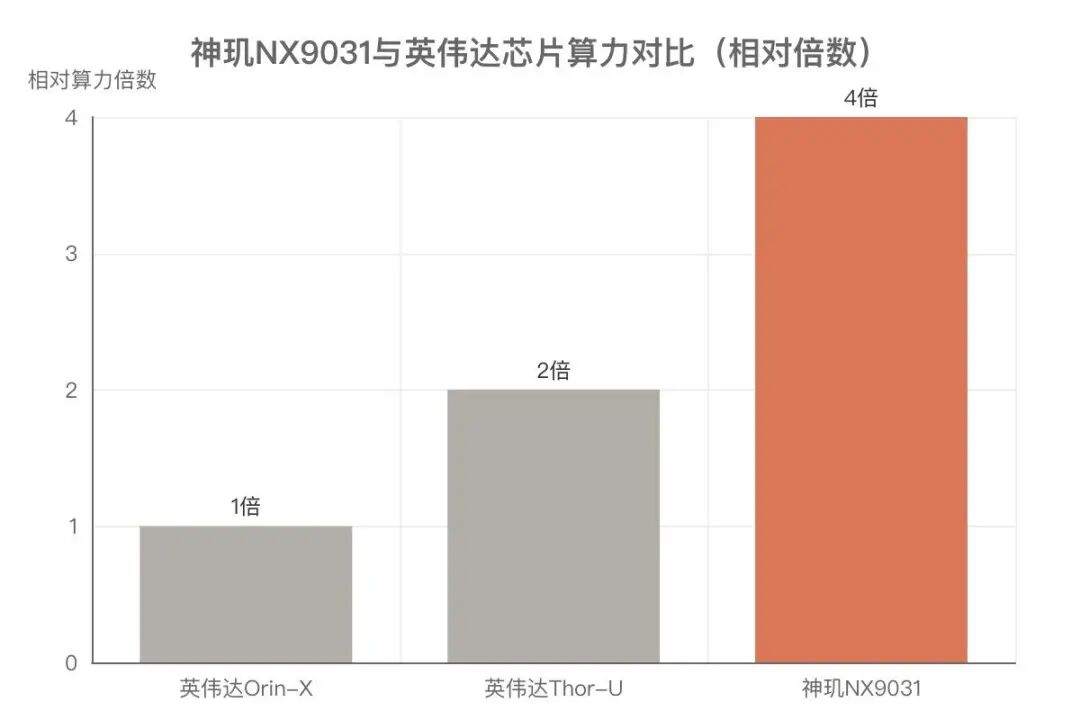
Data source: NIO's official technical documents, for reference only
When processing the BEV (bird's - eye view) algorithm with ultra - high pixels, Shenji's efficiency is more than three times that of contemporary general chips. This is due to its heterogeneous multi - core resource pool architecture, which supports multi - task concurrent processing and can cover various business scenarios such as perception, control, and cockpit computing. Zhang Danyu, the person in charge of NIO's chip design, introduced in May 2025 that some core indicators of this chip are better than those of general chips in the industry, and its mass - production time is earlier than that of NVIDIA's new - generation intelligent driving chip Thor - U.
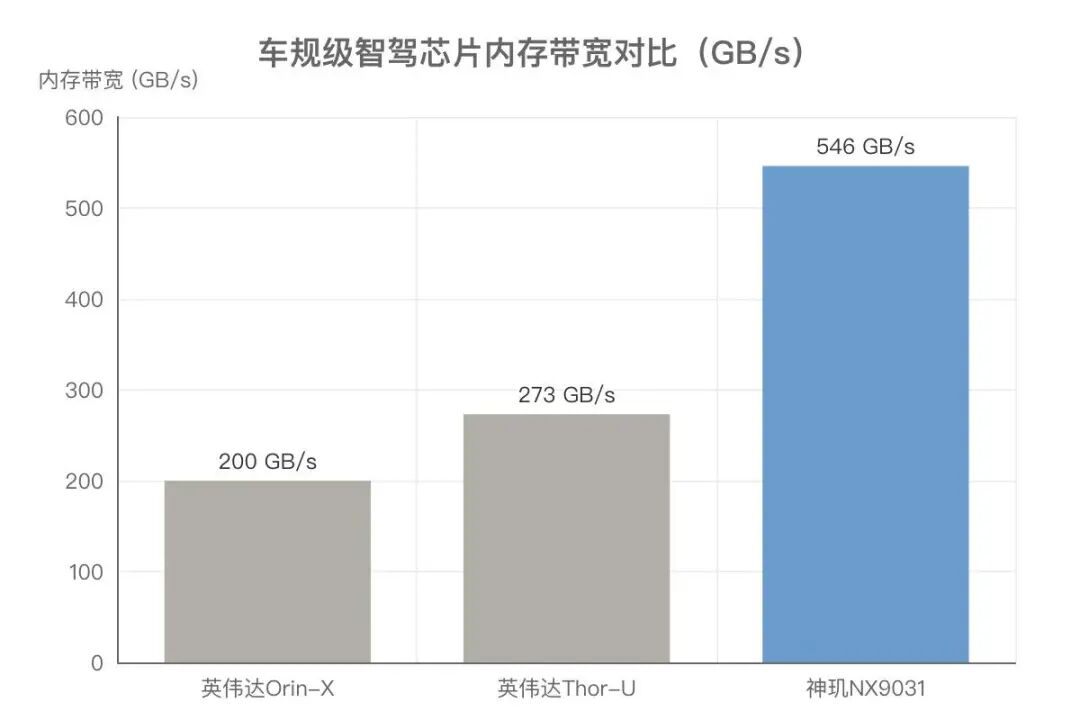
Data source: NIO's official data and industry research, for reference only
In addition to the computing power advantage, Shenji NX9031 has also achieved a breakthrough in the key indicator of memory bandwidth. NIO's official data shows that the memory bandwidth of this chip reaches 546 GB/s, which is twice that of NVIDIA's Thor - U (about