Let robots become skilled workers. Lei Jun and Ubtech have the same idea.
"Compared with performance shows, humanoid robots should be put to work in factories to do real things." This industry consensus found a more specific foothold at the National Two Sessions in 2026.
At the recent Two Sessions, Lei Jun, a National People's Congress deputy and the founder of Xiaomi Group, submitted five proposals in one go. One of them directly focused on those somewhat clumsy yet futuristic figures in the workshops - humanoid robots. He suggested promoting the transformation of humanoid robots from "apprentices" to "full - time workers" and accelerating their application in intelligent manufacturing.
This vivid metaphor precisely hits the core anxiety of the current humanoid robot industry: Why do these "geniuses" that can run and jump in the laboratory become clumsy "interns" once they enter the factory? How far are they from becoming real "veteran workers" on the production line?
Riding on the wave of the Two Sessions, let's take a look inside the factory workshops to see how those humanoid robots that are already "working" are performing, especially UBTECH, the so - called "top dog" in the humanoid field trying to carve out a new territory in the industrial scenario, and its competitors waiting in the wings.
Robots Excel in "Never Getting Tired"
Lei Jun's proposal reveals a profound understanding of the industry's pain points. He didn't just stop at the grand slogan of "vigorously developing" but set clear benchmarks for the "regularization" of robots.
He mentioned that by 2027, efforts should be made to ensure that the mean time between failures (MTBF) of robots in specific industrial scenarios exceeds 10,000 hours, and the task success rate exceeds 99%. What does this mean? It means that robots have to work continuously for more than a year without any problems, making at most one mistake in every hundred tasks, just like a dedicated old worker.
Moreover, Lei Jun also worried about the "ID card" issue of robots. He suggested accelerating the formulation and implementation of a unique code for humanoid robots. This is not only for production safety but also to establish a traceable file for each robot, making data security, ethics, and privacy traceable in the industrial scenario.
Lei Jun is not the only one advocating for humanoid robots to enter factories.
Entrepreneurs such as Zhou Yunjie, the Chairman and CEO of Haier Group, He Xiaopeng, the Chairman and CEO of XPeng Motors, and Liu Yonghao, the Chairman of New Hope Group, have also put forward relevant proposals. For example, Liu Yonghao mentioned that it is far from enough for robots to just perform shows. The current task of the industry is to make these robots serve industrial manufacturing, agricultural production, and family life in depth. There is a huge market prospect behind these three fields.
The market's keen perception has already been translated into action. In the past two years, "entering factories to work" has become a training method for leading humanoid robot companies. Products of companies such as UBTECH, Tesla, Xiaomi, Zhipu Robotics, and Unitree have entered different factory scenarios. Undoubtedly, UBTECH, headquartered in Shenzhen, is the benchmark in this "working wave."
In NIO's factory, the 1.7 - meter - tall Walker S series products of UBTECH are conducting quality inspections on door locks with millimeter - level precision. In Geely's 5G smart factory, they are shuttling between the three - dimensional warehouse and the general assembly workshop, coordinating the handling of large - sized material boxes.
Thanks to this real - world factory training experience, UBTECH's humanoid products have accumulated thousands of hours of training time and sufficient real - environment data, which has become the core confidence for its technological iteration.
However, there is still room for improvement in the efficiency of humanoid robots. Recently, when being interviewed by the media, Zhou Jian, the founder of UBTECH, admitted that currently, in simple tasks such as loading and unloading and intelligent handling, the completion rate of a single product has reached 99%. But compared with human efficiency, it is expected to reach 60% by 2026.
Although the efficiency is temporarily low, they excel in "never getting tired." In 2025, UBTECH launched the Walker S2, which pioneered the 3 - minute self - battery - swapping technology globally. When the battery level is below 20%, it can locate the nearest battery - swapping station through the group - brain network, and its arms can autonomously complete hot - swapping of the battery. The core system remains powered on throughout the process, and it can work continuously for three hours after battery swapping, truly achieving 7×24 - hour uninterrupted operation.
This "never - stopping" ability brings the vision of a lights - out factory one step closer - without human intervention, robots can charge themselves and keep working, becoming a stable and reliable new productive force.
"Now It's All About Work Ability"
The value of this training is being translated into real orders.
According to UBTECH, in 2025, the total order amount of its humanoid robots was nearly 1.4 billion yuan. The list of customers is quite impressive, including well - known companies such as BYD, Geely, FAW - Audi, Foxconn, and SF Express, and even Airbus, a global aviation manufacturing giant. From the automotive industry to 3C electronics, and then to aviation manufacturing and intelligent logistics, UBTECH seems determined to cast a wide net in the industrial scenario.
With orders worth nearly 1.4 billion yuan, the production capacity must keep up. Zhou Jian has recently been sending out signals of mass production: In 2025, UBTECH's production capacity of industrial humanoid robots exceeded 1,000 units, and the delivery volume exceeded 500 units. It plans to increase the annual production capacity to 10,000 units in 2026.
Regarding the future, a few years ago, Zhou Jian put forward a clear "three - step" plan: From 2023 to 2024, enter the new - energy vehicle manufacturing scenario and conduct tests on simple industrial scenario tasks; from 2025 to 2027, gradually expand to medium - difficulty tasks, focus on creating applications in 3 - 5 dedicated scenarios, and gradually achieve large - scale commercialization; from 2028 to 2033, expand to more complex task scenarios.
Interestingly, although UBTECH is currently fully committed to the industrial scenario, Zhou Jian's ultimate goal is still the household. He once said that the ultimate scenario for humanoid robots is to enter households. It is expected to take at least 3 to 5 years, and the most likely initial application will be in the emotional companionship scenario.
UBTECH is not alone. Zhipu Robotics, co - founded by Peng Zhihui (also known as Zhihui Jun, a former "Genius Teenager" at Huawei), is using the "laying eggs along the way" strategy to expand in the industrial field - implementing applications in corresponding scenarios as the technology matures.
Currently, Zhipu's influence has extended to eight scenarios, including industrial manufacturing, logistics sorting, and commercial cleaning. Peng Zhihui once pointed out that in early 2025, competitors were still comparing whose robots could walk more naturally. Now, everyone is competing on who has stronger work ability and who can better implement solutions. This coincides with Lei Jun's emphasis on the "99% task success rate." The core competitiveness in the second half of the industry has shifted from "dancing skills" to "practical work."
In terms of production capacity planning, Zhipu is also very ambitious. Peng Zhihui revealed that the company's joint - series products are expected to reach an output of 2 million units in 2026, and the cost per unit can be reduced to a minimum of 500 yuan. Once the cost of core components drops significantly, the large - scale popularization of humanoid robots will not be far away.
Cool Thinking on the Trillion - Dollar Track
Whether it is UBTECH's production capacity of 10,000 units or Zhipu's "laying eggs along the way," they all point to a common trend: Humanoid robots are moving from sample demonstrations to large - scale entry into factories.
According to Frost & Sullivan data, the global market size of embodied intelligent robot solutions is expected to grow from 82 billion yuan in 2024 to 367.5 billion yuan in 2030; the Chinese market will jump from 28.7 billion yuan to 142.6 billion yuan.
Despite the excitement, taking a calm look, humanoid robots are still apprentices at present. Moreover, problems such as poor process stability, high single - unit hardware cost, and a small number of workshop workstations, which are commonly faced by the industry, are all tough nuts to crack.
Although UBTECH has orders worth nearly 1.4 billion yuan, the outside world doesn't know how many of them can be actually fulfilled and how many are just "pretty numbers" in the contract framework. And Zhipu's claim of a production capacity of 2 million joints still needs time to test its actual delivery ability.
The multi - robot collaborative training of robots in Geely's factory looks cool. But to make it as stable, inexpensive, and error - free as the screw - tightening robots on the assembly line for decades, in addition to technology, the coordinated evolution of the entire industrial chain is also needed.
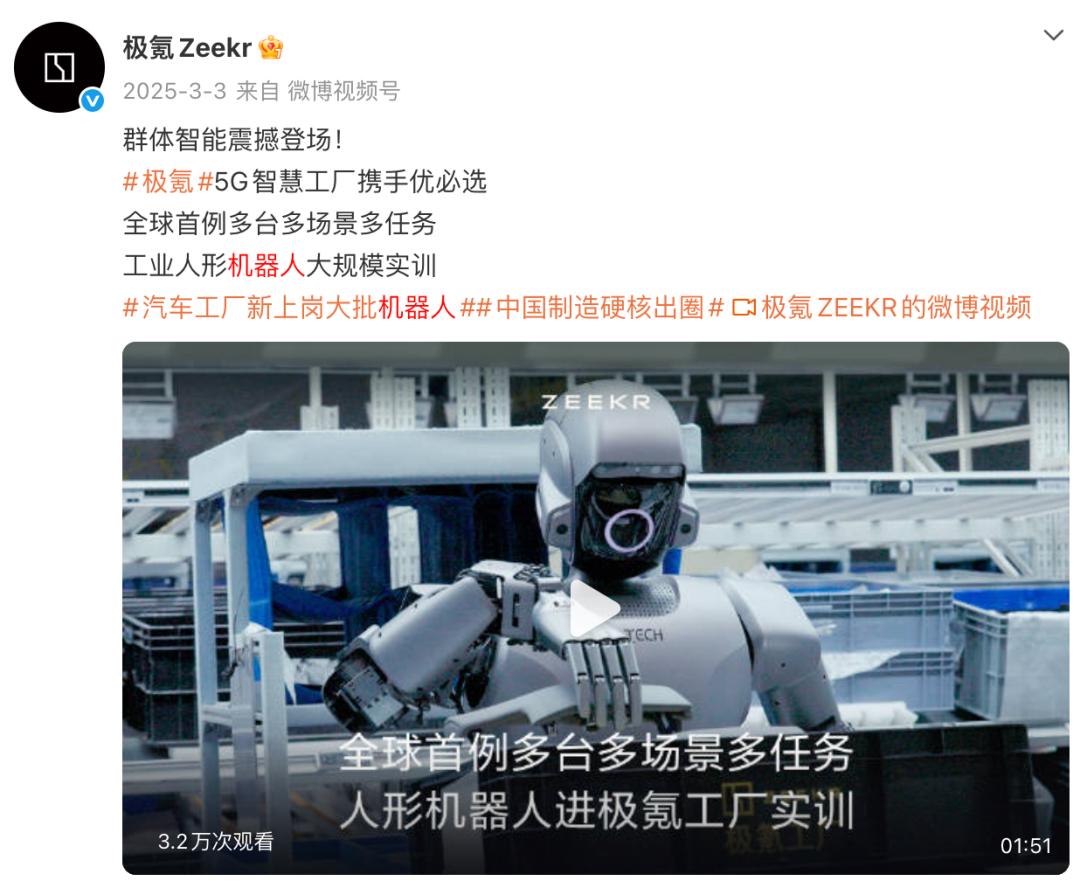
Screenshot from Weibo
Just as Zhou Jian said when talking about robots entering households, if the industry develops rapidly, it can be achieved in three to five years; if it develops more slowly, it will take seven to eight years or even ten years. The same is true for the industrial scenario. The journey from an apprentice to a full - time worker is not just about a few proposals and orders. It is a long - distance marathon about reliability, cost, and ecosystem.
The voices of the deputies at the Two Sessions are like a starting gun. After the gun goes off, let's wait and see who can be the first to reach the finish line and make a successful sprint.
Some pictures are quoted from the Internet. Please inform us if there is any infringement and we will delete them.
This article is from the WeChat official account "Yuanmeihui," author: Xie Chunsheng, editor: Su Huai. It is published by 36Kr with authorization.