Why are global giants pouring money into edge AI when its penetration rate is less than 1%? Three core variables and value insights in the enterprise-level IoT track in 2026
During a recent corporate earnings conference call, an extremely counterintuitive phenomenon emerged: Despite the continuous high growth in the number of Internet of Things (IoT) connections and the overall market size, the frequency with which executives mentioned IoT has been steadily declining. Meanwhile, industrial AI and related topics have climbed to the top of the digital agendas of CEOs of various enterprises.
Has IoT fallen out of favor? On the contrary, the "State of Enterprise IoT 2026" report released by IoT Analytics in January this year shows that the enterprise IoT market grew by 13% year-on-year in 2025, reaching a market size of up to $324 billion. Looking ahead to 2026, driven by AI technology and countries such as China and India, the market is expected to further grow by 14%.
IoT has not disappeared; instead, it has become "invisible" - it has become the underlying infrastructure that is taken for granted. As Morten Wierod, the CEO of Swiss industrial giant ABB, accurately summarized at the end of 2025: "Ten years ago, all we talked about was IoT, the interconnection of all things. Then we talked about digitalization. And today, everything revolves around AI."
The "IoT Value - Maturity Curve" proposed by the CEO of IoT Analytics outlines a clear evolution path: from basic data monitoring to ecosystem empowerment and autonomous operation. Now, the trend is becoming increasingly clear: IoT has entered the later stage of the maturity curve, and the market has begun to move towards autonomous connected operations. The shift towards AI and autonomous systems is precisely a sign that IoT has reached the peak of its maturity.
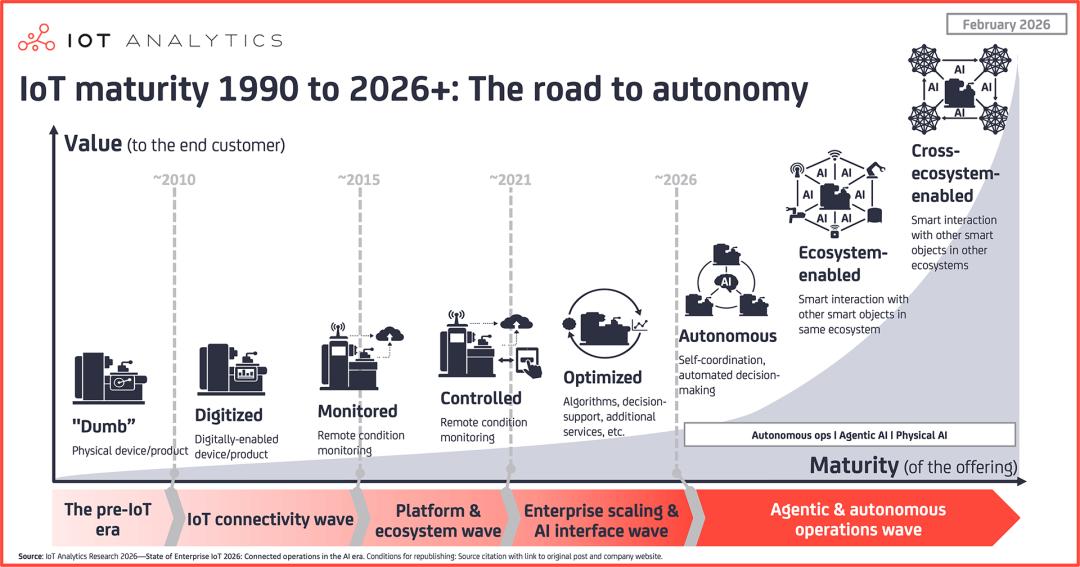
Re - examining the Evolution History: From Dumb Devices to Intelligent Connected Systems
To understand the logic of the technological explosion in 2026 and beyond, we need to review the historical context of the transformation of enterprise IoT from isolated devices to system integration:
First Stage: Pre - IoT Era (1990s–2010). At this time, the concept of IoT was not yet popular. Most industrial field systems operated in a closed manner, with local deployment, lacking external connections and cloud support. Connections relied on local serial/fieldbus protocols, and security was mostly achieved through physical and network isolation.
Second Stage: IoT Connection Wave (2011–2015). Network connection technologies such as 3G made breakthroughs in terms of maturity and single - connection cost. Enterprises carried out large - scale deployments on the premise of predictable ROI. The maturity of protocol standards (such as MQTT 3.1.1 and CoAP in 2014) and the deployment of LPWAN (such as Sigfox and LoRaWAN 1.0) triggered a wave of industrial device online. For example, in 2015, there were approximately 64.7 million smart meters in operation in the United States, and North American commercial vehicle fleets had 4.7 million active vehicle networking systems.
Third Stage: IoT Platform Wave (2016–2020). The industry's focus shifted to creating IoT projects that could be replicated at low cost across factories and sites. The cloud became the mainstream place for processing industrial data. By 2019, more than 620 cloud - centric IoT platforms emerged in the market. However, customers began to question the ROI of general horizontal platforms. After a round of mergers and reorganizations, the once - blue ocean market eventually turned into a highly competitive red ocean.
Fourth Stage: Enterprise Scaling and AI Wave (2021–2025). The core requirement of IoT has changed to promoting the large - scale implementation of core application scenarios. Many enterprises have exceeded one million connected devices, such as General Motors (16 million vehicles), Toyota (10 million vehicles), and Caterpillar (1.5 million units). Riding on the wave of ChatGPT, AI has begun to be deeply embedded in human - machine interfaces and IoT platforms, becoming a new intelligent interaction layer covering industrial data.
Next Stage: Intelligent Agents and Physical AI Wave (2026 and beyond). Statistics from IoT Analytics show that as of December 2025, edge AI devices accounted for less than 1% of the 21.1 billion IoT connections globally. However, as we fully enter the new wave, this proportion will skyrocket in the next few years. Edge AI is becoming the new engine driving the explosion of connections.
Three Core Variables in the 2026 IoT Market
As the strategic focus of IoT shifts from the underlying data channels to intelligent agent applications, the business logic and product forms of the entire industry are undergoing reconstruction. Under the general trend of Software Defined Everything (SDE), these emerging AI concepts are leading the future direction of IoT. The enterprise - level IoT market in 2026 and beyond will be strongly driven by the following three core evolutions:
Variable One: Hardware Transformation - AI Computing Power Sinks to the Limit of Edge Devices
In the past decade or so, the core requirement of IoT hardware design has often been how to achieve wide connections with low cost and low power consumption. However, in the era of physical AI and intelligent agents, this requirement has undergone a fundamental change.
The pursuit of autonomy and intelligent agent operation inevitably requires the system to have extremely strong real - time decision - making capabilities. However, in complex industrial fields or high - frequency interaction scenarios such as autonomous driving, uploading all massive raw data to the cloud for AI inference and then sending down instructions often faces serious delays and bandwidth bottlenecks. The traditional cloud architecture is no longer competent. Therefore, AI computing power is sinking directly from the data center to the device end. Chip manufacturers are no longer only focused on achieving connection capabilities but are embedding advanced AI accelerators and NPUs (Neural Processing Units) into microcontrollers to support powerful edge AI capabilities.
A highly notable industry trend is that Qualcomm, an American semiconductor company, acquired the open - source electronics platform Arduino in October 2025. This is not a simple hardware acquisition but a key layout for Qualcomm to build an end - to - end edge AI development ecosystem. If we consider its previous acquisitions of Foundries.io in March 2024 and EdgeImpulse in March 2025, a clear hidden line has emerged: the giant is comprehensively opening up the closed - loop implementation of edge AI from the underlying chips, middleware OS to the upper - layer developer ecosystem.
For IoT device manufacturers, the core competitiveness in the future will shift from supporting which connection protocols to the depth of computing power and energy efficiency ratio of end - side intelligence. Although not all devices need top - level GPUs, AI accelerators will become the standard configuration for more and more devices.
Variable Two: Connection Transformation - New - Type Cellular and Satellite Communications Build "Ubiquitous Autonomy"
If edge computing power is the brain of physical AI, then ubiquitous connection is the nervous system that supports its operation. As the industry's focus gradually shifts from what machines can connect to what machines can do autonomously, the underlying connection support technologies are also evolving quietly, building a solid infrastructure for AI - driven systems.
The operation of autonomous systems highly depends on seamless network coverage. This strict requirement for full - time online is giving rise to two key infrastructure evolution trends:
The Accelerated Rise of 5G RedCap: As the global 2G and 3G networks are accelerating their withdrawal, for IoT terminals that need to balance low power consumption and medium - speed connections, 5G RedCap and LTE Cat - 1 bis are becoming the ideal choices. According to IoT Analytics' prediction, by 2030, the shipments of 5G RedCap chipsets are expected to grow explosively at a compound annual growth rate (CAGR) of 82%, providing the necessary efficient transmission channels for massive edge intelligent devices.
The Integration of Space - Terrestrial Satellite Networks: Manufacturers are directly integrating satellite communication capabilities into mainstream cellular IoT modules to create an all - weather online space - terrestrial integrated solution. Even in remote areas where the ground network cannot cover, this solution can ensure that the autonomous system's real - time decision - making remains connected, effectively achieving global coverage to support the all - weather operation of AI.
For IoT connection providers and module manufacturers, the proportion of simple connection capabilities in customers' purchasing decisions will be gradually diluted. However, autonomous operation scenarios place extremely strict requirements on the stability of the underlying network: including extremely high uptime, seamless coverage, stable ultra - low latency, cross - domain roaming, high security, and controllable costs.
Variable Three: Software Transformation - Transition from Passive "Assistant" to Active "Action Intelligent Agent"
This is the most disruptive and imaginative part of the entire IoT's leap towards AI.
In the past one or two years, the wave of generative AI Copilots has lowered the threshold for using IoT data through natural language, but they are essentially passive tools that follow instructions. After entering the era of intelligent agents, this logic has been completely broken: industrial software is transitioning from a passive AI assistant to an active intelligent agent. Intelligent agents will not only be responsible for answering questions but can autonomously orchestrate extremely complex workflows, correlate massive alarms across systems, and directly trigger operations and responses in the physical world with almost zero human intervention.
The major giants have begun to make arrangements:
Microsoft: At the 2025 Microsoft Ignite conference, it clearly announced a strategic upgrade from "AI assistant" to "collaborator and orchestrator".
Hitachi Group: It is deploying intelligent agents that can autonomously monitor and maintain 30,000 industrial assets based on such models.
Siemens: It is restructuring its product line around the "ONE Tech Company" strategy and investing more than 1 billion euros to build a unified data architecture, specifically providing sufficient data nutrients for these future industrial intelligent agents.
For industrial and IoT software suppliers, the future competitive barrier is no longer simply building a platform but whether they can achieve smooth action coordination between OT and IT systems. More importantly, software manufacturers need to provide an orchestration layer with both strong execution ability and a solid "safety guardrail" for AI intelligent agents that can change the physical world.
Re - evaluation of the Ecosystem Value and Industrial Implications
The paradigm shift from basic IoT to intelligent agents and physical AI is reshaping the value distribution logic of the entire industrial chain. All parties in the ecosystem need to upgrade their response strategies:
IoT Device Manufacturers: The R & D focus will shift from supporting which connection protocols to the depth of computing power and energy efficiency ratio of end - side intelligence. AI accelerators will become the standard configuration for more and more devices.
IoT Connection Providers and Module Manufacturers: The weight of connection capabilities is decreasing, but autonomous operation scenarios place extremely strict requirements on the stability of the underlying network, including extremely high uptime, seamless coverage, stable ultra - low latency, and cross - domain roaming.
Industrial and IoT Software Suppliers: The competitive barrier is no longer simply building a platform but whether they can achieve smooth action coordination between OT and IT systems and provide an orchestration layer with both strong execution ability and a solid "safety guardrail" for AI intelligent agents.
Enterprises and Industrial Operators: The decision - making thinking will completely shift to being goal - and result - oriented. Operators do not need to issue trivial step - by - step instructions but only need to set the final goal, and the intelligent agent will autonomously deduce the optimal execution path.
In addition, when AI changes from assisting decision - making to autonomous execution, the overall network security protection framework must be upgraded and reconstructed accordingly. Enterprises cannot only stay at the user access control level but need to establish a safety guardrail to constrain the behavior boundaries of intelligent agents, a fine - grained permission control system at the operation level, and an operation traceability mechanism throughout the entire link to ensure that every automated change can be explained and verified. The end - game of IoT is not connection but comprehensive coordination of security, autonomy, and intelligence.
Conclusion
IoT has not faded away. After completing its historical mission of "building bridges and roads", it has quietly stepped backstage, giving the spotlight to the upcoming explosion of physical AI and industrial intelligent agents. From the 1% penetration rate of edge AI devices, to the 82% compound growth rate of RedCap, to the intelligent agent orchestration layer that the giants are investing heavily in, in 2026, the starting gun for the second half of enterprise IoT has been fired. For investors and industry pioneers, the real value capture has just begun.
Reference: State of enterprise IoT 2026: The shift from IoT to autonomous connected operations —— IoT Analytics
This article is from the WeChat official account "IoT Think Tank" (ID: iot101), author: Soda Soda, published by 36Kr with authorization.