Web 4.0 is here. Are IoT companies ready? Three overlooked strategic opportunities
Previously, I wrote an article titled "Strict Prohibitions Domestically, Tight Controls Abroad: Is Device Data on the Verge of Crossing the Line? Three Compliance Warnings for AIoT Enterprises from Document No. 42", which told everyone what not to do and which lines not to cross.
Compliance sets the bottom line, but enterprises cannot just focus on the bottom line to survive. So in today's article, I want to change the direction. Instead of talking about what not to do, I'll discuss where to go in the future.
The previous article was about avoiding pitfalls, and this one is about showing the way. Only by combining the two can we get a complete and real judgment that the AIoT industry currently needs.
The guiding coordinates I've chosen is a concept that suddenly exploded in the spring of 2026: Web 4.0, where the Internet evolves from Read to Write to Own and then to Act.
To understand Web 4.0, we need to quickly review the generational leap of the Internet first.
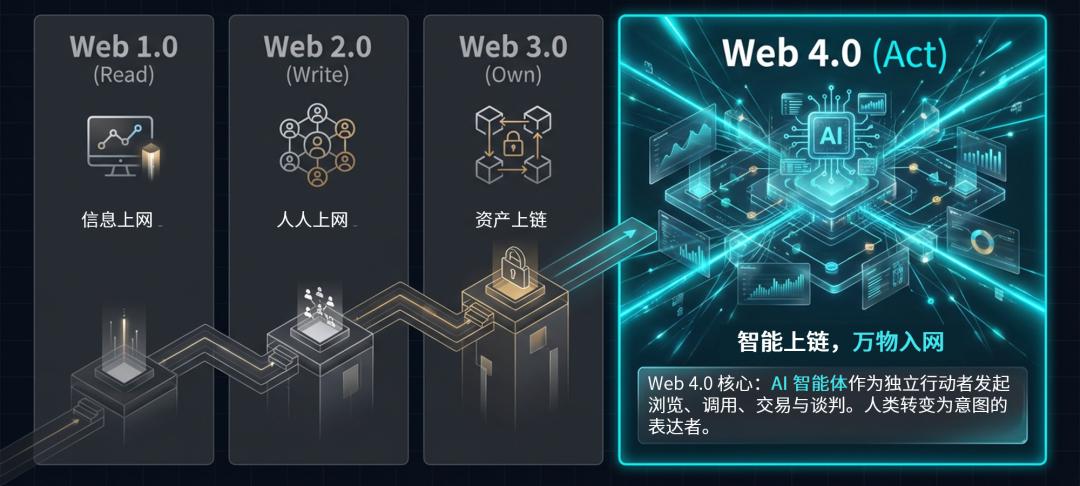
Web 1.0 solved the problem of getting information online, Web 2.0 enabled everyone to access the Internet, and Web 3.0 emphasized putting assets on the blockchain. So, what about Web 4.0?
It can be summarized in eight words: Intelligence on the blockchain, all things connected to the network. In the world of Web 4.0, humans are no longer the only protagonists of the Internet.
AI agents will join the network as independent actors. They can browse information, call services, initiate transactions autonomously, and even negotiate and cooperate with other agents. The role of humans is gradually changing from hands - on operators to expressers of intentions. We just need to say what we want, and a group of AI agents will automatically handle the rest in the background.
In February 2026, Sigil Wen published a "Web 4.0 Manifesto" that sparked a nationwide discussion. His core argument is that the most powerful AI currently can think, reason, and generate content, but it cannot act independently because the entire Internet is designed for human users. The significance of Web 4.0 is to enable AI agents to read, write, own, earn, and trade autonomously.
However, as of today, there is no unified and widely - accepted standard definition of Web 4.0. Currently, there are at least three competing definitions of Web 4.0 coexisting in the industry.
The EU version first used this term at the policy level in July 2023, defining Web 4.0 as the in - depth integration of the physical world and the virtual world, covering AR/VR, digital twins, and the Internet of Things. The academic community tends to call it a symbiotic network, emphasizing that AI evolves from an additional tool of the Internet to a native resident. The round of discussions ignited by Sigil in February 2026 pushed the definition in a more radical direction, where AI agents become the main actors of the Internet.
Interestingly, these three seemingly fragmented definitions are actually converging in the underlying logic. They all point to the same core judgment: The Internet is evolving from an information tool designed for humans to an intelligent infrastructure where humans and AI coexist and participate together. The difference lies only in the different aspects they emphasize. The EU focuses on the integration interface between the physical and virtual worlds, the academic community focuses on the native status of AI, and Sigil focuses on the economic autonomy of agents.
From China's perspective, these three threads are also converging at an accelerating pace. The China Academy of Information and Communications Technology listed autonomous agents as one of the top ten trends of the year in its in - depth observation report in 2026, clearly stating that the key capabilities of models continue to evolve and autonomous agents have become the core of implementation. In other words, although the Chinese academic and industrial circles have not directly used the label of Web 4.0, in fact, China has comprehensively laid out the core issues of Web 4.0, from the nativization of agents, the implementation of embodied intelligence, to the construction of a policy framework for cross - border circulation of data elements.
After understanding the multiple definitions of Web 4.0, I want to propose three strategic opportunities that are easily overlooked in this article. These three viewpoints correspond to the three definition dimensions of Web 4.0 respectively and form a complete value chain from perception to organization and then to monetization.
From "Data Dashboards" to "Embodied Interaction": The Physical World Will Become a Super - Sized "Browser"
Let's start with a simple question: How has the human - machine interaction interface of AIoT changed in the past two decades?
The answer is quite disheartening: It has hardly changed.
In the Web 1.0 era, engineers checked device parameters through configuration software on the PC. In the Web 2.0 era, it was replaced by mobile apps and WeChat mini - programs. After the concept of Web 3.0 emerged, there appeared cool 3D digital twin dashboards. Although the forms have been renovated, the essence has never gone beyond a framework: people sit in front of the screen, look at the data, make judgments, and give instructions.
If the core proposition of Web 4.0 is that AI agents become independent actors, then every link in this chain will be rewritten. The question is no longer how humans can view data more conveniently, but how AI agents can directly perceive, make decisions, and act in the physical world.
That is to say, the first paradigm shift in the AIoT industry in the Web 4.0 era is not the upgrade of the interaction interface, but the replacement of the interaction subject. AI agents are stepping out of the screen and the cloud, and entering the physical world through embodied carriers. And AIoT devices will become their most important perception and execution terminals.
Some people may say that this is just the industrial meta - universe that was hyped up a few years ago. Scenes like wearing AR glasses to view device data and giving control instructions by voice were demonstrated by Microsoft HoloLens in 2017.
The fundamental difference of Web 4.0 is that AI agents themselves become actors. It doesn't need humans to walk up to the water pump wearing glasses to diagnose faults. It can perceive the environmental status in real - time through the AIoT sensor network distributed on the devices, understand physical laws through large - scale models and world models, and then make decisions autonomously, such as reducing the rotation speed, scheduling maintenance, and even coordinating the linkage adjustment of upstream and downstream production lines. All of this may happen before people even realize there is a problem.
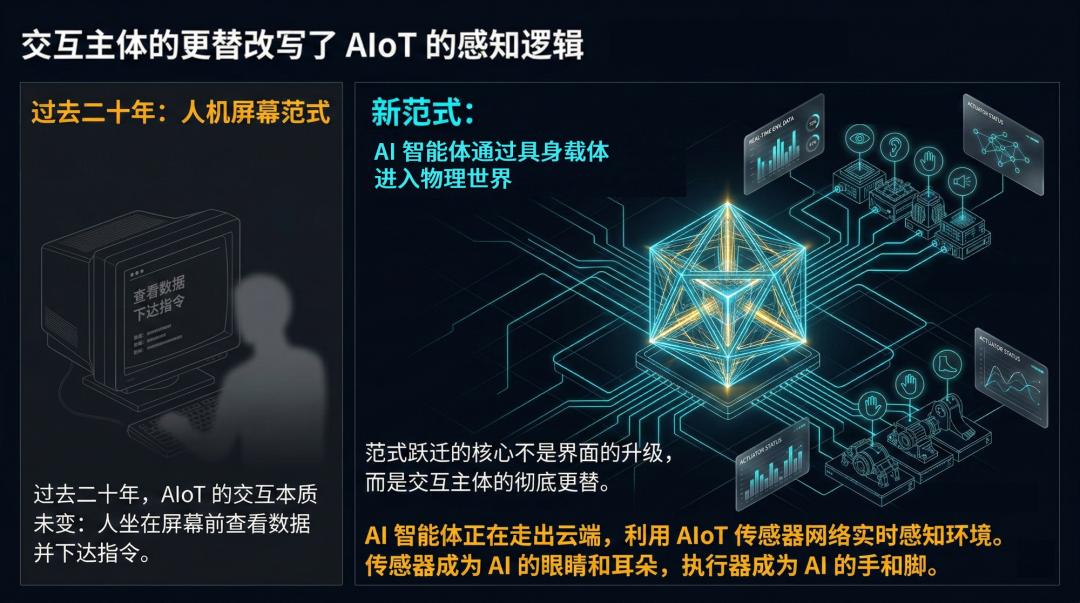
The intelligent operation of all things is the qualitative change that Web 4.0 brings to AIoT. In the past, AIoT made the physical world visible, while in the Web 4.0 era, AIoT makes the physical world controllable. Sensors are no longer just data collectors; they are also the eyes and ears of AI agents. Actuators are no longer just terminals for instructions; they are the hands and feet of AI agents.
The AIoT system itself is evolving from a passive data pipeline to a distributed body of AI agents in the physical world.
Pushing this logic to the extreme, we will naturally conclude that when an AI agent needs a complete physical avatar to perform complex tasks, the embodied intelligent robot is the most advanced evolutionary form of AIoT devices.
This is not a distant future but a reality that is happening right now. In 2025, embodied intelligence was written into the government work report for the first time and became one of the key future industries to be cultivated. And for the embodied intelligence and humanoid robot industries in 2026, it is a crucial node with the dual significance of being the first year of mass production and the year of intelligent breakthrough. The industry is crossing the threshold from technology demonstration to commercial application.
From the cost perspective, the cost reduction has far exceeded expectations. According to a Goldman Sachs report, the manufacturing cost of humanoid robots has decreased by 40% year - on - year, significantly exceeding the previous expected annual decline of 15 - 20%. The current cost range has dropped to between $30,000 and $150,000. In terms of technological maturity, industrial chain completeness, and market expansion speed, China's embodied intelligence industry is already in the global first echelon. The signals from the capital market are also clear: In the first 11 months of 2025, the financing amount of the embodied intelligence industry reached 33.473 billion yuan, four times that of the same period in 2024, and there were more than 305 financing events throughout the year.
From these data, we can see that embodied intelligence is not something for the next five years. It is rushing from the laboratory to production lines and living scenarios at a speed that exceeds most people's expectations.
The current embodied intelligence industry is still in its initial stage. The core breakthrough point in the development of humanoid robots lies in the evolution of the robot's brain, especially whether the world model technology can make key breakthroughs. In the future, humanoid robots need to rely on the world model to break through the spatial intelligence bottleneck and achieve a higher - dimensional environmental understanding and autonomous decision - making ability.
And this is precisely the deepest intersection point between AIoT and embodied intelligence.
The massive operation data of the physical world accumulated by AIoT in the past decade is exactly the raw material urgently needed for training the robot's world model. AIoT not only provides hardware components such as sensors and communication modules for robots, but more importantly, it provides the data base for robots to understand the physical world.
In other words, what AIoT enterprises hold in their hands may not just be a data pipeline, but a mine for training the robot's brain.
Therefore, in the Web 4.0 era, AIoT devices are no longer just the sensory nerve endings of the physical world. They will also become the sensory and motor organs of AI agents. When AI agents learn to see with the eyes of AIoT devices, operate with the hands of AIoT devices, and think with the data of AIoT devices, the physical world itself is the real "browser" of Web 4.0.
When the Physical World Becomes Programmable, the Core Product of AIoT Enterprises Will No Longer Be Data
Next, we need to discuss where AI agents think after they enter the physical world.
The answer is digital twin, but not the current kind of digital twin.
The commercial value of digital twin technology no longer needs to be demonstrated. A McKinsey survey shows that 44% of manufacturers have deployed digital twins, and another 15% plan to do so. Data from early adopters indicate that digital twins can drive revenue growth of up to 10%, shorten the product launch time by 50%, and improve product quality by up to 25%. Gartner predicts that the digital twin market will cross the chasm in 2026 and reach a scale of $183 billion by 2031, with composite digital twins being the biggest growth opportunity.
But behind these figures hides an embarrassing fact: Most digital twin deployments are isolated.
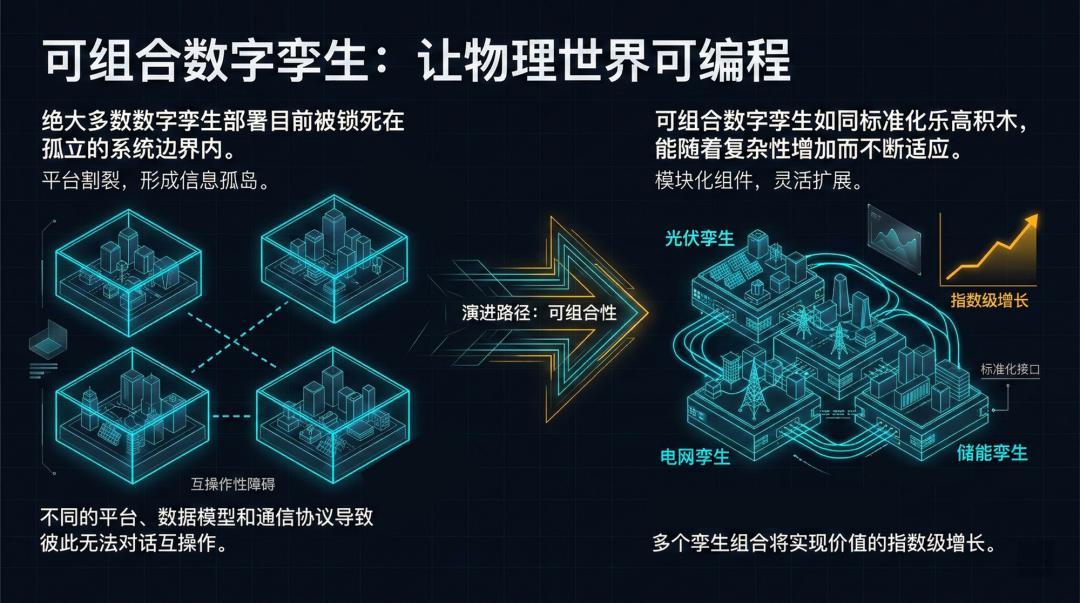
Company A has a digital twin of its photovoltaic power station, Company B has a digital twin of its power grid, and Company C has a digital twin of its energy storage facilities. They operate on different platforms, use different data models and communication protocols, and cannot communicate or interoperate with each other. Each twin is useful, but each is also locked within its own system boundary.
This situation reminds me of the early days of the Internet. Before the TCP/IP protocol unified the network, each company had its own local area network, but the networks were not connected to each other. The real value explosion did not occur within a single network but at the moment when the networks were connected.
Digital twins are at the same node.
Today's digital twin is a digital mirror of physical assets, which faithfully reflects the operating status of the equipment for humans to view and analyze. But the problem with the mirror is that it is passive, closed, and one - to - one bound. We cannot put two "mirrors" together to see a bigger picture.
The innovation of composable digital twins lies in that it turns the digital twin from a closed mirror into a standardized Lego block. The so - called composability means building a digital twin system in a modular way so that it can continuously adapt as the complexity increases. This composable method allows components and capabilities to be reused, thus building a variety of applications for different business goals and end - users.
When the twin of a photovoltaic power station, the twin of a power grid, the twin of an energy storage facility, and the twin of an electricity market model are combined, what we get is not four mirrors but a virtual energy system that can be optimized end - to - end.
A single twin has value, but when multiple twins are combined, the value increases exponentially. This is the power of composability.
At this point, some people may still ask, digital twin technology has been developing for several years. What exactly has Web 4.0 changed?
Indeed, the above description of composable digital twins would not be out of place in an industry article three years ago if taken out of the context of Web 4.0. So why has composable digital twin only remained at the conceptual level in the past, but suddenly become possible to implement in the Web 4.0 era?
Because what was lacking in the past was not the concept, but a role: the combiner.
Previously, combining digital twins from different manufacturers, different fields, and different data models was a huge system integration project. Engineers needed to define interface protocols, map data models, write format conversion logic, handle timestamp alignment, and coordinate semantic differences... Each step required a lot of manual intervention, and almost every new combination had to start from scratch. The high cost and long cycle made composable digital twins exciting in theory but difficult to implement in practice.
Web 4.0 has changed this equation. When AI agents become powerful enough, the marginal cost of combination changes from approaching infinity to approaching zero. AI agents are the long - missing combiners.
This is the real novelty that Web 4.0 injects into composable digital twins: It's not that the technical architecture has changed, but that AI agents make the combination scalable for the first time.
The good news is that the industry is accelerating the paving from standard setting to technical verification. The Digital Twin Consortium (DTC) has officially launched the digital twin test - bed project, aiming to accelerate the integrated evolution of digital twins, AI agents, and enabling technologies.
In the Web 4.0 era, data is oil, but digital twins are refineries. When twins become composable, every AIoT enterprise has the opportunity to upgrade from selling raw materials to defining how the world is programmed.
Hidden in the Gap between "Strict Prohibitions Domestically and Tight Controls Abroad" Are Overlooked Global Strategic Opportunities
In the Web 4.0 architecture, AI agents are not just assistants that help us search for information. They are becoming independent economic actors, holding wallets, initiating transactions, purchasing services, and generating income, all without human intervention.
The operation of this machine economy requires a brand - new infrastructure: reliable physical world data as an anchor for pricing and decision - making. How much is a building worth? It depends on its rental income, vacancy rate, and energy consumption cost. How is the revenue of a photovoltaic power station? It depends on its actual power generation, equipment attenuation curve, and operation and maintenance expenditure. How much cash flow can a new energy vehicle fleet generate? It depends on each vehicle's mileage, battery health, and operating income.
Where does this data come from? It comes from AIoT sensors.
And China happens to have the world's largest - scale industrial Internet of Things deployment, the largest photovoltaic installed capacity, the largest number of new energy vehicles, and the most dense smart city infrastructure.
But the problem is: For this data to legally