Dialogue with WANG Xingxing: After Searching for Martial Arts Moves Worldwide, How Can Unitree Surpass Itself?
Text by|Qiu Xiaofen
Edited by|Su Jianxun
On the Eve of the Lunar New Year in 2026, before the Spring Festival Gala of the Year of the Horse ended, we met Wang Xingxing, the founder of Unitree Technology, who had just rushed back from the recording site at the robot training base in Xingguang Film and Television Park, Daxing, Beijing.
It was almost midnight, but Wang Xingxing was still excited. He was very satisfied with the performance of Unitree's program "Martial Arts BOT" that night. During the conversation, when Wang Xingxing talked about technical details, the usually introverted him kept demonstrating the robot's fighting moves with body language, and his tone became much more excited.
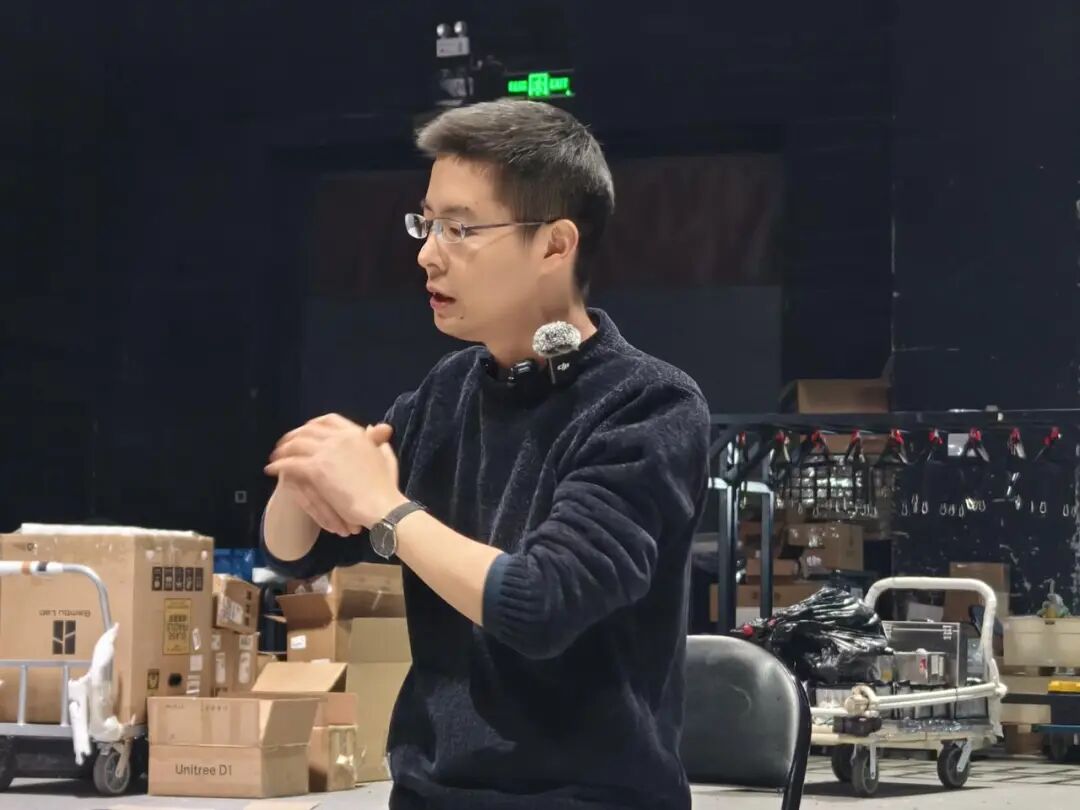
Wang Xingxing, the founder of Unitree Technology; Photo by "Intelligent Emergence"
"After the performance, a big stone in my heart finally dropped." Although it was the third time for Unitree to appear on the Spring Festival Gala, Wang Xingxing still felt a lot of pressure. "We can't just say that we danced last year and do the same this year. That wouldn't be very challenging," he told "Intelligent Emergence".
Judging from the program effect, Unitree's efforts were not in vain.
In the program "Martial Arts BOT", 24 G1 robots of Unitree Technology "fought" with several human actors, performing various high - difficulty moves such as fancy table - flipping parkour, continuous one - foot flips, backflips after two - step wall - climbing, and seven and a half large spins.
Wang Xingxing told us that in order to improve the program effect compared with last year's Spring Festival Gala, they specifically chose the martial arts form, which could better showcase the robots' movements.
For this purpose, Unitree and the Spring Festival Gala director group searched for all martial arts moves around the world and extracted dozens of the most representative ones. Behind this set of smooth martial arts moves, there were also complex technical challenges.
If you observe carefully, you can find that in Unitree's "Yangge BOT" in 2025, the robots moved slowly between different actions. However, in "Martial Arts BOT" in 2026, the robots moved quickly between actions. This newly developed ability allows the robots to run at a maximum speed of 4 meters per second.
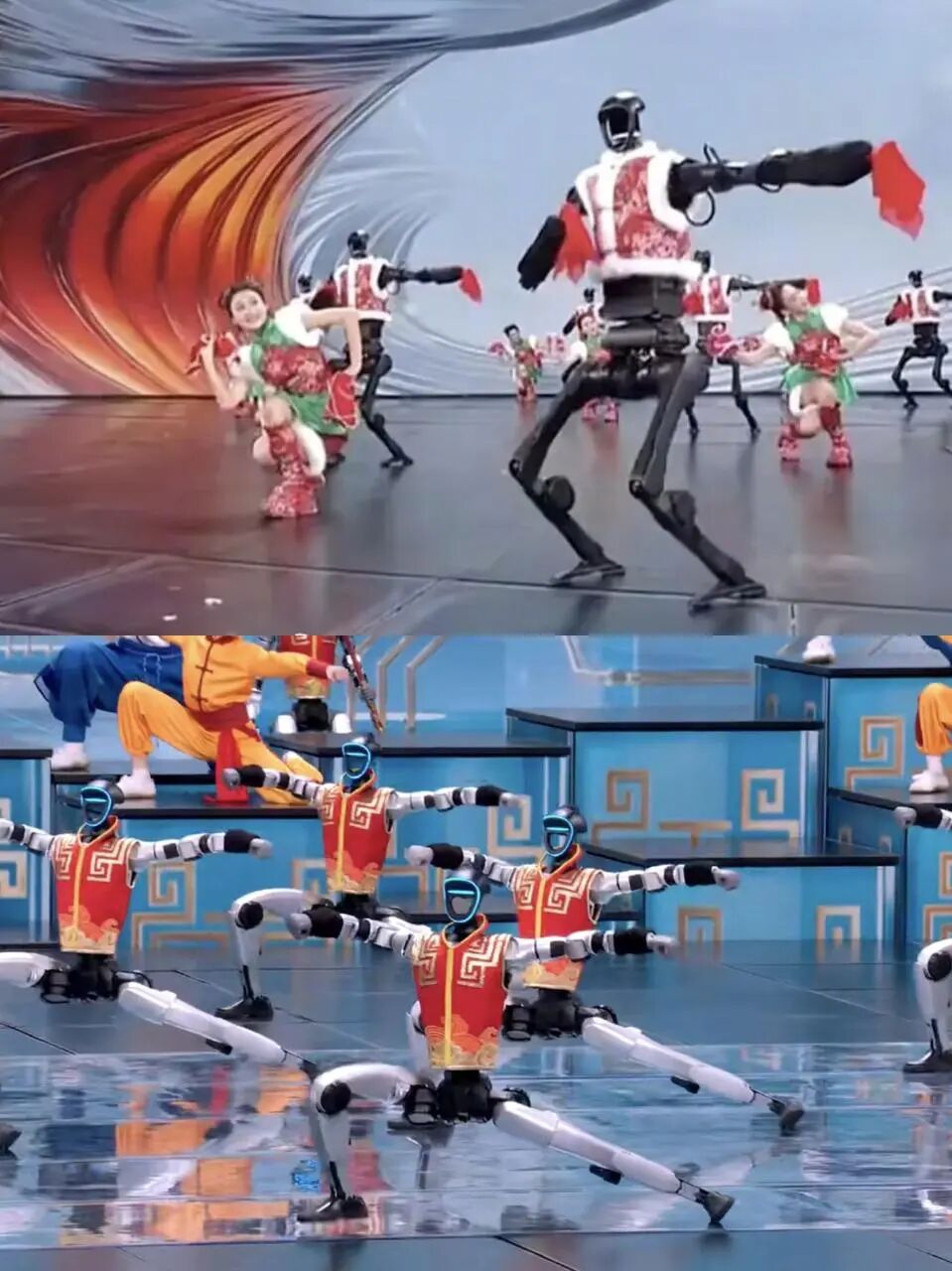
The above/below pictures are the comparison of Unitree's Spring Festival Gala programs in 2025/2026 respectively. It can be seen that Unitree's robots have a more mature form, no exposed wiring harnesses, more anthropomorphic leg lines, and even real "hands". Picture source: Screenshots from the Spring Festival Gala video
As the number of robots increased, it also put forward higher requirements for the scheduling work. It is understood that Unitree has also developed cluster control technology for this purpose.
That is to say, the 24 robots on the stage do not need operators to closely monitor their movements. Relying on an on - board sensor, they can sense the environment in real - time. When the robots deviate from their positions due to large - amplitude martial arts moves, they can also return to their original positions autonomously.
In Wang Xingxing's view, "Martial Arts BOT" is by no means just a simple martial arts performance. The technologies overcome behind it can play a valuable role in real - world scenarios in the future.
For example, the robot cluster control technology and the rapid movement ability mentioned earlier can be transferred to factory scenarios. "These technologies are very practical and conducive to large - scale cluster work of robots in the future," Wang Xingxing said.
Obviously, behind "Martial Arts BOT", there is Unitree's ambition to expand into more scenarios in 2026.
After appearing on the Spring Festival Gala in 2025, Unitree pioneered the "commercial performance" revenue model for the entire robot industry. In 2026, Wang Xingxing said that in addition to the original basic application scenarios (consumer end, scientific research and education, commercial performances), Unitree also plans to expand its application in the industrial field and commercial services.
According to Wang Xingxing's prediction, Unitree's shipments in 2026 may reach about 10,000 to 20,000 units.
"The biggest market growth for humanoid robots comes from the maturity of technology. When technology becomes more and more valuable, the entire market scale will gradually expand," Wang Xingxing said.
The following is the edited transcript of the conversation between media such as "Intelligent Emergence" and Wang Xingxing, the founder of Unitree Technology:
The biggest pressure is how to surpass last year
Intelligent Emergence: I'm very curious about the source of inspiration for your martial arts performance this time.
Wang Xingxing: We always hope to do better than before. So we can't just say that we danced last year and do the same this year. That wouldn't be very challenging.
The reason we chose martial arts is that we can challenge more difficult moves and further improve the robots' movement ability, both in terms of rapid movement ability and movement limit ability.
Intelligent Emergence: The program "Martial Arts BOT" has been successfully completed. How do you feel now?
Wang Xingxing: I've been under a lot of pressure in the past one or two months because we want to present a much better program on the Spring Festival Gala stage than last year. So we must have more outstanding performance content and program forms.
We had a lot of communication with the director group. We even listed all the kung - fu moves around the world, let the robots learn to replicate them, and finally selected dozens of the better moves to present in the program.
This program is not just about teaching the robots some collected moves. In order to make the whole movements more coherent, match the music rhythm and time, and create a sense of human - robot interaction, we made a lot of minor adjustments and spent a lot of time.
After this performance, I feel relieved.
Intelligent Emergence: There are so many companies competing on the Spring Festival Gala of the Year of the Horse. What's the significance for the industry?
Wang Xingxing: After the industry gets hot, it's very normal for more startups to enter.
But for Unitree, our biggest competitor is always ourselves. We need to do a good job in this performance. The biggest pressure comes from our "Yangge BOT" last year. We hope to surpass last year's program in terms of various technologies and the final product effect.
So we are meticulous in the design of various moves, hoping to reach a level more advanced than the world's cutting - edge level.
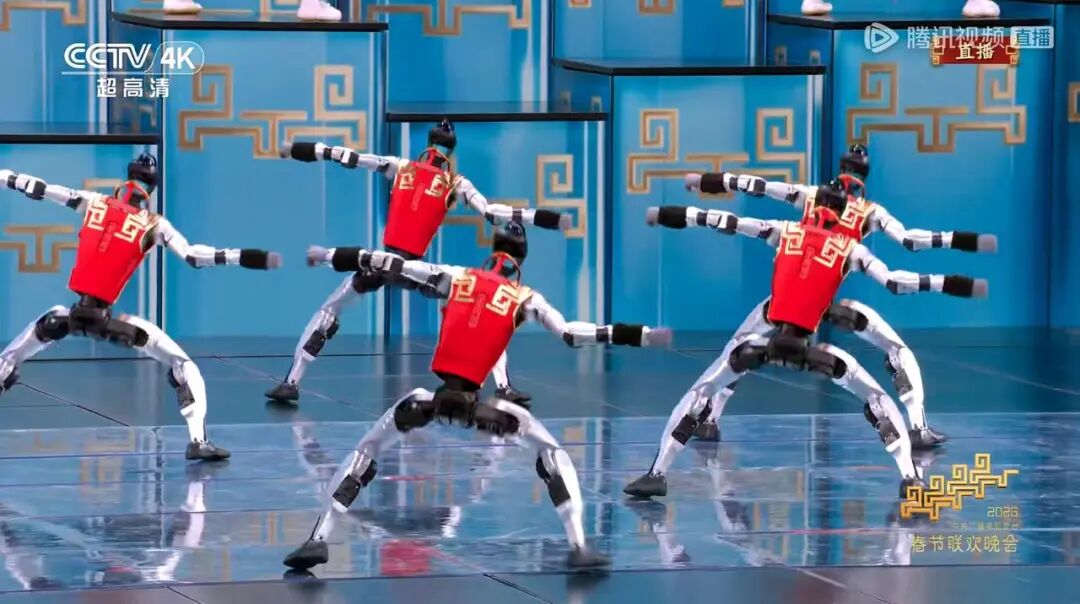
Screenshot of the "Martial Arts BOT" program
Intelligent Emergence: You just mentioned rapid movement ability and movement limit ability. What are the specific challenges for you, and what problems did you actually encounter?
Wang Xingxing: We encountered a lot of problems. In order to achieve the program effect, we accomplished many firsts in the history of global humanoid robots.
For example, in our program "Yangge BOT" last year, the robots moved slowly between actions. This rhythm was definitely not good - looking in the program presentation. So, this time our robots move quickly.
The high - speed movement ability was specially developed for this Spring Festival Gala program. The robots can run around on any trajectory, with a maximum speed of 4 meters per second. This technology is very practical and conducive to large - scale cluster work of robots in the future.
Additionally, we challenged many extreme moves in this program. For example, there is an interesting move called "two - step wall - climbing". The robot can jump very high after stepping on the wall twice.
Actually, when we first developed it, the robot could only step on the wall once. But we thought it was not challenging enough, so we spent a long time optimizing it to make it step on the wall twice, jump higher, and achieve a better movement effect.
Intelligent Emergence: How long did you specifically prepare for this performance?
Wang Xingxing: We started preparing in November last year. The most time - consuming parts were screening martial arts moves, choreographing the plot, and making minor adjustments to the moves.
Intelligent Emergence: The robots on the stage this time have very difficult moves. What are the core breakthroughs in cluster collaboration and other aspects?
Wang Xingxing: The number of robots has increased a lot this year. There were 16 last year, and this year there are 24 G1 robots alone. Moreover, the formation of the robots is quite neat.
When the robots perform kung - fu, each machine will have a slight drift when the movements are intense. So we developed positioning technology to pull the robots back to their fixed positions, ensuring the uniformity and beauty of the movements.
Intelligent Emergence: There is a move where a robot falls and then stands up. Did it really fall, or was it deliberately designed?
Wang Xingxing: It was for the sake of the plot. This program is a performance - oriented program, and it must have some fun elements. Drunken boxing itself should have a sense of being on the verge of falling. If the robot falls and then stands up by itself, it looks very cool and fits the artistic conception of drunken boxing.
Intelligent Emergence: So many robot manufacturers are on the Spring Festival Gala this year. What do you think the value of the Spring Festival Gala is for robot manufacturers?
Wang Xingxing: I think the Spring Festival Gala is a great platform for display. It is also a showcase of products and technologies to the whole nation, allowing people to truly see the current development level of robot technology.
Technology maturity determines market maturity
Intelligent Emergence: In 2026, what are the strategic focuses of Unitree in model algorithms and application scenarios?
Wang Xingxing: We have tried many routes in model development. Currently, the routes of embodied intelligence models are not very unified, such as world models, VLA models, VLA + reinforcement learning models, etc.
Regarding the embodied intelligent robot brain, we are also exploring various cutting - edge possibilities and collaborating with third - party companies. Because in the field of AI development, there is indeed some element of luck in many cases.
We maintain an open attitude towards the embodied brain. Currently, no one company has done particularly well in the embodied brain. There has been no breakthrough in the ceiling of the brain globally.
In terms of commercial application scenarios, in addition to the consumer end, scientific research, and education we have been involved in, Unitree will be more active in expanding into the industrial field and commercial services in the future.
Actually, in 2024, we were promoting the use of humanoid robots in automobile factories for production, assembly, and handling. However, this field has not yet reached large - scale application. The implementation in factories is very realistic. It is about comparing efficiency with humans. But globally, robots still can't match humans in terms of efficiency.
Intelligent Emergence: Is To C your next focus?
Wang Xingxing: We have always had ToC products for our robot dogs and humanoid robots, which are available on JD.com and Taobao. The price of the R1 humanoid robot starts at 29,900 yuan.
Intelligent Emergence: Besides stage performances, what new applications can the robots have in real - life scenarios this year?
Wang Xingxing: Currently, the situation of robots is as follows: If a dedicated program is written for a specific scenario, the robot can run. However, for the general public, the home scenarios of each family are different. We can't write a separate program for each family because the embodied intelligent brain of robots is not general enough. So large - scale application is still in the relatively early stage.
But I think that this year or next year, in the field of guided tours or relatively fixed industrial scenarios, relatively good implementation results can be achieved.
The current wave of humanoid robots has only developed for about three years. In the early stage of technology development, if we push too hard, it will be like pulling up seedlings to help them grow. I think it may be too radical for this industry.
Intelligent Emergence: The significance of robot performance programs is to arouse people's interest first. But how can robots really enter production and daily life?
Wang Xingxing: We have always attached great importance to making robots really enter daily life to work. But at this stage, we are still in the early exploration phase. Currently, we are still trying our best to improve the movement ability of the entire robot.
We believe that a robot that can really work must have very strong movement ability. Movement ability is a prerequisite and necessary condition for the implementation of all robots or embodied intelligence.
I think for the entire intelligent evolution stage, movement ability is a prerequisite and necessary ability. After improving the movement ability, we can then improve the intelligence level to make it really work.
Intelligent Emergence: Some analyses and predictions suggest that the shipment volume of humanoid robots in 2026 may increase from thousands to tens of thousands. Do you agree with this judgment?
Wang Xingxing: In 2026, the global shipment volume of humanoid robots will be at least tens of thousands of units. We should also reach about 10,000 to 20,000 units. For humanoid robots, the biggest market growth actually comes from technology maturity. When technology becomes more and more valuable, the entire market scale will gradually expand.
If there is continuous technological progress this year, I think the growth of the entire market scale should be relatively predictable. But if there is no new progress in technology and products, the entire shipment volume may not be so optimistic.
Intelligent Emergence: Robot companies are emerging everywhere now. Is this an inevitable result of the maturity of robot technology or a short - term push by capital?
Wang Xingxing: Currently, the global robot wave is very hot. If we compare it with the large - scale application after the real maturity of robot technology, the current popularity is still relatively controllable.
Every wave of technological innovation has its peaks and troughs. Currently, we may be at the peak, but people may gradually get used to it. I think the biggest reason is that everyone has expectations for technology. Of course, there is also the factor of investment promotion. But I think the entire industry is still in a healthy state.
Intelligent Emergence: How do you think we can avoid low - level redundant construction in the industry?
Wang Xingxing: Currently, a lot of capital has entered the industry, so homogeneous competition is a very serious problem. I advocate that we should reasonably restrain competition. Don't engage in malicious and ineffective competition. For example, when everyone is selling robots at a loss, I think it will ruin the industry.