At 11 p.m., after downing five glasses of wine, Jensen Huang "spoke his mind": "Writing code is just typing. It's no longer valuable."
Two weeks ago, Jensen Huang, the CEO of NVIDIA, was still in China.
He visited several cities in a row, including Shanghai, Beijing, and Shenzhen. He attended the New Year's Eve party of NVIDIA's Chinese branch and had face-to-face conversations with employees. Immediately afterwards, he flew back to the United States without a moment's rest. Before this back-to-back itinerary was about to end, Jensen Huang spent the last night of his business trip on an informal yet extremely wonderful public dialogue:
On the evening of February 3rd, Jensen Huang walked onto the stage with a glass of wine in his hand, together with Chuck Robbins, the CEO of Cisco. They faced a live-streamed in-depth dialogue across the internet - no PPT, no press conference tone, more like an impromptu conversation between old friends, even mixed with self-mockery, jokes, and a little bit of "truth after a little alcohol."
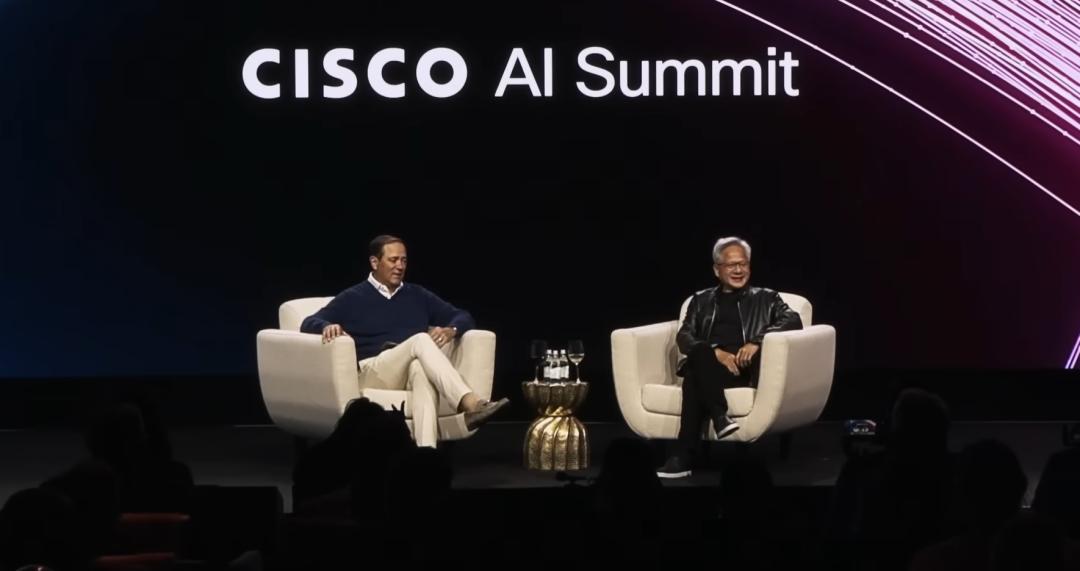
"I'm drinking on the company's dime," Jensen Huang said with a smile as soon as he took the stage.
"When I first took out the wine, Jensen reminded me, 'You know this is a live stream across the internet, right?'" Chuck Robbins joked.
"Who cares? It's so late anyway."
Applause rang out from the audience, and this nearly 50-minute AI dialogue, with a high alcohol content and an equally high information density, officially began. In this dialogue, Jensen Huang put forward several extremely impactful judgments:
"We are experiencing the first true reinvention of computing in 60 years."
"Writing code is essentially typing, and typing is becoming a cheap commodity."
"What really matters is not the answer, but the questions you can ask."
"Companies don't need to calculate ROI right away. Let a hundred flowers bloom first."
"The future is not 'Human-in-the-loop,' but 'AI-in-the-loop.'"
In Jensen Huang's view, AI is not just "helping programmers write code." It is a comprehensive reconstruction of the entire set from the computing paradigm, software form, to the organizational structure.
The following is the complete transcript of this dialogue:
What is an "AI Factory"? This is the First Rewrite of Computing in 60 Years
Chuck Robbins: First of all, thank you all for staying here after such a long day. We started early in the morning, with speakers taking turns on stage one after another, and only had a two-and-a-half-hour break in between. Yet, you all still came back to see him.
Jensen Huang: I've been wide awake since 1 a.m.
Chuck Robbins: You may not know that this guy has just finished a two-week trip to Asia, visiting several places.
Jensen Huang: I was in Taiwan just a day ago, in Houston last night, and now I'm here.
Chuck Robbins: He's been on a business trip for two weeks, and I'm the last stop on his itinerary. After this, he can finally get back to his comfortable bed at home. So let's have some fun and then send him home quickly. Although you don't need much introduction, thank you for coming.
Jensen Huang: You're welcome. Thanks for our cooperation. I'm also proud of what we've achieved together.
Chuck Robbins: Okay, let's start with our cooperation. We've always had a deep cooperative relationship. You proposed the overall concept of the "AI Factory," and we're working together to make it a reality. However, in the enterprise-level market, the progress may not be as fast as we both hoped. For you, what exactly is an "AI Factory"?
Jensen Huang: First of all, remember that we are experiencing the first true reinvention of computing in 60 years. In the past, it was "explicit programming." We had to write programs line by line, and variables were passed through APIs. Everything was very clear. Now, we're moving towards "implicit programming." You just need to tell the computer what you want, and it will figure out how to solve the problem on its own - this is the core shift from explicit to implicit.
Secondly, it's the shift from general-purpose computing (basically a calculator) to artificial intelligence. The entire computing stack is being reinvented. When people talk about computing these days, they often only focus on the processor layer, which is NVIDIA's area. But don't forget that the essence of computing includes not only processing but also storage, networking, and security - all of these are being redefined right now.
And the first step we need to take is to develop AI to a level where it's truly useful to humans. So far, chatbots that give you a response when you provide a prompt, although interesting and curious, aren't really useful.
Chuck Robbins: It can sometimes help me with crossword puzzles.
Jensen Huang: Yes. But that's only limited to the content it has memorized and summarized. Recall three years ago when ChatGPT first emerged. We were amazed and said, "My goodness, it can generate so much text and write poems in Shakespeare's style." But in fact, it was all based on rote memorization and summarization.
We need to understand that true intelligence lies in problem-solving. And the key to problem-solving is partly "knowing what you don't know" and partly reasoning - how to solve a problem you've never seen before: breaking it down into easily solvable sub-elements, combining these elements to tackle unprecedented problems, and at the same time formulating strategies, plans, and carrying out tasks, such as seeking help, using tools, and conducting research.
These are all the basic elements now. In jargon, it's called "Agent AI," which you've probably all heard of - tool use, research ability, "Retrieval Augmented Generation" (RAG) based on facts, and memory ability. These are all the keywords mentioned when discussing Agent AI.
But most importantly, we need to evolve from general-purpose computing with explicit programming. Back then, we wrote code in FORTRAN, C, C++...
Chuck Robbins: And COBOL (an ancient business programming language).
Jensen Huang: Exactly, COBOL. That's a great thing, definitely a great thing.
Chuck Robbins: That's my fallback skill.
Jensen Huang: That's a great skill. It's one of those skills that's still very valuable even today.
Chuck Robbins: I know. I've received quite a few job offers.
Jensen Huang: Dinosaurs (old-timers) are always valuable.
Chuck Robbins: We just confirmed that you're older than me.
Jensen Huang: Okay, I'm the prehistoric creature. Although I don't look like it, it's the truth. I'm probably the oldest person in this room... maybe the oldest one.
Chuck Robbins: Back to the topic, Jensen. Let's continue talking about AI...
Jensen Huang: Sure. Actually, I approached Chuck before and said, "Listen, we need to reinvent computing, and Cisco has to play an important role in it." We're about to launch a brand-new computing stack - Vera Rubin, and Cisco will launch it simultaneously with us. This is the computing layer. In addition, there's the networking layer: Cisco will integrate our AI networking technology into its Nexus control plane. In this way, enterprise users can enjoy the ultimate performance of AI while still retaining Cisco's controllability, security, and ease of management. We'll do the same thing in the security field.
We'll talk later about why enterprise AI wasn't ready three years ago, but now, you have no choice but to get on board as soon as possible - don't fall behind. I don't think you have to be the first company to take the plunge, but don't be the last one.
Don't Calculate ROI at the Beginning: Let a Hundred Flowers Bloom First
Chuck Robbins: That makes a lot of sense. So, if there's a company that wants to start preparing for embracing AI now, what specific suggestions do you have for their first, second, and third steps?
Jensen Huang: I'm often asked questions about ROI (Return on Investment), but I suggest you don't start here. The reason is simple - in the early stages of deploying any new technology, it's very difficult to calculate its ROI on a spreadsheet.
I suggest you first find the "soul" of your company, that is, what is the most influential work in our company? Don't mess around with peripheral businesses. Take NVIDIA as an example. Our philosophy is "let a hundred flowers bloom": the number of AI projects within the company is out of control, but that's great - because innovation isn't always controllable. If you want everything to be under control, I suggest you see a psychologist first. It's an illusion; you can't control it at all.
If you want your company to succeed, you can't control it; you have to influence it. Too many companies want a definite, demonstrable ROI, but in the early stages, it's very difficult to prove that something is worth doing. So my suggestion is: let a hundred flowers bloom and let people experiment safely.
We try all kinds of things in the company, like Anthropic, Codex, Gemini, you name it. When my team says, "I want to use this AI," my first reaction is "yes," and then I ask "why," instead of asking "why" first and then deciding "whether to allow it."
This is like how I treat my kids: be brave and explore life! If they want to try something, the answer should be "yes" first, and then ask why. You can't say, "Prove to me that this will bring economic success or happiness in the future, or I won't let you do it" - we don't do that at home, but we always do it at work. Do you understand what I mean?
Chuck Robbins: I do.
Jensen Huang: It doesn't make sense to me. So when it comes to AI, we should treat it like we did with the internet and the cloud in the past: let a hundred flowers bloom first, and then at a certain stage, use your judgment to prune this garden. Because when a hundred flowers bloom, the garden will become messy, and you have to start screening to find the best methods and platforms, and then "concentrate your firepower." But you can't put all your eggs in one basket too early. What if you choose the wrong direction? So, let a hundred flowers bloom first and prune at the right time.
For your reference, I haven't started pruning yet. I'm still letting a hundred flowers bloom within the company, but I'm very clear about what's most important to our company - chip design, software engineering, and system engineering. You may have noticed that we've established partnerships with Synopsys, Cadence, Siemens, and Dassault. To integrate our technology, I'll provide 1000% support for whatever they want or need. In this way, I can completely revolutionize the tools we use to design products and create the next generation of products.
Actually, the real value of AI is that it reduces the cost of intelligence and creates an "abundance of intelligence," achieving an order-of-magnitude increase. In other words, work that used to take a year to complete may now only take a day, an hour, or even be completed in real-time - we're living in a world of abundance.
What people used to call Moore's Law now seems too slow, like a snail crawling. Moore's Law states that performance doubles every 18 months, ten times in five years, and a hundred times in ten years. But what we're aiming for now is a million times in ten years!
In the past ten years, we've advanced AI so far that engineers dare to say, "Let's train an AI model with all the data in the world" - they're not talking about "collecting the data on my hard drive" but "downloading all the data in the world for training." That's the definition of "abundance." The so-called "abundance" means looking at a huge problem and daring to say, "I'll take it all on," like "I don't just want to cure cancer; I want to solve all human diseases." That's abundance.
Now, when I think about engineering problems, I always assume that my technology, tools, and instruments are infinitely fast: how long does it take to get to New York? One second. If it only takes one second to get to New York, what different things would I do? If something used to take a year but now it's real-time, how would I change my approach? - You have to approach every problem with this attitude. That's "AI thinking."
For example, we're collaborating with many companies on graph analysis, dealing with complex relationship graphs containing trillions of nodes and edges. In the past, you'd break the graph into small pieces for processing. Now? Just give me the whole graph, no matter how big it is.
This kind of thinking is being applied everywhere. If you're not applying this thinking, you're doing it wrong. Imagine that your competitors are thinking like this, or a startup that's about to be founded is thinking like this. It changes everything. So I suggest you find the most influential work in your company, give it "infinite" capabilities and "light-speed" efficiency, and then ask Chuck how to make it happen - after all, Cisco is very good at implementation.
Software Transitions from "Pre-recorded" to "Generative"
Chuck Robbins: Next, let's talk about how to achieve it. You once used the metaphor of a "five-layer cake." Now, everyone is talking about infrastructure, models, and applications. How should we start? Let's talk about this.
Jensen Huang: What successful people usually do is to deduce the essence of things. What on earth is going on?
About 15 years ago, two engineers solved a computer vision problem with an algorithm. Computer vision is the first step in intelligence: perception. Intelligence consists of perception, reasoning, and planning - perception: what do I see, and what's the context? Reasoning: how to analyze the current situation based on my goals? Planning: formulating a plan to achieve the goal. It's like the problem of a fighter jet: perception, positioning, and action.
There's no follow-up without perception. If you don't understand the context, you can't decide what to do. And context is highly multimodal - sometimes it's a PDF, sometimes a spreadsheet, sometimes a sensory smell, and it also includes where we are, what we're doing, who the audience is, and learning to "read the room." All of these are perception.
About thirteen or fourteen years ago, we made a huge leap in computer vision (the first layer of perception). It used to be extremely difficult until AlexNet emerged. That was the first breakthrough we saw, like in the movie "Close Encounters of the Third Kind." It was also our first encounter with AI.
We wondered at that time, what did this mean? Why could two kids with a few GPUs beat the algorithms that we had been researching for thirty years? I was talking about this with Ilya Sutskever (co-founder of OpenAI) and Alex Krizhevsky just yesterday. Ten years ago, I deduced it and came to the conclusion that most of the difficult problems in the world that can be solved can be solved in this way.
Because most of the tricky and valuable problems in the world don't have a so-called "first-principles algorithm" - there's no F = ma (Newton's second law), no Maxwell's equations, no Schrödinger equation, no Ohm's law, and no laws of thermodynamics. For the problems you and I encounter, the answer is often "It depends." If the answer is a fixed 3, that's great; if it's 3.14, that's even better. But the most difficult and valuable problems in life are all "It depends" because it depends on the context and the environment.
Thirteen years ago, computer vision was conquered. We deduced that this could be extended through deep learning, and the models could be made larger and larger. We only needed to solve one problem: how to train the models? The huge breakthrough was "self-supervised learning" (unsupervised learning) - AI could learn on its own,