The "life-or-death battle" of mid-range mobile phones during the Spring Festival: collective price hikes and a dilemma of advance or retreat
"The memory price hike has forced various brands to either raise prices or reduce configurations, directly shaking the foundation of the'mid - range phones' value - for - money proposition. Against this backdrop, Turbo still insists on doing a good job in connecting mid - range products, ensuring that it offers unrivaled products in the 2500 - yuan price range." On January 26th, three days before the release of the REDMI Turbo 5 series, Lu Weibing, the president of Xiaomi's mobile phone department, wrote on Weibo. This is almost the voice of all mobile phone manufacturers.
In the past few years, mid - range phones have had a tough time. The products are highly homogeneous, and their market share has been gradually encroached upon by low - end and high - end phones. From once accounting for half of the market, their share has shrunk to less than 30%. The memory price hike has made the situation even worse for manufacturers. "It's better to buy the previous generation of flagship phones than mid - range ones" has become a consensus among many consumers.
Throughout January 2026, Android manufacturers released five mid - range phone models, with new models coming out every week. Even in the first week after New Year's Day, the Honor Power 2 and the OnePlus Turbo 6 series were launched simultaneously.
In terms of configuration, manufacturers have shown great sincerity. All models aim to excel in niche scenarios. However, at the same time, many models have increased their prices. Will consumers buy them?
No Longer Obsessed with All - Round Phones, but Battery Life is Key
Mobile phone manufacturers, trying to stimulate consumers' desire to buy through a large number of product launches, have launched another offensive before the Spring Festival.
Tech Planet's statistics show that from November 2025 to January 2026, major mobile phone brands released a total of nine models, mostly mid - range phones priced between 2000 and 4000 yuan.
Mid - range phones have the largest user base. Among the nearly 1 billion users in the Chinese smartphone market, 500 million use mid - range phones priced between 2000 and 4000 yuan, and their sales once accounted for more than half of the smartphone market share.
It is a common practice for mobile phone manufacturers to release new models intensively around New Year's Day. Their goal is simple: to embrace the sales peak during the Spring Festival. Among the nine released models, the most significant upgrade is the large - capacity battery.
In 2024, the battery capacity of mainstream flagship phones was 5000mAh, which increased to around 5700 - 6000mAh last year. This year, mid - range models can reach or even exceed this level. Tech Planet's statistics show that the battery life of all nine recently released models is over 6000mAh. The Honor Power 2 is even equipped with a 10000mAh battery, while the OnePlus Turbo 6 and Redmi Turbo 5 Max both come with a 9000mAh battery.
An employee of a leading mobile phone brand told Tech Planet that compared with the processor, imaging, etc., battery life is a configuration that everyone can more easily perceive. Behind this is the increasing dependence of users on mobile phones. Users spend more than six hours a day on their phones on average. The ever - richer mobile applications further increase the usage time, and the computing power requirements of AI applications also increase power consumption.
Different from previous years, mid - range models have changed from frantically competing on parameters in 2022 to being obsessed with "all - round phones" from 2023 to 2024. Apart from battery life, each brand wants to maximize the configuration in niche scenarios.
The Honor Power 2 focuses on battery life, equipped with a 10000mAh battery. It claims to allow users to watch dramas continuously for 32.5 hours after a full charge, making it a veritable mobile power bank. The OPPO Reno 15 series emphasizes imaging, featuring a 50 - megapixel high - definition telephoto camera. The OnePlus Turbo 6 series is a boon for game lovers, with a 165Hz gaming screen for a full - fledged gaming experience. The Huawei Nova 15 series has introduced the satellite communication function, which was originally only available on flagship models...
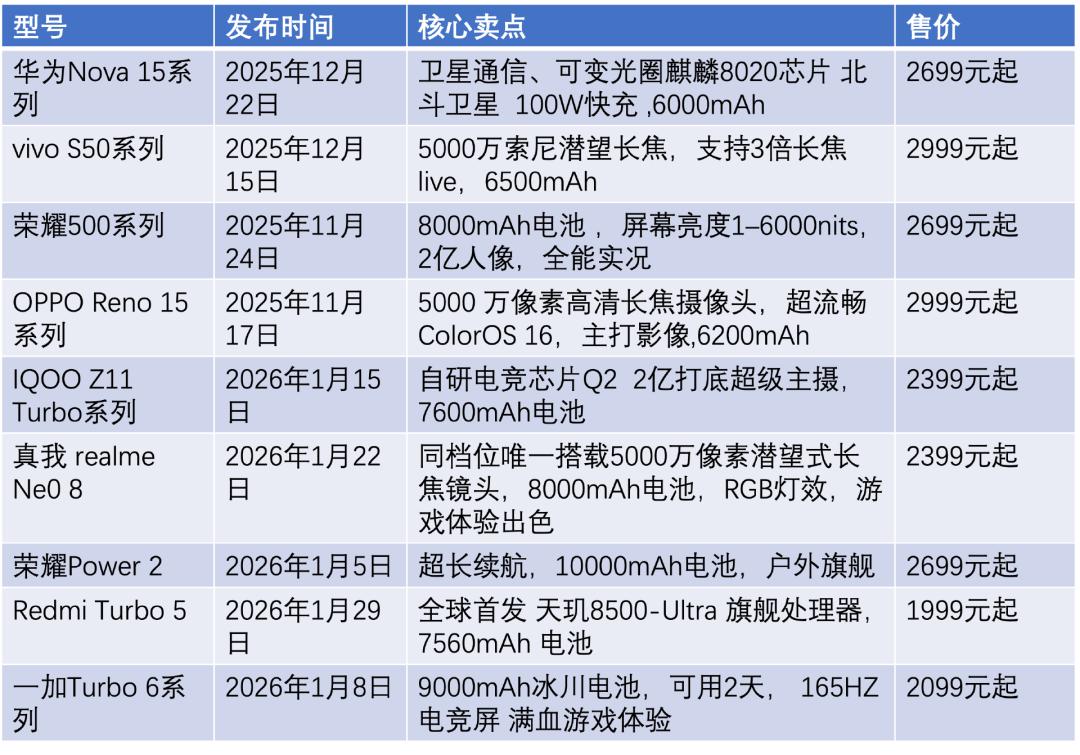
Chart: Compiled by Tech Planet based on publicly available information.
A mobile phone industry supplier with many years of experience told Tech Planet that in the past two years, the product definition of mid - range phones has undergone a fundamental reconstruction, from "parameter stacking" to "experience first". At the same time, it has promoted the flagship - level configuration of mid - range phones, and durability has become a hard requirement for most users.
In order to enhance the experience in certain scenarios, mobile phone manufacturers have started to cut configurations that were previously added for parameter comparison. For example, the front - facing camera of the Realme Neo 8 has removed the 4K 60 - frame video recording function because users usually use high - end phones for video recording. Meanwhile, the Realme Neo 8 has upgraded the gaming experience, and its PC handheld mode allows the phone to run PC - version Steam games.
Currently, the OPPO Reno 15 is selling the best. According to blogger RD's prediction, from the release date until January 21st, its sales volume reached 1.1875 million units, followed by the Honor 500 series with 961,200 units. However, considering that there is only a seven - day difference between the release times of the two, Honor still has the possibility of catching up.
Squeezed Living Space
The good days for mid - range phones ended in 2021.
Analysis data from Goldman Sachs also shows that the market share of the mid - range segment has dropped significantly from 35% in 2021 and is expected to fall to 23% by 2027. In contrast, the entry - level market with a price of less than $200 (about 1465 yuan) has remained stable, with its share always between 41% and 45%.
On the contrary, mobile phone manufacturers have released more models. Data from the China Academy of Information and Communications Technology shows that in 2024, as many as 396 new models were launched in the Chinese market, with mid - range phones accounting for more than 70%.
Behind this, mid - range phones have faced double pressure from high - end and low - end phones since their inception. A mobile phone dealer said that many consumers may not care about parameters when making a purchase but about the usage experience because high parameters do not necessarily mean a good actual experience. For example, a phone with a 9000mAh battery claimed to have a two - day battery life may not be able to achieve this in reality.
A mobile phone industry supplier said that in the past two years, there has been a large number of mid - range phone models, and the products are highly homogeneous. The price cuts of high - end models and the improved cost - effectiveness of low - end models have diverted customers in two directions. Coupled with the extended replacement cycle in the mobile phone stock market, the demand from mid - range users has been diluted, resulting in a situation where many models are released but their sales volume accounts for a low proportion.
Last year, the mobile phone industry started to receive national subsidies, and the mid - range phone price range was the most covered and suitable stage for subsidies. However, the sales volume of mid - range phones did not increase significantly. According to Canalys and Counterpoint data, the sales volume increased by about 4% to 7% year - on - year, but the growth was mainly concentrated in the high - end and low - end segments.
Greater pressure comes from high - end phones, especially the iPhone. A report from Counterpoint Research shows that the market share of Apple's second - hand phones increased to 56% in 2024, up from 51% in 2023, and it is still growing.
The iPhone 17 series sold more than 15 million units in China within three months of its release, almost breaking all records for new phone launches. Among them, the 256GB version of the iPhone 17 can enjoy a 500 - yuan national subsidy, with an after - subsidy price as low as 5499 yuan.
An Apple dealer said that due to the popularity and price of the iPhone 17 series, the prices of older and second - hand Apple phones have been further depressed. "Before the iPhone 17 came out, a 14 Pro Max cost more than 5000 yuan. After the iPhone 17 came out, it dropped to more than 2000 yuan," he added. The price of a second - hand 128GB iPhone 13 is even less than 2000 yuan, which is very attractive to most consumers as long as they are not hardcore gamers.
It's not just second - hand iPhones. For the same 2500 yuan, you can buy the Xiaomi 15 Pro, which is considered a shining star among Android phones, and the Huawei Pura 70 PRO. A consumer said that at the 2500 - yuan price point, you can blindly choose the previous generation of flagship phones without hesitation, while the only pleasure of buying a new mid - range phone lies in unpacking.
Profits are also declining. A dealer told Tech Planet that currently, the profit of a 3000 - yuan phone is only 30 yuan, which is even less than one - third of that of high - end phones. In fact, due to the profit decline, many dealers have transformed into the second - hand market.
No More Cost - Effectiveness, Mid - Range Phones at a Crossroads
Even though manufacturers have come up with their trump cards, the mid - range mobile phone market in 2026 may not be very promising.
Affected by the demand for AI, the storage chip industry witnessed a price hike in 2025. Among them, the price of LPDDR4X, commonly used in low - and mid - range phones, increased by nearly 80% from the middle to the end of the year. The price of the 12GB LPDDR5X, used in high - end and mid - range phones, rose from about $33 at the beginning of the year to over $70 in November, an increase of more than 110%. This has made storage chips the third - largest cost item after the screen and the processor.
However, the price hike is not over. Some institutions predict that storage chips will rise by another 40% - 50% in the first quarter of 2026 and by 20% in the second quarter.
This has hit the profits of mobile phone manufacturers hard. In the second quarter of this year, the gross profit margin of Xiaomi Group's mobile phone business was 11.5%, but it dropped to 11.1% in the third quarter. Lu Weibing, the president of Xiaomi Group, said bluntly in an earnings conference call that the memory price increase was much higher than expected and was the biggest burden.
For low - and mid - range phones, storage chips directly account for 20% - 34% of the cost, more than twice the proportion in high - end phones. Therefore, the impact of the storage chip price hike on low - and mid - range phones is significantly greater.
To maintain profits, mobile phone manufacturers either raise prices or reduce memory configurations. Currently, most manufacturers have chosen the former. Tech Planet's statistics show that among the new models released in the past two months, except for the Honor models, which need to boost market share due to poor performance, and the Nova 15 series and Rdemi Turbo 5 launched by Huawei, which has self - developed chips, the starting prices of all models have increased by 200 - 600 yuan.
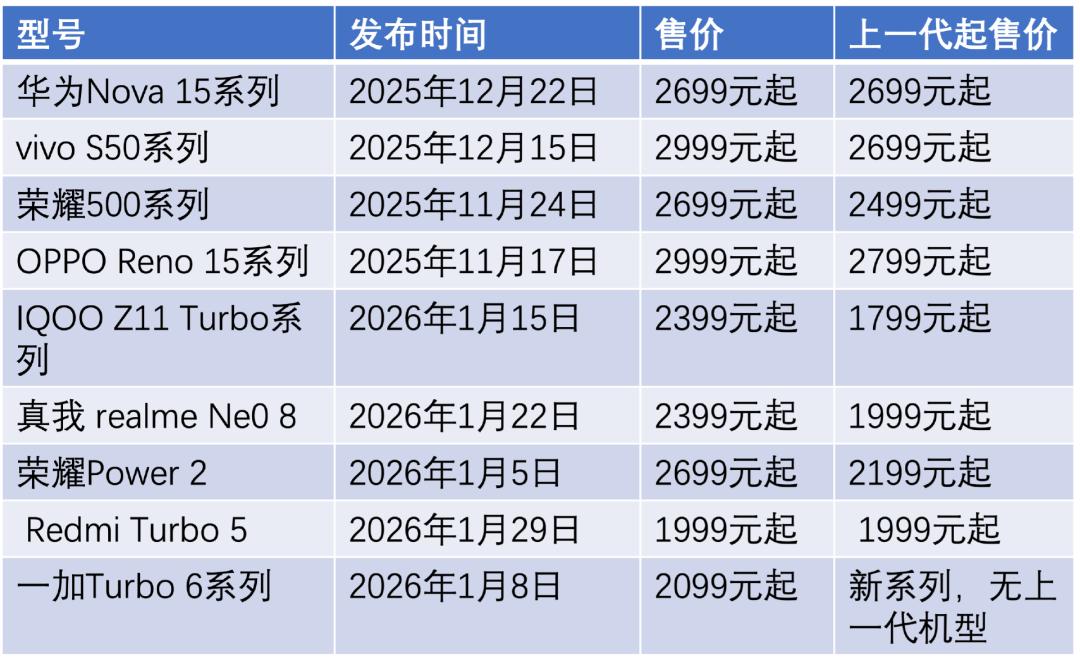
Chart: Compiled by Tech Planet based on publicly available information.
A dealer said that the night before the release of the Nova 15 series, the manufacturer asked for his opinion. The manufacturer offered two options: raising the phone price by 500 yuan or keeping the price unchanged but reducing the dealer's profit. Considering the sluggish sales, he chose the latter.
Almost all market research institutions are lowering their forecasts. Counterpoint and IDC both believe that the mobile phone market will turn from growth to decline in 2026, with the overall shipment volume expected to decline by 3% - 4%. The price increase means that the cost - effectiveness that mid - range phones were once proud of is no longer there, which is likely to further suppress sales.
To avoid selling at a loss, many mobile phone manufacturers have reduced their annual order quantities for mobile phones. Among them, Xiaomi and OPPO have cut orders by more than 20%, vivo by nearly 15%, and Transsion to less than 70 million units. Each manufacturer's order cuts mainly focus on low - and mid - range and overseas products.
Mobile phone manufacturers are also learning from car manufacturers. They hope to launch "super standard versions", that is, with all - in - one configurations instead of a large number of optional parameters, in order to support product premium and competitiveness when costs are limited. This measure has been effective. For example, the sales volume of the Honor 500 series on the full - channel first - sale day was 151% of that of the same - period series.
Xiaomi has also taken action. For the Redmi Turbo 5 series released on January 29th, it has launched a 1 - billion - yuan memory subsidy. The price of the 512GB version has been directly reduced by 200 yuan, and during the first - sale period (until March 3rd), it will be further reduced by 300 yuan.
However, the crisis has not been resolved. Relying solely on the emergency strategies of "price increase" or "configuration reduction" is no longer sustainable and may even accelerate the market's shrinkage. Facing the double blow of the continuous soaring price of storage chips and weak market demand, the mid - range mobile phone market is at a critical crossroads. Many industry insiders believe that this may be the most difficult year for mid - range phones ever.
This article is from the WeChat official account "Tech Planet" (ID: tech618), author: Wang Lin. Republished by 36Kr with authorization.