How to cool down a space data center?
Recently, Elon Musk's remarks about space computing power have attracted wide attention.
According to Musk, he plans to integrate SpaceX, Tesla, and xAI, deploy one million satellites, and build an "orbital data center system" to provide computing power support for future artificial intelligence.

Theoretically, Musk's plan is feasible. In fact, this is not a brand - new concept. Similar space computing power projects have been proposed in the United States, Europe, and even in our country, but they are not as large - scale.
Space computing power is not that mysterious. It simply involves using rockets to send a large number of satellites equipped with computing power chips into space, and then forming a huge computing power cluster.
The biggest advantage of a space data center is that it can fully utilize solar energy as a power source, significantly reducing energy costs. However, it also faces many engineering and commercialization problems.
For example, there are issues such as the launch capacity and frequency of rockets (which requires a large amount of investment), the lifespan of satellites (usually 5 years), space radiation problems (complex radiation can damage hardware such as chips), on - orbit maintenance problems (unmanned operation makes it difficult to repair and replace damaged parts), communication bandwidth and latency problems (inter - satellite and satellite - ground laser communication technologies are not yet very mature), space and spectrum resource problems, business model problems, and so on.
In addition to the above problems, there is also a key heat dissipation problem. Such a huge intelligent computing data center has a vast number of chips, which generate a large amount of heat during operation. How can we dissipate heat to ensure that the space data center will not be burned out due to overheating?
Many people may ask, isn't the temperature in space very low? Shouldn't it be easier to dissipate heat?
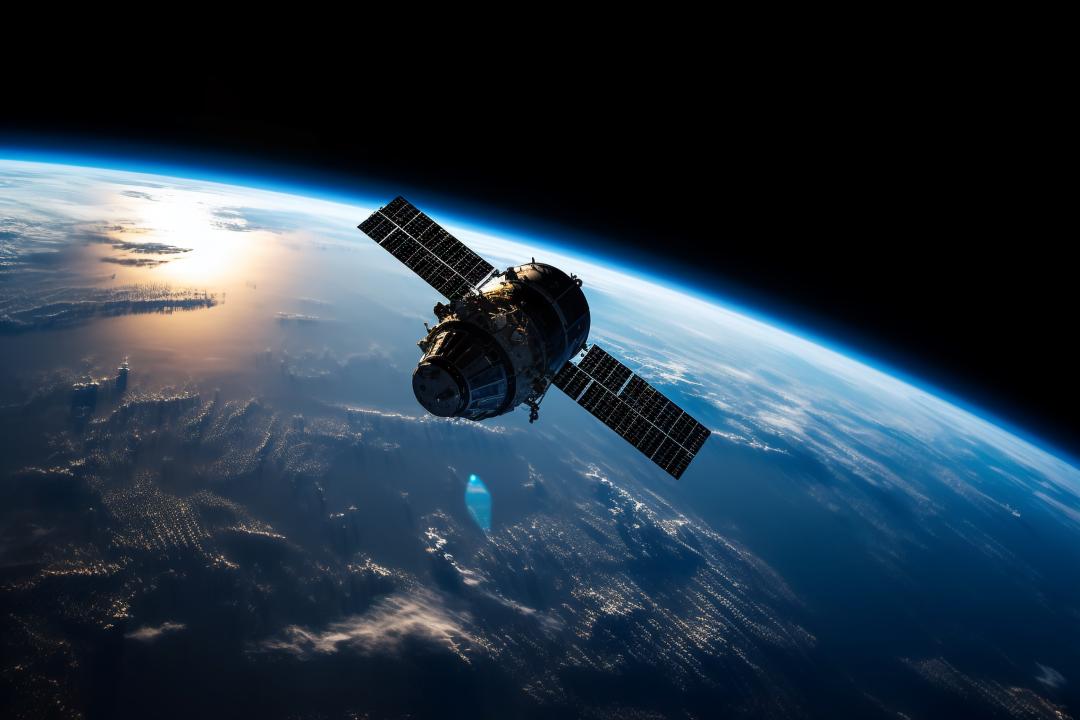
Actually, it's not that simple. The temperature environment in space is not as straightforward as people imagine.
There are generally only three ways to dissipate heat: gas convection, heat conduction (liquid circulation), and thermal radiation. Although the temperature in space is very low (- 270°C, close to absolute zero), it is a vacuum environment without air convection. Therefore, heat cannot be removed by methods such as air cooling, and only heat conduction and thermal radiation can be relied on.
This results in a longer and more complex heat transfer path, which requires considering many internal and external factors and a very precise systematic heat dissipation design.
Next, let's take a detailed look at how to dissipate heat (thermal control technology) in a space data center.
Heat collection (chip level)
Generally, the heat dissipation of spacecraft such as satellites and space stations adopts a system - level thermal control architecture of "hierarchical management, combination of active and passive, and multi - loop backup".
At the chip level, micro - channel liquid cooling is used. At the cabinet level, cold plates and fluid circulation are used. At the cabin section level, it is connected to the heat radiator through the main loop.
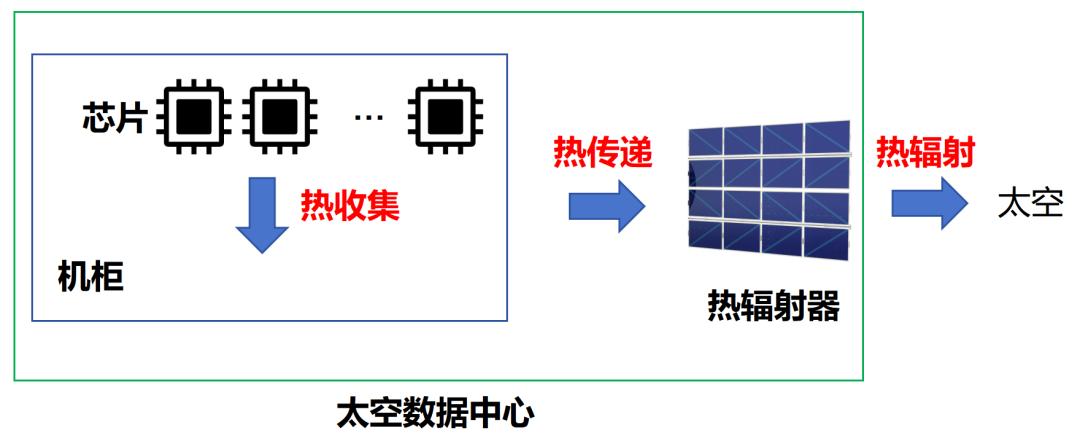
First, start with the most basic chip - level heat dissipation, which is the source of heat generation.
When the chip works, it generates heat (hundreds of watts per square centimeter). High - density heat needs to be quickly exported to prevent the chip from burning out.
The method used here is to use high - performance thermal interface materials (such as graphene, liquid metal, carbon fiber thermal pads, boron nitride thermal pads, etc.) and vapor chambers (Vapor Chamber) inside the chip package to fill the tiny gaps between electronic devices and heat dissipation components, minimize the thermal resistance between them as much as possible, and efficiently transfer heat to the subsequent system like "thermal glue".
Here, the technology of embedded micro - channel liquid cooling can also be used, which uses flowing liquid to take away heat. This requires high - quality coolant. At low temperatures, freezing needs to be prevented. Moreover, because space is a microgravity environment, the flow of coolant is different from that on the ground and requires special design.
For extreme temperature differences, the expansion coefficient of materials needs to be considered to avoid bursting and damage.
Heat transfer (internal transmission level)
After the heat is collected, it needs to be transferred step by step to the final heat radiator.
For heat transfer over a certain distance, heat pipes (especially loop heat pipes, LHP) can be used. Through the phase change (evaporation and condensation) of the cooling working fluid (the working medium that realizes cyclic refrigeration in the refrigeration device, such as ammonia, propane, or special fluids), passive heat transfer is carried out.
Heat pipes have extremely high heat transfer efficiency, long - distance transmission ability, and excellent isothermal performance. They are one of the most mature thermal control components for spacecraft and space computing platforms.
There is also a type of variable conductance heat pipe (VCHP) in the industry. Non - condensable gas is introduced into the working fluid, and the effective area of the condensation section is adjusted through the change of gas volume to achieve adaptive temperature control.
Heat pipes, thermal interface materials, etc. all belong to passive thermal control technologies. The thermal load of a space data center is too large, so relying solely on passive thermal control is definitely not enough. Therefore, some active thermal control technologies need to be introduced.
Currently, the mainstream active thermal control technology adopted in the industry is the mechanical pump fluid loop (MPFL).
As the name suggests, MPFL drives the cooling working fluid through a mechanical pump. The fluid flows through the cold plates installed on the equipment, absorbs heat, and transports the heat from dispersed heat sources to the heat radiator.
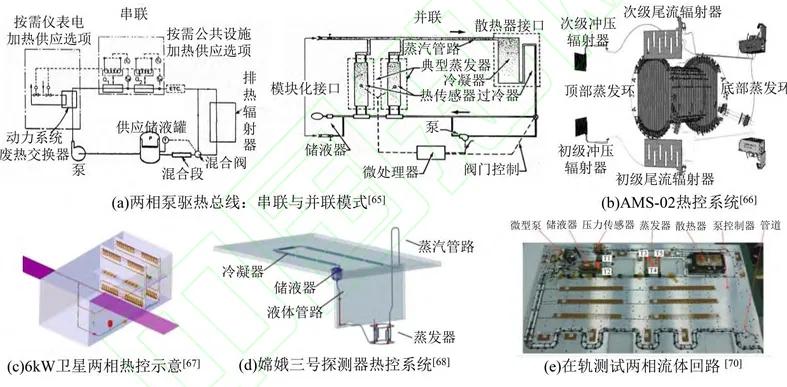
Pump - driven two - phase convection system
The MPFL technology is relatively mature and highly controllable, and it is the benchmark solution for large - scale space computing power centers in the industry. Our Shenzhou spacecraft and Chang'e 3 have both adopted this solution.
This technology is still evolving rapidly, increasing the response speed and compensation accuracy, and enhancing the stability and safety of temperature control.
Thermal radiation (external radiation level)
Finally, the heat is sent to the heat radiator and radiated into deep space.
A heat radiator is a bit like a solar panel. However, a solar panel absorbs solar energy and converts it into electrical energy, while a heat radiator radiates heat in the form of infrared electromagnetic waves.
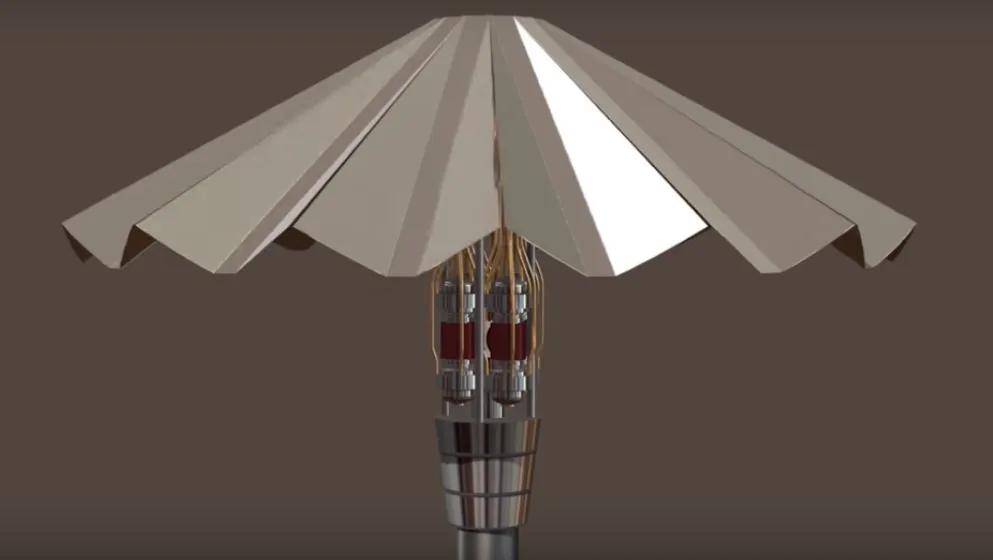
Heat radiator
Thermal radiation is the only ultimate way to dissipate heat in space. Its efficiency directly depends on the area, surface temperature, and coating performance of the radiator.
The radiator is usually a wing plate outside the satellite, with a coating having a high emissivity (> 0.8) and a low absorptivity (such as special white paint and second - surface mirrors).
Some new materials, such as carbon nanotube coatings and photonic crystal films, can achieve nearly ideal black - body radiation in specific wavelength bands while reflecting sunlight, significantly improving performance.
The larger the area of the radiator, the higher the heat dissipation efficiency. Therefore, deployable radiators are generally used (like folded wings). They are compactly folded during satellite launch and unfolded after entering orbit to obtain a large heat dissipation area.
The radiator must have sufficient strength, but it doesn't have to be made of hard materials. There are also some flexible film radiators.
It should be noted that spacecraft in orbit need to face an extreme and fluctuating external heat flux environment. That is to say, when on the sun - facing side, they need to face the heating from direct sunlight, Earth's albedo (sunlight reflected by the Earth), and Earth's infrared radiation, resulting in a very high temperature. When on the shaded side, the situation is a little better.
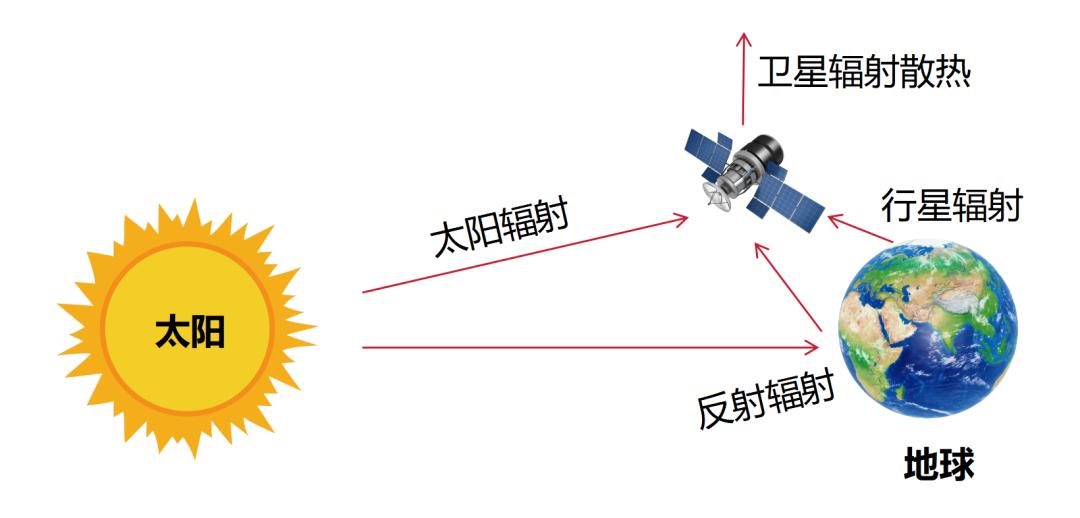
On the sun - facing side, the heat radiator may not be able to dissipate heat but may instead become a "heat absorber". Therefore, careful design of the radiator's orientation, adoption of heat insulation measures, or use of adjustable heat dissipation technologies are required to prevent heat reversal.
Speaking of this, it should be mentioned that there are also heaters on spacecraft. They are used for heating when the spacecraft is on the shaded side (where the temperature is extremely low) to ensure the normal operation of the equipment.
Some intelligent radiators use louver devices (similar to those used in the Hubble Space Telescope) or electrochromic/thermochromic materials to actively adjust the effective emissivity of the radiator or the view factor to deep space, dissipating heat fully in a "cold environment" and turning off for heat preservation in a "hot environment".
New space heat dissipation technologies
If space data centers really develop, their scale will be extremely large.
According to industry predictions, if a space data center is built, each ton of satellite can provide 100 kilowatts (kW) of computing power. Musk's plan of one million satellites will have 100 gigawatts (GW) of AI computing power.
What does 100 gigawatts mean? Assuming a light - bulb has a power of 10 watts, 100 gigawatts can light up 10 billion such light - bulbs simultaneously. The total installed capacity of the Three Gorges Dam Hydropower Station is about 22.5 gigawatts, so 100 gigawatts is approximately equivalent to the total installed capacity of 4.5 Three Gorges Dam Hydropower Stations.
A gigawatt - level data center requires a heat dissipation area of several square kilometers. This is a huge engineering challenge.
To meet the needs of space computing power development, the industry has also proposed some new space heat dissipation technology solutions:
● Phase change material heat storage and buffering
Phase change materials (PCM) can complete the heat absorption and release process at a nearly constant temperature. When the ambient temperature is higher than the phase change point, they absorb heat and melt. When the temperature is lower than the phase change point, they release heat and solidify.
Integrate phase change materials (such as paraffin and salts with specific melting points) into the heat dissipation path. When the radiator faces the sun (low heat dissipation efficiency), it absorbs and stores excess heat. When the satellite enters the shaded side, it releases the heat to be discharged by the radiator.
This is a bit like a "battery (heat storage pool)", which can effectively buffer the fluctuations of internal heat sources in the space data center and the periodic temperature differences in the space environment.
● Radiation heat dissipation enhancement and wavelength - selective radiation
Through nanostructure design, a "spectral - selective radiator" with extremely high emissivity in a specific mid - infrared wavelength band (atmospheric window) and extremely high reflectivity in the main wavelength bands of sunlight (visible light and near - infrared) can be manufactured. In theory, the heat dissipation efficiency can be increased several times.
● Evaporative heat dissipation and material discharge
In extreme cases, volatile working fluids (such as water) can be considered to be carried and sprayed into the vacuum to take away heat.
This solution has high consumption and is not very suitable for space. It is mostly used for short - term, high - intensity emergency heat dissipation. On celestial bodies with ice resources (such as the moon), it is more feasible. A sustainable "ice - making - evaporation" cycle can be established to achieve heat dissipation for the entire system.
● System AI intelligent control
Use AI algorithms to predict the thermal load and dynamically adjust the pump speed, valve, or louver angle, so that the entire heat dissipation system can adaptively optimize and maintain the highest efficiency in the complex and changeable space environment.
Conclusion
Well, the above is an introduction to the thermal control scheme of a space data center.
In general, a space data center faces special environments such as vacuum without convection, microgravity effects, and extreme temperature differences, and thus faces great challenges in heat dissipation.
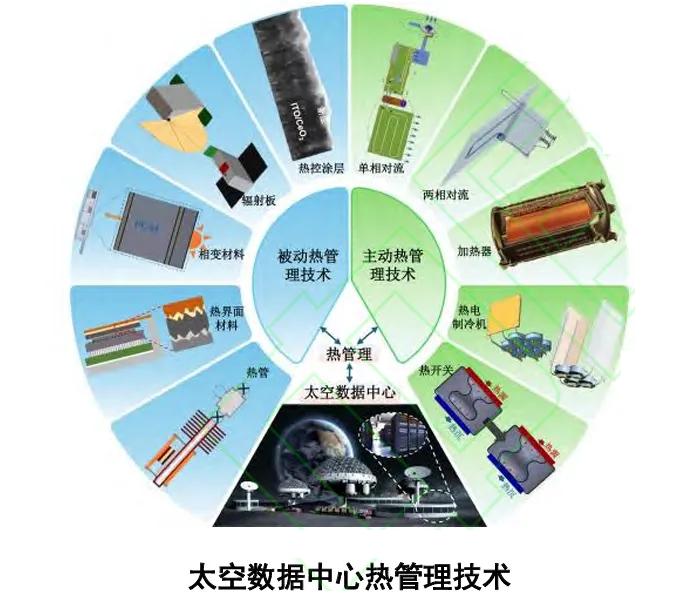
The existing thermal control technologies for aircraft can be divided into two categories: passive and active.
Passive technologies include heat pipes, heat conduction tapes, radiation plates, phase change modules, thermal control coatings, and thermal interface materials, which are suitable for low - power, low - heat - flux scenarios.
Active technologies include single - phase convection systems, pump - driven two - phase convection systems, heaters, thermoelectric coolers, and thermal switches, which are suitable for high - power, high - heat - flux, long - distance, and multi - heat - source scenarios.
If space computing power really becomes a popular trend, then the thermal control technology for space data centers will definitely receive more attention, and the technology will accelerate innovation and iteration.
This field is really worth paying attention to.
References:
1. "A Discussion on Feasible Solutions to the Heat Dissipation Problem of Space - Deployed Computing Power Centers";
2. "Research Status and Prospect of Thermal Control Technology for Space Data Centers", Journal of Refrigeration;
3. "The Triple - Realization Closed - Loop of Space Computing Power, with Revenue Expected to Exceed 100 Billion", Galaxy Securities;
4. Wikipedia, Baidu Baike, etc.