Soaring by over 215%, JunDa Co., Ltd., the leading company in space photovoltaic, was taken to the "sky" by Elon Musk.
The narrative logic of space photovoltaics is being verified by Elon Musk.
As an extension of future space energy, the dilemma of the photovoltaic industry is being rescued by the concept of "space photovoltaics". And as Musk's vision of space photovoltaic energy is gradually being realized, the practicality of space photovoltaics is increasing.
With Musk's support, the prosperity of the photovoltaic industry is gradually rising.
So, what exactly is space photovoltaics?
Its core concept is to build solar power stations in Earth's orbit to achieve all - weather, unobstructed collection of clean energy. And as companies like SpaceX have significantly reduced launch costs, this "science - fiction - level" vision is accelerating towards reality.
More importantly, as the vision of space photovoltaics gradually enters the practical operation stage, the sluggish photovoltaic industry has found a new way out, and leading companies are beginning to recover. According to statistics, as of the latest closing, the photovoltaic equipment sector has risen nearly 30% this year, and the share prices of leading companies such as Junda Co., Ltd. have increased by more than 100%.
Since early December 2025, the share price of Junda Co., Ltd., a leading company in the "space photovoltaics" field, has risen by more than 215%, and its market value has exceeded 35 billion yuan. That is to say, in just two months, the market value of Junda Co., Ltd. has increased by more than 24 billion yuan.
Of course, from a fundamental perspective, Junda Co., Ltd. is not outstanding.
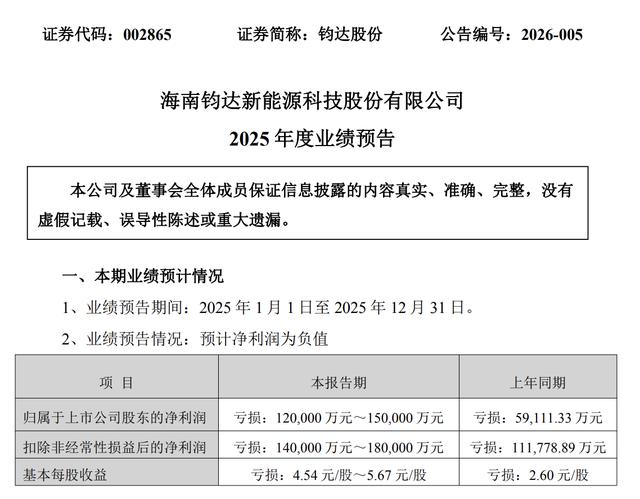
According to the previously disclosed performance forecast, it is estimated that the net profit in 2025 will be a loss of 1.2 billion to 1.5 billion yuan, a further expansion compared to the loss of 591 million yuan in 2024; the estimated non - recurring net profit will be a loss of 1.4 billion to 1.8 billion yuan, compared with a loss of 1.118 billion yuan in the same period of the previous year.
Regarding the sharp rise in the share price, Junda Co., Ltd. recently issued an announcement stating that the fields the company has recently entered are still in the technological exploration stage. There is great uncertainty in the future market space and industrialization rhythm, and it may face risks such as technological route iteration and intensified market competition. Currently, the relevant business is in the R & D stage, and the company has no on - hand orders. The progress of future market development is uncertain.
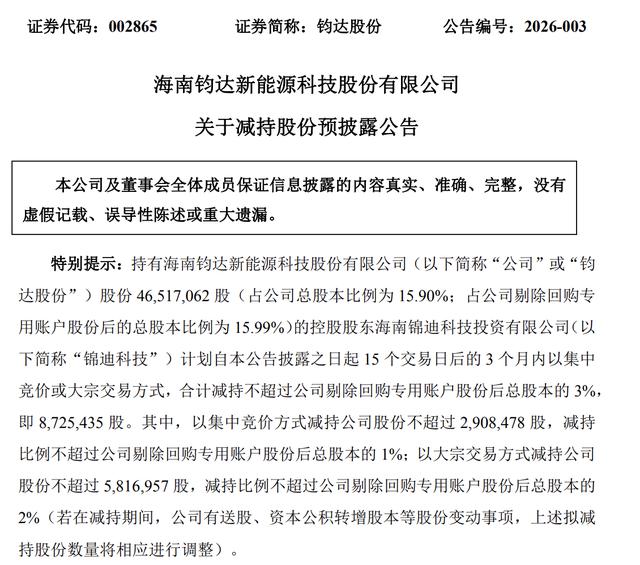
In addition, with the sharp rise in the share price of Junda Co., Ltd., the share reduction of its controlling shareholder has also attracted market attention. According to the announcement it issued, Jindi Technology, the controlling shareholder of Junda Co., Ltd., plans to reduce its holdings of about 3% of the company's shares, approximately 8.7254 million shares. Calculated at the latest closing price, the amount of the share reduction is about 997 million yuan.
In addition, recently, Junda Co., Ltd. placed 18.682 million H - shares at a price of HK$22 per share, and the estimated net proceeds from the placement are about HK$397.7 million.
The Comeback of the "Latecomer"
From the rise and fall of Suntech Power in Wuxi to Longi Green Energy rewriting the industry pattern with monocrystalline silicon technology, the comeback script has been staged more than once in the photovoltaic industry.
As a "dark horse" in the industry, there is also a story of a "latecomer" making a comeback behind Junda Co., Ltd.
Junda Co., Ltd. was established in 2003. For nearly two decades, the company's main business was the production of automotive interior and exterior parts such as instrument panels and bumpers.
However, as the Chinese automobile market shifted from an incremental to a stock market, Junda Co., Ltd.'s traditional business began to encounter a "ceiling" crisis, and its net profit declined continuously. In 2019, Yang Renyuan, the founder of Junda Co., Ltd., had the intention to retire, and his daughter Lu Xiaohong took over as the chairperson. After taking office, this new leader began to look for a second growth curve for the company.
At that time, the external environment was undergoing drastic changes. The most significant one was China's "dual - carbon" goal proposed in 2020, which injected new growth impetus into the new energy industry. The photovoltaic industry, which used to rely on subsidies and had strong periodicity, also ushered in an upsurge after a long period of dormancy.

The management of Junda Co., Ltd. realized that this was a once - in - a - lifetime opportunity, so they were determined to enter the photovoltaic field and began to seek transformation into the photovoltaic industry.
However, Junda Co., Ltd.'s transformation was not smooth. As an outsider, how to enter the market became the biggest problem. Finally, Junda Co., Ltd. chose to enter the market quickly by acquiring a mature enterprise. After extensive searching, Junda Co., Ltd. set its sights on Jietai Technology. Information shows that Jietai Technology was established in 2010 and is a professional manufacturer in the photovoltaic cell field. It ranks among the top in the industry for its solid technology and stable shipment volume. However, due to limited financing channels, Jietai Technology found it difficult to expand rapidly during the industry's capacity expansion wave.
On one hand, there was an urgent need for transformation, and on the other hand, there was an extreme desire for financing. The two sides hit it off, and Junda Co., Ltd. began to promote this large - scale acquisition.
For Junda Co., Ltd. at that time, this cross - border acquisition was also a bold gamble. According to the acquisition plan, Junda Co., Ltd. acquired 100% of Jietai Technology's equity in two steps at a total price of more than 1.4 billion yuan. To raise funds, the company not only used up its cash on the books but also took out loans and transferred equity. Finally, in 2022, it completely divested its original automotive parts business and fully transformed into a photovoltaic cell enterprise. It was also from this year that Junda Co., Ltd. began its comeback story.
In 2022, after the complete transformation, Junda Co., Ltd.'s revenue soared to 11.595 billion yuan, a 304.95% increase compared with the previous year's revenue of 2.863 billion yuan; the net profit reached 711.69 million yuan, turning from a loss of 178.6 million yuan in the previous year to a profit. Driven by the overall improvement in performance, Junda Co., Ltd.'s share price also began to rise. On the basis of a 321.18% surge in the share price in 2021, the share price rose another 168.38% in 2022, reaching a maximum of 189.97 yuan per share, and its market value approached 60 billion yuan.
Of course, in addition to the significant increase in both performance and share price, the acquisition of Jietai Technology also had a very important significance - it helped Junda Co., Ltd. directly enter the key track of photovoltaic cells, which was in the midst of intense technological iteration. At that time, the photovoltaic industry was at the crossroads of transitioning from P - type PERC cells to N - type technology. Among the N - type technologies, TOPCon, heterojunction (HJT), and BC were the main competing routes. As a "latecomer", Junda Co., Ltd. chose the TOPCon technology with the clearest industrialization path at that time as its main direction of attack.
Looking back now, choosing the TOPCon technology was undoubtedly the right choice. With its rapid mass - production ability and economies of scale, Junda Co., Ltd. quickly established a leading position in the N - type TOPCon cell field. By 2023, in terms of shipment volume, Junda Co., Ltd. had reached about 46.5% of the global market share of N - type TOPCon among professional cell manufacturers, ranking first. By the end of 2024, Junda Co., Ltd.'s N - type cell production capacity reached 44GW, with the shipment volume accounting for more than 90%, and the mass - production efficiency exceeded 26.3%.
The Windfall of "Space Photovoltaics"
Although Junda Co., Ltd. achieved a comeback as a "latecomer" through transformation, the past two years have not been easy for the company.
The financial report shows that Junda Co., Ltd.'s performance declined significantly in 2024. Its revenue was 9.952 billion yuan, a year - on - year decrease of 46.66%; the net profit was a loss of 591.1 million yuan, a year - on - year sharp decline of 172.47%. In 2025, its operating conditions further deteriorated, and the net profit is estimated to be a loss of 1.2 billion to 1.5 billion yuan, a more severe loss compared to the previous year.
Affected by the performance, after reaching a record high of 189.97 yuan per share in 2022, Junda Co., Ltd.'s share price began to decline. In 2024, it once dropped to 35 yuan per share, and the share price was "cut by half".
However, as the narrative logic of space photovoltaics was recognized by the market, Junda Co., Ltd. once again stood at the forefront of the industry.
In January 2026, Elon Musk announced at the Davos Forum that SpaceX and Tesla plan to build a total of 200GW of photovoltaic production capacity in the United States within three years.

According to Musk's vision, some computing systems will no longer rely on ground - based data centers but will "move up" to space along with the energy to complete calculations in orbit and only transmit the results back to Earth. This concept attempts to bypass the huge engineering and energy loss problems of wireless power transmission and provides a feasible path for the commercial closed - loop of space energy.
The reason why Junda Co., Ltd. stands out is related to its bet on perovskite technology.
Perovskite is regarded as a disruptive next - generation photovoltaic technology. In principle, perovskite refers to a class of materials with a specific crystal structure. The ones used in photovoltaics are usually metal halide perovskites. It has a similar working principle to the well - known crystalline silicon cells, both using the "photoelectric effect" to convert sunlight into electricity. However, compared with crystalline silicon cells, perovskite cells have a higher theoretical efficiency limit. After being made into tandem cells with other materials (such as crystalline silicon), its theoretical efficiency can be increased to more than 40%.
In addition, perovskite cells have dual advantages in terms of cost and process. The core raw materials of perovskite are abundant in reserves and have relatively low purity requirements, with huge potential cost advantages. In the manufacturing process, it can form a film at low temperatures through the solution method, with a shorter production process, which can significantly reduce energy consumption. More importantly, perovskite materials are lightweight, flexible, and semi - transparent, which enables them to break through the limitations of traditional crystalline silicon cells being hard and heavy and can be applied in the aerospace field.
Currently, the grand narrative of photovoltaics going into space has begun. Since space is an extremely harsh environment, strong radiation, severe thermal cycling, and huge vibrations and accelerations during launch are all tests of the service life of photovoltaic components. Therefore, the screening criteria for space photovoltaics mainly focus on several dimensions such as power per unit weight, long - term reliability, and manufacturability. Technologically, it pursues extreme efficiency, extreme weight reduction, and extreme stability, and perovskite cells meet these criteria, which is why Junda Co., Ltd. has caught the windfall.
However, although space photovoltaics are full of prospects, whether they can be actually converted into performance still needs further market testing.
Generally speaking, space photovoltaic orders are like "distant water" that cannot quench Junda Co., Ltd.'s "immediate thirst" for performance. Even if SpaceX signs equipment orders, judging from its GW - level vision, it will inevitably be a phased construction process lasting several years or even a decade. In addition, space photovoltaics are still in the early stage of parallel exploration of technological routes (such as gallium arsenide, HJT, perovskite tandem, etc.), and large - scale procurement has not yet arrived. Whether Junda Co., Ltd. can finally achieve a comeback in performance still needs the test of time.
This article is from the WeChat official account "Kan Jian Finance". Author: Kan Jian Finance. Republished by 36Kr with authorization.